
Graphene-Silicon Modulator Unlocks High-Efficiency Optical Switching at Key
Researchers have developed a high-efficiency graphene-silicon microring modulator, a critical step toward faster, lower-power optical communications and...
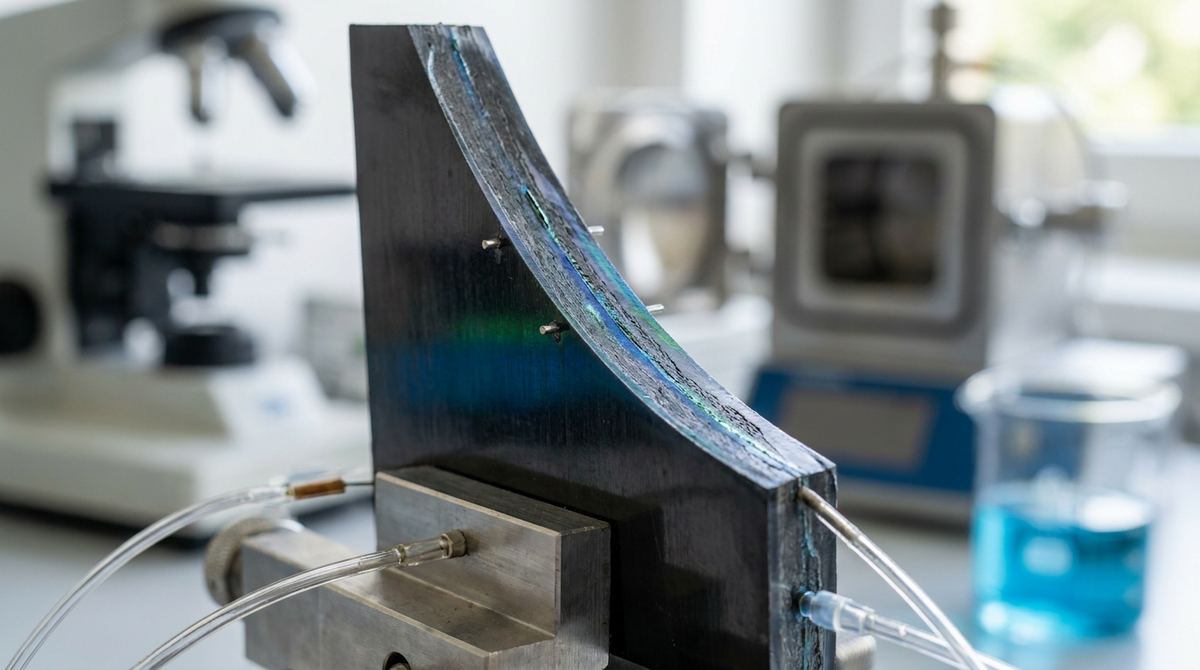
Imagine a world where electronics are smaller, faster, and more flexible than they are today. This future relies on materials that can be manipulated at the atomic level. Graphene, a single layer of carbon atoms, is the superstar of this movement, but its true potential lies in its ability to be shaped into tiny ribbons. However, as we shrink these materials, their edges become the most important part of the structure. If we can master how these edges behave and how stretching them changes their electrical flow, we could unlock a new era of computing. Recent computational studies have begun to reveal the intricate dance between chemistry and mechanical force at these atomic boundaries.
While graphene is famous for its incredible conductivity in its bulk, two-dimensional sheet form, it faces a fundamental hurdle when we try to use it in traditional electronics. A standard sheet of graphene is a zero-bandgap semimetal. In the context of digital electronics, this is a problem because a transistor needs a bandgap to act as an efficient switch. Without a bandgap, the device cannot be turned off completely, leading to significant power leakage and the inability to distinguish between a zero and a one in binary logic. To solve this, scientists have turned to graphene nanoribbons, or GNRs.
By cutting graphene into narrow strips, the edges of the ribbon create a physical boundary that alters the electronic landscape. This confinement of electrons naturally opens a bandgap, theoretically making GNRs perfect for nano-sized transistors. However, this introduces a new level of complexity. The edges of a nanoribbon are not just clean breaks; they are chemically active sites. Depending on how the edges are terminated—whether with hydrogen, oxygen, or other chemical groups—the electrical properties change drastically. Furthermore, in any real-world device, these ribbons will not remain static. They will be subjected to mechanical stress, whether from thermal expansion, the substrate they sit on, or intentional mechanical deformation. Understanding how these two variables—edge chemistry and mechanical strain—interact is vital for moving from theoretical physics to functional, reliable nanoelectronics.
The research explores a concept called strain engineering, which is the practice of using mechanical force to tune the properties of a material. Think of a guitar string: when you tighten it, the tension changes the way it vibrates. In a graphene nanoribbon, when you stretch or compress the lattice, you change the way electrons move through it. This study uses advanced mathematical models to predict how these changes affect the ribbon's ability to conduct electricity.
What makes this research particularly significant is that it does not just look at strain or edge modification in isolation. Instead, it looks at how they work together. The researchers aim to understand if changing the chemical makeup of the edge can either offset or amplify the effects of mechanical strain. By predicting these relationships, we can learn how to design nanoribbons that are either extremely sensitive to movement—useful for sensors—or extremely resistant to movement—useful for stable computer chips.
To understand how these ribbons function, we have to look at the quantum mechanics of carbon atoms. Graphene is composed of carbon atoms arranged in a hexagonal lattice. The electrons move through this lattice via pi-orbitals, which are clouds of electron density that overlap between adjacent carbon atoms. The strength and overlap of these orbitals determine the electrical conductivity.
In a graphene nanoribbon, the edge modification involves attaching specific atoms or functional groups to the carbon atoms at the boundary. This changes the local electronic environment. For example, certain chemical groups might pull electrons away from the ribbon or push them in, effectively changing the energy required for an electron to jump from the valence band to the conduction band. This is the essence of bandgap engineering.
When mechanical strain is applied, the distance between the carbon atoms is altered. If the ribbon is stretched, the distance between atoms increases, which reduces the overlap between the pi-orbitals. Since the overlap is what allows electrons to hop from one atom to the next, reducing it generally increases the electrical resistance. Conversely, compression might increase this overlap. The interplay between the edge chemistry (which sets the baseline electronic structure) and the strain (which modifies that structure) determines the final conductivity of the nanoribbon.
The research conducted by Sanjay Prabhakar and Roderick Melnik utilizes first-principles calculations to map these complex relationships. First-principles, or ab initio, methods are specialized computational techniques that solve the fundamental equations of quantum mechanics to predict material behavior without relying on empirical data from previous experiments. This allows for a high degree of accuracy in predicting how a theoretical material will behave.
The findings highlight that the electrical conductivity of edge-modified graphene nanoribbons is highly sensitive to both the chemical termination and the applied strain. The researchers found that the specific way an edge is modified can fundamentally shift how the ribbon responds to mechanical stress. For certain edge configurations, a small amount of strain might cause a massive change in conductivity, making the material highly responsive. In other configurations, the electronic structure might be more robust, maintaining stable conductivity even when the material is being stretched. This suggests that we can "program" the mechanical sensitivity of a nanoribbon by simply changing the atoms at its edges.
The implications of these findings are profound for the field of nanoelectronics and the emerging field of strain-tronics. As we approach the limits of silicon-based technology, we need new ways to control electron flow. The ability to tune the bandgap and conductivity of graphene through both chemistry and strain offers a multi-dimensional toolkit for engineers.
First, it provides a roadmap for designing more reliable transistors. If we know exactly how much strain a specific nanoribbon can withstand before its conductivity becomes unstable, engineers can design devices that are much more robust. Second, it opens the door to highly sensitive quantum sensors. A material that undergoes a massive, predictable change in conductivity when stretched can be used to detect incredibly small mechanical vibrations or pressures, which could lead to ultra-sensitive microphones, pressure sensors, or even seismic monitoring tools.
While these results are groundbreaking, it is important to distinguish between a computational prediction and a manufactured product. This research is based on first-principles calculations, which simulate ideal, perfect systems. In a real-world laboratory or factory, graphene nanoribbons are rarely perfect. They contain defects, such as missing carbon atoms or unintended chemical impurities, which can disrupt the very electrical properties being studied.
Furthermore, the transition from a mathematical model to a physical device is a massive hurdle. Creating ribbons with precise, atomic-scale edge modifications is an immense manufacturing challenge. Current lithography and chemical vapor deposition techniques are improving, but they do not yet offer the level of control required to implement these findings perfectly. Future research must move from these idealized simulations to experimental validation in a laboratory setting to see if the predicted sensitivity and stability hold true under real-world conditions.
The practical applications of this research span several high-tech industries. In the semiconductor industry, GNRs could lead to the development of field-effect transistors that are significantly smaller and more energy-efficient than current silicon models. This could lead to longer battery life in portable electronics and more powerful high-performance computing.
In the realm of flexible electronics, the strain-sensitivity of these ribbons is a game-changer. We are seeing a surge in demand for foldable smartphones, wearable health monitors, and smart textiles. A material that can maintain consistent electrical performance while being bent or stretched is essential for these technologies. Finally, in the field of quantum computing, the ability to precisely control the electronic states of nanostructures through mechanical means could provide new methods for controlling quantum bits, or qubits, which are the building blocks of quantum computers.
If there is one takeaway from this research, it is that the edges of a material are not just boundaries; they are control centers. By precisely engineering the chemistry at the edge of a graphene nanoribbon and understanding how mechanical strain interacts with that chemistry, we can create a new class of "smart" materials that respond to their environment in predictable and useful ways.
How does cutting graphene into ribbons change its properties? When graphene is in a large sheet, it lacks a bandgap, meaning it cannot be easily turned off. Cutting it into nanoribbons introduces edges that disrupt the electronic structure, creating a bandgap that allows the material to function as a switch in electronic components.
What is meant by first-principles calculations? First-principles calculations are a method of modeling materials using the fundamental laws of quantum mechanics. Instead of using experimental data to guess how a material might behave, researchers use complex mathematics to simulate the behavior of electrons from the ground up, providing a highly accurate theoretical prediction.
Why is strain important in nanoelectronics? As electronic components get smaller, they become more susceptible to mechanical stresses from heat, movement, or the materials they are attached to. Strain changes the distance between atoms, which in turn changes how electricity flows through the material, making it a vital factor for device reliability and performance.
What is edge modification? Edge modification is the process of attaching specific chemical groups, such as hydrogen or oxygen, to the atoms at the ends of a nanoribbon. This is done to tailor the electrical properties of the ribbon, allowing scientists to tune the bandgap and the overall conductivity of the material.
Is this research ready for commercial use? No, the current work is primarily computational and theoretical. While it provides a vital roadmap for how materials should be designed, the actual manufacturing of these ribbons with perfect precision remains a significant engineering challenge that must be solved in laboratory settings.
The work by Sanjay Prabhakar and Roderick Melnik highlights the incredible versatility of graphene nanoribbons. By exploring the intersection of edge chemistry and mechanical strain, this research moves us closer to a future where materials are not just passive components, but highly tunable elements of a sophisticated electronic system. As we bridge the gap between quantum simulations and physical manufacturing, the insights gained from these first-principles calculations will likely serve as the foundation for the next generation of nano-scale technology.
Serious about B2B integration? Test our premium Pulsed Electrical Resistive Carbon Heating turbostratic graphene in your lab. 100g sample packs available now.
Explore More
Researchers have developed a high-efficiency graphene-silicon microring modulator, a critical step toward faster, lower-power optical communications and...

Build a near-infrared photodetector with nitrogen-doped porous graphene nanoribbons. This guide details the materials, fabrication steps, and test plan.

Discover how preempted band-inversion transitions in graphene-based systems create a self-doped crystal, a revolutionary material for ultra-clean electronics.