
Graphene Nanoplasmonics: Tuning Scintillators for Better Medical Imaging
Explore how researchers are using graphene-based nanoplasmonic scintillators to tune light-matter interactions, paving the way for faster, more sensitive...
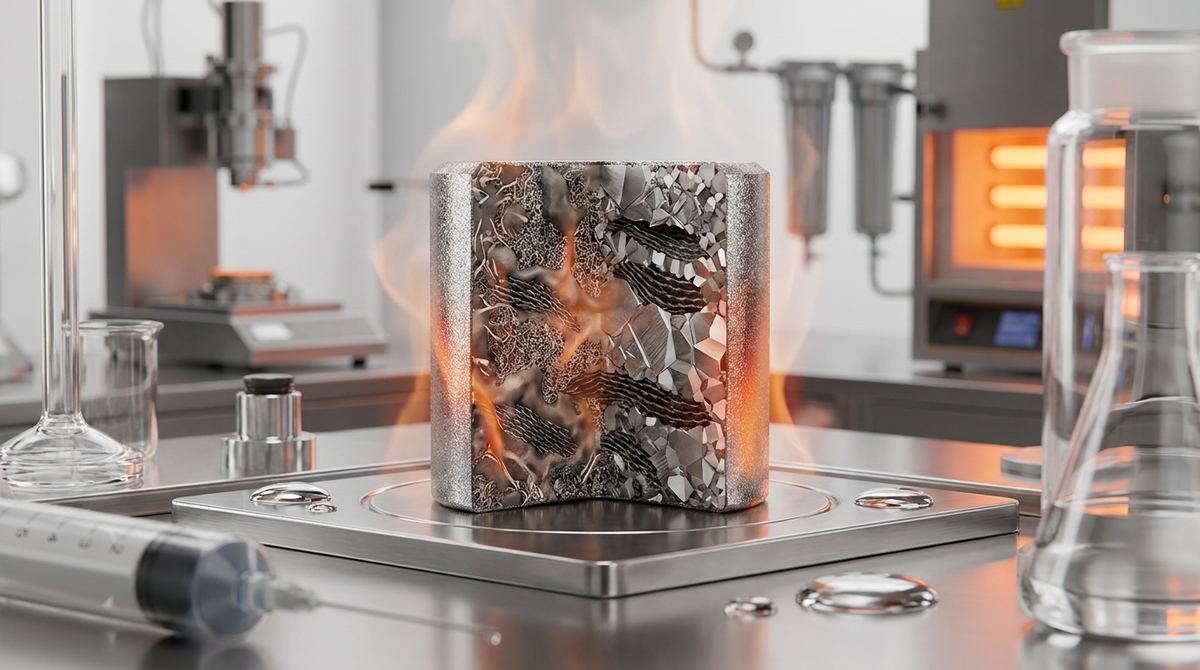
Imagine you are trying to create a new type of super-tough ceramic that can withstand the extreme heat of a jet engine or the intense electrical demands of a next-generation microchip. To do this, scientists often start with a liquid polymer—a substance similar to the plastic used in everyday items—and heat it until it transforms into a hard, inorganic ceramic. This process is known as polymer-derived ceramics. While this method offers incredible flexibility in designing new materials, it comes with a hidden complication. As the liquid polymer turns into a solid ceramic, the atoms within the material do not always stay evenly distributed. Instead, they tend to cluster together into different chemical groups, a phenomenon known as phase separation. This internal "divorce" of atoms can create defects or change the material's properties in ways that are difficult to predict. Understanding exactly when and how these atoms segregate is the key to mastering the next generation of high-performance materials.
The fundamental challenge in material science is the ability to predict how a substance will behave during its transition from one state to another. In the case of silicon carbonitride (SiCN) ceramics, the transition from a polymer precursor to a ceramic is a chaotic chemical dance. During the heating process, the chemical bonds that hold the polymer together are broken and reformed into a rigid, three-dimensional network of silicon, carbon, and nitrogen.
If the chemical composition is not perfectly controlled, the material undergoes phase separation. This means instead of having a single, uniform SiCN material, you might end up with tiny pockets of pure carbon or silicon-rich regions. These inhomogeneities can drastically change how the material conducts electricity, how it expands when heated, and how much mechanical stress it can endure before cracking. For engineers in the aerospace or semiconductor industries, an unexpected phase separation can mean the difference between a reliable component and a catastrophic failure.
Historically, scientists have faced a massive computational barrier when trying to model these transitions. On one hand, they can use quantum mechanics—specifically Density Functional Theory (DFT)—to look at a very small number of atoms with extreme precision. However, DFT is computationally expensive and can only simulate a few hundred atoms for a very short period of time. On the other hand, they can use classical molecular dynamics, which simulates millions of atoms by treating them like simple balls and springs. While fast, classical methods are often too imprecise to capture the complex, changing chemical bonds found in SiCN. This gap in simulation capabilities has left researchers struggling to bridge the gap between small-scale chemistry and large-scale material behavior.
To overcome this barrier, the research team utilized a cutting-edge approach known as extended machine learning molecular dynamics (MLMD). To understand this, think of a professional translator. A traditional simulation is like a translator who only knows basic words; they are fast, but they miss the nuance of complex technical conversations. Quantum mechanics is like a scholar who knows every nuance perfectly but takes years to translate a single page. Machine learning molecular dynamics acts like a high-speed, AI-driven translator.
The researchers first use quantum mechanics to teach a machine learning model how atoms interact in the SiCN system. The AI "learns" the complex patterns of electronic density and atomic forces from the most accurate data available. Once the AI has been trained, it can act as a proxy for the quantum mechanics. It can predict how atoms will move and react with nearly the same accuracy as the super-accurate quantum methods, but at a fraction of the computational cost. This allows scientists to simulate much larger groups of atoms and much longer periods of time, finally allowing them to watch the phase separation process unfold in slow motion.
In the context of advanced carbon-based and ceramic materials, the "system" being modeled refers to the complex interplay of the silicon, carbon, and nitrogen atomic network. The researchers, including Fabien Mortier, Sylvian Cadars, Olivier Masson, Mauro Boero, Guido Ori, Yun Wang, Samuel Bernard, and Assil Bouzid, focused on how these specific atoms organize themselves during the heating process.
The simulation works by building a potential energy surface through a machine learning algorithm. In a system like SiCN, the bonds are not static. As temperature increases, certain bonds break and new ones form, creating a dynamic and changing environment. The machine learning model is trained to recognize these shifts. When the simulation begins, the atoms are placed in a configuration representing the polymer precursor. As the simulated "temperature" rises, the machine learning model calculates the forces acting on every single atom based on its neighbors.
The magic of this system lies in its ability to handle "many-body" interactions. In a complex ceramic, an atom is not just being pulled by its immediate neighbor; it is part of a collective electronic environment. The machine learning model captures these subtle, non-linear forces that traditional models miss. This enables the simulation to capture the exact moment when the nitrogen and carbon atoms decide to move away from the silicon, triggering the phase separation. By modeling this "system," scientists can observe how the local chemical environment dictates the ultimate structural outcome of the ceramic.
The research demonstrated that machine learning molecular dynamics is a powerful tool for observing the intricate details of phase separation. The team successfully used the MLMD approach to track the evolution of the SiCN structure, providing a window into the atomic-scale mechanisms that lead to material inhomogeneity.
One of the key findings is the ability to observe the specific pathways through which phase separation occurs. The researchers were able to see how the distribution of carbon and nitrogen atoms shifts over time, leading to the formation of distinct domains. This is a significant achievement because it moves beyond simply knowing *that* phase separation happens; it provides insight into *how* it happens.
The study showed that the machine learning model could accurately reproduce the complex chemical environments found in the SiCN system. This means the simulation could distinguish between different local atomic configurations, such as silicon atoms bonded to three nitrogens versus silicon atoms bonded to two nitrogens and one carbon. By mapping these configurations, the researchers can pinpoint the exact thermal and chemical conditions that lead to desirable uniform structures versus undesirable phase-separated structures. This provides a roadmap for controlling the stoichiometry—the specific ratio of atoms—to achieve specific material goals.
The implications of this research are profound for the future of material design. By providing a way to predict phase separation before a material is ever synthesized in a laboratory, this research significantly reduces the cost and time associated with material development. In the past, engineers might have had to perform hundreds of physical experiments, varying the temperature and chemical composition each time, to find the "sweet spot" for a new ceramic. Now, they can perform those tests virtually.
Furthermore, the ability to control phase separation means we can engineer materials with customized properties. If an engineer needs a ceramic that is highly conductive, they can use these models to design a material with specific carbon-rich domains that act as conductive pathways. If they need a high-strength insulator, they can design a system that avoids phase separation entirely. This level of "atomic-scale tailoring" is the holy grail of modern materials science, moving us from discovering materials by accident to designing them by intent.
While this research represents a major leap forward, it is important to recognize that it is a computational model, not a physical manufacturing process. The simulation is a highly controlled environment that may not capture the full complexity of a real-world industrial furnace. For instance, real-world chemical synthesis often involves trace impurities like oxygen or hydrogen, which can act as catalysts for phase separation. While these could eventually be added to the models, the current research focuses on the idealized Si-C-N system.
Additionally, there is a difference in the timescales. Even though machine learning molecular dynamics is much faster than traditional quantum methods, it still operates on timescales much shorter than the actual hours or days required to bake a ceramic in a real furnace. While the models are excellent at showing the *onset* of phase separation, predicting the complete, long-term structural evolution of a material over several hours remains a massive computational challenge. Future research will need to bridge this temporal gap to create even more robust predictive tools.
The ability to model and control SiCN ceramics has direct applications across several high-tech sectors. In the aerospace industry, these ceramics are used for high-temperature coatings and components in gas turbines. Being able to predict how these coatings will behave under extreme heat can prevent engine failures and improve fuel efficiency.
In the electronics industry, silicon carbonitride and related ceramics are used as dielectric materials or as components in semiconductor packaging. As electronic devices become smaller and more powerful, the ability to control the atomic structure of these materials becomes critical to prevent electrical leaks and ensure device stability.
Finally, the methodologies developed by this research—using machine learning to bridge the gap between quantum mechanics and large-scale simulations—can be applied to any complex material system. Whether it is developing new battery electrolytes for electric vehicles or creating more efficient solar cell materials, the ability to simulate complex chemical transitions is a transformative capability for all of materials science.
If you take away only one point from this research, let it be that machine learning is fundamentally changing how we design materials by allowing us to watch the atomic-scale "divorce" of elements during chemical transformations, giving us the power to prevent defects before they ever happen in a real lab.
What exactly is a silicon carbonitride ceramic?
Silicon carbonitride, or SiCN, is a specialized type of ceramic material that is created by taking a polymer that contains silicon, carbon, and nitrogen and heating it to very high temperatures. This process, called pyrolysis, turns the flexible polymer into a hard, heat-resistant inorganic solid. These ceramics are prized for their ability to remain stable and strong even in environments that would melt or destroy most other materials.
Why is phase separation a problem for engineers?
Phase separation occurs when the atoms in a material stop being evenly mixed and instead start to cluster into different chemical groups. For engineers, this is problematic because it creates an inconsistent material. Instead of having a uniform substance with predictable properties, you end up with a "patchwork" of different materials. This can lead to unexpected changes in how the material conducts electricity or handles heat, which can cause parts to fail unexpectedly in high-stress environments.
How does machine learning help in this specific research?
Machine learning acts as a computational bridge. It allows scientists to take the extremely accurate but very slow data from quantum mechanics and "teach" it to an AI model. Once the AI learns these patterns, it can simulate much larger systems of atoms much faster than quantum mechanics could. This allows researchers to observe complex processes like phase separation that were previously too difficult or too expensive to model accurately.
Can these simulations replace real-world laboratory experiments?
No, simulations cannot completely replace experiments, but they can significantly supplement them. A simulation is a model of reality, and it might not account for every single variable, such as tiny impurities or complex airflow in a furnace. However, by using simulations to narrow down the best "recipes" for a material, scientists can save a tremendous amount of time and money by only performing the most promising experiments in the lab.
What are the future implications for technology if we master this?
Mastering the control of these materials could lead to much more efficient jet engines, more reliable high-speed electronics, and better energy storage solutions. If we can precisely control the atomic arrangement of ceramics, we can create materials that are "custom-made" for specific extreme environments, pushing the boundaries of what is possible in aerospace, computing, and renewable energy.
The work conducted by Fabien Mortier, Sylvian Cadars, Olivier Masson, Mauro Boero, Guido Ori, Yun Wang, Samuel Bernard, and Assil Bouzid marks a significant step forward in our ability to master the complexity of polymer-derived ceramics. By leveraging the power of machine learning molecular dynamics, they have provided a way to peek into the atomic-scale mechanisms of phase separation in the Si-C-N system. This research doesn't just solve a modeling problem; it provides a fundamental toolkit for the future of materials engineering, moving us closer to a world where we can design advanced materials atom by atom, with unprecedented precision and predictability.
Serious about B2B integration? Test our premium Pulsed Electrical Resistive Carbon Heating turbostratic graphene in your lab. 100g sample packs available now.
Explore More
Explore how researchers are using graphene-based nanoplasmonic scintillators to tune light-matter interactions, paving the way for faster, more sensitive...

Learn to build air-stable quantum circuit components using graphene-encapsulated superconductors. This guide details a practical fabrication process.

Researchers discover a moiré heterostructure with a unique "dual-flatness" electronic property, enabling continuous electrical tuning between exotic quantum...