
Rippled Graphene Pores for Neuromorphic Fluidic Memristive Devices
Discover how rippled graphene pores act as fluidic memristors, enabling advanced synaptic functionalities for the next generation of neuromorphic computing.
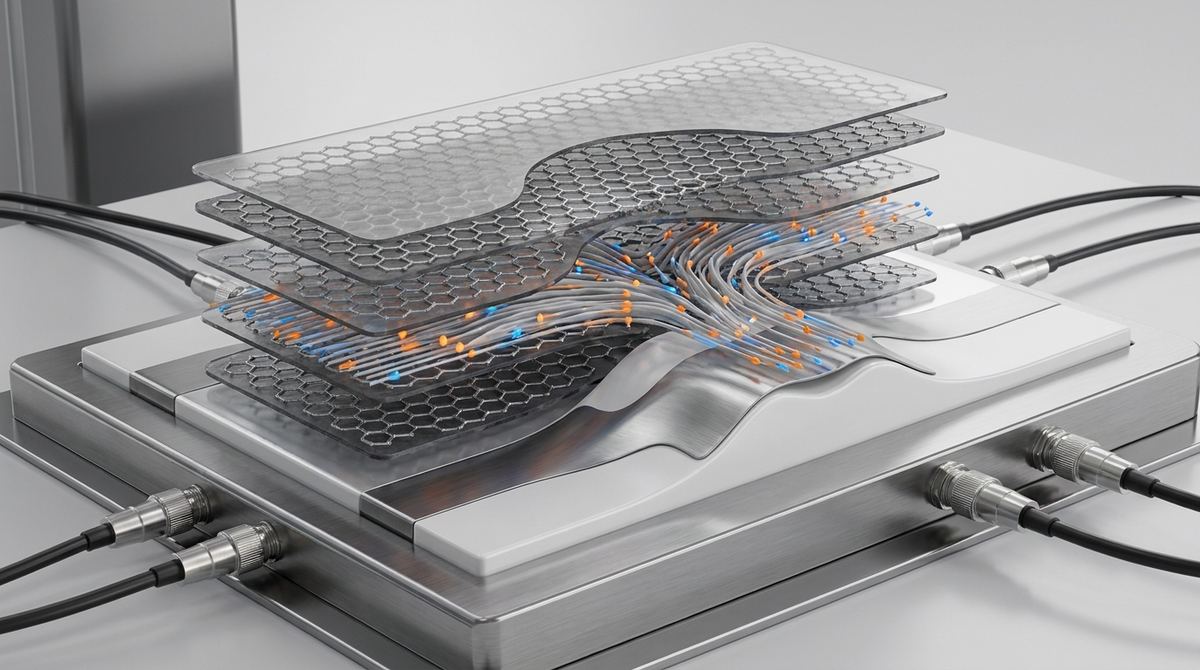
Imagine a substance that behaves like a liquid in terms of its ability to flow, yet possesses the structural directionality of a crystal. This phenomenon is not limited to the liquid crystals found in your smartphone screen; it can actually occur within the very sea of electrons flowing through a piece of carbon. In the microscopic world of quantum materials, the way electrons organize themselves dictates everything from how a computer chip heats up to how fast a quantum processor can perform a calculation. As we push the boundaries of nanotechnology, understanding these strange, organized states of electron matter is becoming essential for the next leap in computing technology.
Current semiconductor technology relies heavily on silicon, a material where electrons act much like a predictable gas of independent particles. In silicon, we control the flow of electricity by adding impurities or applying voltages, essentially managing a crowd of individuals moving through a corridor. However, as we shrink these components to the atomic scale, we reach a physical limit known as the scaling wall. At these incredibly small dimensions, the behavior of electrons can no longer be described by simple, independent movements. Instead, the interactions between electrons become so strong that they begin to act collectively, behaving more like a coordinated group than a collection of individuals.
When electrons become highly correlated, they enter a regime where standard models of electricity fail to predict their behavior. In these advanced materials, the electronic system can undergo phase transitions—sudden, dramatic changes in how the electrons are organized. Some of these transitions are well-understood, such as the transition from a liquid to a solid. However, others are much more elusive, such as the transition into a nematic phase. In a nematic phase, the electrons break the rotational symmetry of the crystal lattice. This means that even though the atoms in the graphene remain in a perfect, symmetric grid, the electrons flowing through them suddenly decide to prefer one direction over another. This spontaneous preference for a specific orientation creates immense challenges for engineers who need predictable, uniform electronic properties. Without a fundamental understanding of why and how these transitions occur, we cannot hope to harness the unique properties of these materials for stable, high-performance devices.
To understand the concept of a nematic phase transition, think about a crowded dance floor. Normally, people move about in all directions, and there is no preferred orientation for the crowd as a whole. This represents a symmetric state. Now, imagine that suddenly, everyone on the dance floor decides to face the same direction and move in a similar orientation, even though they are still moving freely and are not locked into a rigid grid. The crowd has become nematic. They have broken the rotational symmetry of the dance floor by choosing a specific direction, even though they haven't become a static, frozen formation.
In the context of multilayer graphene, the electrons are the dancers. Graphene is a single layer of carbon atoms arranged in a hexagonal lattice. When you stack these layers on top of one another, you create a complex environment where the electrons in one layer can interact heavily with the electrons in the layers above and below. Under certain conditions—such as specific temperatures or electrical densities—the electrons collectively decide to align their movement or their density distribution along a specific axis. This is a nematic phase transition. It is a quantum phenomenon where the electrons undergo a change in their organizational symmetry without actually changing the physical arrangement of the atoms themselves. This "electronic liquid crystal" state offers a new way to control information, as switching the direction of this electronic alignment could potentially serve as a new type of digital bit.
The mechanics of multilayer graphene systems are rooted in the geometry of the carbon lattice and the quantum interactions between the layers. Graphene is famous for its incredibly high electron mobility, meaning electrons can travel long distances without bumping into anything. When you stack multiple layers, the way these layers are aligned—known as stacking sequences—dramatically alters the electronic landscape. For example, in Bernal-stacked graphene, the atoms in one layer sit directly above the centers of the hexagons in the layer below. This creates a periodic potential that influences how electrons move through the system.
The interaction between these layers is the engine that drives the interesting physics. Because the layers are separated by only a few angstroms, the electron orbitals—specifically the pi-orbitals that extend above and below the carbon plane—overlap. This overlap allows electrons to "feel" the presence of electrons in adjacent layers. This is referred to as strong electron correlation. When these interactions are strong enough, the kinetic energy of the electrons (their desire to move around) is balanced against the potential energy (the repulsion they feel from other electrons).
In multilayer systems, the electronic system can be tuned. By applying an external electric field perpendicular to the layers, researchers can change the density of electrons in specific layers or adjust the energy gap between them. This tunability is the key to observing a nematic transition. As the environment changes, the electron system may reach a tipping point where it is no longer energetically favorable for the electrons to move symmetrically. Instead, the system finds a lower energy state by breaking its rotational symmetry, creating an anisotropic environment where conductivity might be much higher in one direction than in another.
In this specialized research, R. David Mayrhofer and Andrey V. Chubukov have delved into the theoretical underpinnings of these transitions. Their work focuses on the mathematical and physical frameworks required to describe how symmetry-breaking occurs in these multilayered environments. The research specifically addresses the question of how the interplay between multiple layers can stabilize or induce these nematic phases.
The findings suggest that the complexity of the multilayer system adds new degrees of freedom that are not present in single-layer graphene. For instance, the researchers explore how the specific stacking order and the interlayer coupling strengths determine the boundaries of the nematic phase. They have worked to identify how the electronic system moves from a standard, symmetric liquid-like state into a state where the electron density itself becomes directional.
Crucially, the work by Mayrhofer and Chubukov helps clarify the relationship between the electronic density and the onset of the transition. They provide a theoretical roadmap for how a researcher might predict when a material will transition from a symmetric state to a nematic state. This is vital because, in the world of quantum materials, we cannot simply guess how a material will behave; we need precise models to predict these phase changes before we attempt to build devices from them. Their work provides that mathematical foundation, bridging the gap between abstract quantum mechanics and the practical observation of new electronic states.
The implications of understanding nematic phase transitions are profound for the future of condensed matter physics and materials science. First and foremost, it expands the toolkit available to scientists. If we can understand how to trigger and control these electronic liquid crystal states, we can create a new class of "phase-change" electronics. Instead of using a transistor to turn a current on or off, we could use a device that switches between a symmetric and a nematic electronic state. This could lead to devices that are significantly faster and consume much less power than current silicon-based technology.
Furthermore, this research is a stepping stone toward quantum technologies. Many of the most promising candidates for quantum computing require materials where electron behavior can be precisely manipulated at a fundamental level. By mastering the symmetry-breaking transitions in graphene, we gain a deeper understanding of how to manipulate quantum states. The ability to control the directionality of electron flow through phase transitions could allow for the creation of topological electronic components, which are inherently protected from the noise and interference that currently plague quantum systems. Essentially, this research moves us from being passive observers of electron behavior to being active architects of quantum matter.
While the theoretical insights provided by Mayrhofer and Chubukov are significant, it is important to distinguish between theoretical prediction and experimental reality. The research presented is primarily focused on the theoretical and mathematical modeling of these transitions within a controlled, idealized environment. In a theoretical model, scientists can perfectly control variables like temperature, layer thickness, and electron density, but the real world is much messier.
In actual laboratory settings, several challenges remain. Fabricating multilayer graphene with perfect, defect-free stacking is an immense engineering hurdle. Any slight misalignment in the layers or the presence of chemical impurities can disrupt the delicate electron-electron interactions that lead to a nematic phase. Therefore, while the theory tells us that these transitions should occur, we need extensive experimental verification to confirm the exact conditions under which they happen in physical samples. Additionally, the research does not currently provide a blueprint for manufacturing these materials at scale. There is a significant gap between observing a nematic transition in a high-tech laboratory and integrating such a phenomenon into a mass-produced microchip.
The eventual mastery of nematic phases in graphene could revolutionize several high-tech industries. In the field of telecommunications, the ability to control electron directionality could lead to ultra-high-frequency transistors capable of handling the massive data rates required by 6G networks and beyond. These transistors would operate with much higher efficiency, reducing the heat generation that currently limits the speed of communication hardware.
In the realm of data storage and processing, we may see the emergence of neuromorphic computing. This is a type of computing inspired by the human brain, where information is processed in a way that mimics neural connections. The ability to switch between different electronic phases could allow for extremely dense, low-power information processing architectures that behave more like biological neurons than classical binary switches. Finally, in the field of sensing, the extreme sensitivity of these phase transitions to external stimuli (like electric fields or pressure) could lead to a new generation of sensors capable of detecting incredibly minute changes in the environment, useful in everything from medical diagnostics to advanced geological surveying.
If you take away only one concept from this research, let it be this: the electrons in a material do not always act like a simple gas of independent particles; they can organize themselves into complex, directional "liquid crystal" phases that could revolutionize how we design the computers of the future.
What exactly is a phase transition in an electronic system? A phase transition occurs when a material's electrons suddenly change how they are organized in response to a change in environment, such as temperature or voltage. It is similar to how water turns into ice, but instead of the atoms changing position, the electrons change their collective behavior and symmetry.
Why is graphene such a popular subject for this kind of research? Graphene is unique because its electrons move exceptionally fast and can be highly influenced by the structure of the material. This makes it a perfect playground for studying the complex, collective behaviors of electrons that are impossible to see in traditional materials like silicon.
What does the term "nematic" mean in this context? In physics, nematic refers to a state where there is a preferred direction, but there is no rigid structure. In graphene, it means the electrons have chosen a specific orientation to flow or organize themselves, even though the carbon atoms themselves remain in a symmetric grid.
Why does having multiple layers of graphene matter? A single layer of graphene has limited complexity. When you stack layers together, you introduce new interactions between the layers. These interactions allow for much more complex electronic behaviors, such as the nematic phase, which requires the collective influence of multiple electron populations.
How close are we to using this in our phones or computers? We are currently in the fundamental research phase. While the theory is providing the roadmap, we still need to perfect the manufacturing of these materials and prove that these quantum effects can be controlled reliably in a commercial environment.
The work conducted by R. David Mayrhofer and Andrey V. Chubukov represents a vital step forward in our journey to understand the quantum landscape of multilayer graphene. By exploring the theoretical boundaries of nematic phase transitions, they are helping to uncover the rules that govern how electrons behave when they are strongly correlated. While the path from theoretical physics to a consumer-ready quantum chip is long and filled with engineering challenges, the discovery of these new electronic states opens up a frontier of possibility. As we learn to master the dance of the electrons, we move closer to a future defined by ultra-fast, ultra-efficient, and entirely new forms of information technology.
Serious about B2B integration? Test our premium Pulsed Electrical Resistive Carbon Heating turbostratic graphene in your lab. 100g sample packs available now.
Explore More
Discover how rippled graphene pores act as fluidic memristors, enabling advanced synaptic functionalities for the next generation of neuromorphic computing.

Learn how to use electromechanical responses in gapped graphene to measure electronic temperature and band gaps using traveling flexural waves.

Explore how researchers have discovered viscous electron fluid behavior in cadmium, a breakthrough that could revolutionize the future of nanoelectronics.