
Rippled Graphene Pores for Neuromorphic Fluidic Memristive Devices
Discover how rippled graphene pores act as fluidic memristors, enabling advanced synaptic functionalities for the next generation of neuromorphic computing.
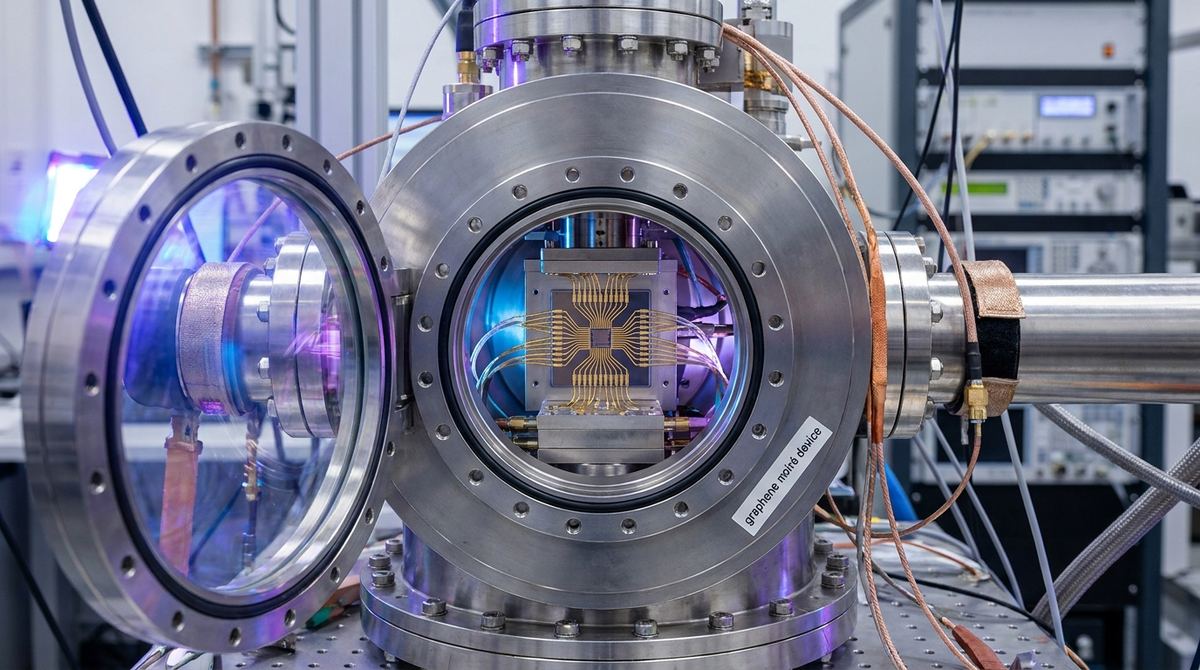
The discovery of the second-order nonlinear Hall effect (NLHE) has opened a new frontier in condensed matter physics, moving beyond the standard linear response to probe the quantum geometry of electronic wavefunctions. Recent research has demonstrated that in graphene moiré systems, this nonlinear response can exhibit quantum oscillations when subjected to a magnetic field. These oscillations are a direct signature of topological Brown-Zak fermions—novel quasiparticles that emerge from the periodic potential of the moiré superlattice.
For specialized quantum materials startups and advanced research labs, the ability to characterize these nonlinear transport properties is critical. While standard Hall effect measurements are routine, detecting the nonlinear component requires a specific experimental architecture designed to isolate second-order responses from much larger linear signals. This guide outlines the engineering requirements for building a prototype testbed to observe these topological quantum oscillations.
The goal is to construct a high-precision cryogenic transport measurement system capable of detecting the nonlinear voltage response (V proportional to I squared) in a graphene-hBN (hexagonal Boron Nitride) heterostructure. The system must be able to sweep a magnetic field from 0 Tesla to at least 2 Tesla (to capture the 0.5 Tesla onset identified in recent studies) and maintain extremely low temperatures to prevent thermal smearing of the quantum oscillations.
The primary technical challenge is not just the fabrication of the moiré device, but the signal processing required to extract the nonlinear Hall signal, which is typically several orders of magnitude smaller than the linear Hall voltage.
To build this testbed, you will require high-purity materials and specialized cryogenic electronics.
Materials:
1. High-quality Graphene: Ideally exfoliated graphene for maximum mobility, though high-quality CVD graphene may be used for larger-scale prototyping.
2. Hexagonal Boron Nitride (hBN): High-purity flakes used for encapsulation to protect the graphene and provide an atomically smooth environment.
3. Substrate: Silicon/Silicon Dioxide (Si/SiO2) wafers with a thickness of approximately 285 nm for back-gating capabilities.
4. Contact Metal: Gold (Au) for the primary contacts and Titanium (Ti) as an adhesion layer.
5. Transfer Polymer: Polycarbonate (PC) or PDMS for the dry-transfer method used in stacking the moiré layers.
Equipment:
1. Cryogenic System: A liquid Helium-4 cryostat or a dilution refrigerator. The system must reach temperatures below 4 Kelvin to observe quantum oscillations, though 1 Kelvin is a safer target for initial testing.
2. Superconducting Magnet: Capable of providing a stable, uniform magnetic field. A range of 0 to 5 Tesla is recommended to ensure the 0.5 Tesla onset is captured clearly.
3. Lock-in Amplifiers: Two high-precision AC lock-in amplifiers (e.g., SR865 or similar) are essential. One is used for the excitation signal, and the other is tuned to the second harmonic (2-omega) to detect the nonlinear response.
4. Precision Voltage Source: A low-noise AC current source to drive the sample.
5. Micro-manipulator: For precise alignment during the dry-transfer process of the moiré layers.
The performance of the device depends entirely on the quality of the moiré superlattice. The moiré pattern is created by the precise angular misalignment between the graphene layer and the hBN or a second graphene layer.
1. Substrate Preparation: Clean the Si/SiO2 substrate using standard RCA cleaning or oxygen plasma treatment to ensure no organic contaminants remain.
2. hBN Deposition: Use a dry-transfer method to place a thin layer of hBN (approximately 20 to 40 nm thick) onto the substrate. This layer acts as the dielectric.
3. Graphene Exfoliation and Transfer: Exfoliate a single layer of graphene onto a PC/PDMS stamp. Carefully transfer the graphene onto the hBN layer.
4. Moiré Alignment: This is the most critical step. Using a high-precision rotation stage or a specialized twist-transfer setup, rotate the graphene layer by a specific angle relative to the underlying lattice. While the research focuses on moiré systems generally, the specific angle determines the fermion properties. For a prototype, start with a small twist angle (less than 3 degrees).
5. Encapsulation: Place a second, slightly thicker layer of hBN (approx. 30-50 nm) over the graphene. This encapsulates the graphene, protecting it from environmental degradation and reducing charge impurity scattering.
6. Electrode Patterning: Use electron-beam lithography (EBL) to define the Hall bar geometry. Deposit the Ti/Au contacts via thermal evaporation.
7. Annealing: Perform a vacuum anneal (approximately 200 degrees Celsius for several hours) to remove any residual polymers from the device edges, which is vital for achieving the high mobility required for quantum oscillations.
Once the device is fabricated and mounted in the cryostat, follow this testing sequence to validate the presence of Brown-Zak fermions.
1. Linear Characterization: Perform standard longitudinal resistance (Rxx) and linear Hall resistance (Rxy) measurements. Sweep the temperature from 300 K down to 4 K. This establishes the baseline mobility and confirms the device is functional.
2. AC Excitation Setup: Apply a small AC current (I = I0 sin(omega t)) to the device.
3. Second Harmonic Detection: Configure the second lock-in amplifier to detect the voltage at the second harmonic frequency (2-omega). The nonlinear Hall voltage (V2w) is the target signal.
4. Magnetic Field Sweep: Slowly sweep the magnetic field from 0 Tesla to 2 Tesla. Monitor the 2-omega voltage signal.
5. Oscillation Identification: Look for periodic oscillations in the V2w signal as a function of the magnetic field (1/B). The onset should occur near 0.5 Tesla as predicted by the research.
6. Commensurability Check: Verify that the oscillations correspond to the commensurability conditions of the moiré lattice. The frequency of these oscillations should relate to the area of the moiré Brillouin zone.
1. Sample Contamination: Even microscopic amounts of polymer residue can destroy the moiré pattern and kill the nonlinear signal.
Mitigation: Use ultra-clean dry-transfer techniques and perform rigorous vacuum annealing.
2. Signal-to-Noise Ratio (SNR): The nonlinear signal is extremely weak.
Mitigation: Use high-precision, low-noise lock-in amplifiers and ensure the excitation current is kept low enough to avoid Joule heating but high enough to provide a measurable signal.
3. Thermal Heating: The AC current used for the nonlinear measurement can cause local heating in the sample, washing out the quantum oscillations.
Mitigation: Use very low excitation currents (nano-ampere range) and monitor the device temperature using a calibrated thermometer in the cryostat.
4. Twist Angle Inhomogeneity: If the twist angle varies across the device, the moiré pattern will be inconsistent.
Mitigation: Use high-resolution optical microscopy and Raman spectroscopy to verify the twist angle before proceeding to cryogenic measurements.
This guide is based on the research findings of Zhong et al. (2026) regarding the detection of Brown-Zak fermions via nonlinear Hall quantum oscillations.
Engineering Assumptions:
1. The research identifies an onset field of 0.5 T; however, for a practical prototype, we assume a magnet capability of at least 2 T to ensure a sufficient range for oscillation observation.
2. The research does not specify the exact twist angle required for the specific moiré system used; we assume a small-angle twist (under 3 degrees) for the prototype fabrication.
3. We assume the use of a standard Hall bar geometry for the device, as it is the most reliable for measuring both longitudinal and transverse voltages.
4. The temperature range is assumed to be below 4 K, as quantum oscillations in these systems are typically suppressed by thermal energy at higher temperatures.
Serious about B2B integration? Test our premium Pulsed Electrical Resistive Carbon Heating turbostratic graphene in your lab. 100g sample packs available now.
Explore More
Discover how rippled graphene pores act as fluidic memristors, enabling advanced synaptic functionalities for the next generation of neuromorphic computing.

Learn how to use electromechanical responses in gapped graphene to measure electronic temperature and band gaps using traveling flexural waves.

Explore how researchers have discovered viscous electron fluid behavior in cadmium, a breakthrough that could revolutionize the future of nanoelectronics.