
Nature's Nanotech: Graphene and Blue Emission Found in Bee Hives
Researchers discover naturally formed graphene sheets and carbon ovals in stingless bee hives, creating a novel emergent material with powerful blue light...
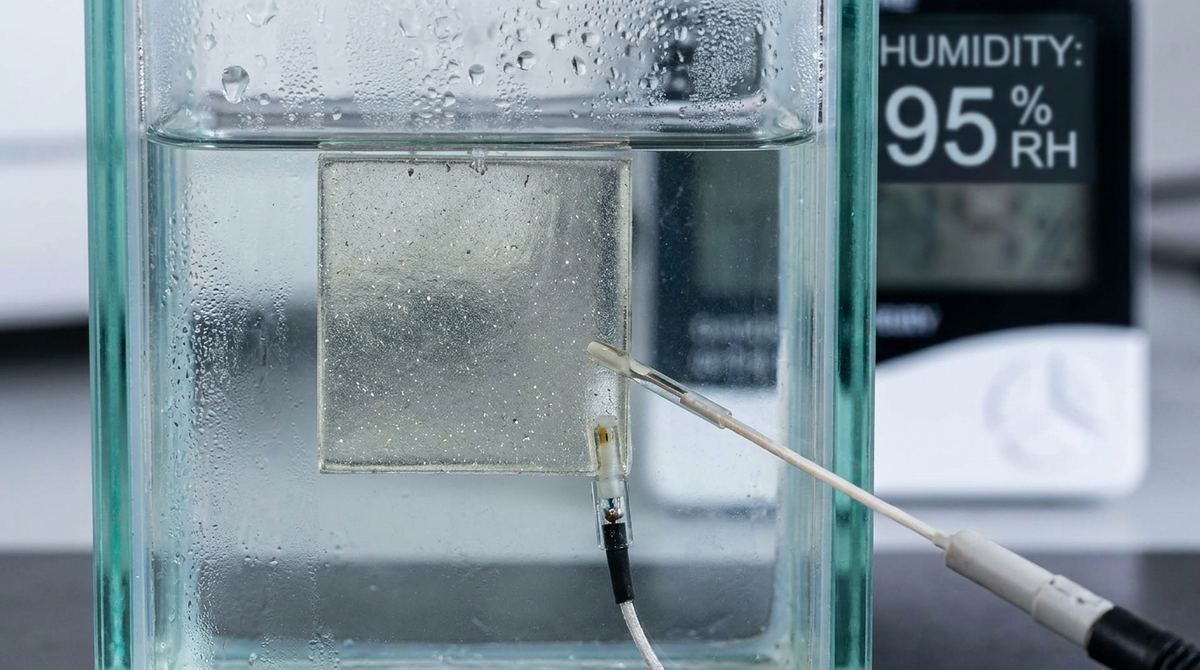
For engineers working in marine, aerospace, or outdoor electronics, epoxy resins are indispensable. They provide excellent adhesion, chemical resistance, and structural integrity. However, epoxy has a fundamental weakness: it is hygroscopic. It naturally absorbs moisture from the environment, and this water uptake can be catastrophic for the material's long-term performance. Water acts as a plasticizer, lowering the glass transition temperature (Tg) and eventually degrading the mechanical properties of the polymer matrix.
Recent molecular dynamics simulations have provided new insights into how graphene can be used to mitigate this specific failure mode. By incorporating graphene into an epoxy matrix, we can create a "tortuous path" for water molecules, effectively slowing down their diffusion into the material. This guide outlines how to develop a prototype of a graphene-reinforced epoxy composite designed to maintain its mechanical strength even when exposed to high humidity.
The research conducted by Vassaux et al. (2026) provides a critical roadmap for this application. Through large-scale molecular dynamics simulations, the study identified a specific threshold for water absorption in epoxy-graphene nanocomposites.
The most important finding for an engineer is the non-linear response to water content. The study observed that when water content is below 3% by weight (wt%), the primary effect of hydration is a reduction in the glass transition temperature (Tg). While the material becomes slightly more flexible at higher temperatures, its fundamental mechanical properties—such as stiffness and strength—remain largely unaffected.
However, once the water content exceeds the 3%wt threshold, the mechanical properties undergo a rapid and non-linear deterioration. This means that if you can use graphene to keep the moisture content below this 3%wt limit, you can prevent the structural failure of the component. The graphene acts as a microscopic barrier, increasing the distance water molecules must travel to penetrate the bulk of the material.
The goal of this prototype is to create a structural epoxy component, such as an enclosure for a marine sensor or an outdoor electronic housing, that maintains its stiffness and strength despite exposure to high-humidity environments. We are not just looking for a material that survives; we are looking for a material that maintains its design-intent mechanical properties.
To replicate this effect in a lab or small-scale manufacturing setting, you will need the following:
1. Epoxy Resin System: A standard, high-performance DGEBA-based epoxy (Diglycidyl ether of bisphenol A) with an amine-based curing agent is recommended.
2. Graphene Nanoplatelets (GNP): High-quality, functionalized graphene nanoplatelets are preferred to ensure better dispersion and interaction with the epoxy matrix.
3. Solvent (Optional): A compatible solvent like acetone or isopropyl alcohol may be used during the dispersion phase to reduce viscosity, though it must be fully removed before curing.
4. Degassing Equipment: A vacuum chamber capable of reaching at least 29 inHg.
5. High-Shear Mixer or Ultrasonic Probe: Essential for breaking up graphene agglomerates.
6. Environmental Chamber: A controlled humidity/temperature chamber for testing.
Because the research focuses on the threshold of water uptake, the precision of your mixing and dispersion is the most critical factor.
1. Preparation of Graphene Dispersion:
The graphene must be thoroughly dispersed to create the barrier effect. Start by weighing out your graphene. While the research does not specify the optimal graphene loading for barrier efficiency, a starting concentration of 0.5%wt to 1.0%wt is a cautious engineering assumption for structural applications. Add the graphene to a small amount of resin and use an ultrasonic probe (sonication) for 15 to 30 minutes in an ice bath to prevent premature curing due to heat.
2. Mixing the Matrix:
Once the graphene is dispersed, add the remaining epoxy resin and the curing agent according to the manufacturer's stoichiometric ratio. Use a high-shear mixer at moderate speeds to ensure the graphene is distributed throughout the entire volume of the resin.
3. Degassing:
Graphene dispersion significantly increases the viscosity of the resin and tends to trap micro-bubbles. Place the mixture in a vacuum chamber for 20 to 40 minutes. This step is vital; any trapped air will act as a pathway for moisture, undermining the barrier effect of the graphene.
4. Casting and Curing:
Pour the mixture into your mold. Follow the manufacturer's recommended curing cycle. Note that the presence of graphene can slightly alter the exothermic reaction of the epoxy, so monitor the temperature during the initial stages of curing.
5. Post-Curing:
To ensure the material reaches its maximum potential Tg and mechanical stability, a post-cure step (e.g., 2 hours at 80 degrees Celsius, depending on the resin) is highly recommended.
To verify if your prototype is successfully resisting moisture-induced degradation, you must perform three specific tests.
1. Gravimetric Moisture Uptake Test:
Weigh your dry samples (W_dry). Place them in a high-humidity environment (e.g., 85% relative humidity at 50 degrees Celsius) for a set duration (e.g., 7 days, 14 days, or 30 days). Periodically weigh the samples (W_wet). Calculate the moisture content by weight. This will tell you if your graphene loading is successfully keeping the water content below the critical 3%wt threshold identified in the research.
2. Differential Scanning Calorimetry (DSC):
Use DSC to measure the glass transition temperature (Tg) of the samples before and after moisture exposure. According to the research, you should see a drop in Tg as water is absorbed, but this drop should not be accompanied by a loss in mechanical integrity if the 3%wt limit is respected.
3. Mechanical Testing:
Perform tensile or flexural testing (e.g., 3-point bend test) on both the dry and moisture-saturated samples. Compare the Young's modulus and the ultimate tensile strength. If the mechanical properties remain stable despite the moisture uptake, your graphene barrier is working.
1. Agglomeration:
If the graphene is not perfectly dispersed, it will form clumps. These clumps act as stress concentrators rather than moisture barriers, actually making the material weaker.
Mitigation: Use high-shear mixing and verify dispersion through visual inspection or microscopy if available.
2. Viscosity Management:
Adding graphene significantly increases the viscosity of the epoxy, which can make degassing difficult.
Mitigation: If the resin becomes too thick to degas, use a compatible solvent during the mixing phase, but ensure it is completely removed via vacuum before the final cure.
3. The 3%wt Cliff:
The most significant risk is the non-linear degradation. If your moisture barrier is insufficient and the water content creeps from 2.9%wt to 3.1%wt, the material's strength may drop precipitously.
Mitigation: Always design with a safety margin. If your target environment is highly humid, aim for a higher graphene loading (up to 1.5%wt or 2.0%wt) to ensure the moisture content remains well below the threshold.
This guide is based on the molecular dynamics simulations presented in the paper "Thermo-elastic properties of hydrated epoxy-graphene nanocomposites from ensemble-based molecular dynamics simulations" by Vassaux et al. (2026).
It is important to note that the source material is based on computer simulations, which, while highly advanced, are models of reality. The 3%wt threshold is a finding from these simulations. In a real-world engineering application, the exact threshold may vary slightly depending on the specific epoxy chemistry and the quality of the graphene dispersion. Furthermore, the research emphasizes that large-scale simulations are required for accuracy; therefore, experimental validation is mandatory before using these materials in mission-critical structural components.
Serious about B2B integration? Test our premium Pulsed Electrical Resistive Carbon Heating turbostratic graphene in your lab. 100g sample packs available now.
Explore More
Researchers discover naturally formed graphene sheets and carbon ovals in stingless bee hives, creating a novel emergent material with powerful blue light...

Discover how rippled graphene pores act as fluidic memristors, enabling advanced synaptic functionalities for the next generation of neuromorphic computing.

Learn how to use electromechanical responses in gapped graphene to measure electronic temperature and band gaps using traveling flexural waves.