
Nature's Nanotech: Graphene and Blue Emission Found in Bee Hives
Researchers discover naturally formed graphene sheets and carbon ovals in stingless bee hives, creating a novel emergent material with powerful blue light...
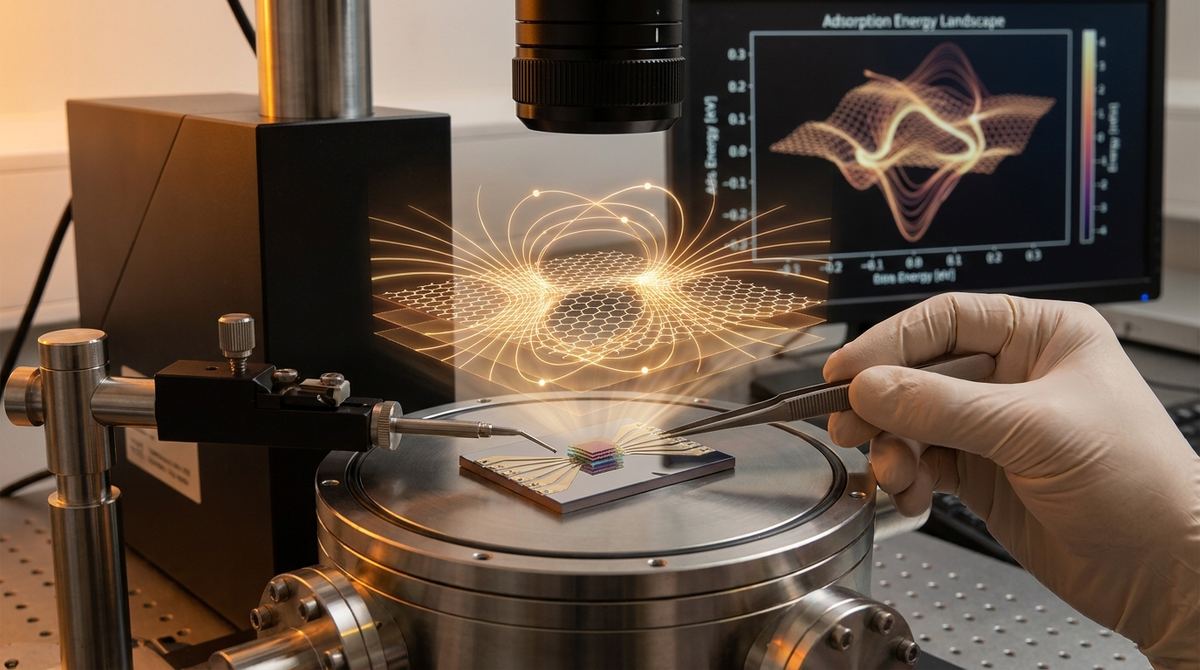
Imagine being able to look at a single, microscopic layer of carbon and see the invisible magnetic shadows cast by the movement of electrons. While we have known for decades that moving charges create magnetic fields, doing so in a way that allows us to see exactly where and how these magnetism patterns emerge in a single-atom-thick material is a monumental challenge. This research, conducted by Owen I. Sheekey, Trevor B. Arp, Benjamin A. Foutty, Ruoxi Zhang, Tixuan Tan, Ludwig F. W. Holleis, Yi Guo, Sandesh S. Kalantre, Canxun Zhang, Mark Zakharyan, David Gong, Aidan Keough, et al., represents a significant leap in our ability to observe these quantum phenomena directly. By focusing on a very specific arrangement of graphene layers known as rhombohedral stacking, the team has opened a window into the complex dance of electrons that could redefine how we design quantum technologies.
In the world of condensed matter physics, understanding magnetism is crucial for everything from high-capacity data storage to the development of quantum computers. Traditional magnetism, such as that found in a permanent magnet on your refrigerator, comes from the intrinsic spin of electrons. However, there is another, more elusive type of magnetism called orbital magnetism. This arises not from the electron's inherent spin, but from the actual circular paths, or orbits, that electrons take as they move through a crystal lattice.
The difficulty lies in the scale and the subtlety of these effects. In most materials, magnetic measurements are taken globally, meaning we measure the total magnetic field of the entire sample. This tells us that magnetism exists, but it does not tell us how that magnetism is distributed spatially. In advanced materials like multilayer graphene, the magnetism might be highly localized or follow complex patterns depending on how the atoms are stacked. Without the ability to visualize these patterns at a microscopic level, scientists are essentially trying to understand a complex symphony by listening to the total volume of the orchestra rather than identifying the individual instruments. This lack of spatial resolution prevents us from understanding how to manipulate the electronic properties of these materials for specific technological purposes.
The core concept behind this work is to move from global measurements to local visualization. Instead of asking how much magnetism a material has, the researchers asked how the magnetism is distributed across the surface. To do this, they looked at rhombohedral multilayer graphene.
In graphene, carbon atoms are arranged in a hexagonal lattice. When you stack multiple layers of graphene on top of each other, the way those layers are aligned—the stacking order—completely changes the electronic properties of the material. The most common way to stack them is called Bernal stacking, but rhombohedral stacking (also known as ABC stacking) creates a very different environment for electrons. In rhombohedral stacking, the electrons experience a unique landscape where they can become "slowed down," a state physicists call a flat band. When electrons move through these flat bands, their orbital motion becomes much more pronounced and susceptible to magnetic effects. By adding extra electrons to this system through a process called doping, the researchers could amplify and observe these orbital magnetic patterns using highly sensitive scanning probes.
To understand how this system works, we must look at the relationship between the crystal structure and electron behavior. In a rhombohedral multilayer graphene stack, each layer is shifted relative to the one below it in a specific sequence. This specific geometry creates a unique electronic band structure. In most materials, electrons have high kinetic energy and zip through the lattice very quickly. However, in rhombohedral graphene, the electronic bands become "flat" near the Fermi level, which is the energy level that determines the behavior of the most important electrons in the material.
When the bands are flat, the electrons have very little kinetic energy, meaning they move much more slowly than they would in a single layer of graphene or in a Bernal-stacked material. This slow movement makes the electrons extremely sensitive to external influences. When we introduce "doping"—which involves adding extra electrons to the system via an electrical gate or chemical means—we change the density of these charge carriers.
As these electrons move through the rhombohedral lattice, their paths are constrained by the underlying atomic structure. Because they are moving in specific loops or orbits dictated by the symmetry of the ABC stacking, they create tiny, localized magnetic moments. These are the orbital magnetic moments. The research team used advanced imaging techniques to detect the magnetic flux generated by these tiny electron loops. By mapping these fluxes, they could essentially create a map of the orbital magnetism, showing how it changes as they changed the number of electrons in the system.
The research team successfully achieved the visualization of these orbital magnetic patterns. This was a critical verification of theoretical predictions. For years, physicists have theorized that rhombohedral graphene should exhibit strong orbital magnetism due to its flat-band electronic structure, but seeing it was a much higher bar to clear.
The researchers observed that the magnetic response is directly tied to the electron density. By tuning the amount of doping, they could see the magnetic signal change in real time. This confirms that the magnetism being observed is indeed orbital in nature and is intimately linked to the unique electronic landscape created by the rhombohedral stacking. The visualization showed that the magnetic signal is not just a uniform background noise but a structured phenomenon that responds to the specific quantum states of the electrons. This finding validates the use of rhombohedral multilayer graphene as a platform for studying high-order quantum effects and provides a blueprint for how other two-dimensional materials might be manipulated.
This discovery is much more than a fundamental physics exercise; it has profound implications for the future of materials science. First, it provides a way to validate quantum mechanical models. When we can observe a phenomenon that was previously only a mathematical prediction, it gives us much higher confidence in our ability to simulate and eventually engineer new quantum materials.
Second, it opens the door to a new field of electronics often called orbitronics. While spintronics (which uses electron spin) has been studied for years, orbitronics—which uses the orbital motion of electrons—offers a potentially much larger magnetic signal and more ways to control the flow of information. If we can visualize and control orbital magnetism at the nanoscale, we can design devices that are significantly more efficient and smaller than current technology allows.
Furthermore, the ability to map these magnetic fields at high resolution is a major step forward for quantum sensing. Materials that show such sensitive responses to electron density and magnetic fields could be used to create sensors that detect incredibly minute changes in magnetic fields, which has applications in everything from medical imaging to geological surveying.
While these results are groundbreaking, it is important to recognize that this research is in the fundamental physics stage. The experiments were conducted under highly controlled laboratory conditions, often requiring extremely low temperatures—close to absolute zero—to minimize thermal noise that would otherwise drown out the tiny magnetic signals.
The graphene samples used are also of a very high quality, meaning they have very few defects. In a real-world manufacturing environment, producing large-scale, defect-free rhombohedral multilayer graphene is a massive engineering challenge. The current methods of creating specific stacking orders are difficult to scale up for mass production. Additionally, while the researchers could observe the magnetism, the ability to actively manipulate these orbital currents to perform logic operations or store data is a separate, much larger challenge that requires further investigation. We are seeing the phenomenon, but we are not yet controlling it for practical use.
As this research moves from the laboratory toward engineering, several real-world applications emerge. In the realm of quantum computing, the ability to control orbital states could lead to new types of qubits. Unlike traditional qubits, which can be sensitive to environmental noise, orbital-based quantum states might offer different ways to protect information, potentially leading to more stable quantum computers.
In the field of ultra-sensitive magnetometry, these principles could lead to a new generation of sensors. Current magnetic field sensors, like those used in brain imaging (MEG), are often large and require massive cooling systems. Understanding how to manipulate orbital magnetism in 2D materials could lead to much smaller, more integrated, and more sensitive magnetic sensors.
Finally, in the semiconductor industry, the principles of controlling electron orbits could lead to the development of next-generation transistors. If we can use the orbital state of an electron to switch a current on or off, we could create electronics that are faster and consume significantly less power than the silicon-based technology currently used in smartphones and computers.
If you take away only one thing from this study, let it be that we are moving from the era of observing materials to the era of visualizing the quantum movement within them, specifically through the unique and controllable orbital magnetism found in rhombohedral graphene.
What is the difference between spin magnetism and orbital magnetism?
Spin magnetism comes from the inherent magnetic properties of an electron itself, which is like a tiny built-in magnet. Orbital magnetism, however, comes from the actual movement or path the electron takes through the material, creating a tiny loop of electric current that produces a magnetic field.
Why is rhombohedral stacking special compared to other types of graphene?
Graphene layers can be stacked in different ways, like Bernal or rhombohedral stacking. Rhombohedral stacking creates a unique electronic environment where electrons move much more slowly. This "slowing down" makes their orbital magnetic effects much easier to detect and manipulate.
What does it mean to "dope" graphene?
Doping is the process of adding extra charge carriers, like electrons, to a material to change its electrical properties. In this research, adding electrons changes the density of the particles that create the magnetic signals, allowing researchers to observe how the magnetism reacts to changes in charge.
Is this research ready for commercial use in electronics?
No, this research is currently in the fundamental science phase. While it proves that these magnetic effects can be seen and understood, the materials are currently too expensive and difficult to manufacture at a scale that would be useful for consumer electronics like smartphones or computers.
How did the researchers actually "see" the magnetism?
Since magnetic fields at this scale are incredibly weak, researchers use specialized, ultra-sensitive scanning probes. These probes move just above the surface of the material and can detect the tiny magnetic flux caused by the orbital paths of the electrons, effectively creating a map of the magnetism.
The ability to visualize orbital magnetism in rhombohedral multilayer graphene marks a significant milestone in condensed matter physics. By moving beyond global measurements and capturing the local, spatial patterns of electron motion, researchers like Sheekey, Arp, and their colleagues have provided essential proof for quantum mechanical theories. This work paves the way for the future of orbitronics and quantum sensing, promising a world where the subtle, circular dance of electrons becomes a powerful tool for the next generation of electronic and quantum technologies. While engineering challenges remain, the map provided by this research is a vital guide for the scientists and engineers of tomorrow.
Serious about B2B integration? Test our premium Pulsed Electrical Resistive Carbon Heating turbostratic graphene in your lab. 100g sample packs available now.
Explore More
Researchers discover naturally formed graphene sheets and carbon ovals in stingless bee hives, creating a novel emergent material with powerful blue light...

Discover how rippled graphene pores act as fluidic memristors, enabling advanced synaptic functionalities for the next generation of neuromorphic computing.

Learn how to use electromechanical responses in gapped graphene to measure electronic temperature and band gaps using traveling flexural waves.