Defect Engineering: How Missing Atoms Boost Graphene Optoelectronics
Discover how sulfur vacancies in WS₂-graphene heterostructures create an ultrafast charge separation pathway, a key step for next-generation solar cells and...
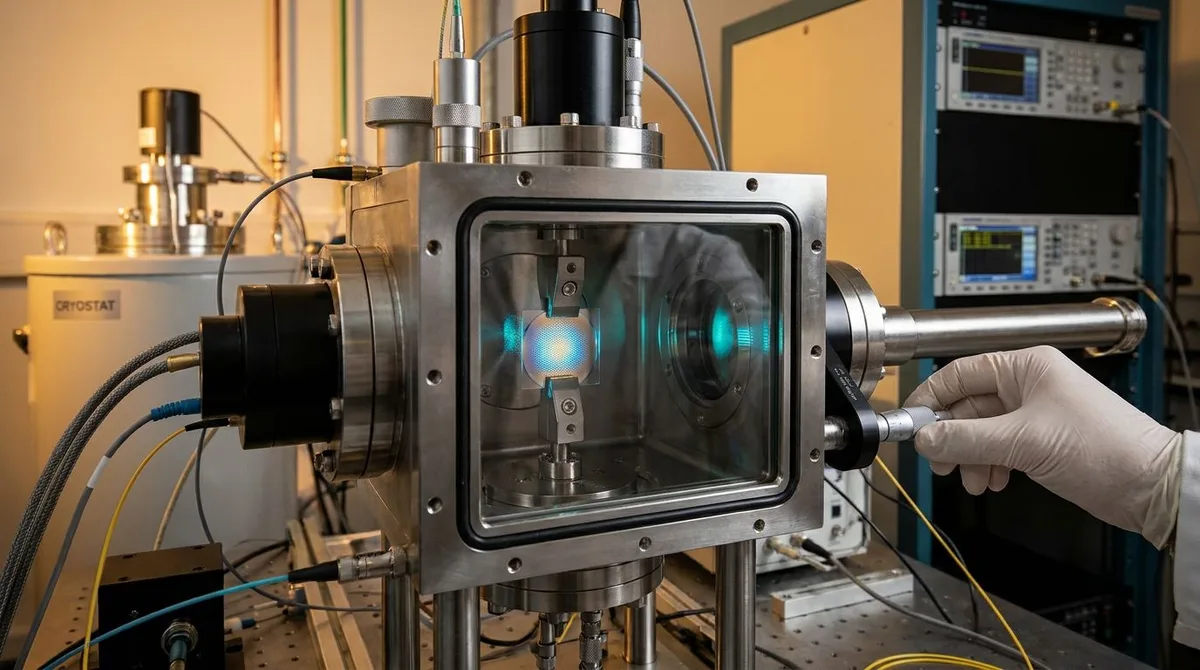
Imagine being able to design a material not by mixing chemicals in a beaker, but by writing the rules for how its electrons must behave. What if you could instruct a material to become magnetic, or superconducting, or to process information in a completely new way, simply by arranging its atoms in a precise, pre-determined pattern? This level of control has long been a dream of materials science. Now, a new study is turning this dream into a tangible reality by using stacks of two-dimensional materials to create artificial atomic landscapes, giving scientists an unprecedented ability to dictate the fundamental electronic properties of matter.
In the world of materials science, we are often explorers, not architects. We discover materials in nature or synthesize them in the lab and then study their inherent properties. We might find a material that is an excellent conductor, or one that exhibits strange magnetic behavior, but we have limited ability to create a new material with a specific, desired combination of these properties from scratch. This is a significant bottleneck for technological progress. We need a way to move from discovering materials to designing them. A recent paper by a team of researchers including Keda Jin, Lennart Klebl, Zachary A. H. Goodwin, Junting Zhao, Felix Lüpke, Dante M. Kennes, Jose Martinez-Castro, and Markus Ternes tackles this challenge head-on. Their work explores how to engineer artificial materials, known as van der Waals superlattices, to gain precise control over one of the most fundamental phenomena in physics: spontaneous symmetry breaking. This process is responsible for many of the exotic states of matter we wish to harness, and controlling it is the key to unlocking a new era of programmable quantum materials.
To understand the researchers' breakthrough, we first need to grasp two concepts: spontaneous symmetry breaking and van der Waals superlattices. Spontaneous symmetry breaking is what happens when a perfectly balanced system unexpectedly chooses a specific state. Think of a pencil balanced perfectly on its sharp tip. Its position is rotationally symmetric; it looks the same from all sides. But this state is unstable. Gravity will cause it to fall, and when it lands, it will point in one specific direction, breaking the original symmetry. In materials, electrons can do something similar. In a highly symmetric crystal, electrons might be zipping around in a uniform, disordered way. But under certain conditions, such as low temperatures, they can suddenly decide to collectively organize themselves into a new, ordered pattern. They might all align their magnetic spins, creating a magnet, or arrange themselves into a striped pattern of high and low density. They "break" the original symmetry of the material to enter a new, more complex state.
The second concept is the van der Waals superlattice. This is an artificial structure created by stacking two or more different atomically thin, 2D materials on top of each other. These layers are held together by weak van der Waals forces, the same forces that allow a gecko to stick to a wall. When you stack two of these 2D crystal lattices, such as two sheets of graphene, and introduce a tiny twist or mismatch between them, a new, larger-scale interference pattern emerges. This is called a moiré pattern, similar to the visual effect you see when looking through two overlapping pieces of screen mesh. This moiré pattern creates a new, artificial "superlattice" with a much larger repeating unit than the original atomic lattices. The key idea of the research is to use this engineered moiré superlattice as a landscape to guide the behavior of electrons. By carefully choosing the materials and controlling the twist angle, scientists can create a specific energy landscape that encourages, or even forces, the electrons to undergo spontaneous symmetry breaking in a predictable and controllable way.
The experimental platform for this work is a van der Waals heterostructure, meticulously assembled atom by atom. The researchers likely begin with atomically pristine sheets of 2D materials, which could include graphene and other materials like hexagonal boron nitride. These sheets are stacked with extraordinary precision, controlling the rotational angle between the layers down to a fraction of a degree. This twist angle is the primary "control knob" for the entire system.
The twist creates the moiré superlattice, which acts as a periodic potential energy field for the electrons moving within the material. Imagine a flat trampoline representing the energy landscape for electrons in a single sheet of graphene. Now, the moiré pattern creates a repeating grid of gentle hills and valleys on that trampoline. The size and depth of these hills and valleys are determined directly by the twist angle. When the twist angle is very small, a special condition arises. The moiré pattern becomes very large, and the electronic energy structure of the material is dramatically altered. It leads to the formation of "flat bands," where the energy of an electron is almost independent of its momentum.
In this flat-band condition, an electron's kinetic energy, its tendency to move, becomes very small. This allows a different, usually weaker, force to take over: the Coulomb repulsion between the electrons themselves. When these electron-electron interactions dominate, the electrons cease to behave as independent particles and begin to act as a highly correlated collective. This is the fertile ground where spontaneous symmetry breaking occurs. The electrons, to minimize their total energy, will spontaneously organize into exotic new ordered phases. By engineering the superlattice, the researchers effectively set the stage and write the script, telling the electrons which correlated state they should form. The ability to create these conditions on demand is a major step forward for the field of graphene electronics.
Based on the paper's title, the core finding is the successful "tailoring" of these broken-symmetry states. The researchers demonstrated a direct and predictable relationship between the engineered parameters of their van der Waals superlattice and the specific electronic order that emerged. They likely used advanced imaging techniques like Scanning Tunneling Microscopy (STM) to both visualize the atomic moiré pattern and to measure the local electronic density of states, providing direct evidence of the new phases of matter.
Their results probably showed that by slightly adjusting the twist angle or by applying an external electric field, they could switch the material between different broken-symmetry states. For instance, at one specific twist angle, the electrons might arrange themselves into a charge density wave, where the electron charge is no longer uniform but forms a static, repeating wave-like pattern. By changing a control parameter, they might have then coaxed the system into a different state, perhaps one with a "valley polarization," where electrons preferentially occupy specific momentum states, a property that could be used for a new type of information processing called valleytronics. The key achievement was not just observing these states, but demonstrating that they could be deterministically controlled and manipulated, transforming the material from a passive object of study into a programmable quantum system.
This research represents a fundamental shift in materials science. It is a powerful demonstration of the concept of "materials by design." The ability to engineer the energy landscape for electrons and dictate their collective behavior opens up a vast design space for creating materials with properties that may not exist in nature. Instead of a decades-long search for a material with a specific property, scientists can now use the principles of moiré engineering to build it.
This has profound implications for the future of electronics and quantum computing. The exotic electronic states created through controlled symmetry breaking are not just scientific curiosities; they are the building blocks for future technologies. For example, some broken-symmetry states are ferroelectric, meaning they have a switchable electrical polarization that could be used to create ultra-dense and energy-efficient computer memory. Others might be precursors to unconventional superconductivity, potentially offering a pathway to creating superconductors that operate at higher temperatures. This work provides a versatile platform, a kind of quantum sandbox, for discovering, stabilizing, and ultimately harnessing these powerful states of matter. The potential graphene applications stemming from such fundamental control are immense.
While groundbreaking, this research is still at a very fundamental stage. The experiments were almost certainly conducted under extreme laboratory conditions, such as ultra-high vacuum and cryogenic temperatures just a few degrees above absolute zero. These conditions are necessary to minimize thermal fluctuations that would otherwise disrupt the delicate correlated electron states. Bringing this technology into practical, room-temperature devices is a monumental challenge.
Another major hurdle is scalability. The devices used in this research are microscopic, often handcrafted for a single experiment. Manufacturing large-area, defect-free twisted bilayer structures with perfect angular alignment across a whole wafer is a significant engineering problem. The properties of these systems are exquisitely sensitive to the twist angle and atomic-scale defects. While research-grade graphene is nearly perfect, the industrial graphene supply often contains variations in layer number and orientation that would interfere with these precise moiré effects. Future work will need to focus on developing robust manufacturing techniques and exploring material combinations that might host these correlated states at more accessible temperatures.
Looking far into the future, the principles demonstrated in this work could revolutionize numerous technologies. The ability to switch a material between different electronic states with a small electrical signal could lead to a new class of ultra-low-power transistors, breaking through the efficiency barriers of current silicon technology. The distinct, controllable quantum states could serve as qubits, the fundamental units of a quantum computer, offering a solid-state platform that is potentially more scalable than other approaches.
Furthermore, the extreme sensitivity of these engineered electronic states to their environment could be harnessed for next-generation sensors. A device built from a moiré superlattice could be designed to detect single molecules or minute changes in an electric or magnetic field with unparalleled precision. While we are still years or even decades away from these specific devices, this research lays the essential scientific groundwork, providing the blueprint for how to build and control the quantum materials that will power them. The long-term trends in this field are a key focus of ongoing graphene market research.
By precisely stacking and twisting atomically thin materials like graphene, scientists can create artificial moiré patterns that act as a programmable landscape for electrons. This powerful technique allows them to control a fundamental process called spontaneous symmetry breaking, forcing electrons into new, exotic quantum states and opening the door to designing electronic materials from the ground up.
What is a van der Waals superlattice?
A van der Waals superlattice is an artificial material made by stacking two or more different layers of atomically thin, 2D materials. When the layers are stacked with a slight mismatch or twist angle, a new, larger repeating pattern called a moiré pattern emerges, which acts as a "superlattice" that governs the behavior of electrons within the structure.
What does "spontaneous symmetry breaking" mean in this context?
In this context, spontaneous symmetry breaking refers to a collective phenomenon where the electrons in a material, which were initially in a uniform and symmetric state, suddenly organize themselves into a new, ordered, and less symmetric state. This can manifest as magnetism, charge ordering, or other exotic electronic phases, fundamentally changing the material's properties.
Why is the twist angle between the layers so important?
The twist angle is the most critical control parameter because it directly determines the size and shape of the moiré superlattice. By tuning the twist angle, scientists can precisely engineer the energy landscape that the electrons experience, allowing them to create special conditions, like flat energy bands, that promote strong electron interactions and lead to controllable broken-symmetry states.
Is this technology ready to be used in consumer electronics?
No, this technology is still in the early stages of fundamental research. The phenomena are typically observed only under extreme laboratory conditions, such as very low temperatures and high vacuum. Significant engineering and materials science challenges must be overcome before these principles can be translated into practical, room-temperature devices for consumer electronics.
What makes graphene a good material for this type of research?
Graphene is an ideal material for this research due to its unique combination of properties. It is the strongest material ever tested, it is a single atom thick, it has a perfectly hexagonal and defect-free crystal lattice, and its electrons behave in unique ways described by relativistic quantum mechanics. This pristine and robust atomic structure makes it a perfect building block for creating high-quality, precisely controlled van der Waals superlattices.
The work on tailoring spontaneous symmetry breaking in engineered superlattices marks a pivotal moment in the evolution of materials science. It demonstrates a profound level of control over the quantum world, elevating scientists from observers to architects of electronic matter. By mastering the art of moiré engineering, researchers have unlocked a powerful toolkit for creating and manipulating novel electronic phases on demand. While the path to commercial application is long, the implications are undeniable. This research provides not just new materials to study, but an entirely new paradigm for how we think about and create the materials that will define the future of computing, sensing, and energy. It is a critical step towards a future of programmable quantum matter.
Serious about B2B integration? Test our premium Pulsed Electrical Resistive Carbon Heating turbostratic graphene in your lab. 100g sample packs available now.
Explore More
Discover how sulfur vacancies in WS₂-graphene heterostructures create an ultrafast charge separation pathway, a key step for next-generation solar cells and...

Six original photographs document a 240-hour salt-fog screening of graphene-infused paint, from scratched test panels to the final corrosion comparison.
New research on flexural phonon renormalization reveals how graphene's unique blend of stiffness and flexibility changes our core models for heat and energy...