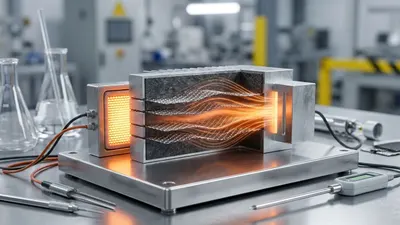
How Graphene's Strange Mechanics Redefine Heat Flow at the Nanoscale
New research on flexural phonon renormalization reveals how graphene's unique blend of stiffness and flexibility changes our core models for heat and energy...
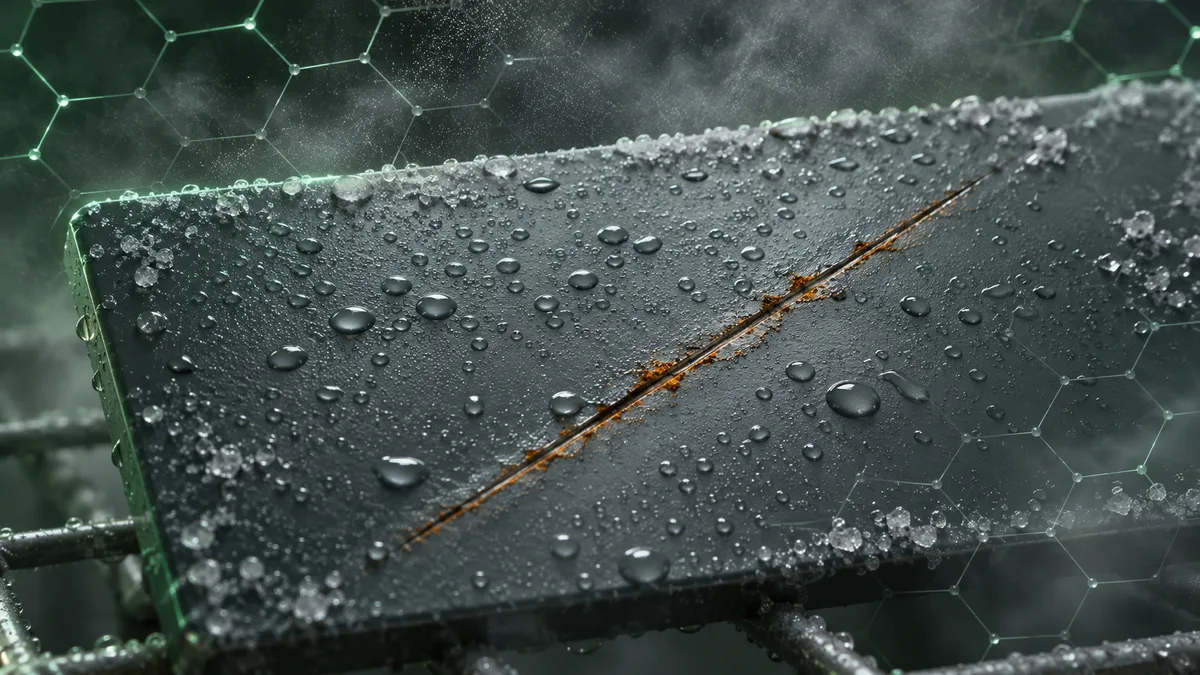
AI-generated cover illustration. The original experiment photographs appear below.
A diagonal scratch tells much of the story. In photos supplied for this article and attributed to a Russian company TGW led by Маrk Gorskij. Team used graphene developed in house. Two coated metal panels labeled 0.58% and 0.5% graphene show less obvious damage away from the scratch than several neighboring samples after a reported 240-hour salt-fog exposure. Rust-colored marks remain visible along the scratches. The company name and original test report could not be independently verified.
How the team accelerated corrosion
The photographs show square coated coupons, including panels numbered by hand, resting at an angle on racks inside a clear-fronted enclosure. Each coupon on the results board has a diagonal line consistent with a deliberate scribe. A scribe is typically used to test how far corrosion spreads from a break in the coating. The images do not establish the scribe depth or whether it reached bare metal on every coupon.
The board reads “240 hours, 5% salt fog,” with a handwritten temperature range that appears to read 28–36 °C. A note beside the lighter series appears to identify the base paint as ПФ-115, transliterated PF-115. Manufacturer literature describes PF-115 as an enamel used over prepared, primed surfaces, but it does not identify the product supplier or prove that the same preparation was used in this experiment. PF-115 manufacturer instructions.
Serious about B2B integration? Test our premium Pulsed Electrical Resistive Carbon Heating turbostratic graphene in your lab. 100g sample packs available now.
Explore More
New research on flexural phonon renormalization reveals how graphene's unique blend of stiffness and flexibility changes our core models for heat and energy...
Explore how rhombohedral graphene, a unique form of carbon, could host Majorana crystals, a theoretical breakthrough for fault-tolerant topological quantum...
New theoretical research reveals how resonant field emission from noble-metal/graphene heterostructures could create a quantum shortcut for electrons...