
Graphene Sensors and a New Method for Dark Matter Detection
Researchers propose a new method for dark matter detection using angular scanning, a technique that may rely on graphene's unique electronic sensitivity.
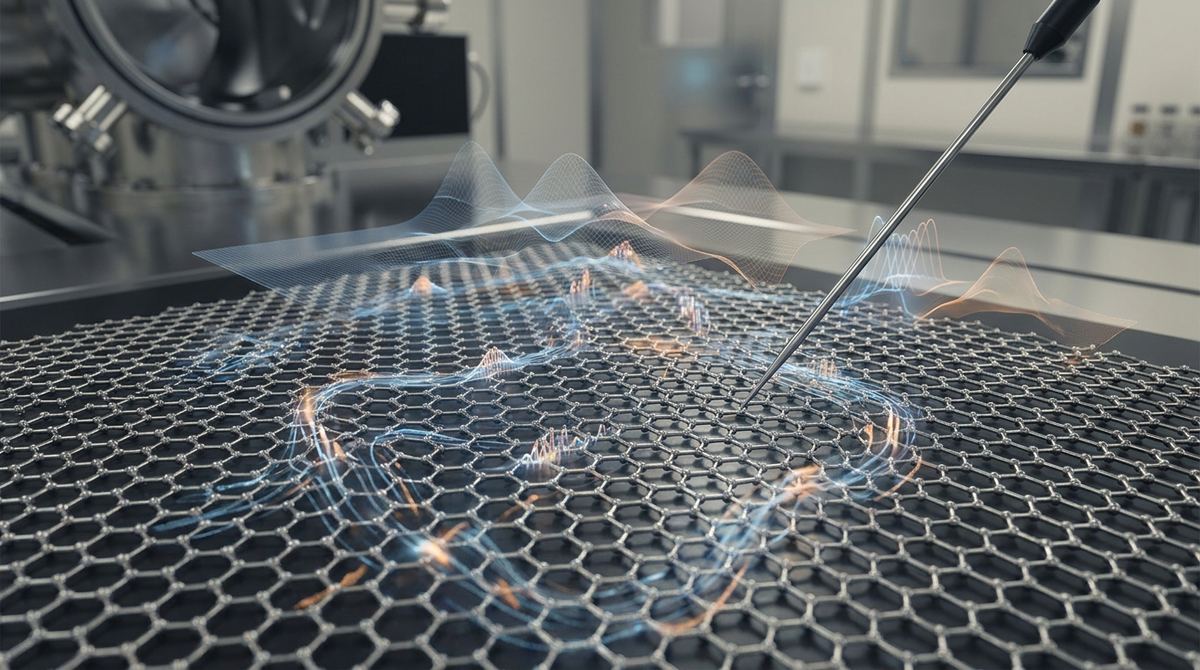
Imagine trying to design a new Formula 1 car. You wouldn't just start welding metal together; you would first use sophisticated computer simulations to model the airflow, engine performance, and structural integrity. These digital tools allow engineers to test thousands of ideas virtually, saving immense time and money before building a single physical prototype. In the world of nanoelectronics, where the components are atoms thick and the "race cars" are electrons, the need for accurate simulations is even more critical. Graphene, with its extraordinary electronic properties, promises a new generation of ultra-fast, ultra-efficient devices. But to unlock this potential, we need a digital wind tunnel that can precisely predict how electrons behave inside it. This is the challenge that new foundational research in computational physics is built to address.
Designing advanced graphene electronics is hampered by a significant challenge: accurately simulating the complex world electrons inhabit. Electrons in graphene don't just move in a straight line; they are constantly interacting with their environment and, crucially, with each other. This electron-electron (e-e) scattering is a chaotic, many-body problem that dictates many of the material's most important properties, from how it handles heat to how it responds to light. Furthermore, electrons are governed by the strict rules of quantum mechanics, most notably the Pauli Exclusion Principle, which states that no two electrons can occupy the same quantum state. It’s like a theater with assigned seating; you can't sell two tickets for the same seat.
Traditional simulation methods, like the Ensemble Monte Carlo (EMC) technique, have struggled to incorporate these two factors—complex e-e scattering and the Pauli principle—simultaneously and efficiently. Implementing the Pauli principle often requires computationally expensive rejection techniques. This is like an usher having to manually check every single seat for every person entering the theater, slowing everything down. This process introduces significant statistical "noise," or randomness, into the simulation results. Overcoming this noise requires enormous computational power and time, making the simulations impractical for many engineering applications. In their recent work, "Low-noise Pauli-consistent ensemble Monte Carlo for graphene with electron-electron scattering," researchers Tigran Zalinyan and Giovanni Nastasi have developed a new method to solve this very problem, creating a more elegant, efficient, and accurate simulation tool.
The core innovation presented by the researchers is a new, mathematically sophisticated algorithm that builds the Pauli Exclusion Principle directly into the simulation's framework from the ground up. Instead of treating it as an afterthought that requires constant, clumsy checks, their method re-formulates the probabilities of electron scattering in a way that inherently respects the rule. To return to the theater analogy, their method is less like a frantic usher and more like a smart, centralized ticketing system that knows which seats are available and only offers those to begin with. The double-booking problem is solved before it can even happen.
This "Pauli-consistent" approach dramatically reduces the computational overhead and, most importantly, the statistical noise that plagued previous methods. A low-noise simulation provides a much clearer picture of the underlying physics. It means that engineers can obtain reliable, high-fidelity results with significantly less computational effort. They can see the subtle effects of electron-electron interactions without the "static" of numerical errors, allowing for more precise predictions of device performance. The method essentially upgrades the digital microscope for observing electron behavior in graphene from a blurry, standard-definition camera to a crystal-clear, high-definition one.
The research does not describe a physical graphene device but rather the computational engine used to design one. The system in question is an Ensemble Monte Carlo simulation specifically tailored for graphene. An EMC simulation is a powerful technique that models the collective behavior of charge carriers—electrons and their counterparts, holes—inside a semiconductor material. Instead of tracking every single electron, which would be computationally impossible, it simulates a large "ensemble" of representative "super-particles," each representing a cloud of real electrons.
The simulation progresses in discrete time steps. At each step, the algorithm calculates the probability that a particle will "scatter." Scattering is any event that changes an electron's trajectory or energy. This can be a collision with an impurity in the graphene lattice, an interaction with a lattice vibration (a phonon), or a collision with another electron. The new algorithm focuses on refining the model for this last type: electron-electron scattering. It uses a sophisticated treatment of the forces between electrons, accounting for how the presence of other electrons "screens," or dampens, the interaction.
Crucially, when an electron scatters to a new energy state, the algorithm must ensure that state is not already occupied. The innovation from Zalinyan and Nastasi lies in how this check is performed. Their method integrates the occupancy information of all possible final states directly into the calculation of the scattering probability. This ensures that every simulated event is automatically consistent with the Pauli principle, eliminating the need for the inefficient rejection steps that cause noise. This allows the simulation to accurately capture phenomena that are heavily dependent on electron-electron interactions, such as how a population of "hot" (high-energy) electrons cools down or how a single high-energy photon can excite multiple electrons, a process vital for photodetectors.
The authors demonstrated that their new algorithm is both robust and efficient. By running simulations of electron transport in graphene under various conditions, they confirmed that their method produces physically accurate results with a significantly improved signal-to-noise ratio compared to conventional techniques. They were able to model complex, many-body phenomena like carrier thermalization and carrier multiplication with high fidelity.
Carrier thermalization is the process by which electrons, after being excited by an external source like a laser pulse, redistribute their energy among themselves through collisions until they reach a stable temperature distribution. Accurate modeling of this process is key to understanding the speed limits of graphene-based switches and photodetectors. Carrier multiplication is a process where one high-energy electron collides with the lattice and creates one or more additional electron-hole pairs. This effect is highly desirable for increasing the efficiency of solar cells and photodetectors. The researchers showed that their low-noise simulation could clearly resolve these effects, which are often obscured by numerical noise in other models. The result is a computational tool that is not only faster but provides more trustworthy insights into the fundamental physics governing future graphene electronics.
The development of a better simulation tool is not merely an academic achievement; it is a critical enabler for technological progress. This low-noise, Pauli-consistent EMC method provides engineers and scientists with a more powerful and reliable virtual laboratory. With this tool, they can explore the performance of novel graphene device architectures before committing to costly and time-consuming fabrication processes.
For example, engineers designing a high-frequency transistor can use this simulation to understand how electron-electron scattering limits the device's maximum operating speed. They can test how changing the graphene's doping level or the device's geometry affects performance, iterating through dozens of designs in the time it would take to build one physical prototype. This accelerates the research and development cycle, reducing the time from concept to commercial product. It also allows for a deeper understanding of the fundamental physics, potentially revealing new ways to engineer graphene's properties for specific graphene applications. Ultimately, better simulation tools lead to better real-world devices, from more sensitive sensors to faster communication systems.
As a work focused on mathematical physics, this research presents a powerful theoretical framework. However, like any simulation, it is an approximation of reality. The current model, while highly advanced, may not yet incorporate every possible physical effect. For instance, interactions with the substrate on which the graphene is placed, the influence of specific types of atomic defects, or complex quantum tunneling effects in ultra-small devices are areas that may require further refinement and inclusion in the model.
The most important next step is rigorous validation against experimental data. The predictions made by the simulation—such as the timescale for electron cooling or the efficiency of carrier multiplication—must be compared with measurements from real, physical graphene devices. This comparison is a crucial feedback loop; disagreements between simulation and experiment can reveal missing physics in the model or new phenomena in the material, driving both theoretical and experimental research forward. While the algorithm is more efficient, large-scale simulations of full, complex devices will still demand significant computational resources, and further optimization will be needed to make it a routine desktop tool for all engineers.
The practical implications of this advanced simulation capability are broad and directly impact the commercialization of graphene. The ability to accurately model electron-electron scattering is not a niche requirement; it is central to a host of next-generation technologies.
In high-frequency electronics, this tool can accelerate the design of terahertz (THz) modulators, receivers, and emitters, which are essential for future 6G wireless communications and advanced security screening. In optoelectronics, it can be used to optimize the design of highly sensitive graphene photodetectors for imaging and data communication, as well as to improve the efficiency of graphene-based light-emitting devices.
Furthermore, as electronic components become smaller and more densely packed, managing heat becomes a primary concern. Electron-electron scattering is a key mechanism of heat generation and transport. This simulation can provide critical insights into thermal management in graphene interconnects and transistors, helping to design more reliable and powerful computer chips. Finally, the performance of many graphene sensors relies on subtle changes in electronic properties. A highly accurate simulation allows for the design of sensors with unprecedented sensitivity and selectivity.
If you take away just one idea from this research, it should be this: a breakthrough has been made in how we can digitally simulate the behavior of electrons in graphene. By creating a more accurate and efficient computational tool that correctly handles the complex rules of quantum mechanics, this work provides engineers with a better "virtual wind tunnel" to design and test the high-performance graphene electronics of the future, significantly accelerating the pace of innovation.
What is a Monte Carlo simulation?
A Monte Carlo simulation is a computational technique that uses randomness to solve problems that might be deterministic in principle. Think of it like trying to estimate the area of a complex shape drawn inside a square. You can randomly throw thousands of darts at the square; the ratio of darts that land inside the shape to the total number of darts thrown gives you a good approximation of the shape's area. In electronics, it is used to simulate the random-walk-like paths of billions of electrons by modeling a representative sample.
What is the Pauli Exclusion Principle and why does it matter here?
The Pauli Exclusion Principle is a fundamental rule of quantum mechanics that states two identical particles like electrons cannot occupy the same quantum state at the same time. It's like having assigned seating in a concert hall—no two people can have a ticket for the exact same seat. For simulations, this is critical because it governs how electrons fill available energy levels, which in turn determines the material's electronic and optical properties. An inaccurate handling of this principle leads to incorrect results.
What is electron-electron scattering?
Electron-electron scattering refers to the process where two electrons collide and exchange energy and momentum, much like billiard balls striking each other. This interaction is the dominant scattering mechanism in pristine graphene and is crucial for understanding how electrons lose energy, how heat is generated, and how the overall electron population responds to an electric field or light.
Is this a new graphene product?
No, this research does not present a new physical product made of graphene. It presents a new and improved software tool, a simulation method. Think of it as a much more advanced version of CAD software specifically designed for engineers who are developing new graphene-based electronic components. Better design tools are a critical prerequisite for creating better physical products.
How does this help build better graphene devices?
This research helps build better devices by making the virtual design and testing process more accurate and efficient. Engineers can use this simulation to predict how a new transistor design will behave before they ever build it. This allows them to quickly identify promising designs and discard flawed ones, saving tremendous amounts of time, effort, and money that would otherwise be spent on physical prototyping and testing.
The path from a promising new material like graphene to its widespread use in commercial technology is paved with engineering challenges. Overcoming these challenges requires not only advances in material synthesis and device fabrication but also in the theoretical tools we use to understand and design with the material. The low-noise, Pauli-consistent Ensemble Monte Carlo method developed by Tigran Zalinyan and Giovanni Nastasi represents a significant step forward in this domain. By providing a clearer, more efficient, and more accurate window into the complex world of electron dynamics in graphene, their work equips scientists and engineers with the computational power needed to accelerate innovation. It is a foundational development that will help unlock the remarkable potential of graphene for the next generation of electronics, photonics, and sensor technologies.
Serious about B2B integration? Test our premium Pulsed Electrical Resistive Carbon Heating turbostratic graphene in your lab. 100g sample packs available now.
Explore More
Researchers propose a new method for dark matter detection using angular scanning, a technique that may rely on graphene's unique electronic sensitivity.

Build a flexible graphene battery sensor for real-time temperature and strain monitoring, a crucial step toward preventing thermal runaway in Li-ion cells.

Research on 30° quasi-periodic twisted bilayer graphene reveals a unique, fractal-like energy structure under magnetic fields, paving the way for novel...