
Graphene’s Ultimate Speed Limit: The Boron Nitride Casing Is the Bottleneck
In BN-encapsulated graphene, the ultimate limit on electron speed is not graphene itself, but remote phonon scattering from the insulating layers that...
The quest for a material that can conduct electricity with zero resistance at room temperature has been one of the most enduring challenges in modern physics. For decades, scientists have chased the dream of superconductivity, a phenomenon that could transform everything from the way we transport electricity across continents to how we build ultra-fast quantum computers. While we have found superconductors in various materials, they often require extreme cold or crushing pressures to function. Carbon, the element that forms the backbone of life and the incredibly strong material known as graphene, offers a fascinating new frontier for this search. Recent theoretical breakthroughs suggest that by manipulating the architecture of carbon networks, we might find a way to silence the magnetic forces that usually prevent superconductivity from occurring.
In the pursuit of superconductivity, researchers face a fundamental conflict between two quantum states: superconductivity and magnetism. To understand this, we have to look at how electrons behave. In a superconductor, electrons pair up to form what are known as Cooper pairs. These pairs move through a material in a coordinated, fluid-like manner that avoids the collisions that cause electrical resistance. However, magnetism is the natural enemy of these pairs. Magnetism relies on the alignment of electron spins, whereas superconductivity requires electrons to pair up with opposite spins, essentially canceling out their magnetic tendencies.
In many carbon-based materials, the very thing that makes them promising for superconductivity—a high density of states—is also what makes them problematic. The density of states, or DOS, refers to the number of available energy levels for electrons to occupy at a specific energy level called the Fermi level. A high DOS at the Fermi level is essentially a crowded room of electrons ready to participate in superconductivity. However, when the electron density is this high, the electrons often find it energetically favorable to align their spins, creating magnetism. This magnetic order disrupts the formation of Cooper pairs, effectively shutting down the superconductivity before it can even begin. The core problem, therefore, is how to maintain a high density of states while suppressing the magnetic order that arises from those same electrons.
The solution proposed in recent computational models involves a process called hole-doping. To understand hole-doping, imagine a crowded room where everyone is trying to dance in a specific, coordinated way (superconductivity), but some people are also trying to stand in a rigid, unmoving line (magnetism). If the room is too crowded, the line becomes too strong to break. Hole-doping is like strategically removing a few people from the room. By removing some of the electrons, you create "holes," which act like positive charges. This reduction in electron density can break the rigid magnetic line without significantly reducing the number of people available to dance. By carefully tuning the amount of "holes" in the material, researchers hope to find a "sweet spot" where the magnetism is weakened enough to disappear, but the density of states remains high enough to support superconductivity.
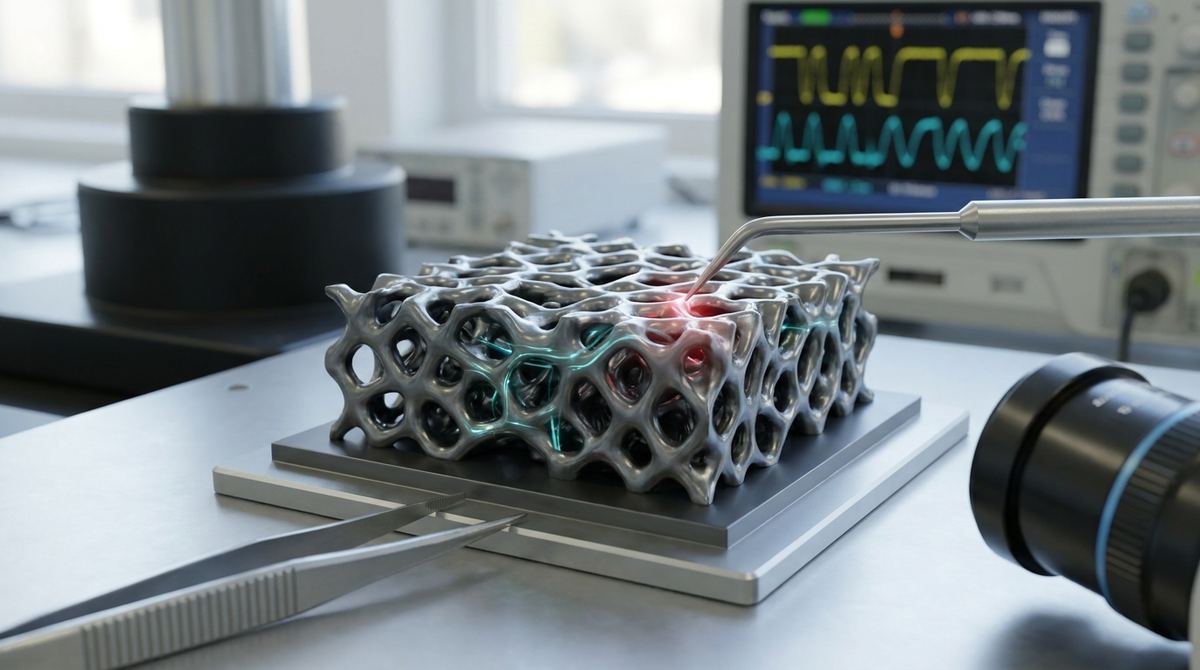
The material at the center of this research is C136 carbon Schwarzite. To appreciate why this material is special, we must distinguish it from the more famous graphene. Graphene is a two-dimensional sheet of carbon atoms arranged in a flat, hexagonal lattice. Because it is flat, it follows the rules of Euclidean geometry. Schwarzite, however, is a three-dimensional network that features negative curvature. This is known as hyperbolic geometry. Instead of being flat, the surface curves away from itself in all directions, much like the surface of a saddle or a piece of coral.
This negative curvature is achieved by incorporating rings of different sizes into the carbon network. While graphene relies exclusively on six-membered hexagonal rings, Schwarzite architectures incorporate seven-membered or even larger rings. These non-hexagonal rings force the carbon lattice to bend and twist, creating a sponge-like, porous structure. This unique geometry is the engine behind its electronic properties. The curvature and the complex connectivity of the rings create unique electronic pathways and, most importantly, a high density of states at the Fermi level. The complex topology of the Schwarzite lattice allows for a significant number of electronic states to cluster at the energy levels necessary for superconductivity, making it a prime candidate for further investigation.
Through the computational analysis performed by Eugene Yashin, a new roadmap for creating superconductors has emerged. Using advanced modeling techniques to simulate the quantum behavior of carbon atoms, the study focused specifically on the C136 Schwarzite structure. The research aimed to determine how the electronic landscape of this material shifts when the electron count is modified through hole-doping.
The findings were significant. The simulation revealed that the C136 structure possesses a very high density of states, which is a prerequisite for high-temperature superconductivity. However, the study also confirmed that in its natural state, this high density of states triggers competing magnetism that would prevent superconductivity. The breakthrough came when the model applied hole-doping. The results showed that by removing a specific amount of electronic charge, the magnetic order was effectively suppressed. Crucially, the research demonstrated that this suppression could happen without drastically lowering the density of states. This suggests that there is a specific window of doping where the magnetic interference is neutralized, leaving the high density of states available to drive superconductivity. This provides a theoretical blueprint for how researchers might approach the synthesis of such a material in a laboratory setting.
This research is vital because it provides a computational shortcut to discovering new materials. Historically, finding a new superconductor was a process of trial and error, involving the physical synthesis and testing of thousands of different chemical combinations. By using computational modeling to identify the exact "doping" levels needed to stabilize a superconducting state, scientists can skip years of wasted laboratory effort.
Furthermore, the reliance on carbon is a significant advantage. Carbon is one of the most abundant and versatile elements in the universe. If we can learn to manipulate carbon architectures like Schwarzite to achieve superconductivity, we are working with a material that is potentially cheaper and easier to source than the rare-earth metals often required for high-performance electronics. This could democratize the production of superconducting technologies, making them more accessible for large-scale infrastructure projects.
While these findings are exciting, it is important to distinguish between a computational prediction and a physical reality. This research is a theoretical route, meaning it was conducted in a digital environment using mathematical models. It is not a demonstration of a physical material that has been manufactured and tested in a lab.
There are several significant hurdles that remain. First, the synthesis of C136 Schwarzite is incredibly complex. Creating a perfectly ordered, three-dimensional network with specific negative curvature and precise hole-doping levels is a massive engineering challenge. Second, the stability of these networks must be tested. It is one thing to model a structure on a computer; it is another to ensure that the material remains stable and does not collapse or react with its environment when actually produced. Finally, the actual transition temperature (the temperature at which superconductivity occurs) is not yet determined for this specific doped system. While the theory suggests it could be high, it remains to be seen through physical experimentation.
If the theoretical roadmap provided by this research can be translated into a physical reality, the implications for technology are staggering. The most immediate application would be in energy distribution. Current power grids lose a substantial percentage of electricity to heat due to the resistance in copper and aluminum wires. A network of superconducting carbon cables would allow for the transmission of electricity over massive distances with nearly zero loss, drastically increasing the efficiency of renewable energy grids.
Beyond energy, superconductivity is critical for medical imaging. Technologies like MRI machines rely on superconducting magnets to create the intense and stable magnetic fields required for high-resolution imaging. A more accessible carbon-based superconductor could lead to smaller, more affordable, and more powerful medical imaging devices. Furthermore, in the emerging field of quantum computing, the ability to create stable, low-loss electronic components is essential. The precise control offered by doped carbon networks could provide the hardware foundation for the next generation of quantum processors.
If you remember only one thing from this research, let it be this: the geometry of a material is just as important as its chemistry. By designing carbon structures with negative curvature, like Schwarzite, and using hole-doping to silence competing magnetism, we have found a theoretical way to unlock the power of superconductivity in an abundant element like carbon.
Question: What exactly is a "hole" in this context?
Answer: In the context of materials science and electronics, a hole is not a physical object but rather a vacancy left behind when an electron is removed from a crystal lattice. These holes act as positive charge carriers. When we talk about hole-doping, we mean adding these positive carriers to the material to change how electrons move and how they interact with one another.
Question: Why does the shape of the carbon matter so much?
Answer: The shape, or topology, of the carbon network dictates how the electron energy levels are distributed. In flat graphene, the electrons move in a predictable, two-dimensional way. In a curved Schwarzite structure, the non-hexagonal rings create a complex, three-dimensional environment that significantly boosts the density of states, which is a key ingredient for superconductivity.
Question: Why does magnetism stop superconductivity?
Answer: Superconductivity requires electrons to form "Cooper pairs" where they move in a synchronized fashion with opposite spins. Magnetism, however, tries to force all the electron spins to point in the same direction. This magnetic alignment breaks the pairs apart, making it impossible for the material to conduct electricity without resistance.
Question: Is this research saying we will have room-temperature superconductors soon?
Answer: Not exactly. This research is a computational discovery that identifies a potential path. It shows that it is mathematically possible to achieve the right conditions for superconductivity in a specific carbon structure. However, there is still much work to do in the laboratory to actually create these materials and verify that they work as predicted.
Question: What is the difference between a simulation and an experiment?
Answer: A simulation, like the one conducted by Eugene Yashin, uses mathematical equations and computer processing to predict how atoms and electrons will behave under certain conditions. An experiment is the physical process of actually building the material in a laboratory and measuring its properties with real-world sensors. Simulations are much faster and cheaper, but experiments are necessary to prove the simulation was correct.
The intersection of geometry and quantum mechanics is revealing new possibilities for the future of materials science. By looking at carbon through the lens of negative curvature and applying the precision of hole-doping, researchers are carving out a new way to bypass the natural magnetic tendencies of high-density electron systems. While the path from a computational model to a commercially available superconducting cable is long and filled with engineering challenges, the theoretical foundation laid by this work provides a vital guiding light for the next generation of materials discovery.
Serious about B2B integration? Test our premium Pulsed Electrical Resistive Carbon Heating turbostratic graphene in your lab. 100g sample packs available now.
Explore More
In BN-encapsulated graphene, the ultimate limit on electron speed is not graphene itself, but remote phonon scattering from the insulating layers that...

Determinant Monte Carlo simulations are key to materials science but fail at low temperatures. New research offers a stable algorithm, enabling accurate...

Researchers developed coupled dynamical Boltzmann transport equations that include long-range interactions, creating a more accurate model for electron...