
Deconstructing Superfluid Weight in Magic-Angle Graphene: The Geometric Key
Explore how the superfluid weight in magic-angle graphene is driven by quantum geometry, a discovery that could redefine our search for new superconductors.
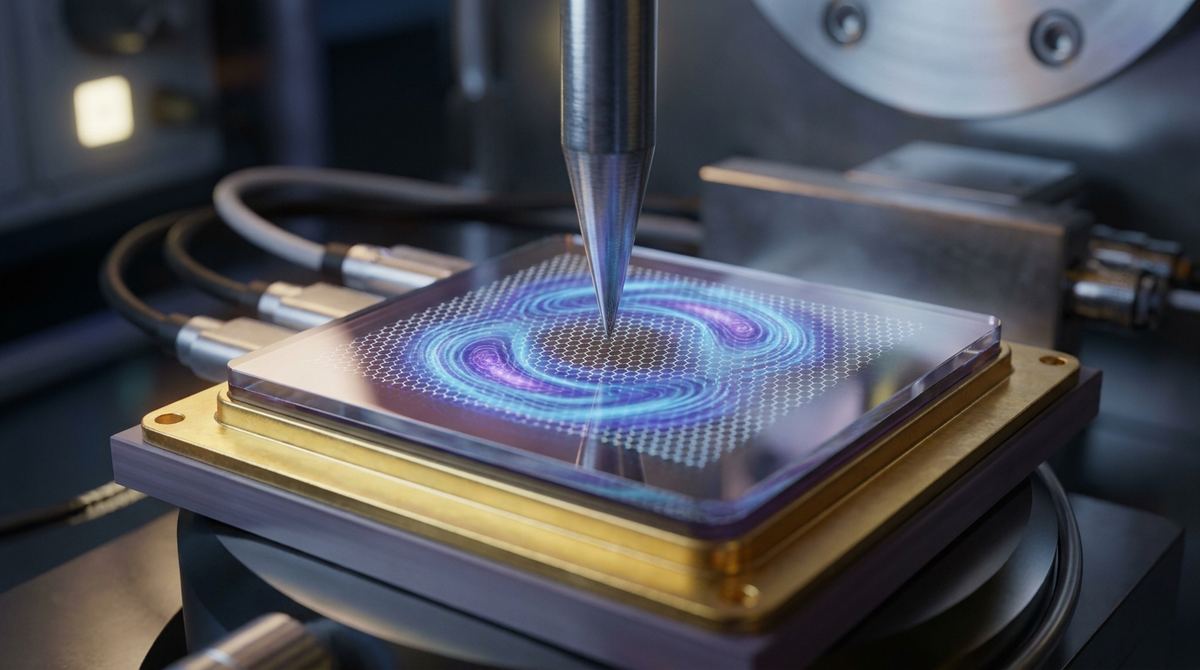
The recent discovery of trans-moiré orbitals in rhombohedral graphene/hBN superlattices provides a critical breakthrough for the development of topological quantum simulators. For specialized quantum materials startups and nano-fabrication labs, the practical application of this research is the construction of a device platform capable of demonstrating the Fractional Quantum Anomalous Hall Effect (FQAHE).
Unlike standard Hall effect devices that require massive external magnetic fields, FQAHE-based devices utilize the internal topology of the material to create quantized conductance plateaus. This makes them ideal for studying fractional Chern insulators and developing the foundations for fault-tolerant topological quantum computation. The engineering challenge lies in the precise control of the twist angle and the management of the electronic density, which the research shows is concentrated in "hollow-cage" trans-moiré orbitals located away from the physical twist interface.
To build a prototype for observing these trans-moiré orbitals and the resulting FQAHE, the following materials and equipment are required. Note that the precision required for these materials is at the limits of current commercial availability.
1. High-quality Hexalayer Rhombohedral Graphene: The research specifically identifies hexalayer (6-layer) graphene as the medium. The stacking must be rhombohedral, not Bernal, which requires extremely controlled growth or post-growth stacking.
2. Hexagonal Boron Nitride (hBN): High-purity, monolayer or few-layer hBN is required to create the moiré superlattice. hBN acts as both the structural template and the insulating encapsulation layer.
3. Substrate: A standard Silicon/Silicon Dioxide (SiO2/Si) substrate or a sapphire substrate, depending on the desired thermal properties.
4. Contact Metals: Gold (Au) or Palladium (Pd) for electrical contacts, depending on the required work function for the specific doping levels.
5. Fabrication Tools: An Electron-Beam Lithography (EBL) system for defining fine-pitch electrodes and a dry-transfer station (such as a PDMS-based pick-up tool) for heterostructure assembly.
6. Characterization Tools: A Scanning Tunneling Microscope (STM) with ultra-low temperature capabilities (mK range) and a Dilution Refrigerator for transport measurements.
Building a device that exploits trans-moiré orbitals requires extreme precision in the stacking process to ensure the twist angle remains below the critical threshold identified in the research.
1. Substrate Preparation: Clean the SiO2/Si substrate using standard RCA cleaning or oxygen plasma treatment to ensure no organic contaminants remain, which could interfere with the moiré periodicity.
2. Heterostructure Assembly (The Tear-and-Stack Method):
- Use a polycarbonate-based pick-up method to lift a thin layer of hBN.
- Place the hBN onto the substrate.
- Pick up the hexalayer rhombohedral graphene. This is the most critical step. The graphene must be rotated at a very small angle (theta) relative to the hBN layer.
- Based on the research, the twist angle must be significantly less than 1 degree. For a prototype, a target angle of 0.3 to 0.5 degrees is recommended to ensure the trans-moiré orbitals are robustly formed.
- Pick up a final layer of hBN to encapsulate the graphene, protecting it from environmental degradation.
3. Electrode Patterning:
- Use Electron-Beam Lithography to define the contact areas.
- Deposit the contact metal (Au/Pd) via thermal evaporation or electron-beam evaporation.
- Use reactive ion etching (RIE) to define the edges of the graphene channels if necessary, though encapsulation usually requires careful etching of the top hBN layer first.
4. Environmental Integration: The device must be transferred to a dilution refrigerator. The research indicates that these topological states are sensitive to thermal fluctuations and require temperatures in the millikelvin (mK) range to observe the FQAHE plateaus.
The validation process must confirm both the structural moiré periodicity and the electronic signature of the trans-moiré orbitals.
1. Moiré Periodicity Verification: Use Scanning Tunneling Microscopy (STM) to map the surface of the device. The goal is to confirm the presence of the moiré superlattice. The periodicity should match the theoretical values for the chosen twist angle.
2. Orbital Mapping via STS: Use Scanning Tunneling Spectroscopy (STS) to map the local density of states (LDOS). The engineer should look for the "hollow-cage" shape of the trans-moiré orbitals. This is a key diagnostic; the electronic density should not be centered at the twist interface but should appear as a distinct, spatially separated orbital structure.
3. Transport Measurement: Perform low-temperature transport measurements to identify the Fractional Quantum Anomalous Hall Effect. Look for quantized resistance plateaus in the Hall resistance (Rxy) at specific fractional fillings.
4. Angle Sensitivity Test: To validate the device's sensitivity, perform a series of measurements while slightly varying the gate voltage to simulate different doping levels. Note that if the twist angle exceeds 1 degree, the topological states are expected to vanish.
Building this prototype involves several high-stakes engineering assumptions and risks.
1. Twist Angle Sensitivity: The most significant risk is the "theta threshold." The research states that trans-moiré orbitals and QAHE plateaus vanish when the twist angle theta is greater than or equal to 1 degree. In a practical lab setting, maintaining a consistent angle below 1 degree across a large sample area is extremely difficult. A failure to maintain this angle will result in a non-topological device.
2. Interfacial Contamination: Even a single layer of trapped hydrocarbons between the graphene and hBN can destroy the moiré potential. The "tear-and-stack" method must be performed in a controlled environment (like a glovebox) to mitigate this.
3. Layer Thickness and Stacking Order: The research focuses on hexalayer (6-layer) graphene. It is an engineering assumption that the rhombohedral stacking order is maintained throughout the entire thickness of the layer. Any deviation into Bernal stacking will fundamentally change the electronic structure and eliminate the trans-moiré effect.
4. Thermal Management: It is assumed that the heat load from the measurement leads will not raise the electron temperature above the mK range. Proper filtering of electrical lines is mandatory to prevent thermal noise from washing out the fragile FQAHE states.
5. Spatial Location of Orbitals: The research notes that the orbitals emerge on the side of the interface distant from the twist. This means that for STM-based testing, the probe must be able to access the top surface of the stack without destroying the delicate moiré structure.
Serious about B2B integration? Test our premium Pulsed Electrical Resistive Carbon Heating turbostratic graphene in your lab. 100g sample packs available now.
Explore More
Explore how the superfluid weight in magic-angle graphene is driven by quantum geometry, a discovery that could redefine our search for new superconductors.

This guide details building a prototype quantum device with twisted rhombohedral multilayer graphene, a platform for topological quantum computing.

Researchers have directly observed Néel vector switching in a single-layer antiferromagnet, Cr2S3, at the atomic scale, a breakthrough for future spintronic...