
Graphene Unlocks a “Fast Lane” for Energy Transfer in 2D Materials
New research reveals that graphene can accept energy from a 2D semiconductor in a highly selective, momentum-dependent way, paving the path for next-gen...
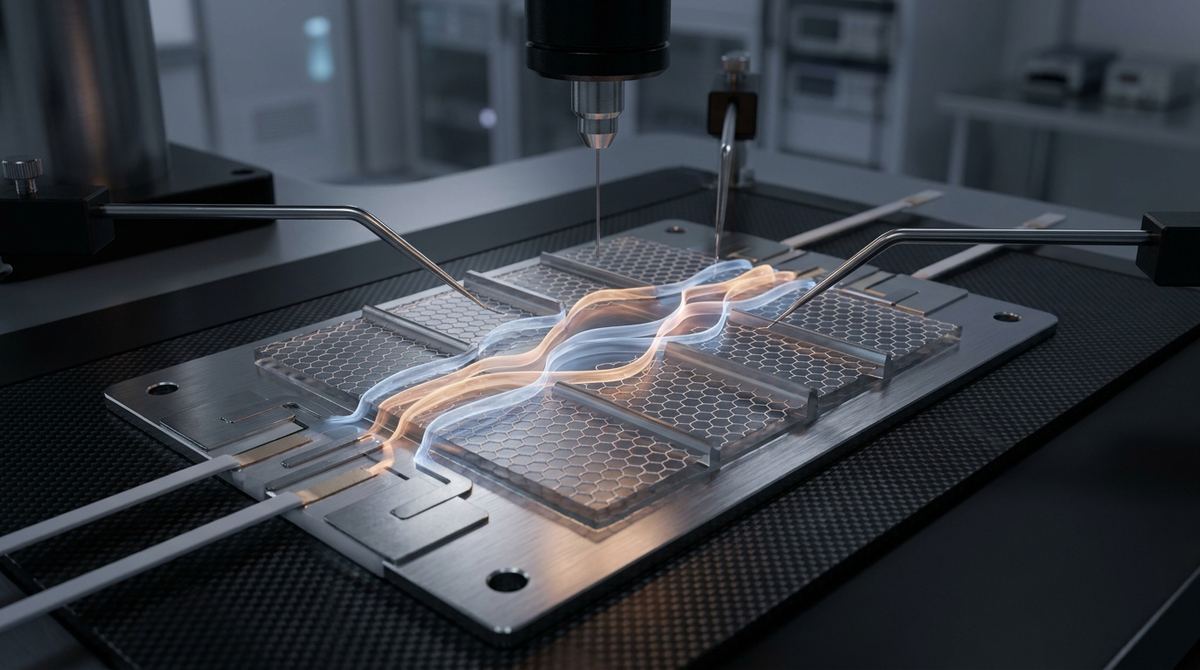
Imagine a crowded, high-stakes ballroom where every single dancer is physically linked to their neighbors by invisible, unbreakable threads. If one dancer takes a sudden step to the left, the entire crowd must adjust their movement in a coordinated, sweeping motion to maintain the balance of the dance. This is not a metaphor for social behavior, but a fundamental reality of how electrons behave in certain advanced materials. In the world of traditional electronics, we treat electrons like a gas of independent particles, bouncing around without much regard for what their neighbors are doing. However, as we push into the realm of quantum computing and ultra-small transistors, we encounter a different phenomenon: correlated electrons. In these systems, electrons are so tightly linked by their electrical repulsion that they act as a single, collective entity. The ability to control this collective motion is the holy grail of modern condensed matter physics, and a recent study suggests we might finally have a way to orchestrate this quantum dance with unprecedented precision.
The primary challenge in modern condensed matter physics lies in the breakdown of the independent particle model. In standard silicon-based semiconductors, we assume that electrons move through the crystal lattice as individual agents. This assumption works well for the devices that power our current laptops and smartphones. However, as we attempt to engineer materials at the atomic scale, the electrostatic forces between electrons—known as Coulomb repulsion—become dominant. When electrons are forced into close proximity, their movements become "correlated." This means the state of one electron is a function of the states of all others nearby.
This correlation introduces an immense level of complexity. In a standard system, calculating the behavior of a few electrons is manageable, but as the number of particles increases, the number of possible interactions grows exponentially. This is often referred to as the many-body problem. For engineers, this complexity translates to instability. In quantum computing, the very thing that makes correlated electrons useful—their interconnectedness—also makes them incredibly fragile. A single disturbance can cause a "decoherence" event, where the synchronized quantum state collapses into a chaotic, non-functional mess. If we cannot control how these correlated electrons expand or move through a material, we cannot build stable quantum processors or predict the behavior of new, exotic states of matter like unconventional superconductors.
The research explores a concept known as controlled expansion via concentrated kinematics. To understand this, we must look at how a group of particles spreads out over time. When a group of correlated electrons is suddenly disturbed, they tend to spread across the material, a process known as quantum expansion. Usually, this expansion is chaotic or follows a predictable, uncontrolled spread that leads to the loss of the information stored in the quantum state.
The breakthrough idea presented by Pavel A Nosov, Eslam Khalaf, and Patrick Ledwith is that we can govern this expansion by manipulating the "kinematics" of the system. In physics, kinematics refers to the geometry of motion—the study of how things move without necessarily looking at the forces that caused them. "Concentrated kinematics" suggests a method of restricting the available paths or momentum states that these electrons can occupy. By narrowing down the ways these electrons are allowed to move through the lattice, the researchers suggest we can direct the expansion of the electron wave function. Instead of a chaotic explosion of movement, the expansion becomes a controlled, orchestrated flow. This turns a source of noise and instability into a tunable parameter that can be precisely managed.
To achieve this level of control, researchers often turn to two-dimensional materials like graphene or other van der Waals heterostructures. These materials provide a nearly perfect, periodic lattice that acts as a playground for electrons. In a graphene-based system, the atoms are arranged in a hexagonal pattern, creating a specific landscape of electrical potential. The geometry of this lattice dictates the "dispersion relation," which is essentially a rulebook that tells an electron how much energy it has relative to its momentum.
When electrons are in a strongly correlated state within this lattice, their movement is restricted by both the physical atoms and the presence of other electrons. The research focuses on how the specific arrangement of these energy states—the kinematics—can be tuned. By adjusting the lattice structure or applying external fields, scientists can create "concentrated" regions in momentum space. This means they can force the electrons to interact primarily within a very specific set of movement patterns. When the electrons are forced to follow these restricted kinematic rules, the way their collective wave function expands is no longer a matter of chance. The lattice structure acts like a guide rail, ensuring that as the electrons attempt to spread out, they do so in a way that preserves the underlying correlation. This structural control over the electron's momentum is what allows for the transition from chaotic movement to controlled expansion.
The study provides a theoretical framework for understanding how the movement of many-body systems can be steered. The core finding is that by manipulating the kinematic constraints of the electron system, one can effectively control the rate and the pattern of quantum expansion. This is a significant departure from previous models where expansion was often treated as an inevitable consequence of many-body interactions.
The researchers demonstrated that the "concentration" of kinematics allows for a state where the electron correlation is preserved even as the particles move through the lattice. This is vital because, typically, expansion leads to a dilution of the interaction strength between electrons. If the electrons spread out too quickly or too randomly, they lose their collective identity and revert to behaving like independent particles. However, by using concentrated kinematics, the system can maintain its correlated nature over a longer period and across a larger physical area. This suggests that the "quantumness" of a material—its ability to exhibit complex, collective behaviors—is not just a matter of how strong the interactions are, but how the movement of the particles is geometrically and kinematically constrained.
The implications of being able to control the expansion of correlated electrons are profound. First, it offers a potential solution to the decoherence problem in quantum information science. If we can control how electron wave functions expand, we can better protect the quantum information stored in those states, making quantum computers much more robust against environmental noise.
Secondly, this research provides a new lens through which to view the development of new materials. Many of the most sought-after materials in modern science, such as high-temperature superconductors, exist because of strong electron correlations. Currently, we often discover these materials by accident through trial and error. The ability to mathematically model and engineer "concentrated kinematics" gives scientists a blueprint to design materials with specific, desired expansion properties. This could lead to the creation of materials that can carry electricity with zero resistance at much higher temperatures or materials that can act as ultra-sensitive sensors by responding to minute changes in their kinematic state.
While the theoretical groundwork laid by Nosov, Khalaf, and Ledwith is a significant step forward, several hurdles remain before this can move from a mathematical model to a commercial reality. One of the primary limitations is the temperature factor. Most strongly correlated electron phenomena are observed at extremely low temperatures, near absolute zero, where thermal vibrations do not wash out the delicate quantum effects. For this research to be applied in everyday technology, the effects must be demonstrated at much higher, more practical temperatures.
Furthermore, there is the challenge of material perfection. The "controlled expansion" relies heavily on the precise geometry of the lattice. In a real-world manufacturing environment, defects, impurities, and structural irregularities in the graphene or other 2D materials can disrupt the kinematic constraints. A single missing atom or a slight wrinkle in the material could act as a "scattering center," causing the electrons to lose their coordinated movement and causing the control mechanism to fail. Extensive testing in various manufacturing conditions will be required to see if this theoretical control can survive the realities of physical fabrication.
The ability to control quantum expansion has several high-impact applications across different industries. In the field of quantum computing, this could lead to the development of "topological" or "protected" qubits. These would be much more stable than current superconducting qubits, allowing for much longer calculations before the quantum state is lost. This would significantly accelerate the timeline for practical, large-scale quantum computers.
In the realm of high-speed electronics, this research could influence the design of next-generation transistors. As we move toward the limits of silicon, we will likely need materials where electron movement is controlled through many-body effects rather than just simple charge flow. This could lead to transistors that are faster, consume less power, and generate less heat. Additionally, the field of precision sensing could see a revolution. Sensors that utilize the delicate, correlated movement of electrons could detect infinitesimal changes in magnetic fields, pressure, or temperature, finding use in everything from medical imaging to autonomous vehicle navigation.
If there is one central takeaway from this research, it is that the complexity of many-body electron interactions is not just a problem to be solved, but a tool to be mastered. By controlling the geometry and kinematics of how electrons move, we can transform chaotic quantum noise into a highly controlled, useful signal.
What exactly are correlated electrons and why are they different from normal ones?
In a standard conductor like a copper wire, electrons move mostly independently of one another. They are like people walking through a wide hallway where everyone has their own space. In correlated electron systems, however, the electrons are so closely packed and their electrical repulsion is so strong that they must move in a coordinated way. They are like dancers in a tightly packed formation; the movement of one person immediately and inescapably dictates the movement of everyone else in the group.
How does graphene play a role in this type of research?
Graphene is a single layer of carbon atoms arranged in a hexagonal lattice. This structure is incredibly important because it provides a very specific "map" for electrons to follow. Because the lattice is so regular and two-dimensional, scientists can use it to precisely define the paths and momentum states available to electrons. This makes graphene an ideal laboratory for studying and controlling how electrons move and interact.
What does "kinematics" mean in the context of electron movement?
In this context, kinematics refers to the study of the patterns and constraints of electron motion. Instead of looking at the forces that push the electrons, scientists look at the available "states" or "paths" the electrons can take based on the material's structure. By controlling these paths—essentially limiting the directions and speeds the electrons are allowed to take—scientists can dictate how the group of electrons expands or shifts through the material.
Could this research lead to better computers?
Yes, there is significant potential for both classical and quantum computing. For quantum computers, controlling the expansion of electron wave functions could help prevent the loss of quantum information, which is currently one of the biggest obstacles to building functional quantum machines. For classical computing, it could lead to new types of transistors that operate using different physical principles than the silicon-based ones we use today, potentially leading to much faster and more efficient devices.
Is this technology going to be in my smartphone next year?
It is unlikely to appear in consumer electronics in the immediate future. This research is currently in the fundamental science and theoretical modeling stage. Before these concepts can be used in a smartphone, scientists must prove they work at higher temperatures, demonstrate they can be manufactured without defects, and develop the engineering processes to integrate these new materials into existing device architectures.
This research points toward a practical lesson: graphene-based materials are most powerful when their nanoscale properties are connected to a clear engineering problem. The result is not a finished commercial product by itself, but it gives researchers and manufacturers a better map for designing lighter, more sensitive, or more durable systems. Future work still needs testing under real operating conditions, but the direction is promising because it joins materials science with application-driven design.
Serious about B2B integration? Test our premium Pulsed Electrical Resistive Carbon Heating turbostratic graphene in your lab. 100g sample packs available now.
Explore More
New research reveals that graphene can accept energy from a 2D semiconductor in a highly selective, momentum-dependent way, paving the path for next-gen...

Explore how researchers are using graphene-based nanoplasmonic scintillators to tune light-matter interactions, paving the way for faster, more sensitive...

Learn to build air-stable quantum circuit components using graphene-encapsulated superconductors. This guide details a practical fabrication process.