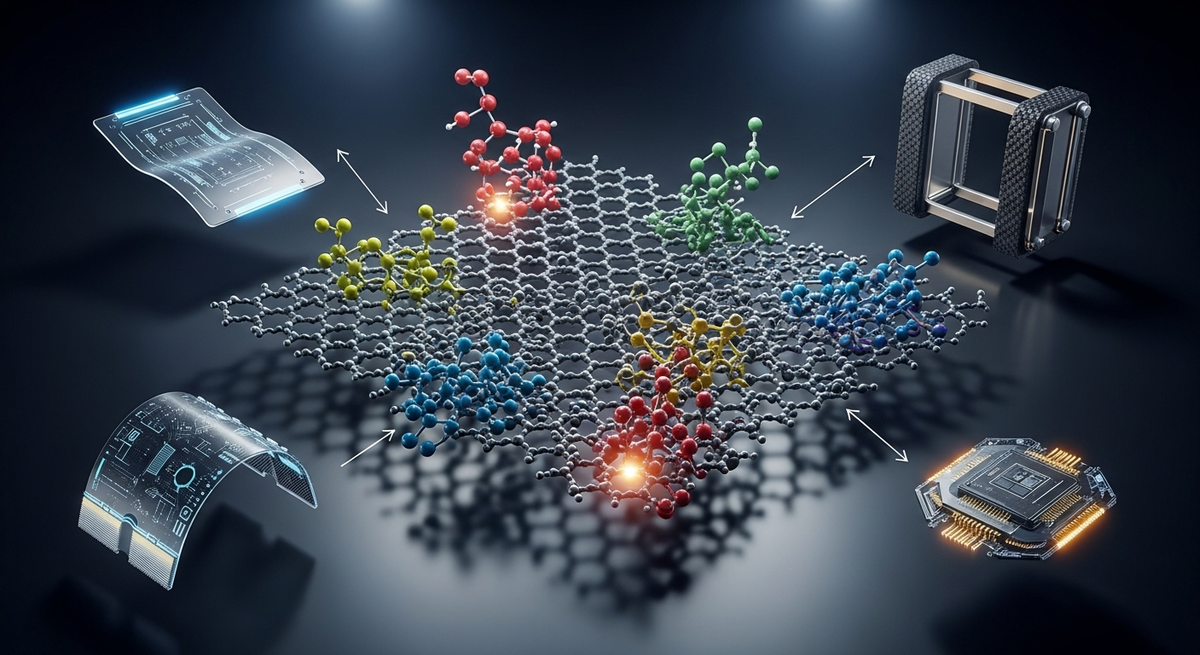
The advent of graphene has undeniably revolutionized materials science, presenting a two-dimensional lattice of carbon atoms with an unparalleled suite of properties. Hailed by some as a “magic discovery,” its potential continues to unfold, yet a complete understanding and harnessing of this material's capabilities remain an active area of investigation. This 2D honeycomb structure, while possessing extraordinary intrinsic strength and electrical conductivity, also presents inherent challenges that necessitate sophisticated engineering solutions. At the heart of optimizing graphene for diverse applications lies a profound understanding and precise manipulation of its surface chemistry. The interactions of graphene with its surrounding environment, primarily governed by its surface atoms, are critical determinants of its reinforcing efficacy within various matrixes. Without controlled surface interactions, graphene’s inherent tendencies, such as restacking and crumpling due to its high aspect ratio and surface energy, can dramatically diminish its performance. Addressing these fundamental issues requires a strategic approach: the chemical modification of graphene with polymers. This methodology is not merely about attaching molecules; it is about fundamentally altering graphene's surface properties to achieve stable dispersions and enhance compatibility with other materials. This discussion will delve into the scientific rationale behind this crucial process, exploring how targeted chemical interventions unlock a new realm of possibilities for graphene-based materials, from improved processability to superior mechanical and electrical performance.
The Imperative of Graphene Surface Chemistry: From Intrinsic Properties to Practical Challenges
Understanding the intrinsic chemistry of the graphene surface is not merely an academic exercise; it is a chief issue foundational to graphene investigation and its practical implementation. The unique sp2 hybridized carbon bonds form a robust in-plane sigma network, bestowing graphene with its exceptional mechanical strength and electrical conductivity. This perfectly planar structure, characterized by delocalized pi-electrons above and below the carbon plane, renders pristine graphene largely inert and hydrophobic. This inherent chemical stability, while beneficial in some contexts, creates significant hurdles when integrating graphene into other materials or dispersing it in common solvents.
The primary challenge stems from graphene's high surface energy and extreme aspect ratio. Individual graphene sheets, when in close proximity, are strongly attracted to each other through powerful van der Waals forces. These forces lead to an irreversible aggregation and restacking phenomenon, effectively collapsing the 2D sheets back into graphite-like structures. This restacking dramatically reduces the available surface area, diminishing graphene's unique properties and making it an ineffective filler or active material. Achieving stable, uniform dispersion of individual graphene sheets is paramount for realizing its full potential in composites, coatings, or electronic devices.
Furthermore, the pristine, non-polar nature of graphene leads to poor compatibility with most polar polymers and solvents. Without specific surface functionalization, graphene sheets tend to phase separate, forming agglomerates rather than homogeneous mixtures. This poor interfacial adhesion is a critical limitation in composite materials, where efficient load transfer between the graphene reinforcement and the polymer matrix is essential for enhancing mechanical properties. Overcoming these intrinsic chemical and physical barriers demands intelligent surface engineering, and polymer modification emerges as a highly effective and versatile strategy.
The Polymer Advantage: Why Polymers for Graphene Modification?
Polymers offer a uniquely advantageous platform for the chemical modification of graphene, primarily due to their intrinsic versatility and ability to impart a wide range of properties. Unlike small molecules, polymer chains can provide substantial steric hindrance, physically preventing graphene sheets from restacking. When polymers are tethered to or adsorbed onto the graphene surface, their extended chains create a protective "brush" or "shell" that keeps individual graphene flakes separated, promoting stable and long-term dispersions in various solvents and polymer matrices.
The chemical diversity of polymers allows for precise tailoring of graphene's surface characteristics. By selecting polymers with specific functional groups, polarity, or even electrical conductivity, researchers can engineer graphene-polymer interfaces to optimize compatibility with target matrices. For instance, hydrophilic polymers can render graphene dispersible in aqueous solutions, while hydrophobic or chemically reactive polymers can enhance its integration into non-polar polymer composites. This tunability is crucial for matching graphene's surface properties with the requirements of diverse applications, moving beyond a "one-size-fits-all" approach.
Polymers also possess the ability to form strong interfacial bonds with both the graphene surface and the surrounding matrix. In composite systems, the polymer chains acting as a bridge can chemically bond or entangle with the bulk polymer, dramatically improving load transfer and overall composite performance. This capability addresses the critical issue of weak interfacial adhesion often encountered when pristine graphene is incorporated into materials. The scalability of polymer synthesis and modification techniques also presents a practical advantage, making polymer-modified graphene a viable option for industrial applications.
Strategies for Polymer-Graphene Functionalization
The chemical modification of graphene with polymers can be broadly categorized into two main approaches: non-covalent and covalent functionalization. Each method offers distinct advantages and disadvantages, influencing the resulting properties of the modified graphene and its suitability for specific applications. Understanding these strategies is crucial for designing graphene materials with tailored performance characteristics.
Non-covalent functionalization relies on weaker interactions, such as π-π stacking, hydrophobic interactions, electrostatic forces, or van der Waals forces, to attach polymer chains to the graphene surface. This method is particularly attractive because it largely preserves the intrinsic electronic structure of graphene, avoiding disruption of the sp2 hybridized carbon network. Conjugated polymers, rich in delocalized π-electrons, are frequently used, as their planar aromatic rings can effectively π-π stack with graphene's surface. Amphiphilic block copolymers or surfactants are also employed; their hydrophobic segments interact with graphene, while their hydrophilic segments extend into the solvent, promoting dispersion. The primary benefit of non-covalent modification is the retention of graphene’s pristine electronic and mechanical properties. However, the interactions are weaker and potentially reversible, which can lead to desorption of the polymer under certain conditions, limiting long-term stability and performance.
Covalent functionalization, in contrast, involves the formation of robust chemical bonds between the polymer and the graphene surface. This approach offers superior stability, enhanced interfacial adhesion, and greater control over the functionalization density and polymer architecture. A common starting point for covalent modification is graphene oxide (GO) or reduced graphene oxide (rGO), which possess abundant oxygen-containing functional groups such as hydroxyl, carboxyl, and epoxy groups on their surfaces and edges. These groups serve as reactive sites for polymer attachment. Two primary techniques are employed: "grafting to" and "grafting from."
In the "grafting to" approach, pre-synthesized polymer chains are reacted with the functional groups present on the GO or rGO surface. Common reactions include esterification or amidation reactions between polymer end-groups (e.g., hydroxyl or amine) and carboxyl groups on GO. Click chemistry, a highly efficient and selective reaction, is also widely utilized for attaching various functionalized polymers. This method offers excellent control over the polymer's molecular weight and polydispersity before grafting. However, steric hindrance from already attached polymer chains can limit the grafting density, making it challenging to achieve high polymer loading.
The "grafting from" technique involves initiating polymerization directly from sites on the graphene surface. This approach typically requires first introducing initiator groups onto the GO or rGO, which then serve as starting points for controlled radical polymerization techniques like Atom Transfer Radical Polymerization (ATRP) or Reversible Addition-Fragmentation Chain Transfer (RAFT) polymerization. Ring-opening polymerization can also be initiated from surface hydroxyl groups. "Grafting from" allows for higher grafting densities and precise control over the grafted polymer chain length and architecture, as the polymerization proceeds outwards from the surface. While covalent functionalization offers robust and stable modifications, it can potentially disrupt the sp2 carbon network of graphene, which may alter its electronic conductivity if not carefully controlled.
Unlocking Performance: How Polymer Modification Transforms Graphene
The strategic chemical modification of graphene with polymers fundamentally transforms its properties, addressing the inherent limitations of pristine graphene and unlocking its full potential across various applications. This transformation manifests in several key areas, directly translating into enhanced performance in advanced materials. The primary benefit revolves around improved dispersibility and exfoliation, crucial for uniform integration.
One of the most significant impacts of polymer modification is the dramatic improvement in graphene’s dispersibility and exfoliation. Grafted or adsorbed polymer chains act as steric barriers, physically preventing individual graphene sheets from re-stacking into agglomerates. This allows for the creation of stable, homogeneous dispersions in a wide range of solvents, which is a prerequisite for solution processing techniques and for achieving uniform distribution in composite materials. Effective dispersion ensures that the high surface area and intrinsic properties of individual graphene sheets are fully utilized, rather than being trapped within bulk aggregates.
Polymer modification also critically enhances the interfacial adhesion between graphene and various matrix materials, particularly in polymer composites. When polymer chains are chemically tethered to graphene, they can interpenetrate, entangle, or even co-react with the surrounding matrix polymer. This creates a strong, robust interface that is essential for efficient load transfer from the matrix to the high-strength graphene reinforcement. Improved interfacial adhesion prevents common failure mechanisms like delamination or pull-out of graphene sheets, leading to significant enhancements in the composite's mechanical strength, stiffness, and toughness.
Beyond mechanical properties, polymer modification offers opportunities to tune graphene’s electrical and thermal characteristics. While covalent functionalization can sometimes decrease intrinsic conductivity by disrupting the sp2 network, careful modification can maintain or even enhance overall electrical performance in composites by providing conductive pathways or improving charge transport at interfaces. For instance, incorporating conductive polymers can create synergistic effects. Similarly, polymer modification can improve the thermal management properties of composites by enhancing phonon transport across interfaces or by creating thermally conductive networks.
Furthermore, polymer modification introduces a vast array of new functionalities to graphene. By grafting responsive polymers, graphene can become sensitive to external stimuli such as temperature, pH, or light, opening avenues for smart materials, sensors, and actuators. Biocompatible polymers can transform graphene into a suitable material for biomedical applications, improving cell adhesion or enabling targeted drug delivery. The ability to impart specific chemical functionalities, like catalytic sites or selective binding regions, expands graphene's utility into areas like environmental remediation, catalysis, and advanced separation technologies.
Applications Across Industries: Where Polymer-Modified Graphene Shines
The transformative power of polymer-modified graphene has opened doors to a multitude of advanced applications across diverse industrial sectors. By overcoming the limitations of pristine graphene, these tailored materials are now positioned to deliver unprecedented performance enhancements, driving innovation from lightweight composites to next-generation electronics. The versatility imparted by polymer functionalization is key to this broad applicability.
In the realm of high-performance composites, polymer-modified graphene is proving revolutionary for industries such as aerospace, automotive, and sporting goods. By improving interfacial adhesion and dispersion, these materials enable the creation of ultralightweight yet incredibly strong and stiff components. The enhanced load transfer between the modified graphene and the polymer matrix leads to composites with superior mechanical properties, including increased tensile strength, flexural modulus, and fracture toughness, surpassing conventional filler materials. This capability contributes to fuel efficiency, extended product lifespan, and improved safety.
The energy storage sector is another area where polymer-modified graphene offers significant advancements. Modified graphene can serve as an active material or an additive in electrodes for lithium-ion batteries, supercapacitors, and fuel cells. The improved dispersibility and controlled surface chemistry lead to electrodes with higher active material loading, enhanced ion and electron transport, and greater structural stability during charge-discharge cycles. This translates into devices with higher energy density, power density, faster charging capabilities, and extended cycle life, addressing critical demands for electric vehicles and portable electronics.
Flexible electronics and advanced sensors also benefit immensely from polymer-modified graphene. The ability to create stable, printable graphene inks with tunable conductivity and mechanical properties allows for the fabrication of flexible circuits, transparent conductive films, and wearable devices. Polymer coatings can enhance the sensitivity and selectivity of graphene-based sensors for detecting gases, biological molecules, or environmental pollutants by providing specific recognition sites and improving signal transduction. These advancements are crucial for the development of smart textiles, point-of-care diagnostics, and environmental monitoring systems.
Biomedical applications represent a rapidly expanding frontier for polymer-modified graphene. By functionalizing graphene with biocompatible and biodegradable polymers, researchers are developing novel materials for drug delivery, tissue engineering, and bioimaging. The controlled surface chemistry can facilitate targeted drug release, reduce cytotoxicity, and promote cell proliferation and differentiation on scaffolds. Modified graphene can also be integrated into advanced biosensors for early disease detection, leveraging its unique electrical and optical properties in a biologically compatible environment.
Finally, in environmental applications, polymer-modified graphene plays a crucial role in water purification and remediation. Graphene-based membranes with tailored polymer coatings exhibit enhanced antifouling properties and improved selective filtration capabilities for removing contaminants, heavy metals, and organic pollutants from water. The high surface area and functionalizable nature of modified graphene also make it an excellent adsorbent for removing various pollutants from wastewater, offering efficient and sustainable solutions to pressing environmental challenges.
Challenges and Future Directions in Polymer-Graphene Science
Despite the significant strides made in polymer-graphene modification, several challenges persist, necessitating continued research and innovation to fully realize its industrial potential. Addressing these issues is paramount for transitioning from laboratory-scale demonstrations to widespread commercial adoption. The complexity of achieving precise control over functionalization remains a central theme.
One primary challenge lies in the scalability and cost-effectiveness of current modification techniques. Many highly effective methods, particularly those involving advanced polymerization techniques, can be complex, time-consuming, and expensive when scaled up for mass production. Developing simpler, greener, and more economical synthesis routes for polymer-modified graphene is critical for its market competitiveness. This includes exploring continuous flow processes and utilizing more readily available, sustainable polymers.
Another key area of focus is maintaining or even enhancing the intrinsic properties of graphene during functionalization. Covalent modification, while offering stability, can sometimes disrupt the sp2 carbon network, potentially compromising graphene’s exceptional electrical or thermal conductivity. Future research aims to develop site-specific functionalization strategies that target only the edges or defect sites, preserving the integrity of the basal plane. This precision will allow for the optimal balance between enhanced dispersibility, compatibility, and property retention.
The long-term stability and environmental impact of polymer-modified graphene also require thorough investigation. Understanding the degradation pathways of these hybrid materials under various environmental conditions and assessing their potential ecotoxicity are crucial for responsible development. Designing inherently biocompatible and biodegradable polymer coatings will be essential for applications in biomedicine and environmental remediation, ensuring that these advanced materials do not pose new risks.
Future directions will undoubtedly involve the development of multi-functional polymer systems that can impart several desired properties simultaneously. Imagine graphene modified with polymers that not only enhance dispersion but also provide self-healing capabilities, stimuli-responsiveness, and specific catalytic activity. The integration of artificial intelligence and machine learning in material design and process optimization will accelerate the discovery of new polymer-graphene architectures with unprecedented performance. These advancements will continue to push the boundaries of what is possible with graphene-based materials.
FAQ
1. What is the primary challenge when using pristine graphene in practical applications?
Pristine graphene suffers from a strong tendency to aggregate and restack due to high van der Waals forces between its sheets, coupled with poor dispersibility in most solvents and incompatibility with many polymer matrices. This aggregation significantly diminishes its unique properties and limits its practical utility.
2. Why are polymers often chosen for graphene modification over small molecules?
Polymers offer several advantages, including their ability to provide substantial steric hindrance to prevent restacking, their versatile chemistry for tailoring surface properties, and their capacity to form strong interfacial bonds with various matrices. Their long chains can effectively encapsulate or tether to graphene, creating stable dispersions and enhancing compatibility.
3. What is the fundamental difference between covalent and non-covalent functionalization of graphene with polymers?
Covalent functionalization involves forming strong, stable chemical bonds between the polymer and graphene, often requiring a reactive precursor like graphene oxide. Non-covalent functionalization relies on weaker interactions like π-π stacking or electrostatic forces, which generally preserve graphene's intrinsic electronic structure but result in less stable attachments.
4. How does polymer modification improve graphene's performance in composite materials?
Polymer modification dramatically enhances interfacial adhesion between graphene and the surrounding matrix. The grafted or adsorbed polymer chains act as a bridge, improving load transfer, preventing delamination, and resulting in composites with superior mechanical strength, stiffness, and toughness compared to those with unmodified graphene.
5. Can polymer modification make graphene suitable for biological applications?
Absolutely. By functionalizing graphene with biocompatible and often biodegradable polymers, its surface properties can be tailored to interact safely and effectively with biological systems. This enables applications such as targeted drug delivery, tissue engineering scaffolds, and advanced biosensors, opening new avenues in medicine and biotechnology.
Conclusion
The journey from isolating graphene to harnessing its full potential has been marked by scientific ingenuity, with chemical modification by polymers standing out as a pivotal advancement. This strategic approach effectively bridges the gap between graphene’s extraordinary intrinsic properties and the practical demands of real-world applications. By intelligently engineering the graphene surface, researchers have overcome critical challenges such as restacking, poor dispersibility, and weak interfacial adhesion, transforming a laboratory marvel into a versatile material ready for industrial integration.
The diverse strategies of non-covalent and covalent functionalization, utilizing the vast chemical landscape of polymers, have unlocked a new era for graphene-based materials. These modifications do not just stabilize graphene; they impart tailored functionalities, enabling unprecedented performance in areas ranging from high-performance composites and advanced energy storage to flexible electronics and biomedical devices. As usa-graphene.com continues to lead in graphene innovation, the ongoing development of sophisticated polymer modification techniques promises to accelerate the deployment of these next-generation materials across every facet of modern technology. The future of graphene is inextricably linked to the precise control of its surface chemistry, and polymer science is charting that course.