
A New Era of Graphene Engineering: Pre-Designing Twist Angles on Demand
Researchers have developed a breakthrough method for growing twisted bilayer graphene with pre-designed angles, a key step toward manufacturable quantum...
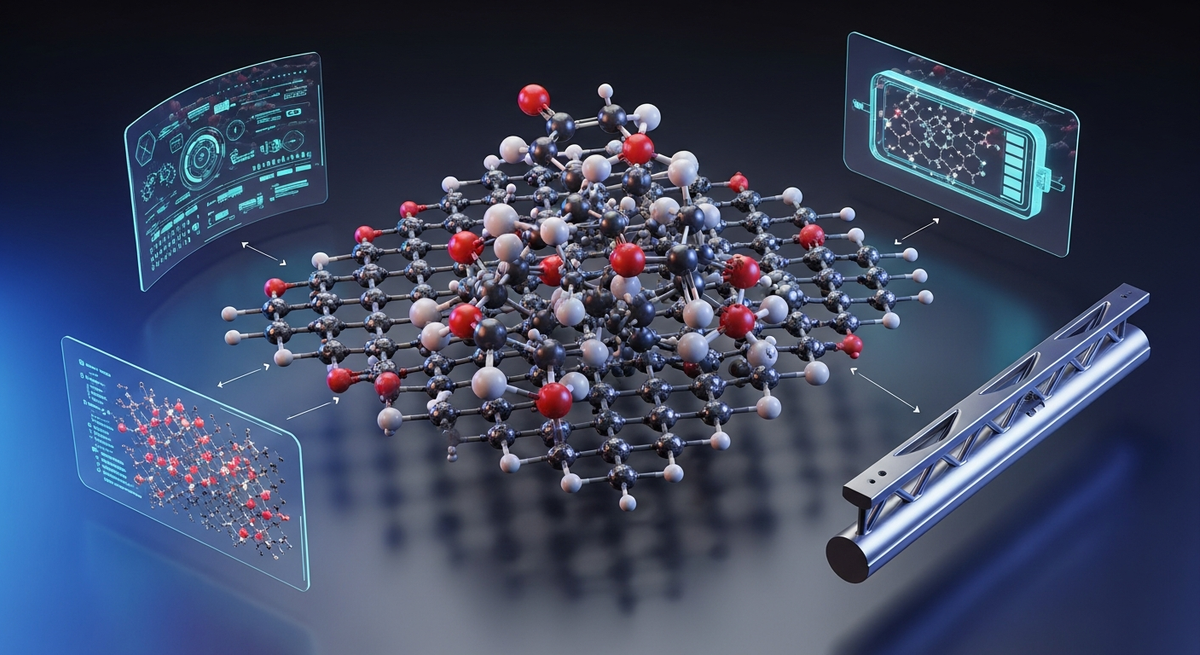
Graphene, a single-layer sheet of sp2 hybridized carbon atoms, has captivated the scientific and industrial communities with its extraordinary properties. Its exceptional electronic conductivity, remarkable thermal stability, and unparalleled mechanical strength position it as a foundational material for future technologies. However, harnessing graphene's full potential often requires fine-tuning its intrinsic characteristics to suit specific application demands.
This need for precise control over graphene’s behavior has propelled chemical modification to the forefront of materials science research. By strategically altering its surface or integrating new atomic species, engineers and scientists can overcome inherent limitations and unlock a vast array of functionalities. Understanding these modification strategies is critical for developing the next generation of graphene-based products.
This article delves into the core methodologies of chemical modification of graphene, examining covalent functionalization, noncovalent approaches, and chemical doping. Each strategy offers distinct advantages and pathways to tailor graphene’s properties, opening new avenues for innovation in fields ranging from advanced electronics to sustainable energy solutions. We will explore the mechanisms and outcomes that make these techniques indispensable for modern graphene engineering.
Despite graphene’s impressive intrinsic properties, its pristine form sometimes presents challenges for real-world applications. Issues such as poor dispersibility in common solvents, limited compatibility with other materials, and a lack of specific reactive sites can hinder its integration into complex systems. Chemical modification directly addresses these limitations, enabling the creation of custom-engineered graphene derivatives.
The primary objective of these modification strategies is to impart new or enhanced functionalities without completely sacrificing graphene's desirable core attributes. This includes achieving desired solubility and stability, which are crucial for processing and integration. Furthermore, modifications can lead to precisely tunable electric, thermal, and mechanical properties, allowing for bespoke material performance.
Beyond these fundamental adjustments, chemical modification can also significantly enhance catalytic and biological properties. This expansion of capabilities broadens graphene's utility across a diverse spectrum of applications, from high-performance sensors to advanced energy storage devices. The ability to systematically engineer these outcomes makes chemical modification an indispensable tool in the graphene development pipeline.
Covalent modification fundamentally alters graphene’s atomic structure by forming new chemical bonds with the carbon network. This process typically involves the rehybridization of one or more sp2 carbon atoms to an sp3 configuration, which is inherently accompanied by a localized loss of electronic conjugation. Despite this change, covalent functionalization provides robust and permanent attachment of various functional groups, offering significant control over material properties.
One prominent approach within covalent modification is nucleophilic addition. The Bingel reaction, originally developed for fullerene chemistry, has proven highly effective for graphene. This reaction typically employs a halide derivative of a diethyl malonate moiety, generated in situ with a tetrahalomethane and a base. The base deprotonates the malonate, forming an enolate that then nucleophilically attacks a C=C bond on the graphene framework.
Subsequent intramolecular ring closure, displacing a halide atom, results in a stable cyclopropane adduct covalently linked to the graphene. Researchers like Tagmatarchis and colleagues have successfully utilized Bingel cyclopropanation to introduce cyclopropane adducts, including extended tetrathiafulvalene moieties, onto exfoliated graphene. Their work demonstrated functionalization levels up to approximately 23%, resulting in hybrid graphene materials with excellent dispersibility in organic solvents such as dichloromethane, o-dichlorobenzene, dimethylformamide, and toluene.
These electroactive extended tetrathiafulvalene–graphene materials exhibited the formation of radical ion pairs, showcasing a one-electron reduction of graphene and a one-electron oxidation of extended tetrathiafulvalene. Similarly, Coronado and coworkers functionalized exfoliated graphene with 4,4′-[(1,3-dioxo-1,3-propanediyl)bis(oxy)]bis[2,2,6,6-tetramethyl-1-piperidinyloxy] organic radicals using the Bingel cyclopropanation reaction. They produced graphene layers via liquid-phase exfoliation of graphite in o-dichlorobenzene (oDCB) or benzylamine, aided by ultrasounds.
By varying the solvent, the density of anchored radicals could be controlled, allowing for detailed studies on the radical concentration’s effect on graphene’s electronic structures and conducting properties. The covalent grafting in these studies was unequivocally confirmed through a suite of analytical techniques, including thermo-gravimetric analysis, X-ray photoelectron spectroscopy, Raman spectroscopy, and electron paramagnetic resonance measurements. Beyond nucleophilic additions, other covalent strategies include electrophilic substitution, which leverages graphene's electron-rich nature for reactions like Friedel–Crafts acylation and hydrogen–lithium exchange, and various cycloaddition reactions such as [2+1], [2+2], [3+2], and [4+2] cycloadditions, each offering unique pathways for functional group integration.
Noncovalent modification offers an alternative to covalent bonding by attaching functional molecules to the graphene surface without disrupting its intrinsic sp2 carbon network. This approach is highly advantageous because it largely preserves graphene's exceptional electronic and mechanical properties. The interactions involved are typically weaker and reversible, providing flexibility in material design and potential for dynamic systems.
These modifications are based on a range of intermolecular forces that allow molecules to adsorb onto the graphene surface. Key mechanisms include van der Waals forces, which are ubiquitous attractive forces between molecules, and electrostatic interactions, where charged species are attracted to graphene’s surface or to other adsorbed molecules. Hydrogen bonding, a strong dipole-dipole interaction, also plays a significant role in anchoring certain functional groups.
Coordination bonds, involving electron pair donation from a ligand to a metal center, can be used to tether metal complexes or nanoparticles to graphene. Furthermore, π–π stacking interactions are particularly effective for aromatic molecules, where the delocalized electron clouds of the graphene lattice and the modifying agent interact favorably. These diverse noncovalent interactions enable the attachment of a wide variety of materials, including polymers, metal nanoparticles, semiconductor quantum dots, and various organic molecules, all while minimizing structural damage to the graphene sheet itself.
Chemical doping represents a powerful strategy for fine-tuning the electronic properties of graphene by introducing foreign atoms into its structure. This process directly influences the concentration of charge carriers and shifts the Fermi level, allowing for precise control over conductivity and potential band gap modulation. Doping can be broadly categorized into interstitial, substitutional, and selective methods, each with distinct impacts on graphene’s electronic landscape.
Interstitial doping involves placing impurity atoms within the voids or interstitial sites of the graphene lattice, typically between the carbon atoms. This type of doping often introduces local strain and alters the electronic environment without directly replacing carbon atoms. The introduced atoms can act as electron donors or acceptors, depending on their electronic configuration and electronegativity relative to carbon.
Substitutional doping, conversely, involves replacing carbon atoms within the graphene lattice with heteroatoms. Common substitutional dopants include nitrogen, boron, and sulfur, which have atomic radii similar to carbon, minimizing lattice distortion. Nitrogen doping, for instance, typically introduces n-type conductivity by contributing extra electrons, while boron doping often leads to p-type behavior by creating electron deficiencies. This direct integration into the lattice has a profound and stable effect on electronic transport.
Selective doping involves the controlled introduction of dopants into specific regions or edges of the graphene sheet, creating localized electronic junctions or patterns. This advanced technique allows for the fabrication of complex electronic devices and circuits with tailored functionalities. The materials used for chemical doping are varied and include polymers, metals, semiconductors, and other organic compounds, each offering unique ways to influence graphene’s electronic characteristics for specific applications.
The strategic application of chemical modification techniques has yielded a remarkable array of functional outcomes, fundamentally expanding graphene’s utility across numerous industries. These modifications translate directly into tangible improvements in material performance, addressing limitations inherent in pristine graphene and enabling entirely new functionalities. The ability to precisely tune properties is paramount for high-performance applications.
Enhanced solubility and stability are among the most immediate and impactful outcomes, facilitating easier processing and integration into complex systems. Modified graphene can be readily dispersed in various solvents, enabling scalable fabrication methods such as solution processing and inkjet printing. This increased processability is critical for industrial adoption and the development of reproducible manufacturing techniques.
Beyond processability, chemical modification allows for the precise tailoring of electrical conductivity, thermal transport, and mechanical strength. For instance, doping can transform graphene from a semimetal into a semiconductor or enhance its charge carrier mobility for ultra-fast electronics. Covalent modifications can introduce specific binding sites for catalysts, significantly boosting reaction rates and selectivity in chemical processes. The integration of polymers can also create composite materials with superior mechanical properties, such as enhanced toughness and flexibility.
Furthermore, chemically modified graphene has shown great promise in biological applications, with surfaces engineered for improved biocompatibility, drug delivery, and biosensing. These advancements open up new arenas for versatile applications, including the development of intelligent sensors with enhanced sensitivity and selectivity, and highly efficient green energy devices such as advanced batteries, supercapacitors, and photocatalysts. The ongoing evolution of chemical modification strategies promises to unlock even more groundbreaking applications for graphene in the coming years.
The primary goal of chemical modification of graphene is to intrinsically alter and tailor its properties for specific applications. This involves enhancing solubility, improving stability, fine-tuning electronic, thermal, and mechanical characteristics, and boosting catalytic or biological functionalities that pristine graphene may lack.
Covalent modification typically involves the rehybridization of sp2 carbon atoms to sp3, which leads to a localized loss of electronic conjugation within the graphene lattice. While this can alter conductivity, it enables robust attachment of functional groups, creating stable and often permanent property changes.
Noncovalent modification primarily relies on intermolecular forces such as van der Waals forces, electrostatic interactions, hydrogen bonding, coordination bonds, and π–π stacking interactions. These methods attach molecules without disrupting graphene's sp2 carbon network, preserving its core electronic properties.
The Bingel reaction is a classic example of covalent modification for graphene, utilizing nucleophilic addition to form cyclopropane adducts. Researchers have used this to functionalize exfoliated graphene up to approximately 23% with moieties like extended tetrathiafulvalene, enhancing dispersibility and creating electroactive materials.
Chemically modified graphene offers versatile applications across various sectors. Key areas include intelligent sensors with enhanced sensitivity, efficient green energy devices like advanced batteries and supercapacitors, improved catalysts, and biocompatible materials for drug delivery and advanced diagnostics.
The strategic chemical modification of graphene stands as a cornerstone in the ongoing advancement of this remarkable material. By carefully applying covalent, noncovalent, and doping strategies, researchers and engineers can precisely tailor graphene's intrinsic properties to meet the exacting demands of diverse applications. This ability to manipulate solubility, stability, and crucial electronic, thermal, and mechanical characteristics is propelling graphene into new realms of innovation.
As we continue to refine these modification techniques, the potential for groundbreaking discoveries and industrial applications will only expand. The future of graphene-based technologies hinges significantly on our mastery of these chemical engineering approaches, unlocking unprecedented performance across sectors. Explore the leading edge of graphene development and discover how these advanced modification strategies can benefit your projects by visiting usa-graphene.com today.
Serious about B2B integration? Test our premium Pulsed Electrical Resistive Carbon Heating turbostratic graphene in your lab. 100g sample packs available now.
Explore More
Researchers have developed a breakthrough method for growing twisted bilayer graphene with pre-designed angles, a key step toward manufacturable quantum...

Learn how deep learning is revolutionizing the structural characterization of twisted bilayer materials, accelerating the development of next-generation...

Learn to build a prototype graphene FET biosensor for sensitive DNA detection. This guide covers materials, fabrication, and testing for point-of-care...