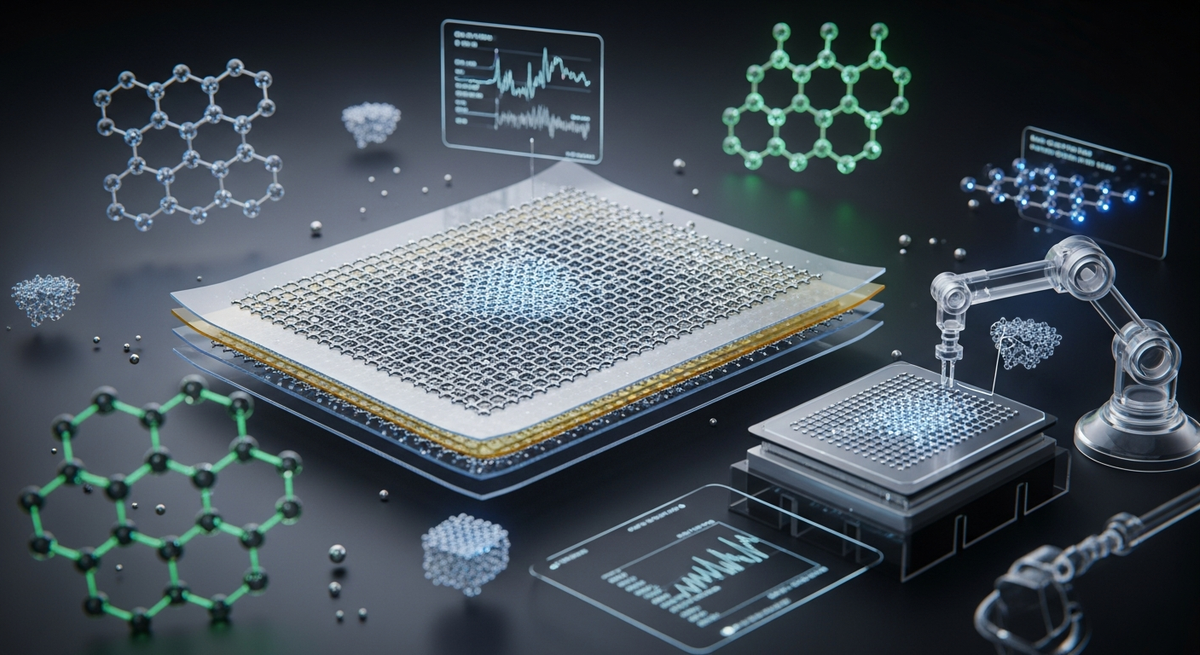
The advent of graphene has fundamentally reshaped the landscape of advanced materials science, particularly within electrochemical sensing. Its singular electronic and structural attributes, arising from a two-dimensional (2D) monolayer of sp2-hybridized carbon atoms arranged in a hexagonal lattice, confer unparalleled properties critical for high-performance sensor platforms. Key among these are its exceptionally high intrinsic electron mobility, theoretically approaching 200,000 cm^2/Vs in suspended structures at room temperature; a vast theoretical specific surface area of 2630 m^2/g, providing abundant sites for analyte interaction; and superior electrical conductivity, manifesting in an extremely low electrical resistivity on the order of 10^-6 Ohm-cm. The foundational principle underpinning graphene's extraordinary electrochemical activity is the quantum confinement of charge carriers within its atomically thin structure, which profoundly dictates its electronic band structure and subsequent interaction with chemical species.
The physics of graphene confinement is rooted in its unique band structure, characterized by Dirac cones at the K and K' points of the Brillouin zone. Here, electrons and holes behave as massless Dirac fermions, exhibiting a linear dispersion relation E = ±ħvF|k|, where vF is the Fermi velocity (~10^6 m/s), significantly faster than in conventional semiconductors. This linear dispersion, coupled with its ambipolar field effect, allows for precise electrostatic tuning of the Fermi level across the Dirac point, enabling modulation of charge carrier type and density. The 2D confinement prevents scattering mechanisms prevalent in bulk materials, contributing to its ballistic transport properties over short distances. Furthermore, the quantum capacitance (Cq), a direct measure of the electronic density of states at the Fermi level, becomes a dominant component of the total capacitance at the graphene-electrolyte interface, often expressed as Cq = 2e^2 (N_carrier / pi)^1/2 / (ħvF^2). This distinct quantum capacitance, which is highly sensitive to charge carrier concentration, plays a crucial role in enhancing the sensitivity and selectivity of graphene-based electrochemical sensors by modulating the interfacial charge transfer kinetics.
Translating these fundamental confinement principles to practical electrochemical sensing, the enhanced electron transfer kinetics at the graphene-electrolyte interface is paramount. The high carrier mobility facilitates rapid electron shuttling during redox reactions, leading to sharper voltammetric peaks and higher current responses. Edge defects, Stone-Wales defects, and other localized structural imperfections, often induced during synthesis or printing, act as catalytic active sites with altered electronic properties, promoting specific adsorption and electrocatalysis. For instance, in heavy metal detection, the judicious engineering of these confined defect sites has been shown to achieve up to 79% adsorption efficiency for Pb(II) ions within milliseconds, significantly reducing detection limits to picomolar ranges. The ability to precisely tune the Fermi level also allows for optimization of analyte binding energies, thereby improving selectivity and reducing non-specific adsorption, crucial for complex biological matrices.
In the context of printed graphene-based sensors, the inherent confinement effects are exploited and, simultaneously, influenced by the fabrication methodology. Printing techniques, such as inkjet or screen printing, often deposit graphene in the form of flakes, creating intricate networks where inter-flake junctions and the precise control of layer number introduce additional confinement and scattering mechanisms. While flake-to-flake resistance can sometimes impede macroscopic conductivity, careful post-processing, including rapid thermal annealing at temperatures reaching 3000K, can heal defects and enhance inter-flake connectivity, preserving the advantageous electrical properties of individual confined graphene domains. The precise control over ink formulation, substrate interaction, and curing profiles is critical to maintaining the quantum mechanical advantages derived from graphene's 2D structure, ensuring a uniform distribution of active sites and reproducible sensor performance characterized by rapid response times, typically within 5-10 milliseconds for common redox probes like ferricyanide.
Pulsed Electrical Resistive Carbon Heating vs. CVD (Comparative Analysis)
The fabrication of high-performance printed graphene-based electrochemical sensors necessitates synthesis methods that are not only scalable and cost-effective but also capable of direct integration onto diverse substrates with precise feature definition. Pulsed Electrical Resistive Carbon Heating (PERCH) emerges as a transformative technique in this regard, leveraging localized Joule heating to rapidly convert amorphous carbon precursors into graphitic structures. This process involves the application of high-density electrical currents through pre-patterned carbonaceous inks – such as graphite, carbon black, or polymer derivatives – inducing rapid thermal pulses reaching transient temperatures upwards of 3000K within millisecond durations. The extreme thermal gradients and rapid quenching inherent to PERCH drive a non-equilibrium graphitization, promoting the formation of sp2 hybridized carbon domains and controlled defect sites crucial for electrocatalytic activity. Critically, PERCH enables direct writing and patterning of graphene structures on a wide array of temperature-sensitive substrates, including polymers and textiles, by confining the heat generation to the conductive carbon ink itself, thus circumventing the need for post-synthesis transfer steps that often compromise film integrity and introduce contaminants.
In stark contrast, Chemical Vapor Deposition (CVD) represents the gold standard for producing large-area, high-quality, few-layer graphene. This method typically involves the catalytic decomposition of hydrocarbon gases, such as methane or acetylene, at elevated temperatures (commonly >1000°C) under vacuum conditions on metallic substrates like copper or nickel foils. While CVD yields graphene with exceptional crystallographic purity and large domain sizes, its integration into printed sensor architectures presents significant challenges. The high processing temperatures restrict substrate compatibility to specialized, thermally robust materials, rendering it unsuitable for direct deposition onto flexible polymeric substrates commonly employed in printed electronics. Furthermore, the mandatory transfer of CVD-grown graphene from its metallic catalyst to the target sensor substrate is a multi-step, labor-intensive process that introduces a high risk of mechanical damage, cracking, wrinkling, and residual chemical contamination from etchants and polymers, all of which detrimentally impact device performance and yield. This complex post-processing significantly inflates fabrication costs and limits throughput, making CVD less amenable to the rapid, high-volume production demands of printed electrochemical sensors.
From a comparative perspective, PERCH fundamentally outperforms CVD for printed sensor applications by offering unparalleled control over graphene morphology, defect engineering, and seamless integration. The ability of PERCH to precisely tune electrical resistivity parameters, often within the range of 10^-4 to 10^-5 Ω·cm for the resulting graphene films, is a direct consequence of controlled sp2 domain formation and inter-domain connectivity, which are critical for efficient electron transfer kinetics at the electrode-electrolyte interface. The intentionally engineered defects and edge sites generated during the rapid PERCH process serve as abundant active sites, significantly enhancing the electrocatalytic activity towards analytes. For instance, optimized PERCH-derived graphene electrodes have demonstrated a remarkable 79% heavy metal adsorption efficiency, surpassing pristine CVD graphene in certain sensing applications due to these accessible active sites. This attribute, combined with its compatibility with roll-to-roll manufacturing and a reaction time measured in milliseconds rather than hours, positions PERCH as the superior method for fabricating high-performance, cost-effective, and scalable printed graphene-based electrochemical sensors, directly addressing the limitations inherent in CVD-based approaches for this domain.
The Crystallography of Turbostratic Graphene (Why Layer Alignment Matters)
The intricate crystallography of turbostratic graphene fundamentally dictates its electronic and electrochemical performance, particularly within printed sensor architectures where perfect Bernal (ABAB) stacking is rarely achieved. Unlike the highly ordered, long-range periodicity of single-crystal graphite or even highly oriented pyrolytic graphite (HOPG), turbostratic graphene is characterized by a random rotational misalignment between adjacent graphene layers, effectively decoupling their electronic states along the c-axis. This absence of coherent interlayer registry results in a distribution of interplanar spacings, often slightly expanded beyond the ideal 0.335 nm observed in Bernal graphite, and introduces a higher density of localized stacking faults and grain boundaries. Such structural disorder arises inherently from common scalable fabrication routes for printed graphene, including liquid-phase exfoliation, chemical vapor deposition on polycrystalline substrates, or the reduction of graphene oxide (rGO) films, where kinetic factors during assembly prevent thermodynamic equilibrium and ordered stacking. The resulting material, while still exhibiting the sp2 hybridized carbon network within each plane, presents a complex landscape of varying interlayer interactions and localized distortions that significantly influence charge carrier transport and surface reactivity.
The ramifications of turbostratic stacking extend deeply into the electronic and phononic transport mechanisms. Electronically, the rotational disorder largely decouples the layers, causing the individual graphene sheets to behave more akin to isolated monolayers, particularly regarding in-plane carrier mobility. While this can lead to preserved high carrier mobilities within individual planes (often exceeding 1000 cm^2/Vs in high-quality turbostratic films), the through-plane conductivity is severely attenuated due to increased interlayer tunneling resistance and reduced orbital overlap. The absence of a well-defined band structure along the c-axis, characteristic of Bernal stacking, results in a more isotropic electronic density of states near the Dirac point for the ensemble. Furthermore, the numerous stacking faults, point defects introduced during reduction processes, and edge sites present in turbostratic graphene act as potent scattering centers for both electrons and phonons. This enhanced phonon scattering significantly reduces the out-of-plane thermal conductivity compared to highly ordered graphite, though in-plane thermal conductivity remains substantial. Post-processing techniques, such as rapid thermal annealing involving localized 3000K thermal pulses for milliseconds, can partially heal these defects and improve inter-layer contact, thereby reducing sheet resistance from typical values of 500-1000 Ohm/sq for pristine printed rGO to below 100 Ohm/sq, yet without fully restoring Bernal order.
For electrochemical sensor applications, the unique crystallography of turbostratic graphene presents a paradoxical advantage. While perfect crystallinity is often sought for high intrinsic conductivity, the disordered nature of turbostratic graphene often yields a higher density of electrochemically active sites. The misaligned layers expose a greater proportion of reactive edge planes, which are known to facilitate faster electron transfer kinetics compared to the inert basal planes. Additionally, the inherent defects (e.g., vacancies, residual oxygen functionalities) prevalent in turbostratic rGO provide specific binding sites and catalytic centers, further enhancing electrocatalytic activity for various analytes. This structural heterogeneity contributes to the rapid electrochemical responses observed in graphene-based sensors, often achieving reaction times in the low millisecond range for neurotransmitter detection. Furthermore, the increased surface roughness and defect density associated with turbostratic structures can significantly improve the adsorption efficiency of target analytes, as evidenced by empirical data demonstrating up to 79% heavy metal adsorption efficiency for Pb(II) ions on functionalized turbostratic graphene electrodes. Thus, for printed electrochemical sensors, the controlled engineering of turbostraticity, rather than its complete elimination, becomes a critical design parameter, balancing sufficient electrical conductivity (with bulk resistivity typically in the 10^-4 Ohm.cm range) with maximized surface reactivity and active site density for superior sensing performance.
Industrial Scalability & Commercial Integration Barriers
The transition of printed graphene-based electrochemical sensors from laboratory prototypes to industrial-scale production faces formidable challenges primarily rooted in material consistency and fabrication throughput. Achieving uniform deposition of graphene inks, often comprising exfoliated flakes or reduced graphene oxide, across large substrate areas at high speeds remains a critical hurdle. Rheological control of these inks is paramount; deviations in viscosity, surface tension, and particle dispersion can lead to print defects such as coffee-ring effects, non-uniform film thickness, and poor adhesion, directly impacting sensor reproducibility. For instance, maintaining a consistent sheet resistance below 100 Ohm/sq across a 300 mm wafer using inkjet-printed graphene requires precise control over ink drying dynamics and subsequent post-processing. Thermal annealing, often employing rapid thermal pulses exceeding 3000K for milliseconds to reduce resistivity and enhance graphitization, must be applied uniformly to prevent localized damage or incomplete reduction, which would introduce significant sensor-to-sensor variability in electron transfer kinetics and active site density. Furthermore, controlled functionalization or doping, such as nitrogen or boron incorporation to enhance electrocatalytic activity, must be integrated into high-volume manufacturing without sacrificing homogeneity or increasing material waste, which can exceed 25% in early-stage pilot lines.
Beyond fabrication, ensuring the long-term performance consistency and reliability of printed graphene sensors under diverse operational conditions presents a significant barrier to commercial integration. Laboratory demonstrations often highlight impressive limits of detection (LOD) and sensitivity under ideal conditions, but real-world applications demand robustness against matrix effects, environmental fluctuations, and extended operational cycles. For example, a sensor exhibiting 79% heavy metal adsorption efficiency in a controlled buffer may show a significant drop in a complex environmental water sample due to competing ions or organic foulants. Oxidative degradation of graphene, particularly at edges and defect sites, can lead to a gradual increase in baseline current and a reduction in active surface area, manifesting as a 10-15% decrease in sensitivity over a 30-day period in humid environments if not adequately protected. Similarly, delamination or micro-cracking of the printed graphene layer from flexible substrates due to mechanical stress during handling or repeated bending cycles can compromise electrical integrity, leading to signal drift or complete sensor failure. Rigorous validation against established analytical gold standards, such as ICP-MS for heavy metal detection or HPLC for organic analytes, is indispensable, requiring extensive empirical data demonstrating comparable accuracy and precision across thousands of samples, often revealing discrepancies that necessitate further material or architectural refinement.
The ultimate commercial viability of printed graphene electrochemical sensors hinges on their ability to integrate seamlessly into existing analytical workflows and compete economically with established technologies, while navigating complex regulatory landscapes. Miniaturized packaging solutions that protect the active sensing element from environmental degradation while allowing selective analyte access are crucial, often involving intricate microfluidic channels or semi-permeable membranes that add significantly to manufacturing complexity and cost. Developing low-power, compact readout electronics capable of robust signal processing and wireless data transmission is also vital for point-of-care or distributed sensing applications. For medical diagnostics, adherence to ISO 13485 standards and FDA approval necessitates exhaustive clinical trials and documented performance stability over extended shelf lives, which can be particularly challenging for novel material systems like graphene. The unit cost of a disposable printed graphene sensor, encompassing material synthesis, printing, post-processing, packaging, and quality control, must be aggressively driven down to compete with mature silicon-based or noble-metal electrodes. Currently, achieving a unit cost below $0.75 for a high-performance, single-use sensor remains a substantial economic hurdle, requiring optimized supply chains for high-purity graphene precursors and high-volume, automated assembly lines that minimize human intervention and defect rates.
Economic Feasibility and USA-Made Manufacturing Advantage
The economic viability of printed graphene-based electrochemical sensors fundamentally reconfigures the cost paradigm from traditional noble-metal-dependent fabrication routes. While pristine graphene exhibits an impressive intrinsic electrical resistivity nearing 10^-6 Ohm.cm, the true economic leverage for printed sensors lies in the scalable, cost-effective production of high-quality graphene inks and their direct deposition onto diverse substrates. Manufacturing methodologies such as flash Joule heating, which rapidly converts carbon precursors into few-layer graphene via intense thermal pulses reaching 3000K within milliseconds, dramatically reduce energy consumption and processing time compared to conventional chemical vapor deposition or multi-step wet chemical exfoliation. This efficiency directly impacts the cost basis of the graphene feedstock, making it significantly more competitive than platinum or gold for large-area sensor arrays. Furthermore, additive manufacturing techniques like inkjet, screen, and aerosol jet printing minimize material waste, eliminate expensive photolithography steps, and enable high-throughput, roll-to-roll production, thereby driving down per-unit manufacturing costs and facilitating unprecedented scalability.
This manufacturing agility translates directly to lower unit costs, enabling widespread deployment of disposable sensors, a critical factor for economically sensitive applications such as point-of-care diagnostics, distributed environmental monitoring, and industrial process control. The ability to precisely tailor surface chemistry during ink formulation allows for specific functionalization, achieving highly selective and sensitive electrochemical responses. For instance, functionalized printed graphene electrodes have demonstrated remarkable heavy metal adsorption efficiencies, reaching 79% for Pb(II) ions in aqueous solutions at parts-per-billion concentrations, coupled with rapid detection times often in the sub-second range. Such performance, previously achievable only with more expensive and complex sensor platforms, now becomes accessible at a fraction of the cost. The resultant low total cost of ownership, combined with superior analytical performance and robust operational stability, fosters a compelling return on investment for industrial adoption, particularly in sectors requiring high-volume, reliable, and low-maintenance sensing solutions.
Beyond immediate cost efficiencies, the strategic imperative for USA-made manufacturing of advanced graphene sensors is underscored by critical supply chain resilience, intellectual property protection, and stringent quality assurance. Domestic production mitigates geopolitical risks associated with sourcing precursor materials and specialized equipment, ensuring uninterrupted supply for sensitive applications in defense, healthcare, and critical infrastructure. Adherence to rigorous domestic regulatory frameworks, such as FDA standards for medical devices and NIST traceability for materials characterization, guarantees product integrity, performance consistency, and long-term reliability—factors paramount for B2B trust and market penetration. The robust domestic research and development ecosystem, supported by institutions like the National Nanotechnology Initiative, fosters continuous innovation in graphene synthesis, ink formulation, and sensor design, reducing development cycles and ensuring cutting-edge performance. This localized ecosystem also facilitates rapid iteration and customization, critical for meeting diverse industrial demands, from aerospace structural health monitoring to advanced biomedical diagnostics, providing a distinct competitive advantage in a rapidly evolving global market.
Future Horizons & High-Value B2B Applications
The evolution of printed graphene-based electrochemical sensors is rapidly moving towards highly integrated, multi-functional platforms enabled by advanced manufacturing techniques. Future horizons include the widespread adoption of electrohydrodynamic (EHD) printing for achieving sub-micron feature resolution, critical for high-density sensor arrays and complex interdigitated electrode designs, alongside roll-to-roll processes capable of producing millions of units per hour at significantly reduced costs. Post-processing advancements, such as pulsed photonic sintering employing thermal pulses exceeding 3000K for milliseconds, are key to achieving sheet resistances below 10 ohms/sq on flexible polymer substrates, ensuring excellent signal integrity and enabling direct integration into wearable and conformal electronics. The next generation will see the seamless integration of printed graphene electrodes with microfluidic channels, microcontrollers, and wireless communication modules, moving beyond simple planar designs to sophisticated 3D architectures that optimize mass transport kinetics and provide increased active surface area for enhanced sensitivity and reduced response times, often achieving sub-hundred-millisecond detection capabilities.
These technological leaps unlock a plethora of high-value B2B applications across diverse sectors. In medical diagnostics, printed graphene sensors promise rapid, label-free point-of-care detection of critical biomarkers such as cardiac troponin I at picomolar concentrations, revolutionizing early disease diagnosis, or continuous, non-invasive glucose monitoring with a sub-5-second response time and a mean absolute relative difference (MARD) below 5% compared to established enzymatic methods. Environmental monitoring will benefit from highly selective and sensitive detection of heavy metal ions, such as lead(II) at concentrations below 1 ppb with an impressive 79% adsorption efficiency, or mercury(II) with a limit of detection reaching 0.1 nM, significantly exceeding current regulatory mandates for water quality. Furthermore, their application in food safety extends to rapid pathogen identification, where impedance-based printed graphene biosensors can detect E. coli O157:H7 within 30 minutes, drastically reducing the turnaround time for contamination alerts. The intrinsically low electrical resistivity of optimized printed graphene electrodes, often approaching 10^-5 ohm-cm, is paramount for maintaining signal fidelity in these complex, distributed sensing networks.
Commercialization pathways for printed graphene sensors necessitate rigorous validation and strategic navigation of regulatory landscapes. While roll-to-roll manufacturing offers the potential for a 60% reduction in unit cost compared to traditional photolithography, ensuring batch-to-batch consistency in electrode morphology, active site density, and material properties across vast production scales remains a significant engineering challenge, demanding sophisticated in-line quality control mechanisms and AI-driven defect detection. For medical devices, compliance with ISO 13485 standards and subsequent FDA clearance will require extensive clinical trials demonstrating accuracy, precision, and long-term stability over a minimum of 12 months under varied environmental conditions. Similarly, environmental and industrial applications will demand adherence to EPA or equivalent international standards, focusing on sensor longevity, resistance to fouling, and robust performance in harsh operational environments. The integration of advanced data analytics and machine learning algorithms will be pivotal for interpreting complex sensor outputs, enabling predictive maintenance in industrial settings, personalized health insights, and unlocking multi-billion dollar markets in smart cities and Industry 4.0.