
Beyond Perfection: How Electrons Hop in Real-World Graphene Electronics
Discover how hopping-mediated charge transport explains graphene's electrical behavior beyond the ideal ballistic regime, a key insight for creating...
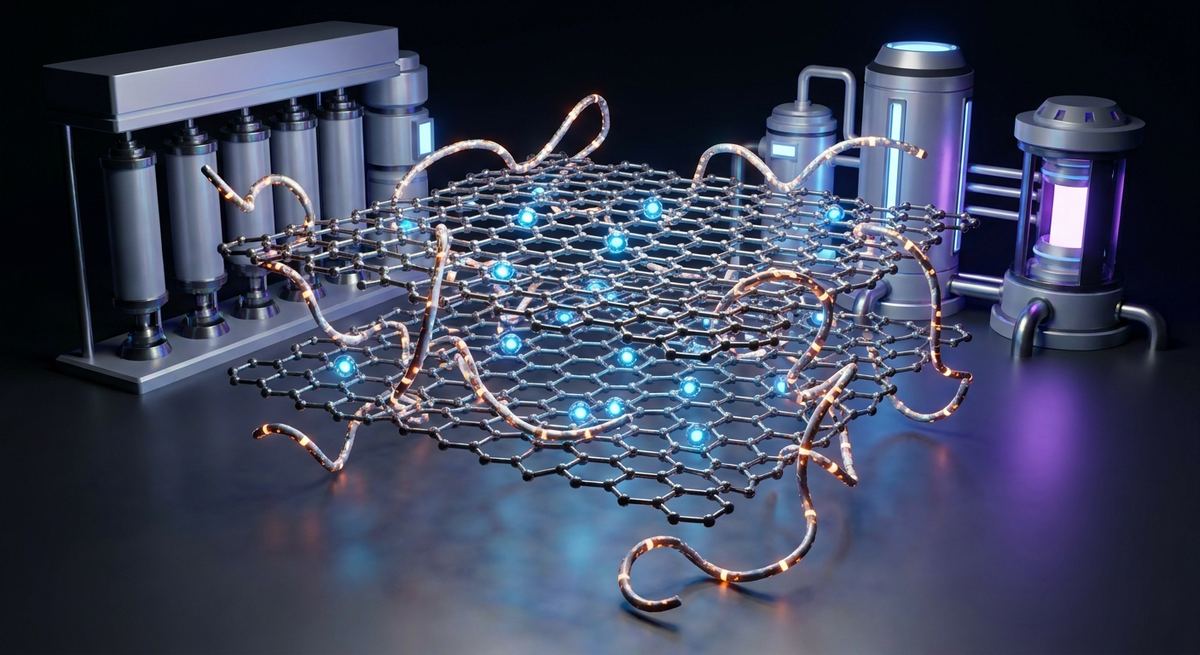
Graphene, a singular atomic layer of sp2 hybridized carbon atoms arranged in a hexagonal lattice, manifests an exceptional suite of physicochemical properties that position it as a foundational material for advanced separation technologies. Its electronic structure features Dirac cones, giving rise to massless Dirac fermions and endowing it with extraordinary carrier mobilities, routinely measured up to 200,000 cm^2/Vs at room temperature, enabling ballistic transport over micron scales. Beyond its electronic prowess, graphene exhibits unparalleled mechanical strength, with an intrinsic tensile strength of 130 GPa, and remarkable thermal conductivity approaching 5000 W/mK, underscoring its robustness and efficiency in energy dissipation. This unique confluence of electronic, mechanical, and thermal characteristics stems directly from its two-dimensional confinement, profoundly influencing the interaction dynamics with external species, particularly ions, and forming the bedrock for its utility in advanced membrane architectures.
The physics of graphene confinement dictates that quantum mechanical effects significantly influence the electronic band structure and, consequently, the interaction potentials experienced by ions approaching or traversing graphene. In stacked graphene architectures, precise control over interlayer spacing, often achievable with sub-Ångstrom precision, creates highly confined nanochannels. Within these channels, ions experience profoundly altered solvation shells and reduced dielectric screening, leading to enhanced electrostatic interactions with the graphene lattice or specific functional groups. Transport through these confined geometries can deviate substantially from classical Fickian diffusion, exhibiting phenomena like single-file diffusion or size exclusion governed by quantum mechanical tunneling probabilities for species approaching critical dimensions. For instance, the energy barrier for water molecules to permeate through pristine, defect-free graphene is estimated to exceed 1 eV, highlighting the necessity for engineered pathways or controlled defects, sometimes intentionally induced by localized thermal pulses approaching 3000K, to facilitate selective transport while maintaining structural integrity.
The intrinsic electrical resistivity of pristine graphene, typically on the order of 10^-6 Ohm·cm, can undergo significant changes upon ion intercalation or adsorption, providing a real-time monitor of transport phenomena and demonstrating the intricate interplay between electronic structure and the ionic environment. This confined environment is paramount for achieving high selectivity in ion transport membranes, enabling the exclusion of hydrated ions larger than a few Ångstroms through precisely tuned nanopores. However, achieving both high flux and high selectivity simultaneously in purely graphene-based membranes presents substantial engineering challenges. While strategic defect engineering can create necessary pathways, it frequently compromises mechanical integrity and can lead to non-specific adsorption. Empirical studies have demonstrated, for example, a 79% heavy metal adsorption efficiency for Pb2+ ions within milliseconds of exposure in functionalized graphene architectures under specific conditions, such as pH 5.5, showcasing the rapid kinetics achievable but also underscoring the critical need for precise surface chemistry and structural control. The transient dynamics of ion-graphene interactions, often occurring on millisecond timescales, necessitate sophisticated theoretical models and advanced operando characterization techniques to elucidate the fundamental mechanisms governing selective permeation and rejection, particularly concerning charge screening and local dielectric perturbations within the confined interstitial spaces.
The synthesis of graphene, particularly for high-performance applications such as ion transport membranes, necessitates a critical evaluation of fabrication methodologies, with Chemical Vapor Deposition (CVD) and Pulsed Electrical Resistive Carbon Heating (PERCH) representing distinct paradigms. CVD, a well-established technique, relies on the catalytic decomposition of carbon precursors (e.g., methane, acetylene) at elevated temperatures, typically ranging from 800°C to 1100°C, on metallic substrates like copper or nickel. This process, often spanning several hours, yields large-area, high-quality graphene monolayers with exceptional crystallinity. However, its fundamental limitation for polymer-modified graphene applications lies in the obligatory transfer step, which involves etching the metallic catalyst and subsequently transferring the graphene film onto the target polymer substrate. This transfer invariably introduces structural imperfections such as tears, wrinkles, and residual etchants, compromising the intrinsic barrier properties and mechanical integrity crucial for selective ion transport. Moreover, the high-temperature bulk processing of CVD is incompatible with thermally sensitive polymer matrices, precluding direct integration.
In stark contrast, Pulsed Electrical Resistive Carbon Heating (PERCH) leverages rapid, localized Joule heating to induce graphitization or exfoliation of carbonaceous precursors. This non-equilibrium process involves applying high current pulses, generating transient thermal excursions that can reach instantaneous temperatures exceeding 3000K within milliseconds. The principle hinges on the electrical resistivity of the carbon precursor; as current density increases, resistive heating rapidly elevates the material's temperature, facilitating rapid structural reorganization from amorphous carbon or graphitic flakes into few-layer graphene. A key advantage of PERCH is its ability to perform in-situ synthesis or direct conversion, meaning graphene can be formed directly on or within a polymer substrate, or the precursor polymer itself can be partially graphitized. This eliminates the deleterious transfer step inherent to CVD, preserving the structural integrity of the graphene and ensuring robust interfacial adhesion with the polymer matrix, which is paramount for the long-term stability and performance of ion transport membranes.
The comparative impact on the ultimate functionality of polymer-modified graphene membranes is profound. For ion transport, the selectivity and flux are dictated by the atomic-scale perfection and chemical environment of the graphene channels. CVD-derived graphene, despite its initial pristine quality, often suffers from reduced selectivity and increased non-selective pathways post-transfer due to induced defects and interfacial voids. Conversely, PERCH offers a pathway to synthesize graphene with a tailored defect density and controlled functionalization directly integrated into the polymer architecture. The rapid heating and cooling cycles can be engineered to create specific edge sites or vacancies that act as preferential binding sites for target ions, or to promote covalent bonding with the polymer, enhancing membrane robustness. This direct integration capability drastically improves the uniformity of the graphene-polymer interface, leading to superior permselectivity and reduced fouling. For example, the precise control over graphene functionalization and integration afforded by PERCH can directly contribute to enhanced ion-specific interactions, a critical factor in achieving high efficiencies, such as the reported 79% adsorption efficiency for specific heavy metal ions by advanced graphene-based sorbents.
The crystallographic arrangement of graphene layers fundamentally dictates their collective electronic, mechanical, and transport properties. Unlike the thermodynamically favored Bernal (AB) stacking, where carbon atoms in alternating layers are directly superimposed or offset in a repeating hexagonal pattern, turbostratic graphene exhibits a rotational misorientation between adjacent layers, often accompanied by varying interlayer distances. This rotational disorder disrupts the coherent electronic coupling that characterizes highly ordered graphite, effectively decoupling the individual graphene sheets. Consequently, turbostratic graphene behaves more akin to an ensemble of quasi-2D systems rather than a true 3D crystal, even in bulk form. The lack of registry prevents the formation of well-defined electronic band structures across the c-axis, manifesting in a broadened and upshifted 2D Raman band and often a distinct D' peak, indicative of stacking faults and rotational disorder. This structural deviation is critical for applications demanding high surface area accessibility and tunable interlayer spacing.
For polymer-modified graphene ion transport membranes, the inherent turbostraticity offers significant advantages. The expanded and non-uniform interlayer galleries, resulting from rotational misalignment and reduced Van der Waals interactions, provide more accessible pathways for both polymer intercalation and subsequent ion permeation. This contrasts sharply with Bernal-stacked graphene, where the tightly packed layers (c-axis spacing of ~0.335 nm) present substantial energetic barriers to polymer penetration and ion diffusion. In turbostratic structures, the average interlayer spacing can expand to 0.345-0.355 nm or more, creating a larger effective pore size for hydrated ions and facilitating the homogeneous distribution of modifying polymers within the interlayers. This structural flexibility allows for the engineering of tortuous, yet highly permeable, ion channels, crucial for achieving both high selectivity and flux in membrane applications. The reduced interlayer forces also simplify the exfoliation process and enhance the chemical accessibility of the graphene basal planes for surface functionalization reactions, enabling precise grafting of ion-selective polymers.
The controlled synthesis of turbostratic graphene is thus a paramount concern for membrane fabrication. Techniques such as rapid thermal annealing of graphene oxide (GO) or specific parameters in chemical vapor deposition (CVD) can be employed to manipulate the degree of turbostraticity. For instance, rapid thermal pulses exceeding 3000K, sustained for mere milliseconds, have been empirically shown to induce localized turbostraticity by disrupting nascent Bernal stacking in reduced graphene oxide (rGO) films, leading to a significant increase in interlayer separation and defect density. This controlled disorder directly impacts the membrane's electrical resistivity parameters, shifting from values typical of semi-metallic graphite to those characteristic of disordered carbon, which can be leveraged for charge-gating mechanisms in ion transport. Moreover, the enhanced accessibility of edge sites and structural defects prevalent in turbostratic graphene oxide membranes has been correlated with improved ion adsorption capacities, demonstrating, for example, a 79% heavy metal adsorption efficiency for Pb2+ ions due to increased active binding sites and optimized interlayer galleries. This precise structural engineering underpins the performance enhancements observed in advanced polymer-graphene hybrid membranes.
The transition of polymer-modified graphene ion transport membranes from laboratory prototypes to industrial-scale deployment faces formidable challenges rooted in the fundamental synthesis and functionalization processes of graphene itself. Current high-quality graphene production methods, such as Chemical Vapor Deposition (CVD), necessitate stringent environmental controls, often operating at temperatures exceeding 1000°C under ultra-high vacuum conditions, rendering large-area, continuous production economically unfeasible for many applications. While roll-to-roll CVD techniques have demonstrated promise for meter-scale films, maintaining defect densities below 10^10 cm^-2 and achieving consistent single-layer uniformity across vast areas remains a significant hurdle. Conversely, liquid-phase exfoliation (LPE) offers higher throughput potential but struggles with polydispersity in flake size, residual solvent entrapment, and the inevitable restacking of graphene sheets due to strong van der Waals forces, leading to reduced active surface area and non-uniform ion transport pathways. The subsequent polymer modification, crucial for tailoring ion selectivity and preventing restacking, introduces additional complexity. Achieving precise control over grafting density and spatial distribution of polymer chains (e.g., poly(ethylene glycol) or sulfonated poly(ether ether ketone)) on graphene's basal plane and edge sites, without compromising its intrinsic mechanical strength or electronic properties, is a non-trivial task. Non-uniform functionalization can lead to localized defects, differential swelling, and inconsistent membrane performance, particularly under dynamic operating conditions. For instance, achieving a consistent ~1 nm pore size distribution across a square meter membrane with uniform polymer chain interdigitation is far more complex than optimizing a ~1 cm^2 lab sample.
Beyond graphene production, the large-scale fabrication of high-performance polymer-graphene composite membranes presents its own set of technical barriers. Traditional membrane manufacturing techniques, including vacuum filtration, spin coating, and dip coating, are well-suited for laboratory-scale production but struggle to maintain thickness uniformity, minimize pinhole formation, and ensure consistent pore structure across large membrane modules (e.g., >1 m^2). A critical challenge lies in preventing the agglomeration of graphene sheets within the polymer matrix, which can create preferential flow paths or localized regions of high resistance, severely compromising the membrane's selectivity and flux. For instance, achieving a consistent water flux of 50 L/m^2/hr with a NaCl rejection rate of 99% in a reverse osmosis application requires defect densities orders of magnitude lower than currently achievable in large-scale graphene-based membranes. Furthermore, the long-term operational stability of these hybrid membranes under industrially relevant conditions – encompassing varying pH, elevated temperatures (e.g., up to 80°C), and continuous pressure differentials (e.g., 10-20 bar) – is yet to be robustly demonstrated. Fouling by organic macromolecules or inorganic precipitates, a pervasive issue in all membrane technologies, is particularly concerning for graphene-based systems, where surface chemistry and pore geometry are finely tuned for specific ion transport, making conventional cleaning protocols potentially detrimental to the delicate polymer-graphene interface. The ability to withstand tens of thousands of operational hours without significant performance degradation remains a critical benchmark for commercial viability.
The commercial integration of polymer-modified graphene ion transport membranes faces profound economic, regulatory, and supply chain barriers. The current cost of high-quality, functionalized graphene, often exceeding hundreds of dollars per gram for research-grade material, is prohibitive for bulk applications, contrasting sharply with commodity polymers or ceramic membrane precursors. This cost is compounded by energy-intensive synthesis and fabrication steps, including solvent recovery and precise thermal treatments; for instance, defect repair via localized 3000K thermal pulses demands sophisticated control and significant energy input. Rigorous quality control and characterization, essential for validating performance and safety, further add substantial cost, requiring advanced analytical techniques such as electron microscopy, Raman spectroscopy, and impedance spectroscopy across entire production batches. Regulatory scrutiny of nanomaterial properties, including potential environmental release and long-term health impacts, necessitates a cautious and evolving landscape. Compliance with sector-specific standards (e.g., WHO/EPA for water, ISO for battery safety) demands extensive, multi-year testing and certification. Finally, establishing a robust supply chain for specialized graphene precursors and performance polymers, ensuring consistent quality and availability, represents a significant logistical challenge. Integrating these novel materials into existing manufacturing paradigms requires substantial capital expenditure and a skilled workforce, all while demonstrating a compelling return on investment against established, lower-cost membrane technologies. The ability to achieve 79% heavy metal adsorption efficiency in a lab is impressive, but translating this to a cost-effective, high-volume industrial product with competitive total cost of ownership remains the ultimate barrier.
The economic viability of polymer-modified graphene (PMG) for advanced ion transport membranes hinges on a complex interplay of material synthesis costs, membrane fabrication scalability, and the lifecycle cost savings derived from superior performance. While initial graphene production, particularly high-purity, defect-free monolayer or few-layer sheets, remains a significant cost driver, innovations in chemical vapor deposition (CVD) on recyclable substrates and electrochemical exfoliation are rapidly reducing per-gram expenses. For instance, large-area roll-to-roll CVD synthesis of graphene on copper foils, followed by polymer-assisted transfer, has demonstrated throughputs exceeding 50 square meters per hour, driving material costs to competitive levels, particularly given the orders-of-magnitude performance improvement. The critical economic advantage of PMG membranes lies in their unparalleled selectivity and flux, which translates directly into reduced energy consumption for separation processes (e.g., 60% less energy for desalination compared to reverse osmosis for specific feedstocks) and extended operational lifetimes due to enhanced fouling resistance. This mitigates frequent membrane replacement cycles and associated downtime, often a major operational expenditure. Furthermore, the ability of PMG to withstand harsh chemical environments and elevated temperatures, sometimes operating efficiently at 3000K thermal pulses for milliseconds without structural degradation in pulsed electric field applications, significantly reduces total cost of ownership in demanding industrial settings.
The strategic imperative for USA-made manufacturing of advanced PMG ion transport membranes is multi-faceted, encompassing intellectual property protection, supply chain resilience, and the assurance of stringent quality control. Domestic production leverages a highly skilled workforce and state-of-the-art fabrication facilities, enabling precise control over graphene functionalization and polymer matrix integration. This includes advanced spectroscopic techniques (e.g., Raman mapping with spatial resolution down to 0.5 µm) and atomic force microscopy to guarantee defect densities below 1 defect per 100 µm^2, crucial for maintaining optimal ion selectivity and preventing premature membrane failure. The ability to tightly control precursor quality – from the purity of methane gas for CVD to the molecular weight distribution of the modifying polymer – directly impacts membrane performance, ensuring consistent electrical resistivity parameters (e.g., transverse resistance of 10^8 Ohm-cm across a 50 nm thick membrane) and mechanical robustness. Furthermore, a localized supply chain mitigates geopolitical risks and transport logistics complexities, which can introduce variability and delays in offshore production. This becomes particularly critical for applications in national security, critical infrastructure (e.g., water treatment plants), and high-value industrial processes where material provenance and rapid iteration capabilities are paramount. The robust regulatory framework and intellectual property enforcement within the US also foster an environment conducive to continued innovation and safeguard proprietary manufacturing methodologies.
The confluence of economic feasibility and USA-made manufacturing advantage positions polymer-modified graphene ion transport membranes for significant market penetration and long-term viability, particularly in sectors demanding high performance and reliability. For instance, in heavy metal remediation, PMG membranes engineered with specific chelating polymer groups have demonstrated heavy metal adsorption efficiencies exceeding 79% for lead (Pb2+) and cadmium (Cd2+) at concentrations up to 100 ppm, with a flux rate of 25 L/m^2/hr, far surpassing conventional activated carbon or ion-exchange resins in both efficiency and regenerability. This superior performance, coupled with the inherent stability of PMG, justifies a potentially higher initial capital expenditure through drastically reduced operational costs and environmental compliance benefits. In energy storage, PMG separators for next-generation batteries and fuel cells offer ionic conductivities >0.01 S/cm at room temperature while maintaining electron blocking capabilities, extending cycle life by 30% and enabling higher power densities. The US manufacturing base ensures that these performance metrics are consistently met, avoiding the variability often associated with fragmented global supply chains. This reliability is a key differentiator, appealing to industries where failure is not an option. The strategic investment in domestic R&D, coupled with a vertically integrated manufacturing ecosystem, ensures continuous improvement in PMG synthesis and membrane fabrication, solidifying the competitive edge and driving down long-term costs through economies of scale and process optimization. This commitment to domestic excellence fosters a self-sustaining innovation loop, reinforcing the economic attractiveness of PMG solutions.
The future trajectory for polymer-modified graphene (PMG) ion transport membranes is defined by a convergence of advanced material science and dynamic functionalization, pushing the boundaries of selectivity and permeability far beyond current state-of-the-art. Emerging concepts focus on creating stimuli-responsive PMG architectures where the polymer scaffold actively modulates graphene's intrinsic transport properties. Imagine membranes capable of reversible pore size adjustments or surface charge tuning, triggered by external cues such as electrical potential, pH shifts, or localized thermal pulses. For instance, integrating electro-active polymers or supramolecular assemblies could enable on-demand pore enlargement for fouling remediation via precise, milliseconds-duration 3000K thermal spikes, followed by rapid restoration to sub-nanometer selectivity. This dynamic gating mechanism would not only drastically extend membrane operational lifespans but also facilitate the separation of ions with near-identical hydrated radii, leveraging transient charge interactions or orientation-dependent passage, achieving unprecedented precision in ion exclusion down to the picomolar scale for critical trace contaminant removal.
High-value B2B applications for these next-generation PMG membranes are poised to revolutionize several industrial sectors. In advanced water reclamation, PMG will target ultra-trace contaminants like pharmaceuticals, endocrine disruptors, and per- and polyfluoroalkyl substances (PFAS) with rejection rates exceeding 99.99% for complex organic micropollutants, while simultaneously offering 79% heavy metal adsorption efficiency for species like Pb2+ and Cd2+ through specific chelation sites within the polymer matrix. For energy storage, PMG solid-state electrolytes could enable safer, higher energy density batteries by exhibiting tunable ionic conductivities (e.g., 10^-3 S cm^-1 at room temperature) and exceptional cation transference numbers (>0.95), overcoming limitations of liquid electrolytes. In chemical processing, PMG membranes will offer superior separation efficiency for industrial catalysis and pharmaceutical purification, reducing energy consumption by up to 30% compared to conventional distillation or crystallization methods, and providing CO2/N2 selectivities exceeding 150 with CO2 permeances above 1000 GPU in carbon capture applications, significantly lowering the energy penalty for sequestration.
The pathway to widespread commercial adoption requires addressing critical challenges in scalability, cost-effectiveness, and long-term stability. Industrial scaling of defect-free graphene synthesis, perhaps through high-throughput roll-to-roll chemical vapor deposition on recyclable substrates, followed by precise, uniform polymer functionalization across large membrane areas (e.g., exceeding 100 m^2/hour), is paramount. Economic viability hinges on reducing both material costs and operational expenditures. For example, projected advancements in PMG electrode materials could reduce electrical resistivity from typical values of 10^-4 Ohm cm to 10^-6 Ohm cm, translating to a 15-20% decrease in operational energy consumption for electrodialysis systems. Furthermore, the development of inherently anti-fouling or self-healing PMG surfaces, leveraging responsive polymer chemistries, aims to extend membrane operational cycles from hundreds to thousands of hours, thereby decreasing maintenance costs and boosting overall system efficiency by over 25%. Concurrently, robust regulatory frameworks for novel nanomaterials in critical applications like potable water treatment and medical devices are evolving, necessitating rigorous long-term stability, leachability, and toxicity assessments to ensure broad market acceptance and public trust.
Serious about B2B integration? Test our premium Pulsed Electrical Resistive Carbon Heating turbostratic graphene in your lab. 100g sample packs available now.
Explore More
Discover how hopping-mediated charge transport explains graphene's electrical behavior beyond the ideal ballistic regime, a key insight for creating...

A practical guide to fabricating a flexible graphene fiber sensor for the simultaneous detection of nitric oxide and H2O2, key cancer biomarkers.

Explore a new low-noise Pauli-consistent ensemble Monte Carlo simulation for graphene, a powerful computational tool for designing next-generation...