
AI-Powered Characterization of Twisted Bilayer Graphene and 2D Materials
Learn how deep learning is revolutionizing the structural characterization of twisted bilayer materials, accelerating the development of next-generation...
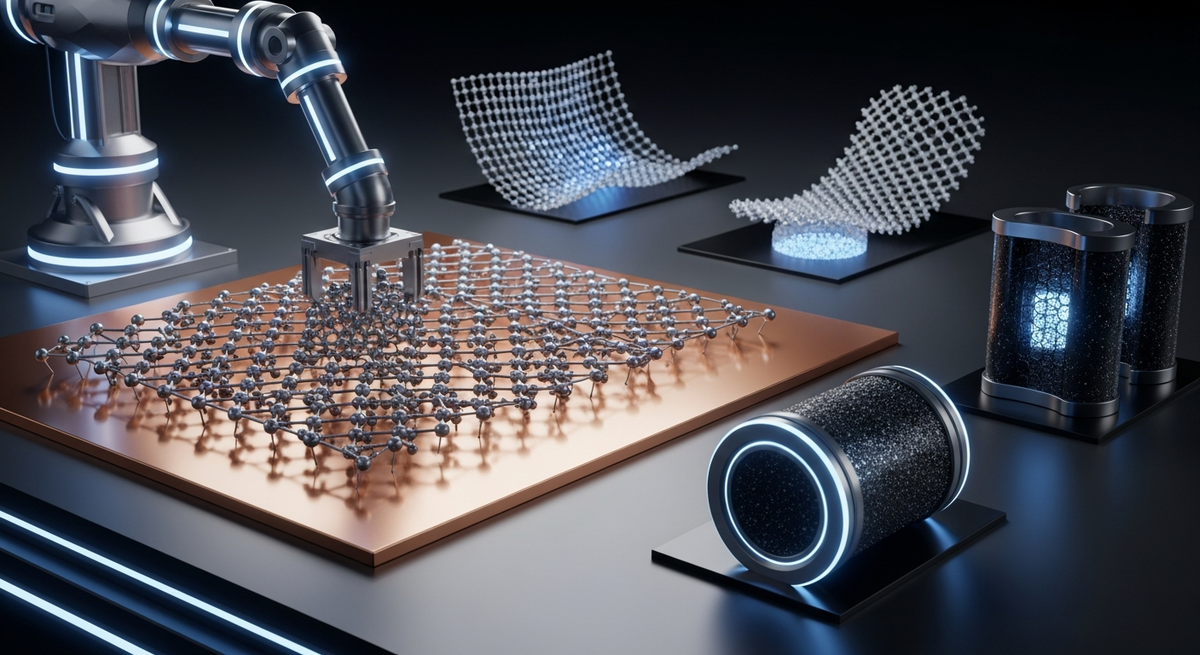
The landscape of materials science experienced a profound transformation with the advent of graphene, introducing a new paradigm in dimensionality. Unlike its low-dimensional predecessors such as fullerenes and nanotubes, graphene offers an unparalleled combination of intrinsic processability and broad applicability. Since its initial isolation, extensive research has unveiled its extraordinary properties, including charge mobilities reaching up to 1,000,000 cm2 V−1 s−1, remarkable broadband optical transparency, and a linear dispersion relation that gives rise to massless Dirac fermions. These attributes are complemented by a near-zero intrinsic bandgap, tunable bandgap characteristics, an exceptional tensile modulus of 1 TPa, and a thermal conductivity of 5300 W m−1 K−1, ranking among the highest reported.
Historically, foundational investigations into graphene’s intrinsic properties relied heavily on mechanically exfoliated graphene sourced from highly oriented pyrolytic graphite. This method yielded crystallographically ideal material, serving as a pristine testbed for fundamental exploration and enabling the precise measurement of many of the unique properties now associated with graphene. However, mechanical exfoliation inherently limits the output to micron- and submicron-sized crystals, randomly located and lacking the reproducibility and scalability essential for industrial adoption. Despite its high quality, the inherent limitations of this top-down approach rendered it unsuitable for the mass production required by emerging technological applications.
Recognizing graphene’s immense potential across diverse sectors—from flexible transparent conductors and integrated circuit elements to high-frequency transistors, ultracapacitors, and advanced composite materials—the industry urgently sought scalable and economical synthesis routes. The necessity for large-area, high-quality graphene propelled the development of bottom-up synthesis methods. Among these, Chemical Vapor Deposition (CVD) on catalytic metal substrates has emerged as the most industrially viable and preferred method, particularly with the groundbreaking introduction of copper as a growth catalyst. This innovation marked a significant leap forward, promising large-area, high-quality CVD Graphene on Copper at a cost-effective scale, aligning perfectly with the demands of modern technological integration.
The journey toward scalable graphene production has navigated various synthesis methodologies, each presenting distinct advantages and limitations. While mechanical exfoliation provided pristine samples for fundamental research, its inability to produce large areas or control crystal placement rendered it impractical for commercial applications. Alternative top-down approaches, such as chemical exfoliation involving the agitation of intercalated graphite or the chemical reduction of graphene oxide, offered routes to larger quantities capable of coating expansive surfaces. These methods, often coupled with mechanical deposition techniques like spray casting or screen printing, produce an ensemble of graphitic material. However, this material frequently falls short of the high quality inherent to a continuous graphene monolayer, often exhibiting issues related to out-of-plane interflake connectivity, dominant tunnel barriers, and altered chemical structures, thus compromising its performance in demanding applications.
Early bottom-up synthesis efforts included epitaxial growth on silicon carbide (SiC), achieved by sublimating silicon atoms from the crystal surface. This technique delivered high-quality graphene, enabling the development of some of the fastest GHz circuits. Despite its performance, the SiC substrate proved exceptionally expensive, and the high processing temperatures, typically around 1500°C, restricted its compatibility with many other substrates, limiting its commercial feasibility to highly specialized, high-performance electronic applications. Direct chemical assembly of benzene subunits also showed promise but faced challenges with poor areal coverage and inconsistent graphitic quality, necessitating further development to overcome these hurdles.
Against this backdrop, Chemical Vapor Deposition on catalytic metal substrates distinguished itself as a superior approach. Its wide process window, inherent compatibility with large-area production, and familiarity within the semiconductor industry positioned CVD as the preferred method for synthesizing graphene across nearly all applications. Initial CVD processes explored various transition metals such as iridium, ruthenium, platinum, palladium, and nickel. While these metals offered catalytic activity, the pivotal breakthrough arrived with the strategic implementation of copper. Copper’s unique properties as a catalyst profoundly altered the landscape of CVD graphene synthesis, offering a path to high-quality, continuous monolayer graphene with unprecedented scalability.
The introduction of copper as a growth catalyst for graphene synthesis by chemical vapor deposition fundamentally transformed the prospects for large-scale, high-quality graphene production. Previous CVD methods utilizing transition metals like nickel often suffered from issues related to carbon solubility. In these systems, carbon atoms from the precursor gas, typically methane, readily dissolve into the bulk of the metal substrate at high temperatures. Upon cooling, the dissolved carbon precipitates out, forming multiple layers of graphene or graphite, which hinders the precise control over monolayer formation crucial for many advanced applications.
Copper, however, presents a distinct advantage due to its significantly lower carbon solubility at typical CVD growth temperatures. This characteristic promotes a surface-mediated growth mechanism, where carbon atoms primarily remain on the surface of the copper foil rather than dissolving into its bulk. This surface-limited growth is paramount for the formation of uniform, high-quality monolayer graphene. The controlled interaction of carbon precursors with the copper surface allows for precise regulation of graphene nucleation and growth kinetics, leading to continuous, large-area films with minimal defects. This distinction represents the “giant leap forward” that copper provided, moving beyond the challenges faced with other transition metals and enabling the promise of large-area graphene at low cost.
This surface-mediated growth mechanism is critical for ensuring the uniformity and structural integrity of the synthesized graphene. By minimizing bulk precipitation, researchers can achieve better control over the number of graphene layers, predominantly producing monolayer films essential for maximizing graphene’s unique electrical and optical properties. The ability to reliably produce large-area monolayer CVD Graphene on Copper has thus been instrumental in bridging the gap between laboratory-scale demonstrations and industrial-scale manufacturing, making graphene more accessible for a wider array of technological applications.
The successful synthesis of high-quality CVD Graphene on Copper is a meticulously controlled process, beginning with precise substrate preparation and extending through intricate growth kinetics. The quality of the copper substrate itself is paramount; typically, high-purity copper foils are used, and their surface must be meticulously cleaned and annealed to remove native oxides and surface contaminants. This initial preparation ensures a uniform and active catalytic surface, which is critical for consistent nucleation and growth of graphene domains. Annealing at elevated temperatures, often in a hydrogen atmosphere, further refines the copper surface, reducing surface roughness and promoting larger copper grain sizes, both of which positively influence graphene quality.
Following substrate preparation, the crystal nucleation phase initiates as carbon-containing precursor gases, such as methane, are introduced into the CVD chamber at high temperatures. Carbon atoms decompose on the hot copper surface, and individual graphene nuclei begin to form. The density and distribution of these nucleation sites are highly sensitive to growth conditions, including temperature, pressure, and the flow rates of precursor gases. A lower nucleation density generally facilitates the growth of larger, more uniform graphene domains by reducing competition between growing crystals.
Growth kinetics govern the expansion of these initial graphene nuclei into continuous films. This process involves the adsorption of carbon species onto the copper surface, their diffusion across the surface, and their incorporation into the growing graphene lattice. Factors such as temperature, precursor concentration, and reaction time directly influence the growth rate and the final size of the graphene domains. Higher temperatures generally increase surface diffusion rates, while optimized precursor concentrations ensure a steady supply of carbon without oversaturation, which could lead to multi-layer growth. Understanding the reaction energetics – the thermodynamic stability and kinetic barriers of carbon species on the copper surface – is crucial for fine-tuning these parameters to achieve desired graphene quality and morphology.
The crystal morphology of the synthesized graphene, encompassing parameters like grain size, shape, and orientation, is a direct consequence of the growth conditions. By carefully controlling temperature ramps, gas flow rates, and cooling procedures, researchers can influence whether graphene grows as isolated hexagonal domains or as a continuous, polycrystalline film. Minimizing defects and achieving large, single-crystal domains are key objectives, as grain boundaries in polycrystalline graphene can degrade its electrical and mechanical properties. Furthermore, careful control is required to prevent the formation of secondary crystal layers, which are undesirable multi-layer regions that can compromise the monolayer purity of the film. This involves precisely managing the carbon supply and ensuring that growth terminates before excessive carbon accumulation leads to additional layer formation, thereby preserving the high quality of the monolayer graphene desired for advanced applications.
While CVD Graphene on Copper offers an unparalleled route to large-area, high-quality material, copper is a conductive metal, limiting direct integration into many applications that require graphene on insulating or flexible substrates. This necessitates a crucial post-synthesis step: graphene transfer. The most common transfer methods involve spin-coating a polymer support layer, such as PMMA (polymethyl methacrylate), onto the graphene film still on its copper substrate. The copper foil is then selectively etched away using a chemical etchant, typically an iron chloride (FeCl3) solution. Once the copper is dissolved, the polymer-supported graphene film is carefully scooped or lifted and transferred to the desired target substrate, after which the polymer support is removed, often by dissolving it in acetone or another solvent.
Maintaining the cleanliness of these transfer processes is paramount for preserving the intrinsic properties of the graphene. Residual polymer films, etchant residues, or trapped contaminants between the graphene and the target substrate can significantly degrade graphene’s electrical mobility, increase contact resistance, and compromise its optical transparency and mechanical integrity. Advanced rinsing techniques, optimized polymer removal protocols, and inert atmosphere handling are employed to minimize contamination and ensure a pristine interface between the transferred graphene and its new substrate. The goal is to achieve a clean transfer that does not introduce defects or impurities that could undo the quality achieved during the CVD growth itself.
Beyond traditional wet transfer methods, research continues into developing cleaner and more efficient transfer techniques, including dry transfer processes and direct growth on dielectrics. Direct growth on dielectric substrates would eliminate the need for a separate transfer step altogether, offering a potentially cleaner and more scalable integration pathway. However, direct growth on insulators presents its own set of challenges, primarily related to the high temperatures required for CVD and the lack of catalytic activity on many dielectric surfaces. Despite these challenges, the continuous refinement of transfer methodologies and the exploration of direct growth approaches are critical for unlocking the full industrial potential of CVD graphene.
The ultimate measure of success for any graphene synthesis method lies in the intrinsic properties of the resulting material. CVD-synthesized graphene, particularly that grown on copper, aims to replicate the exceptional electrical, mechanical, and optical characteristics first observed in mechanically exfoliated samples. The abstract for this chapter highlights graphene’s remarkable charge mobilities, which can reach up to 1,000,000 cm2 V−1 s−1. Achieving such high mobilities in large-area, industrially produced CVD graphene is a primary objective, directly impacting its suitability for high-performance electronic applications such as high-frequency (GHz) transistors and integrated circuit elements.
Beyond electrical transport, the mechanical robustness of CVD graphene is critical for flexible electronics and composite materials, boasting an unprecedented tensile modulus of 1 TPa. Its high thermal conductivity, recorded at 5300 W m−1 K−1, is vital for thermal management in advanced devices. The unique optical properties, including broadband transparency and tunable bandgap characteristics, are essential for applications like transparent conductors, plasmonic sensors, and optical modulators. The ability to precisely control the growth conditions during CVD on copper allows for optimization of these properties, ensuring that the synthesized material meets the rigorous demands of specific applications.
While mechanically exfoliated graphene often serves as the benchmark for pristine quality, ongoing advancements in CVD Graphene on Copper synthesis are continuously narrowing the performance gap. Careful control over nucleation density, growth kinetics, and crystal morphology directly translates into improvements in carrier mobility, defect density, and overall film uniformity. The focus on minimizing grain boundaries and eliminating secondary layer growth is pivotal, as these structural imperfections can significantly degrade electrical and mechanical performance. As synthesis and transfer techniques mature, CVD graphene is increasingly demonstrating properties comparable to its exfoliated counterpart, validating its role as the scalable material of choice for the next generation of graphene-enabled technologies.
The true industrial promise of CVD Graphene on Copper lies in its inherent scalability, a characteristic that fundamentally differentiates it from earlier synthesis methods. The ability to produce large-area graphene at low cost is not merely an academic aspiration but a commercial imperative for its widespread adoption. Current research and development efforts are intensely focused on translating batch-based laboratory processes into continuous, high-throughput manufacturing schemes, most notably through roll-to-roll (R2R) production.
Roll-to-roll CVD systems enable the continuous feeding of large copper foils through a series of chambers for annealing, graphene growth, and subsequent transfer. This methodology significantly boosts production volume, drastically reducing the per-unit cost of graphene. The scaling-up schemes extend beyond just the growth process to include integrated, automated transfer methods that maintain graphene quality while handling vast material quantities. Such advancements are crucial for meeting the demands of applications requiring square meters of graphene, such as flexible transparent electrodes for displays, large-area sensors, and advanced battery electrodes.
The widespread applicability of graphene, as highlighted by its potential use in flexible transparent conductors, integrated circuit elements, high-frequency transistors, ultracapacitors, battery electrodes, porous membranes for filtration and desalination, passivation layers, catalytic supports, plasmonic sensors, and composite materials, underscores the urgency for robust scaling solutions. Each of these applications requires not only large areas but also consistent quality and reproducibility across batches. The continuous refinement of CVD Graphene on Copper technology, coupled with sophisticated process control and quality assurance, is steadily paving the way for graphene to transition from a material of scientific fascination to a cornerstone of industrial innovation.
Q1: What makes copper an ideal substrate for CVD graphene synthesis?
Copper is ideal due to its low carbon solubility at typical growth temperatures, which promotes a surface-mediated growth mechanism. This characteristic minimizes carbon precipitation into the bulk, ensuring the formation of high-quality, uniform monolayer graphene. Its catalytic activity also efficiently decomposes carbon precursors, facilitating controlled nucleation and growth.
Q2: How does CVD graphene on copper compare to mechanically exfoliated graphene in terms of quality?
While mechanically exfoliated graphene often serves as a benchmark for pristine material, optimized CVD Graphene on Copper can achieve comparable high quality, especially in terms of electrical mobility and structural integrity. CVD offers the crucial advantage of scalability and large-area production, whereas exfoliation is limited to micron-sized flakes unsuitable for industrial applications.
Q3: What are the primary challenges in scaling up CVD graphene production on copper?
Key challenges include ensuring consistent graphene uniformity and minimizing defect density across large areas, optimizing the efficiency and cleanliness of transfer processes, and reducing overall production costs. Developing reliable, high-throughput roll-to-roll systems and robust quality control mechanisms are central to overcoming these hurdles.
Q4: What critical properties of graphene make it suitable for a wide range of applications?
Graphene's exceptional properties include extremely high charge mobilities (up to 1,000,000 cm2 V−1 s−1), unprecedented mechanical strength (1 TPa tensile modulus), superior thermal conductivity (5300 W m−1 K−1), and broadband optical transparency. These attributes make it highly versatile for electronics, energy storage, sensors, and structural materials.
Q5: Why are graphene transfer methods so crucial for industrial applications?
Graphene transfer methods are crucial because the as-grown graphene on copper needs to be placed onto diverse target substrates, such as insulators or flexible polymers, for most applications. These methods allow for the integration of high-quality CVD graphene into functional devices, preserving its properties while enabling broad material compatibility.
The journey from laboratory-isolated flakes to industrially scalable material represents a significant triumph in materials science, with Chemical Vapor Deposition on copper emerging as the definitive pathway. The ability to reliably synthesize large-area, high-quality CVD Graphene on Copper has directly addressed the critical need for an economical and scalable production method. This advancement is not merely incremental; it is foundational, enabling the transition of graphene from a material of profound scientific interest to a practical component across a multitude of advanced technological applications, from cutting-edge electronics to next-generation energy solutions.
As research continues to refine growth parameters, enhance transfer cleanliness, and optimize roll-to-roll manufacturing, the industrial landscape for graphene is set for unprecedented expansion. The inherent advantages of copper-catalyzed CVD, particularly its capacity for producing consistent monolayer films over vast areas, solidify its position as the cornerstone of commercial graphene production. For further insights into the latest advancements in graphene materials and their industrial applications, and to explore how high-quality graphene can integrate into your R&D projects, we invite you to connect with the experts at usa-graphene.com today.
Serious about B2B integration? Test our premium Pulsed Electrical Resistive Carbon Heating turbostratic graphene in your lab. 100g sample packs available now.
Explore More
Learn how deep learning is revolutionizing the structural characterization of twisted bilayer materials, accelerating the development of next-generation...

Learn to build a prototype graphene FET biosensor for sensitive DNA detection. This guide covers materials, fabrication, and testing for point-of-care...

Discover how hopping-mediated charge transport explains graphene's electrical behavior beyond the ideal ballistic regime, a key insight for creating...