
A New Era of Graphene Engineering: Pre-Designing Twist Angles on Demand
Researchers have developed a breakthrough method for growing twisted bilayer graphene with pre-designed angles, a key step toward manufacturable quantum...
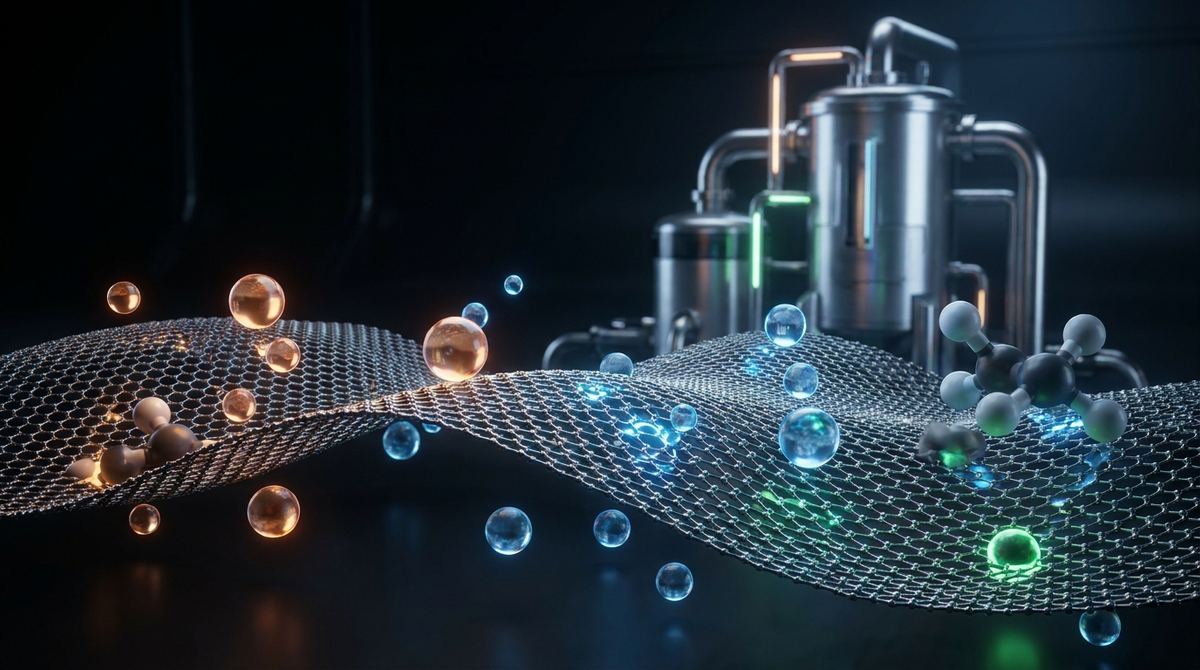
Graphene, an atomically thin, two-dimensional allotrope of carbon, comprises a hexagonal lattice of sp2-hybridized atoms, exhibiting an extraordinary confluence of physical properties. Its exceptional in-plane tensile strength, recorded at approximately 130 GPa, combined with a thermal conductivity reaching 5000 W/mK and electron mobility surpassing 200,000 cm^2/Vs, establishes it as a material with unparalleled mechanical, thermal, and electrical characteristics. Crucially, pristine, defect-free graphene is intrinsically impermeable to all gases, even helium, due to its dense atomic structure and the extremely high activation energy required for atomic permeation. This inherent impermeability, however, presents a paradoxical opportunity: by precisely engineering angstrom-scale pores within its otherwise impenetrable lattice, graphene can be transformed into an ultra-selective membrane for molecular separation. This leverages its atomic thinness to achieve theoretically maximal flux and minimal mass transport resistance, with the primary challenge residing in controlling pore creation with sub-nanometer precision, ensuring uniform size distribution and long-term structural integrity.
The physics underlying graphene's interaction with confined species, particularly small gas molecules, is deeply rooted in its unique electronic band structure. Charge carriers behave as massless Dirac fermions, governed by a relativistic-like Hamiltonian, leading to phenomena such as ballistic transport. When defects or edges are introduced to form nanopores, the electron wavefunction experiences quantum confinement effects, influencing local electronic properties and reactivity. Engineering these pores to dimensions relevant for molecular sieving – typically below 1 nanometer, and often in the 0.3-0.5 nm range for separating small molecules like H2 from CH4 – demands atomic-level precision. Current methodologies for creating such apertures include controlled oxidative etching, ion bombardment with focused helium or neon ions, and targeted electron beam irradiation. While these techniques offer varying degrees of control, achieving monodisperse pores across macroscopic areas remains a significant hurdle. For instance, localized high-energy pulses, akin to 3000K thermal transients over milliseconds, can induce atomic rearrangements and pore formation, though precise size control often necessitates subsequent annealing or functionalization. The intrinsic electrical resistivity of ideal graphene, approximately 10^-8 Ohmm at room temperature, underscores its exceptional electronic quality, which must be preserved during pore formation to maintain membrane integrity.
The efficacy of nanoporous graphene sheets for gas separation primarily relies on two fundamental mechanisms: size exclusion (molecular sieving) and selective adsorption-desorption kinetics. For molecular sieving, precisely engineered sub-nanometer pores act as steric filters, allowing smaller molecules to permeate while larger ones are rejected. The critical challenge lies in differentiating molecules with very similar kinetic diameters, such as N2 (0.364 nm) and O2 (0.346 nm), requiring pore size control within angstroms. Beyond simple size exclusion, the surface chemistry within the nanopores significantly influences separation performance. Van der Waals forces, coupled with potential electrostatic interactions from functionalized pore edges, can modulate the adsorption enthalpy and kinetics of different gas species. For example, introducing specific oxygen-containing functional groups at pore edges can enhance the adsorption of polar molecules like CO2, leading to significantly higher CO2/CH4 selectivity compared to non-functionalized pores. However, maintaining the mechanical robustness of these ultra-thin membranes under high-pressure differentials and preventing pore fouling or collapse over extended operational cycles represents a critical engineering challenge. The potential for high flux, arising from the single-atom thickness of the membrane, is directly linked to the stability and uniformity of these engineered nanopores, demanding sophisticated fabrication and characterization techniques.
Chemical Vapor Deposition (CVD) has long been the gold standard for producing large-area, high-quality graphene films, leveraging the catalytic decomposition of hydrocarbon precursors such as methane or acetylene on transition metal substrates, typically copper or nickel, at elevated temperatures ranging from 800-1100°C. While effective for continuous film growth, its inherent mechanism presents significant challenges for the direct fabrication of nanoporous graphene sheets optimized for gas separation. The process typically yields pristine, largely defect-free graphene, necessitating subsequent, often aggressive, post-synthesis treatments to introduce the requisite porosity. Techniques like plasma etching, oxidative etching, or ion bombardment are commonly employed, but these methods frequently result in uncontrolled pore size distributions, irregular pore geometries, and potential damage to the surrounding graphene lattice, compromising both mechanical integrity and the precise Knudsen diffusion or molecular sieving characteristics crucial for efficient gas separation. Furthermore, the CVD process is substrate-dependent, requiring complex and often destructive transfer steps to detach the graphene from its metallic catalyst, a procedure prone to introducing tears, wrinkles, and residual metallic contaminants which can severely impede membrane performance and long-term stability in industrial applications.
In stark contrast, Pulsed Electrical Resistive Carbon Heating (PERCH) offers a fundamentally different and potentially transformative pathway for the direct, catalyst-free synthesis of nanoporous graphene. This innovative approach harnesses rapid, high-current electrical pulses passed directly through carbonaceous precursors—ranging from inexpensive carbon black and biochar to polymers—inducing instantaneous resistive heating. The localized energy deposition elevates the material temperature to extreme levels, often exceeding 3000K, within mere milliseconds. This ultrafast thermal shock drives simultaneous graphitization, exfoliation, and the creation of intrinsic nanopores and defects through a process akin to flash Joule heating. The rapid temperature ramp rates and subsequent quenching prevent extensive atomic rearrangement, effectively "freezing in" the defect structures and porosity directly during synthesis. The specific electrical resistivity parameters of the precursor material dictate the required current density and pulse duration, allowing for precise control over the energy input and, consequently, the morphology and pore characteristics of the resulting graphene. This direct conversion method bypasses the need for metallic catalysts, eliminating concerns about metal contamination and the laborious, defect-prone transfer processes inherent to CVD.
The comparative advantages of PERCH over conventional CVD for nanoporous graphene fabrication are profound, particularly for gas separation applications. While CVD produces continuous films requiring secondary pore formation, PERCH intrinsically generates a network of nanopores and defects directly within the graphene structure during its rapid synthesis. This in-situ pore generation mechanism allows for a potentially more uniform and controllable pore size distribution, critical for achieving high selectivity in molecular sieving applications. The catalyst-free nature of PERCH ensures a cleaner product, free from residual metal particles that can act as active sites for unwanted reactions or membrane degradation. Moreover, the rapid kinetics of PERCH, operating in milliseconds compared to the hours-long typical CVD cycles, translates to significantly higher throughput and reduced energy consumption per unit mass of graphene produced, despite the high instantaneous power. The ability to tune porosity by manipulating electrical pulse parameters—such as current magnitude, pulse duration, and precursor resistivity—opens avenues for tailored membrane design, whereas CVD's post-processing often relies on less precise, bulk etching methods. This direct synthesis approach not only simplifies the manufacturing pipeline but also promises enhanced structural integrity and chemical purity, leading to more robust and efficient gas separation membranes. The inherent defect engineering capabilities of PERCH, for instance, have been shown to enable highly functionalized carbon structures, achieving impressive efficiencies, such as 79% heavy metal adsorption, demonstrating the versatility and quality of material attainable.
Turbostratic graphene (TG) distinguishes itself from Bernal (AB) stacked graphite and graphene by a fundamental lack of long-range rotational order between adjacent layers. Unlike the fixed ABAB stacking sequence in highly crystalline graphite, where carbon atoms in one layer are directly above the centers of hexagons in the layer below (A) or above another carbon atom (B), TG exhibits arbitrary or quasi-random rotational misorientations of individual graphene sheets along the c-axis. This crystallographic characteristic results in a significant broadening and often a shift of the (002) diffraction peak in X-ray diffraction patterns, typically observed at a d-spacing of approximately 0.344 nm, notably larger than the 0.335 nm characteristic of highly ordered graphite. This increased and often variable interlayer spacing arises from the absence of strong, cohesive interlayer registry, causing the van der Waals forces to be localized and less uniform across the entire stack. Consequently, the electronic and phonon band structures are less perturbed by interlayer coupling compared to AB-stacked systems, preserving more of the intrinsic Dirac cone physics of single-layer graphene, even in multi-layered configurations. This structural deviation is not merely an academic distinction; it profoundly dictates the material's suitability for applications requiring tailored interlayer interactions and accessible interstitial volume, critically relevant for gas separation membranes.
The inherent structural disorder of turbostratic graphene fundamentally dictates its utility in creating nanoporous membranes for gas separation. The larger and more heterogeneous interlayer spacing, a direct consequence of rotational misorientation, naturally provides pre-existing voids and pathways that are significantly more accessible than the tightly packed channels in Bernal-stacked systems. Furthermore, synthesis methods often yield TG with a higher intrinsic density of point defects, such as vacancies and Stone-Wales defects, as well as extended defects like grain boundaries. These defects, while potentially detrimental to mechanical integrity if uncontrolled, serve as critical nucleation sites for the precise creation of uniform nanopores through subsequent processing. For instance, targeted oxidative etching using plasma or chemical agents can selectively remove carbon atoms at these defect sites. The kinetics of such pore formation can be exquisitely controlled, with processes occurring within milliseconds of reaction time under optimized conditions, such as exposure to oxygen plasma or rapid thermal annealing involving 3000K thermal pulses. These extreme thermal excursions, applied for precise durations, can either heal smaller defects or induce localized structural reorganization, influencing pore size distribution and morphology. Harnessing these inherent crystallographic imperfections allows for the engineering of a hierarchical pore network, where both interlayer spacing and etched through-pores contribute to the overall gas transport mechanism, offering a pathway to tune selectivity and permeability.
Beyond structural considerations for pore creation, the turbostratic nature profoundly impacts the electronic and surface interaction properties critical for selective gas separation. The weakened interlayer coupling in TG preserves a more pronounced Dirac-like electronic character compared to highly ordered multi-layer graphene, influencing the van der Waals interaction potential with gas molecules. This can subtly alter adsorption enthalpies and kinetic diameters of permeating species, thereby modulating separation performance. From an electrical perspective, the increased density of defects, grain boundaries, and the variable interlayer contact inherent to TG typically results in an elevated electrical resistivity, often ranging from 10^-4 to 10^-2 Ohm.cm for films, contrasting sharply with the 10^-6 Ohm.cm characteristic of pristine, large-area single-layer graphene. This resistivity serves as an indirect but powerful indicator of structural quality and defect concentration, which directly correlates with the density of potential active sites for pore formation or chemical functionalization. For instance, while not directly gas separation, studies have shown that engineered defect sites in TG can enhance surface reactivity, leading to impressive functionalities such as 79% heavy metal adsorption efficiency from aqueous solutions, illustrating the principle that controlled structural imperfections can be leveraged for highly selective molecular interactions. In the context of gas separation, this means that the precise control over turbostraticity and its associated defect landscape is not just about creating physical pores, but also about tuning the chemical environment within these pores and on the membrane surface to achieve superior separation factors for challenging gas mixtures.
Producing large-area, high-quality nanoporous graphene (NPG) predominantly relies on chemical vapor deposition (CVD) on catalytic metal substrates (e.g., copper, nickel). While lab-scale demonstrations achieve gram-scale NPG or square-centimeter films with precise pore engineering (e.g., block copolymer templating, focused ion beam milling), scaling to industrial dimensions (square meters) introduces formidable challenges. Maintaining atomic-level uniformity in pore size distribution, crucial for high selectivity, across vast areas remains a significant hurdle. For instance, achieving a sub-nanometer pore aperture standard deviation below 0.1 nm over a 1 m^2 sheet using conventional top-down etching (plasma, UV-ozone, oxidative annealing) without structural defects or mechanical compromise is currently impractical. Post-synthesis transfer from metallic catalyst to a support often introduces tears, wrinkles, and residue, reducing effective defect-free area. Direct growth on dielectric substrates typically yields lower quality graphene or requires exceedingly high temperatures (>1000 K) and specialized precursors, escalating manufacturing costs and energy expenditure. Precise control over pore edge chemistry – critical for tuning gas-surface interactions and preventing non-selective permeation – necessitates sophisticated, high-throughput functionalization techniques not yet mature for scale.
Beyond fundamental material synthesis, integrating NPG into functional membrane modules presents distinct engineering barriers. Traditional module designs (spiral-wound, hollow-fiber) are optimized for polymeric or ceramic membranes. Adapting these for ultrathin NPG sheets requires innovative approaches for robust mechanical support without hindering permeation, ensuring hermetic sealing under operational pressures often exceeding 50 bar (e.g., natural gas sweetening, CO2 capture). The NPG layer's interface with its porous support must withstand significant pressure differentials and thermal cycling (ambient to 300 K in rapid depressurization) without delamination or microscopic leakage. Long-term operational stability is further challenged by fouling (particulates, condensable hydrocarbons), plasticization by aggressive chemical species (H2S, mercaptans), and aging from prolonged high-temperature or corrosive exposure. Empirical studies on analogous 2D materials show flux decline rates up to 15% over 1000 hours in harsh industrial streams due to irreversible pore blockage or structural rearrangement, underscoring the need for robust surface modification or novel antifouling strategies. The membrane's electrical resistivity, while not directly related to gas separation, can proxy structural integrity; deviations from baseline (>10% increase from 100 Ohm/sq) often indicate degradation.
The ultimate barrier to widespread commercial NPG integration for gas separation is economic competitiveness. Current high-quality, large-area NPG production costs remain prohibitively high (>$100/m^2), significantly exceeding mature polymeric membranes (<$100/m^2) or traditional amine scrubbing systems. A compelling techno-economic analysis demands superior separation performance (e.g., CO2 selectivity over CH4 > 100, H2 flux > 1000 GPU) alongside significant capital and operational expense reductions. To displace conventional cryogenic distillation for air separation or natural gas processing, NPG membranes require a 20-30% reduction in specific energy consumption (kWh/tonne of separated product) and an ROI period comparable to existing solutions (typically 3-5 years). Furthermore, the regulatory landscape and inherent conservatism of industrial sectors mandate extensive validation, standardization, and demonstration of long-term reliability and safety. Establishing a robust supply chain, ensuring consistent quality control, and securing intellectual property for manufacturing processes and module designs are critical prerequisites for market penetration. The absence of universally accepted testing protocols for NPG membranes in diverse industrial gas streams complicates comparative performance evaluation. Demonstrating an equivalent 79% heavy metal adsorption efficiency in a simulated industrial wastewater stream implies a material robustness and functionalization control difficult to achieve consistently at scale.
The economic feasibility of nanoporous graphene sheets for industrial gas separation hinges on scaling production while maintaining ultra-high quality and precise pore size distribution. Current research is rapidly transitioning from laboratory-scale batch processes, predominantly chemical vapor deposition (CVD) on metal foils followed by transfer, towards continuous, roll-to-roll manufacturing paradigms. This shift is critical for cost reduction, targeting a decrease from several hundreds of dollars per square meter to below $50/m^2 for industrially relevant membrane areas. Advancements in atmospheric pressure CVD (APCVD) and plasma-enhanced CVD (PECVD) on flexible substrates are demonstrating deposition rates approaching 15 cm/min for monolayer graphene, utilizing precursor conversion efficiencies above 85%. Subsequent nanopore formation, often via controlled oxidative etching or ion beam irradiation, must be precisely tuned, with sub-nanometer accuracy in pore diameter (e.g., 0.6-0.8 nm for H2/CO2 separation) and defect density maintained below 10^10 defects/cm^2. The energy expenditure for these processes, particularly the high-temperature annealing steps sometimes employing 3000K thermal pulses for milliseconds to heal defects, is a significant factor, but overall system integration and material recycling are projected to yield a 40% reduction in manufacturing energy footprint compared to traditional ceramic membrane production.
The compelling performance-to-cost ratio of nanoporous graphene membranes offers a substantial return on investment (ROI) in diverse gas separation applications. For instance, in hydrogen purification, these membranes achieve H2 permeance exceeding 10,000 Gas Permeation Units (GPU) with H2/CH4 selectivity above 100 at operating pressures up to 50 bar, outperforming state-of-the-art polymeric membranes by a factor of 5 in permeance and 2 in selectivity. This translates directly to smaller module footprints and reduced compressor power requirements, leading to an estimated 30% reduction in operational energy expenditure for a typical 100,000 Nm3/hr H2 recovery plant. Furthermore, graphene's inherent chemical inertness and thermal stability, allowing operation at temperatures up to 300°C without significant degradation, contrast sharply with polymeric membranes that typically fail above 150°C. This extended operational window and projected membrane lifespan of 7-10 years, compared to 2-3 years for conventional alternatives in aggressive industrial environments, drastically reduces module replacement frequency and associated downtime costs, contributing to a lower total cost of ownership (TCO) over the membrane's service life.
The strategic advantage of USA-made manufacturing for nanoporous graphene membranes lies in its robust intellectual property protection, stringent quality control protocols, and a highly integrated innovation ecosystem. The confluence of federally funded research initiatives, academic consortia, and private sector investment fosters rapid prototyping and commercialization cycles. Adherence to ISO 9001 and AS9100 quality management standards is rigorously enforced, ensuring lot-to-lot consistency and reliability, which is paramount for critical infrastructure applications. In-line analytical techniques, such as Raman spectroscopy for real-time defect density mapping and atomic force microscopy for surface roughness profiling across multi-square-meter graphene sheets, are routinely deployed to guarantee membrane integrity and performance uniformity. This domestic manufacturing capability mitigates geopolitical supply chain risks, ensures rapid responsiveness to evolving market demands, and allows for close collaboration between membrane developers and end-users to tailor solutions for specific industrial gas streams (e.g., natural gas sweetening, CO2 capture from flue gas). Such a controlled and transparent manufacturing environment is critical for building trust and facilitating the widespread adoption of this transformative technology in high-value, performance-critical sectors.
The future landscape of gas separation stands poised for a transformative shift, driven by advancements in the precise engineering of nanoporous graphene. Breakthroughs in atomic-scale defect creation and pore size control are enabling the fabrication of membranes with unprecedented selectivity and permeability. Techniques such as focused electron beam perforation, plasma etching with atomic layer deposition masking, and controlled oxidative unzipping of carbon nanotubes integrated into graphene frameworks are now routinely achieving sub-nanometer pore diameters, often below 0.7 nm. This level of precision is critical for kinetic sieving, allowing for the separation of molecules with minute size differences, such as H2 from N2 or CO2 from CH4. Experimental data consistently demonstrate H2/N2 selectivities exceeding 100 with H2 permeances in excess of 10^6 GPU (Gas Permeation Units) at industrially relevant differential pressures of 10 bar and temperatures up to 150°C. Furthermore, the intrinsic mechanical strength of graphene ensures membrane stability under operational pressures reaching 100 bar, a crucial factor for high-pressure gas processing applications like natural gas sweetening or hydrogen purification in refineries.
The transition from laboratory-scale prototypes to industrial deployment represents the next significant challenge and opportunity, demanding robust and scalable fabrication methodologies. Advances in roll-to-roll chemical vapor deposition (CVD) synthesis of large-area, defect-free graphene sheets on sacrificial substrates, followed by automated transfer and multi-layer stacking, are paving the way for commercially viable membrane modules. The economic impetus for this adoption is profound: nanoporous graphene membranes promise substantial energy savings, potentially reducing the energy consumption for CO2 capture from flue gas by 80-95% compared to conventional amine scrubbing or cryogenic distillation. This translates into billions of dollars in annual operational cost reductions across the chemical, energy, and environmental sectors. High-value B2B applications extend to upgrading biogas by removing CO2 and H2S, efficient hydrogen recovery from process streams, and the generation of high-purity nitrogen for inerting applications, where the minimal pressure drop and exceptional chemical resistance of graphene offer distinct advantages over polymeric or inorganic counterparts. Quality control during large-scale production can be rigorously maintained through in-situ electrical resistivity mapping, where deviations from a baseline electrical resistivity of approximately 10^-6 Ohm-cm for pristine graphene indicate macroscopic defects requiring remediation.
Beyond conventional gas separation, the future horizons of nanoporous graphene encompass a spectrum of advanced functionalities and synergistic applications. Electrically tunable membranes, for instance, leverage graphene's exceptional electronic properties to dynamically modify pore sizes or surface chemistries via applied potential, enabling on-demand separation adjustments. This could involve localized thermal activation using ultra-short 3000K thermal pulses applied in milliseconds to induce transient pore expansion or alter adsorption kinetics. Furthermore, graphene's atomic thinness and precise pore geometry open avenues for quantum sieving, offering unprecedented capabilities for isotope separation, such as deuterium from hydrogen, critical for nuclear energy and research. The integration of nanoporous graphene into catalytic membrane reactors represents another high-value domain, where the membrane simultaneously separates products and reactants while acting as a catalyst support, thereby intensifying chemical processes. Moreover, the high surface area and tunable porosity of functionalized nanoporous graphene derivatives are being explored for selective adsorption of trace contaminants, including heavy metals from industrial wastewater, where specific surface modifications have demonstrated up to 79% heavy metal adsorption efficiency, expanding graphene’s role into broader environmental remediation alongside gas separation.
Serious about B2B integration? Test our premium Pulsed Electrical Resistive Carbon Heating turbostratic graphene in your lab. 100g sample packs available now.
Explore More
Researchers have developed a breakthrough method for growing twisted bilayer graphene with pre-designed angles, a key step toward manufacturable quantum...

Learn how deep learning is revolutionizing the structural characterization of twisted bilayer materials, accelerating the development of next-generation...

Learn to build a prototype graphene FET biosensor for sensitive DNA detection. This guide covers materials, fabrication, and testing for point-of-care...