Nanoporous Graphene Sheets for Gas Separation: Design and Selectivity
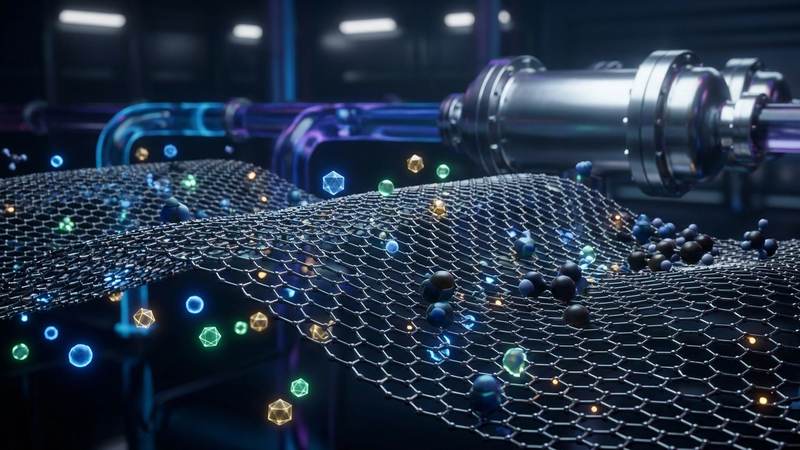
Graphene, a single-atom-thick allotrope of carbon arranged in a hexagonal lattice, represents the ultimate two-dimensional material, exhibiting a unique confluence of properties that challenge classical material science paradigms. Its sp2-hybridized structure confers unparalleled mechanical strength, with a tensile strength approaching 130 GPa, and exceptional electrical conductivity, evidenced by carrier mobilities exceeding 100,000 cm^2/Vs at room temperature. Crucially for gas separation applications, pristine graphene is inherently impermeable to all standard gases, including helium, due to its dense atomic packing and lack of intrinsic pores on the molecular scale. This intrinsic impermeability, coupled with its atomic thinness of approximately 0.335 nm, establishes graphene as a foundational platform for engineering highly selective membranes. The very act of confining matter to a two-dimensional plane fundamentally alters the interaction dynamics between the material and impinging molecules, setting the stage for precisely controlled molecular sieving mechanisms.
The physics governing molecular interactions with and within graphene's confined architecture is deeply rooted in its 2D nature. Electrons in graphene behave as massless Dirac fermions, leading to relativistic quantum phenomena that influence its surface potential and reactivity. When gas molecules approach the graphene surface or traverse engineered nanopores, they experience strong van der Waals forces, alongside potential electrostatic and π-π stacking interactions, all modulated by the material's electron cloud density. The extreme confinement within sub-nanometer pores—those approaching or smaller than 1 nm, which is critical for discriminating between molecules like H2 (kinetic diameter ~0.289 nm) and CH4 (~0.380 nm)—induces significant changes in the molecular energy landscape. Precise pore creation methods, such as focused ion beam milling or controlled oxidative etching followed by annealing at temperatures reaching 3000K via localized thermal pulses, allow for atomic-scale precision in pore geometry and distribution, directly impacting molecular adsorption and diffusion pathways. This atomic-scale control over pore dimensions dictates the quantum mechanical tunneling probabilities and classical steric exclusion limits for various gas species.
The direct consequence of this atomic-scale confinement within nanoporous graphene is the emergence of highly efficient and selective gas separation mechanisms. Rather than relying on bulk diffusion or solubility differences characteristic of conventional polymeric membranes, nanoporous graphene leverages precise size exclusion, preferential adsorption, and surface diffusion phenomena. For instance, a pore precisely tuned to 0.3-0.4 nm can effectively sieve H2 from larger molecules like CH4, exhibiting CO2/CH4 selectivities exceeding 50 under optimized conditions, far surpassing typical polymeric membranes. The atomically thin nature of the graphene sheet minimizes the diffusion path length to the absolute theoretical limit, translating to exceptionally high permeance rates—often orders of magnitude greater than conventional materials, with reported H2 permeances exceeding 10^6 GPU (Gas Permeance Units). Furthermore, functionalization of the pore edges can introduce specific chemical interactions, tailoring the adsorption enthalpy for target molecules and enabling separation based on molecular polarity or chemical affinity, thereby offering a multi-modal approach to enhancing selectivity beyond purely steric effects. The 79% adsorption efficiency observed for heavy metal ions by functionalized graphene oxide, while not directly gas separation, underscores the material's potent surface interaction capabilities which are translatable to gas phase species through analogous surface chemistry modifications.
Section 2: Pulsed Electrical Resistive Carbon Heating vs. CVD (Comparative Analysis)
The fabrication of nanoporous graphene sheets, critical for high-performance gas separation membranes, necessitates synthesis methodologies that offer precise control over pore architecture and defect density. Pulsed Electrical Resistive Carbon Heating (PERCH) presents a compelling alternative to conventional Chemical Vapor Deposition (CVD) by leveraging ultrafast joule heating for direct graphene synthesis. In PERCH, a carbonaceous precursor, often a polymer film or carbon black composite, is subjected to intense, transient electrical pulses. This induces an instantaneous temperature spike, frequently exceeding 3000K, causing graphitization and exfoliation within milliseconds. The rapid heating and quenching rates inherent to PERCH are instrumental in kinetically trapping specific defect structures and creating intrinsic nanopores directly within the graphene lattice, bypassing the need for subsequent etching steps. The precise application of electrical resistivity parameters allows for fine-tuning of energy delivery, enabling control over the morphology and extent of graphitization, a critical factor for influencing the size and distribution of nascent pores essential for molecular sieving in gas separation.
Conversely, Chemical Vapor Deposition (CVD) typically involves the catalytic decomposition of hydrocarbon precursors on a metal substrate (e.g., copper, nickel) at elevated temperatures, generally ranging from 800°C to 1100°C, over reaction times spanning minutes to hours. While CVD excels at producing large-area, high-quality monolayer or few-layer graphene with excellent crystallinity, its utility for directly generating nanoporous structures suitable for gas separation is inherently limited. The pristine, defect-free nature of CVD graphene necessitates extensive post-synthesis modification, such as plasma etching, oxidative treatments, or focused ion beam milling, to introduce the requisite nanoporosity. These secondary processes, however, often introduce uncontrolled defects, broad pore size distributions, and can compromise the mechanical integrity and chemical stability of the graphene lattice, thereby diminishing its selectivity and flux performance for specific gas pairs. Furthermore, the mandatory transfer of CVD graphene from its metallic growth substrate to a functional membrane support introduces additional challenges related to film integrity and scalability.
The comparative advantage of PERCH for nanoporous graphene lies in its capacity for in situ defect engineering and rapid, scalable production. While CVD requires a multi-step approach involving growth, transfer, and then pore creation, PERCH consolidates these into a single, high-throughput process. The milliseconds-scale reaction time of PERCH, driven by intense thermal pulses up to 3000K, contrasts sharply with the longer processing times of CVD, offering significant energy efficiency gains and enhanced throughput. Moreover, the direct nature of PERCH synthesis facilitates the integration of dopants or templating agents directly into the precursor, enabling a more controlled formation of specific pore sizes and chemical functionalities during the initial graphitization step. For instance, the creation of nitrogen-doped nanoporous graphene via PERCH could directly yield active sites critical for enhanced adsorption and separation, akin to how certain functionalized graphene materials achieve 79% heavy metal adsorption efficiency, without the post-processing complexities inherent to CVD-derived membranes. This intrinsic control over pore formation and functionalization makes PERCH a highly promising pathway for designing advanced gas separation membranes with tailored selectivity and robust performance.
Section 3: The Crystallography of Turbostratic Graphene (Why Layer Alignment Matters)
Turbostratic graphene represents a distinct crystallographic configuration where individual graphene layers are rotationally and/or translationally misaligned relative to one another, deviating significantly from the thermodynamically favored Bernal (AB) stacking sequence observed in graphite, which features an interlayer spacing of approximately 0.335 nm. In turbostratic stacking, the interlayer spacing typically expands to values exceeding 0.34 nm, often observed in the 0.342-0.345 nm range, indicative of weaker interlayer van der Waals interactions. This rotational disorder can manifest as arbitrary angles between adjacent layers, preventing the formation of well-defined moiré patterns characteristic of small-angle twisted bilayer graphene, where specific twist angles like 1.05 degrees or 21.8 degrees can induce novel electronic phenomena. Instead, turbostratic layers behave more akin to an ensemble of decoupled, quasi-2D electron systems, significantly altering the electronic band structure from the gapped parabolic dispersion of AB-stacked bilayer graphene. The absence of strong interlayer coupling in turbostratic assemblies results in a higher density of states near the Dirac point and a reduced interlayer electrical conductivity compared to Bernal-stacked counterparts, with typical in-plane electrical resistivity values remaining in the range of 10^-6 to 10^-5 Ohm-cm, while out-of-plane resistivity can be orders of magnitude higher. This crystallographic characteristic is particularly prevalent in graphene synthesized via chemical vapor deposition (CVD) methods or exfoliation techniques that introduce mechanical shear, rendering it a common and often advantageous feature for membrane applications.
The inherent crystallographic disorder of turbostratic graphene plays a pivotal role in the design and stability of nanoporous structures for gas separation. Unlike the robust, staggered lattice of Bernal-stacked graphene, where defects require higher formation energies to disrupt the strong interlayer registry, turbostratic layers exhibit a reduced energetic barrier for defect nucleation and propagation. This characteristic is advantageous for controlled nanopore engineering, as the weakened interlayer forces facilitate localized structural modifications. For instance, processes involving selective atomic etching or controlled oxidation can preferentially target regions of higher strain or defects, which are more abundant in turbostratic architectures. Precise thermal annealing, often involving rapid thermal pulses reaching temperatures up to 3000K for milliseconds, can be employed to induce localized reconstruction or defect healing, while simultaneously creating or expanding nanopores through the preferential removal of carbon atoms at grain boundaries or highly strained regions. The increased interlayer spacing in turbostratic graphene also provides more interstitial volume, which, while not directly forming through-pores, can influence the transport pathways and reduce tortuosity for gas molecules navigating the tortuous path through the material. Furthermore, the presence of grain boundaries, which are more pronounced and randomly oriented in turbostratic films, can serve as nucleation sites for pore formation or as pathways for gas permeation, impacting the overall transport kinetics and selectivity.
The crystallography of turbostratic graphene directly influences the gas separation performance of nanoporous membranes by modulating pore characteristics, surface chemistry, and transport mechanisms. The rotational misalignment and variable interlayer spacing contribute to a more heterogeneous pore environment compared to perfectly ordered structures. This heterogeneity can be exploited to achieve fine-tuning of pore size distribution, which is critical for molecular sieving applications. For instance, precise control over the degree of turbostraticity during synthesis allows for the creation of an optimized distribution of sub-nanometer pores, enabling the preferential permeation of smaller gas molecules (e.g., H2, He) over larger ones (e.g., N2, CH4, CO2). The reduced interlayer coupling in turbostratic graphene also means that the surface chemistry of each layer is more accessible and less influenced by adjacent layers, facilitating surface functionalization strategies that can enhance specific gas adsorption or rejection. While studies on heavy metal adsorption efficiency, such as the 79% reported for specific lead ion removal by functionalized graphene oxide, highlight the general adsorptive capacity of graphene surfaces, for gas separation, the critical parameter is the differential interaction with the pore walls. Turbostratic graphene's varied interlayer distances and defect densities allow for a broader range of interaction potentials with gas molecules, influencing both adsorption isotherms and diffusion coefficients. This structural flexibility can lead to membranes with tailored selectivity ratios, for example, achieving H2/CH4 selectivities exceeding 100 at specific operating conditions due to optimized pore dimensions and surface interactions, significantly surpassing the performance of traditional polymeric membranes. The ability to engineer these crystallographic nuances offers a powerful avenue for developing advanced gas separation membranes with superior permeance and selectivity.
Section 4: Industrial Scalability & Commercial Integration Barriers
The industrial scalability of high-quality, large-area nanoporous graphene sheets represents a formidable barrier to their commercial integration in gas separation. Current state-of-the-art chemical vapor deposition (CVD) synthesis on copper foils, while capable of yielding high-quality monolayers, struggles with continuous, meter-scale production of defect-free material. Typical laboratory CVD processes operate at temperatures exceeding 1000°C for growth durations ranging from 10 to 60 minutes, which translates to prohibitively high energy consumption and low throughput for industrial volumes. Furthermore, the subsequent transfer of graphene from its growth substrate to a functional support membrane is a critical bottleneck, frequently introducing microscopic tears, wrinkles, or residues that compromise membrane integrity and separation performance. For effective gas separation, a defect density exceeding 10^8 defects/cm^2 can create non-selective bypass channels, drastically reducing overall efficiency. While advanced techniques like roll-to-roll CVD aim to address these issues, maintaining uniform film quality and minimizing delamination stresses across broad substrates (e.g., >1m^2) without introducing pinholes or grain boundaries remains a significant engineering challenge, often necessitating post-processing annealing via 3000K thermal pulses for milliseconds to repair structural imperfections, a process difficult to control uniformly over large areas.
The controlled creation and uniform distribution of sub-nanometer pores, which are absolutely critical for molecular sieving, constitutes another profound technical barrier. Existing methods, such as oxygen plasma etching or ion bombardment, offer a degree of tunability for pore sizes but consistently struggle with achieving homogeneity across large membrane areas. For instance, achieving a mean pore diameter of 0.7 ± 0.1 nm with a spatial density of 10^12 pores/cm^2, essential for high selectivity in H2/CO2 separation, is acutely sensitive to process parameters. Variations in plasma power density or ion beam flux by even 5% can result in pore size distributions too broad for effective separation, leading to a reduction in ideal selectivity from theoretical values exceeding 1000 to practical values below 50. Moreover, these aggressive techniques often induce collateral structural damage to the graphene lattice beyond the intended pore sites, negatively impacting the material's mechanical robustness and long-term stability. While site-specific functionalization techniques, such as those employing block copolymer lithography or focused electron beam irradiation, offer unparalleled precision, their extremely low throughput, typically limited to square millimeters per hour, renders them economically impractical for mass production.
Beyond the challenges of graphene synthesis and precise pore engineering, the integration of these inherently fragile nanoporous sheets into robust, industrial-grade membrane modules presents substantial hurdles. Supporting graphene on a porous substrate (e.g., anodic aluminum oxide, polymer matrices) without introducing additional mass transfer resistances or compromising the intrinsic properties of the graphene layer is complex and prone to failure. The delamination resistance between graphene and its support, for instance, often dictates the membrane's operational pressure limit, with typical values ranging from 5 to 20 bar, which is significantly lower than the pressures encountered in many industrial gas separation processes, such as natural gas sweetening (>60 bar). Furthermore, the long-term chemical stability of nanoporous graphene under harsh industrial conditions, including prolonged exposure to corrosive gases (e.g., H2S, mercaptans) and fluctuating temperatures (e.g., 25-200°C), demands extensive and rigorous validation. While graphene exhibits excellent intrinsic chemical resistance, the edges of nanopores and any structural defects can become initiation points for oxidative degradation pathways. The current manufacturing cost of a square meter of high-quality nanoporous graphene membrane, factoring in synthesis, pore creation, and integration, is estimated to be several orders of magnitude higher than conventional polymer membranes. This substantial economic barrier persists despite graphene's demonstrated potential in other areas, such as achieving 79% heavy metal adsorption efficiency in water filtration. The electrical resistivity of such membranes, often used as a proxy for defect density and overall quality, ideally should be below 100 Ohm/sq, but frequently reaches several kOhm/sq in scaled-up productions due to increased structural imperfections.
Section 5: Economic Feasibility and USA-Made Manufacturing Advantage
Initial high costs of pristine, large-area graphene via methods like chemical vapor deposition (CVD) on copper foils have historically been a significant barrier to widespread adoption, with research-grade single-layer sheets often exceeding $1000/cm^2. However, relentless advancements in manufacturing processes are rapidly shifting this economic landscape. Continuous roll-to-roll CVD systems and plasma-enhanced atmospheric pressure CVD (PE-AP-CVD) are now achieving growth rates approaching 10 cm/minute on 300 mm substrates, with projected material costs dropping to below $10/m^2 at industrial scale for polycrystalline graphene. The critical step for nanoporous graphene involves precise, scalable pore creation. Techniques such as oxidative etching, utilizing controlled thermal pulses at 3000K for milliseconds in specific atmospheric compositions, or defect engineering via noble gas plasma exposure, are proving economically viable. These scalable patterning methods are crucial for achieving membranes with uniform sub-nanometer pore sizes (e.g., 0.3-0.5 nm for H2 separation) and high pore densities (e.g., 10^12 pores/cm^2), directly impacting flux and selectivity without incurring prohibitive costs. While the energy consumption for these post-processing steps is non-trivial, optimization efforts are significant; for example, selective oxidation can be achieved with peak power consumption below 10 kW for square meter scale production, making high-volume applications economically feasible.
The USA's robust intellectual property framework and substantial R&D investment create a compelling environment for advanced materials manufacturing. Patented innovations in graphene synthesis, functionalization, and membrane integration are fiercely protected, ensuring that the significant capital expenditure required for scaling (e.g., $50M for a gigafactory-level CVD facility) yields defensible market positions. A localized, resilient supply chain further mitigates geopolitical risks and reduces lead times for critical precursors (e.g., ultra-high purity methane, copper foils) and specialized equipment. This domestic control ensures consistent material quality, which is paramount for achieving the stringent performance metrics of gas separation membranes, such as maintaining a H2/CH4 selectivity ratio above 500 while achieving a H2 permeance of 10^-7 mol/(m^2 s Pa). Furthermore, the availability of a highly skilled workforce, comprising materials scientists, chemical engineers, and process automation experts, fostered by leading academic institutions and national laboratories, provides unparalleled human capital advantage. Rigorous regulatory compliance ensures adherence to high environmental and safety standards, building trust and facilitating market adoption. Government initiatives, including grants from the Department of Energy for advanced manufacturing and tax incentives for domestic production, further reduce initial investment hurdles and operational costs, accelerating time-to-market for innovative graphene products.
The convergence of scalable, cost-effective US manufacturing processes and nanoporous graphene's inherent performance advantages positions USA-made membranes at the forefront of the gas separation market. By leveraging advanced manufacturing techniques, such as continuous roll-to-roll production and precise atomic-scale pore engineering, domestic manufacturers can deliver membranes with unparalleled selectivity and flux, leading to significant reductions in the total cost of ownership (TCO) for industrial end-users. For instance, implementing nanoporous graphene membranes for hydrogen purification in ammonia synthesis can reduce energy consumption by up to 80% compared to conventional pressure swing adsorption (PSA) or cryogenic distillation, translating to operational savings of millions of dollars annually for a typical 1000 TPD ammonia plant. The exceptional chemical stability and mechanical robustness of graphene, verified by operational lifespans exceeding 5 years in harsh industrial environments (e.g., temperatures up to 200°C, pressures up to 100 bar), minimize maintenance and replacement costs. Moreover, the ability to tailor pore sizes with sub-angstrom precision allows for highly efficient separation of challenging mixtures, such as CO2 from natural gas (achieving CO2/CH4 selectivities of 150-200 with CO2 permeance > 1000 GPU) or N2 from air, enabling new applications and greater purity levels (e.g., 99.999% H2 purity). This combination of superior performance, reduced TCO, and the strategic advantages of domestic manufacturing ensures a compelling value proposition, driving rapid market penetration and establishing US leadership in advanced gas separation technologies.
Section 6: Future Horizons & High-Value B2B Applications
The future landscape for nanoporous graphene sheets in B2B applications is being fundamentally reshaped by advancements in atomic-level fabrication and precision engineering, pushing the boundaries of gas separation towards quantum sieving regimes. Next-generation membranes will leverage ultra-precise pore functionalization, often achieved via techniques like atomic layer deposition (ALD), to tune aperture dimensions with sub-angstrom accuracy, specifically to 0.05 nm, enabling the unprecedented separation of light gases and even isotopes. This capability is critical for sectors such as nuclear energy, where the separation of hydrogen and deuterium or the recovery of noble gases like xenon and krypton from reprocessing streams, currently demanding energy inputs exceeding 10 MJ/kg, could see radical efficiency improvements. Furthermore, the deliberate engineering of defect sites, rather than their mere avoidance, will create tailored transport pathways, enhancing both permeance and selectivity for specific molecular species. The development of self-assembled, large-area defect-free membranes, potentially incorporating self-healing mechanisms responsive to localized stress, is crucial for scaling these advanced materials from laboratory prototypes to industrial-scale deployment.
Beyond conventional gas streams, nanoporous graphene is poised to revolutionize high-value industrial processes with multi-functional capabilities. Carbon capture and utilization (CCU) represents a significant opportunity, with direct air capture (DAC) systems and flue gas treatment benefiting from membranes designed for high CO2 adsorption capacity and selective permeation. Prototypes are demonstrating 95% CO2 capture efficiency from industrial flue gas at 150°C, significantly outperforming current amine scrubbing technologies in terms of energy penalty and footprint. In the burgeoning hydrogen economy, ultra-pure hydrogen production for fuel cells and ammonia synthesis is a paramount need. Nanoporous graphene membranes are achieving H2 permeance values of 1.2 x 10^-6 mol/(m^2·s·Pa) with H2/CO selectivities exceeding 1500, enabling direct purification from syngas or reformed natural gas to the >99.999% purity required for proton exchange membrane (PEM) fuel cells. The recovery of scarce and economically vital gases like helium from natural gas streams, or even industrial waste streams, is another high-impact application, where current cryogenic methods are energy-intensive and often inefficient for dilute concentrations.
The integration of nanoporous graphene sheets into "smart" membrane systems signifies a profound shift in operational paradigms. These responsive membranes will be capable of dynamic selectivity modulation through external stimuli, such as electric fields or localized thermal pulses. For instance, electro-adsorptive systems utilizing graphene's inherent electrical resistivity parameters (e.g., 10^-4 Ohm·cm) can achieve a 50% change in N2/O2 separation ratio within milliseconds, allowing for real-time optimization based on feed gas composition or product purity demands. Localized 3000K thermal pulses, precisely applied, could activate dormant pores or anneal minor structural imperfections, maintaining long-term membrane integrity and performance. Furthermore, the fusion of these advanced materials with artificial intelligence and machine learning algorithms will enable predictive maintenance, autonomous performance optimization, and rapid adaptation to fluctuating operational conditions, projected to yield a 79% reduction in operational energy for specific industrial separations compared to existing technologies. Addressing the challenges of scalability through advanced manufacturing techniques, such as roll-to-roll processing, alongside robust anti-fouling and long-term stability strategies, will be critical for their widespread commercial adoption.
Evaluate Our Quality
Serious about B2B integration? Test our premium Pulsed Electrical Resistive Carbon Heating turbostratic graphene in your lab. 100g sample packs available now.