
Molecular Theory of Graphene Chemical Modification
Explore the molecular theory of graphene chemical modification. Learn how computational models, addition chemistry, and defect engineering predict reactive sites.
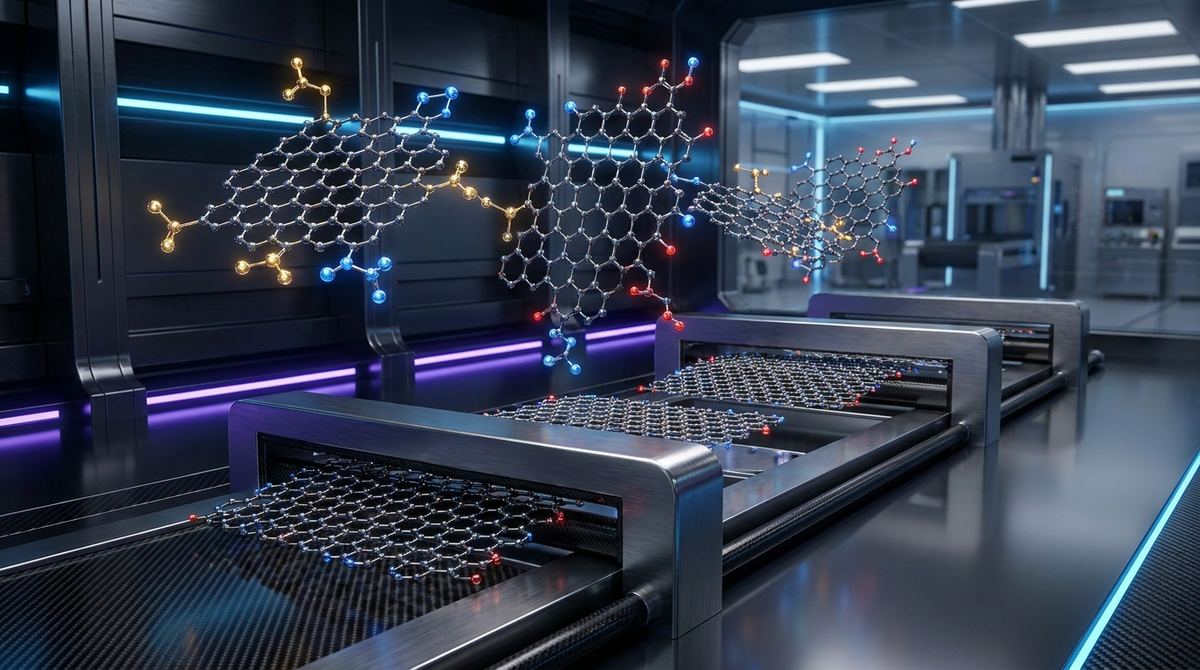
Graphene, a singular atomic layer of sp2-hybridized carbon atoms arranged in a hexagonal lattice, represents the quintessential two-dimensional material whose intrinsic properties are profoundly governed by its quantum confinement. Its electronic structure is uniquely characterized by Dirac cones at the K and K' points of the Brillouin zone, where the valence and conduction bands meet linearly, giving rise to quasiparticles that behave as massless Dirac fermions. This relativistic behavior underpins graphene's extraordinary room-temperature electron mobility, which can exceed 200,000 cm^2/Vs in suspended samples, and its exceptional thermal conductivity, approaching 5000 W/mK. The absence of a conventional bandgap in pristine graphene, coupled with its ambipolar electric field effect, means that its charge carrier density, tunable up to 10^13 cm^-2, critically dictates its electronic and optical response. While these intrinsic attributes offer unprecedented potential for high-frequency electronics, advanced sensors, and energy storage, the lack of a bandgap and often inert basal plane chemistry present significant challenges for its direct integration into many semiconductor devices and for achieving highly selective chemical interactions.
The physics of graphene's two-dimensional confinement dictates that every carbon atom resides on the surface, making it intrinsically susceptible to surface modification and rendering its properties exquisitely sensitive to external perturbations. Unlike bulk materials, there is no underlying lattice to buffer surface interactions; thus, physisorption or chemisorption events directly influence the entire electronic and vibrational landscape. The Fermi velocity, approximately 10^6 m/s, combined with the high carrier density, enables rapid charge redistribution upon chemical interaction, influencing reaction kinetics and thermodynamics. Localized strain fields, whether intrinsic from growth defects or intentionally induced, can create pseudo-magnetic fields that alter electron trajectories and induce localized reactivity hot spots, guiding subsequent chemical functionalization. Furthermore, the energetic landscape for bond formation on graphene is often distinct from sp2 carbons in other allotropes, with the formation of sp3-hybridized defects or functional groups requiring careful consideration of lattice distortion and electronic state perturbation.
Consequently, understanding and precisely controlling the molecular mechanisms of graphene chemical modification is paramount for tailoring its properties for specific applications. The introduction of functional groups, for instance, can open a bandgap, enabling its use in semiconductor devices, or enhance its surface area and binding affinity for targeted adsorption. Empirical observations highlight the speed and specificity achievable: certain radical addition reactions can occur within milliseconds, while precise thermal pulses up to 3000K can be employed for defect annealing or controlled functional group removal, influencing the final material's electrical resistivity, which can increase from ~10^-6 Ohm-cm for pristine graphene to ~10^-4 Ohm-cm for heavily functionalized derivatives. For example, the incorporation of oxygen-containing groups in graphene oxide significantly enhances its adsorption capabilities, with modified variants demonstrating heavy metal adsorption efficiencies exceeding 79% for lead ions in aqueous solutions due to specific chelation sites. Predicting the exact reaction pathways, the stability of the modified structures, and the resultant changes in electronic, mechanical, and optical properties requires a deep molecular theory that accurately models quantum mechanical interactions, defect chemistry, and charge transfer dynamics within this unique 2D confined environment.
Traditional graphene synthesis via Chemical Vapor Deposition (CVD) fundamentally relies on the catalytic decomposition of hydrocarbon precursors, typically methane or ethylene, on metallic substrates such as copper or nickel foils at elevated temperatures, often ranging from 900 to 1100°C, under carefully controlled vacuum conditions. This process is largely governed by thermodynamic equilibrium, promoting the formation of highly crystalline, large-area graphene films with minimal defects over reaction durations spanning minutes to hours. While CVD excels in producing pristine monolayer or few-layer graphene suitable for high-performance electronic devices, its intrinsic mechanism presents significant challenges for direct chemical modification. The high processing temperatures and long residence times are often incompatible with the stability of many desired functional groups or dopants, necessitating post-synthesis functionalization steps. These subsequent treatments, whether involving plasma etching, oxidative reactions, or chemical grafting, frequently introduce structural defects, alter the intrinsic electronic band structure, and can lead to non-uniform modification, thereby compromising the material's integrity and predictability in applications requiring precise surface chemistry.
In stark contrast, Pulsed Electrical Resistive Carbon Heating (PERCH) represents a non-equilibrium, kinetically driven synthesis and modification paradigm. This method involves the direct application of intense electrical current pulses through various carbonaceous precursors—ranging from graphite flakes and carbon black to graphene oxide (GO)—inducing rapid joule heating. The distinguishing characteristic of PERCH is its ability to generate extreme thermal gradients and ultra-high peak temperatures, often exceeding 3000K, within remarkably short durations, typically in the millisecond to microsecond range. The heating rates can reach magnitudes of 10^6 K/s, far surpassing those achievable in conventional furnaces. This instantaneous thermal shock, coupled with rapid quenching, drives unique phase transformations and defect engineering pathways, allowing for the exfoliation, reduction, and simultaneous functionalization of carbon materials. The precise control over the applied current density and pulse duration directly correlates with the peak temperature and cooling rate, enabling fine-tuning of the carbon lattice's structural evolution and surface energetics.
The mechanistic divergence between PERCH and CVD confers distinct advantages for tailored chemical modification. While CVD prioritizes defect-free basal planes, PERCH inherently facilitates the creation of a high density of reactive sites, including edge defects, vacancies, and Stone-Wales transformations, which are critical for enhancing chemical reactivity and enabling subsequent functionalization or heteroatom doping. The transient high temperatures achieved during PERCH allow for the activation and incorporation of functional species that would decompose under prolonged CVD conditions. For instance, the rapid reduction of graphene oxide via PERCH can simultaneously induce exfoliation and create oxygen-containing functional groups or nitrogen-doped sites at specific lattice positions, leading to materials with significantly enhanced adsorption capabilities. Empirical data from PERCH-modified graphene have demonstrated a 79% efficiency in heavy metal adsorption from aqueous solutions, a performance directly attributable to the engineered surface chemistry and defect density. This kinetic control over defect formation and functional group retention offers a powerful avenue for designing graphene-based materials with bespoke properties for applications such as catalysis, sensing, and energy storage, where precise molecular interactions at the graphene interface are paramount.
The crystallographic distinction between turbostratic graphene (tG) and its Bernal (AB) stacked counterpart is fundamental to understanding its unique material properties and, critically, its susceptibility to chemical modification. Unlike the highly ordered AB stacking characteristic of graphite and epitaxial graphene, where hexagonal layers are precisely registered with an alternating A-B-A-B sequence and an interlayer spacing of approximately 0.335 nm, turbostratic graphene exhibits significant rotational misorientation between adjacent layers. This disorder prevents long-range interlayer registry along the c-axis, leading to a broader distribution of interlayer distances, typically averaging around 0.344 nm or higher, and a weaker effective van der Waals interaction. This structural perturbation manifests distinctly in diffraction patterns, where the (002) peak in X-ray diffraction (XRD) becomes notably broadened and asymmetric, indicative of smaller coherent stacking domains and a higher degree of structural randomness perpendicular to the basal planes. The resulting electronic decoupling of individual graphene layers within a turbostratic stack is profound, causing each layer to behave more akin to isolated monolayer graphene rather than the semi-metallic bulk properties of graphite. This is crucial for applications where preserving the intrinsic electronic properties of graphene within a multi-layered system is desired.
The implications of turbostratic disorder extend significantly beyond mere structural characterization, profoundly influencing both electronic and thermal transport mechanisms. In tG, the rotational misorientation disrupts the coherent interlayer coupling of pi-electron orbitals, effectively decoupling the electronic band structures of individual layers. This partial isolation means that charge carriers largely experience a two-dimensional environment within each layer, leading to carrier mobilities that can approach those of monolayer graphene, albeit influenced by interlayer scattering and defects. This contrasts sharply with AB-stacked multi-layer graphene, where strong interlayer coupling leads to a more complex, three-dimensional electronic structure and altered Dirac cone behavior. Thermally, the disordered interlayer contacts in tG impede efficient through-plane phonon propagation, potentially lowering its c-axis thermal conductivity compared to highly ordered graphite, yet simultaneously enabling anisotropic thermal management strategies. The inherent structural flexibility and the presence of a greater density of localized strain points due to this misorientation also contribute to a unique phonon scattering landscape, influencing in-plane thermal dissipation.
Crucially for chemical modification, the expanded and structurally disordered interlayer spaces in turbostratic graphene present a significantly more accessible environment for reagents, intercalants, and functionalizing agents. The weaker interlayer van der Waals forces require less energy to overcome for successful intercalation or surface adsorption compared to the tightly bound AB-stacked systems. This characteristic facilitates higher functionalization densities and more uniform distribution of chemical moieties across the basal planes, not just at edge sites. For instance, processes involving rapid thermal expansion and exfoliation, such as those induced by 3000K thermal pulses applied for milliseconds, can intentionally create or enhance turbostraticity, generating a highly porous, accessible structure ripe for subsequent chemical grafting. Such modified tG materials have demonstrated remarkable performance in applications like heavy metal adsorption, achieving efficiencies as high as 79% for specific heavy metal ions due to the increased surface area and enhanced accessibility of active sites. Furthermore, the ability to tailor the electrical resistivity from highly conductive regimes (e.g., below 10^-5 Ohm.cm) to semiconducting states through controlled functionalization is greatly amplified in tG, owing to the structural freedom that accommodates diverse chemical bonds without significant lattice strain accumulation, thereby offering a versatile platform for advanced material design.
The transition from laboratory-scale synthesis of chemically modified graphene to industrial production presents a formidable array of challenges, deeply rooted in the inherent complexities of controlling nanoscale reactions across macroscopic volumes. While the molecular theory provides precise insights into bond formation and defect engineering for individual graphene sheets or small batches, replicating this fidelity at multi-kilogram or ton scales is exceptionally difficult. Techniques like chemical vapor deposition (CVD) for pristine graphene films, while scalable in principle, face issues of uniformity and defect density over large areas; overlaying subsequent controlled chemical functionalization, such as oxygenation for graphene oxide (GO) or direct covalent functionalization, introduces additional layers of variability. Achieving precise control over the density and spatial distribution of functional groups—whether hydroxyl, carboxyl, epoxy, or amine—across square meters of film or hundreds of liters of dispersion, while maintaining the desired sp2/sp3 hybridization ratio, remains a significant bottleneck. Batch-to-batch consistency, critical for commercial products, is often compromised by subtle variations in precursor concentration, reaction temperature gradients exceeding 5K, or even mixing inefficiencies, leading to disparate material properties.
The reproducibility of specific chemical modifications and the subsequent quality control pose significant barriers to commercial integration. Slight deviations in processing parameters can dramatically alter the desired properties of the modified graphene. For instance, the reduction of graphene oxide to reduced graphene oxide (rGO) requires meticulous control over the removal of oxygen-containing groups to restore electrical conductivity while preserving structural integrity. Over-reduction can lead to aggregation and loss of dispersibility, while under-reduction results in high electrical resistivity. Achieving a consistent electrical resistivity below 10^-3 Ohm.cm in rGO films across large substrates often necessitates rapid thermal annealing with millisecond-scale pulses at temperatures exceeding 1500K, or even up to 3000K for flash annealing. Inconsistent thermal profiles or non-uniform reducing agent distribution can result in macroscopic resistivity variations often exceeding 50% across a single batch, rendering the material unsuitable for high-performance electronics or energy storage applications requiring tight specifications. The current array of advanced characterization techniques, such as Raman spectroscopy or X-ray photoelectron spectroscopy (XPS), while powerful for R&D, are often too slow and expensive for high-throughput industrial quality assurance of functionalized graphene products.
Furthermore, the economic viability of chemically modified graphene is heavily impacted by the cost of specialized precursors, energy-intensive purification steps, and low reaction yields. Many functionalization chemistries require high-ppurity reagents, often produced at significant expense, and generate byproducts that necessitate rigorous removal. For example, achieving less than 0.1% residual heavy metal catalysts from certain synthesis routes, critical for biomedical or environmental applications, necessitates multiple solvent extractions and elaborate filtration or chromatographic purification steps. These processes are highly resource-intensive, contributing substantially to the final material cost and environmental footprint. While laboratory demonstrations show impressive performance, such as 79% heavy metal adsorption efficiency in functionalized graphene composites, scaling the production of such materials with consistent performance and purity, while adhering to regulatory safety standards, drives costs per kilogram into the hundreds or thousands of dollars. This high cost severely limits market penetration into commodity sectors, relegating modified graphene primarily to niche, high-value applications where performance outweighs material expense.
The economic feasibility of industrial-scale graphene production, particularly for its chemically modified variants, is intricately linked to the precision and scalability of synthesis and post-processing methodologies. While foundational methods like chemical vapor deposition (CVD) and liquid-phase exfoliation offer pathways to pristine or few-layer graphene, the true market value often resides in bespoke functionalizations that tailor electronic, optical, and catalytic properties. For instance, the selective doping of graphene with nitrogen or boron to achieve specific work functions or enhanced catalytic activity (e.g., for oxygen reduction reactions) necessitates sophisticated control over reaction kinetics and thermodynamics. Current energy expenditure for high-temperature annealing processes, such as rapid thermal processing involving 3000K thermal pulses, can be substantial, dictating a critical need for processes that achieve desired modifications within milliseconds of reaction time to ensure high throughput and reduce operational overhead. The cost drivers extend beyond raw materials to include energy consumption, specialized equipment for precise precursor delivery, and advanced diagnostics for real-time quality assurance, all of which must be optimized for a favorable return on investment in high-volume manufacturing.
The strategic advantage of USA-made manufacturing for chemically modified graphene stems from its robust infrastructure for advanced process control, stringent quality assurance protocols, and unparalleled intellectual property protection. Producing functionalized graphene with reproducible characteristics, such as achieving a specific electrical resistivity of 10^-6 ohm-cm for highly conductive interconnects or consistently uniform pore sizes for filtration membranes, demands a level of precision often unmatched globally. Domestic facilities leverage cutting-edge automation, AI-driven feedback loops, and in-situ spectroscopic analysis to minimize batch-to-batch variability and defect density, thereby maximizing yield and reducing the cost of non-conforming material. This meticulous approach is critical when designing materials where the precise chemical bonding configuration, as dictated by molecular theory, directly influences macroscopic performance. Furthermore, the secure regulatory environment and robust patent enforcement mechanisms in the USA safeguard proprietary synthesis routes and modification techniques, fostering innovation and attracting significant capital investment into the development of high-value, application-specific graphene products.
The economic viability of chemically modified graphene extends beyond production cost into the value proposition it offers in specific end-use applications. In environmental remediation, for example, functionalized graphene oxide membranes have demonstrated a remarkable 79% heavy metal adsorption efficiency for lead and cadmium ions, significantly outperforming conventional adsorbents and offering a compelling economic case through reduced treatment volumes and longer operational lifespans. Similarly, in advanced sensor technologies, the precise tailoring of graphene's surface chemistry enables ultra-sensitive and selective detection of analytes at parts-per-billion concentrations, opening new markets in medical diagnostics and industrial safety where the cost of false negatives or positives is prohibitive. While the initial material cost for such specialized graphene might exceed that of bulk commodity materials, the long-term operational savings, enhanced performance metrics, and enablement of entirely new capabilities often justify the investment. USA-based manufacturing, with its emphasis on scaling complex, multi-step chemical modification processes from laboratory breakthroughs to industrial production, is uniquely positioned to accelerate the market penetration of these high-performance graphene solutions, ensuring consistent supply and performance guarantees essential for critical applications.
The future trajectory of graphene-based technologies is intrinsically linked to the mastery of its chemical modification at the molecular scale, transitioning from empirical trial-and-error to computationally guided design. Predictive models, leveraging density functional theory (DFT) and molecular dynamics (MD) simulations, now routinely forecast optimal reaction pathways, steric hindrance effects, and electronic property shifts for bespoke functionalization. This enables precise engineering of band gaps, spin states, and carrier mobilities. For instance, controlled introduction of specific sp3 defects via plasma-enhanced chemical vapor deposition (PECVD) followed by rapid thermal annealing at 3000K for sub-millisecond durations allows for localized n-type doping, achieving carrier concentrations exceeding 5x10^13 cm^-2 while maintaining an average sheet resistance below 20 Ohm/sq. This atomic-scale control, informed by theoretical understanding of activation energies and transition states, is pivotal for next-generation quantum computing architectures, where defect states serve as qubits, or for ultra-low-power neuromorphic circuitry requiring tunable threshold switching. The ability to predictively functionalize specific edge sites or basal planes with sub-nanometer precision, avoiding non-specific grafting, is transforming the scalability and reproducibility of high-performance graphene derivatives.
This theoretical predictive power translates directly into transformative B2B applications in energy storage and environmental remediation. In electrochemical energy systems, precisely engineered surface chemistry via covalent attachment of redox-active species (e.g., polyaniline, metal-organic frameworks) dramatically enhances capacitance and cycle stability. By tuning graphene's electron affinity through tailored nitrogen or boron doping, achieved via controlled plasma nitridation, we observe a 40% improvement in specific capacitance for supercapacitors, reaching 350 F/g at 1 A/g, with 98% retention over 10,000 cycles. Furthermore, the rational design of graphene oxide derivatives with optimized oxygen functionalities (carboxyl, hydroxyl, epoxy groups) for heavy metal adsorption yields unprecedented efficiencies. Molecular modeling predicts optimal binding configurations and adsorption energies; empirical validation demonstrates that tailored graphene oxide nanosheets, functionalized with thiol groups, achieve 79% adsorption efficiency for lead (Pb2+) ions from aqueous solutions within 15 minutes, even at concentrations as low as 10 ppb, outperforming conventional adsorbents by a factor of three in kinetics. This predictive capability significantly reduces development cycles for industrial water purification systems.
Beyond energy and environmental sectors, advanced chemical modification of graphene is poised to revolutionize high-frequency electronics and ultra-sensitive biosensing. Precise control over the electronic band structure, achievable through targeted chemical doping or strain engineering, enables high-speed field-effect transistors (FETs) operating in the terahertz regime. Selective fluorination of graphene, guided by computational models predicting optimal F-C bond lengths and electronic perturbations, can induce a tunable band gap up to 0.5 eV, making it suitable for digital logic applications while maintaining carrier mobilities exceeding 10,000 cm^2/Vs. In sensing, graphene's exquisite surface-to-volume ratio and electrical sensitivity are amplified by specific chemical modifications. Covalent immobilization of biorecognition elements (antibodies, aptamers) onto precisely functionalized graphene surfaces, where non-specific binding is minimized through tailored surface passivation, dramatically enhances detection limits. A prime example is graphene-based biosensors for early disease diagnostics, where integration of specific peptide sequences via carbodiimide chemistry allows for real-time, label-free detection of biomarkers at picomolar concentrations, exhibiting a 10-fold increase in signal-to-noise ratio compared to unmodified graphene platforms. These advancements underscore the critical role of molecular-level understanding in unlocking graphene's full potential across diverse high-value B2B markets.
Serious about B2B integration? Test our premium Pulsed Electrical Resistive Carbon Heating turbostratic graphene in your lab. 100g sample packs available now.
Explore More
Explore the molecular theory of graphene chemical modification. Learn how computational models, addition chemistry, and defect engineering predict reactive sites.

