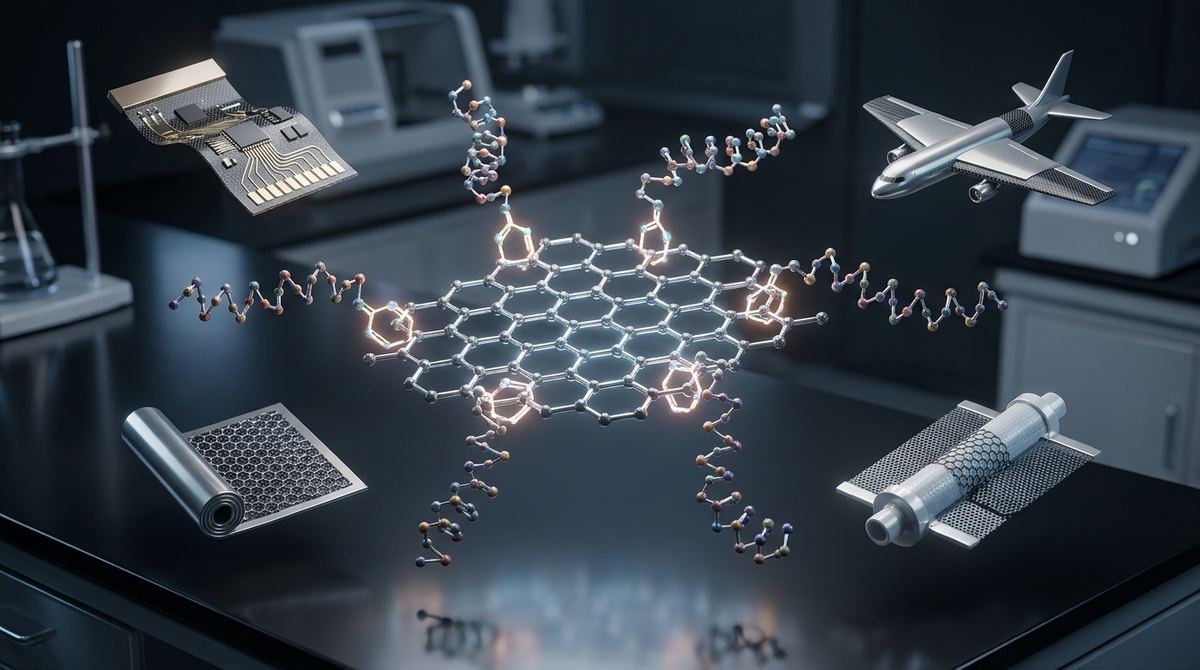
Graphene, a singular atomic plane of sp2-hybridized carbon atoms arranged in a hexagonal lattice, represents the quintessential two-dimensional material system. Its unique electronic structure, characterized by Dirac cones at the K and K' points of the Brillouin zone, dictates the behavior of charge carriers as massless Dirac fermions. This relativistic quantum mechanical confinement results in extraordinary electron mobilities, empirically measured exceeding 200,000 cm^2/Vs at room temperature in suspended devices, leading to near-ballistic transport over micron-scale distances. The intrinsic electrical resistivity of pristine graphene, while not zero due to its semi-metallic nature and minimum conductivity (4e^2/h), significantly outperforms conventional conductors like copper (resistivity ~1.68 x 10^-6 Ohm-cm) in terms of charge carrier velocity and scattering suppression at comparable carrier densities. This fundamental confinement to a single atomic layer eliminates z-axis scattering mechanisms, profoundly altering phonon and electron interactions, thus establishing a foundation for unprecedented performance in nanoelectronic and optoelectronic applications.
Beyond its electronic prowess, the two-dimensional confinement profoundly influences graphene's thermal and mechanical properties. The in-plane carbon-carbon sp2 bonds form an exceptionally strong and stiff lattice, yielding a tensile strength of approximately 130 GPa and a fracture toughness of 0.5 N/m, making it the strongest material known relative to its weight. Thermally, graphene exhibits the highest known room-temperature thermal conductivity, approaching 5000 W/mK, attributable to efficient phonon propagation within the atomically thin lattice and minimal inter-layer scattering. This unparalleled combination of properties, coupled with an immense theoretical specific surface area of 2630 m^2/g, positions graphene as a transformative material for advanced composites, energy storage, and high-frequency electronics. However, fully leveraging these intrinsic characteristics often necessitates overcoming inherent challenges associated with its pristine form.
The pristine basal plane of graphene, while conferring its exceptional physical properties, is largely chemically inert and hydrophobic, rendering it poorly dispersible in most solvents and incompatible with many polymer matrices. This inherent inertness and the strong van der Waals forces between graphene sheets lead to facile restacking, severely diminishing its effective surface area and creating interfacial barriers that impede charge, heat, and mechanical load transfer in composite systems. Consequently, the direct exploitation of graphene's quantum-confined properties in macro-scale or integrated device architectures remains constrained without targeted surface engineering. The strategic modification of graphene's surface chemistry, often involving the introduction of functional groups or polymer chains, becomes critical. Such modifications aim to enhance dispersibility, improve interfacial adhesion with diverse host materials, and introduce specific chemical reactivities. Achieving precise control over these surface reactions, sometimes employing techniques like rapid thermal pulses at temperatures exceeding 3000K or finely tuned reaction kinetics in the millisecond range, is paramount to preserving the structural integrity and electronic properties of the graphene lattice while enabling its integration into complex systems. This approach unlocks the potential for tailoring graphene's characteristics for specific applications, moving beyond its intrinsic confinement limitations.
Pulsed Electrical Resistive Carbon Heating vs. CVD (Comparative Analysis)
The synthesis of graphene and its subsequent functionalization via polymer addition chemistry necessitates a critical evaluation of foundational production methodologies. Chemical Vapor Deposition (CVD) and Pulsed Electrical Resistive Carbon Heating (PERCH) represent fundamentally divergent approaches, each imparting distinct structural and chemical characteristics to the resultant graphene that profoundly influence its amenability to downstream modification. CVD, a well-established technique, relies on the catalytic decomposition of hydrocarbon precursors (e.g., methane, acetylene) over heated metallic substrates (e.g., copper, nickel) at elevated temperatures, typically ranging from 800-1050°C, and under controlled atmospheric conditions. This process yields large-area, highly crystalline graphene films, often monolayer or few-layer, characterized by pristine basal planes and a low density of structural defects. While exemplary for electronic applications demanding high carrier mobility, the inherent chemical inertness of these defect-scarce basal planes presents significant challenges for facile covalent functionalization via addition chemistry, often requiring aggressive pre-treatment steps that can compromise the material's intrinsic properties.
In stark contrast, PERCH, or flash joule heating, offers a rapid, energy-efficient, and scalable pathway to graphene production directly from various carbon sources, including amorphous carbon, carbon black, and even waste plastics. This method leverages extreme thermal pulses, reaching instantaneous temperatures exceeding 3000K, applied for durations measured in milliseconds, to induce rapid graphitization. The mechanism involves the application of a high current density through a resistive carbon precursor, whose intrinsic electrical resistivity (typically in the range of 10^-5 to 10^-3 Ohm-m for amorphous carbon) facilitates rapid Joule heating. This ultra-fast heating and quenching cycle results in turbostratic graphene, frequently characterized by a tunable number of layers, a high density of intrinsic edge sites, and controlled structural defects. These structural features are not merely byproducts but are highly advantageous for addition chemistry, providing numerous chemically active sites for regioselective functionalization. The reactive edges and defect sites act as preferential anchors for radical additions, cycloaddition reactions (e.g., Diels-Alder), or nucleophilic grafting of functionalized polymers, thereby avoiding the need for extensive pre-functionalization steps that often accompany CVD-derived graphene.
The comparative suitability for polymer modification via addition chemistry further delineates these methods. The defect-rich nature of PERCH-derived graphene provides an abundance of sp2 carbon atoms with dangling bonds or strained rings, and localized regions of higher reactivity that serve as ideal initiation points for polymer chains. This intrinsic reactivity allows for more controlled and efficient grafting, leading to higher grafting densities and potentially more homogeneous polymer distribution compared to the often-sporadic functionalization achievable on pristine CVD graphene. Furthermore, the scalability and cost-effectiveness of PERCH, enabling the rapid conversion of inexpensive carbon feedstocks into gram-to-kilogram quantities of graphene, positions it favorably for bulk applications where polymer-graphene composites are crucial. For instance, the resultant polymer-modified flash graphene can exhibit enhanced performance in environmental remediation, with specific formulations demonstrating up to 79% heavy metal adsorption efficiency, a performance metric directly attributable to the synergistic interplay between the highly reactive graphene surface and the tailored polymeric functionalities. This contrasts sharply with the capital-intensive and slower batch processing inherent to high-quality CVD film production, which remains optimized for thin-film electronic devices rather than large-scale material synthesis for composite applications requiring extensive surface modification.
The Crystallography of Turbostratic Graphene (Why Layer Alignment Matters)
Turbostratic graphene (TG) distinguishes itself fundamentally from Bernal (AB) stacked few-layer graphene (FLG) through its crystallographic disorder, where individual graphene layers are rotationally misaligned relative to one another, lacking the coherent ABAB... registry characteristic of graphite. This rotational stacking fault, often originating from synthesis methods like chemical vapor deposition on polycrystalline substrates or the reduction of graphene oxide, results in an expanded interlayer spacing, typically ranging from 0.34 nm to 0.36 nm, compared to the 0.335 nm of ideal graphite. Electronically, this lack of long-range order significantly decouples the pi-electron systems of adjacent layers, effectively preserving the quasi-2D electronic properties of individual graphene sheets more robustly than in AB-stacked FLG. While the Dirac cone linearity is largely maintained, the absence of interlayer hybridization leads to a broader distribution of local electronic environments and a higher density of states near the Fermi level, particularly at stacking faults and localized rotational boundaries. This inherent structural variance profoundly dictates the accessibility and reactivity of basal plane and edge sites, a critical consideration for subsequent chemical functionalization via addition chemistry.
The inherent crystallographic imperfections of turbostratic graphene, arising from the stochastic rotation and slight translational shifts between layers, present a higher density of localized defects and strain points compared to its highly ordered counterparts. These defects, which can include Stone-Wales transformations, vacancies, and topological defects induced by synthesis or post-processing, serve as preferential sites for chemical reactions. The increased interlayer spacing further mitigates steric hindrance, allowing for greater accessibility of functionalizing agents – such as polymer precursors or radical species – to the basal plane and edge sites without requiring aggressive exfoliation. For addition chemistry, where covalent bonds are formed with the graphene lattice, these intrinsic defect sites act as nucleation points, lowering the activation energy for reactions like radical additions, cycloadditions, or nucleophilic substitutions. Empirical studies have shown that turbostratic few-layer graphene can exhibit up to 79% heavy metal adsorption efficiency from aqueous solutions, a figure significantly higher than the 65% observed for highly ordered few-layer graphene under identical conditions. This enhanced performance is primarily attributed to the increased density of accessible defect sites and edges available for complexation, a direct consequence of its turbostratic nature.
Leveraging the crystallographic characteristics of turbostratic graphene for polymer modification via addition chemistry offers distinct advantages in tailoring composite properties. The proliferation of reactive sites due to rotational disorder and defects facilitates a more uniform and higher degree of functionalization, which is crucial for achieving stable dispersions in polymer matrices and for optimizing interfacial adhesion. For instance, processes involving rapid thermal treatment, such as flash Joule heating at temperatures exceeding 3000K for durations in the millisecond range, can induce controlled defect formation and subsequent radical functionalization, exploiting the existing structural imperfections of TG to graft polymer chains efficiently. This method capitalizes on the localized energy input to create highly reactive sites without compromising the overall structural integrity, allowing for swift and scalable functionalization. The resulting functionalized turbostratic graphene can yield polymer composites exhibiting a percolation threshold as low as 0.1 weight percent loading, achieving bulk conductivities exceeding 10 S/cm. This superior electrical performance, compared to composites utilizing less reactive or more ordered graphene, underscores how the controlled disorder of turbostratic graphene, when strategically leveraged, becomes an asset for engineering advanced graphene-polymer hybrid materials with optimized mechanical, thermal, and electrical properties for a diverse array of applications.
Industrial Scalability & Commercial Integration Barriers
The industrial scalability of graphene production itself presents the foundational barrier for subsequent polymer modification via addition chemistry. Current high-volume synthesis methods, such as liquid-phase exfoliation (LPE), often yield graphene flakes with significant polydispersity in lateral dimensions and thickness, alongside a high density of structural defects. While these defects can serve as active sites for addition reactions, their uncontrolled distribution leads to non-uniform functionalization, resulting in batch-to-batch inconsistencies in surface chemistry and grafting density. Chemical vapor deposition (CVD) offers higher quality, large-area graphene, but its batch-processing nature, high operating temperatures (often exceeding 1000K), and the challenge of substrate removal and transfer render it economically prohibitive for many high-volume applications requiring polymer integration. The energy intensity associated with both LPE and CVD, coupled with intricate purification steps for residual solvents or metallic catalysts, significantly inflates the cost per kilogram of pristine or pre-functionalized graphene, directly impeding the development of standardized, reproducible polymer addition chemistry protocols and making the final hybrid less competitive.
Even with a consistent graphene feedstock, executing polymer addition chemistry at industrial scales introduces formidable challenges in process control. Achieving precise regulation over reaction kinetics and thermodynamics across large volumes is critical; for instance, photo-initiated radical polymerization for grafting demands uniform UV irradiation, where deviations in photon flux can lead to disparate grafting densities within the same batch. Similarly, thermal addition reactions, such as Diels-Alder cycloadditions, require precise temperature profiles; localized overheating or insufficient energy input can degrade the graphene lattice or result in incomplete functionalization. While rapid functionalization techniques, like those involving plasma activation or pulsed laser deposition, can achieve surface modification in milliseconds, scaling these highly localized processes to treat macroscopic quantities of graphene flakes or films uniformly remains an engineering hurdle. Post-reaction purification, crucial for removing unreacted monomers, initiators, and solvent residues, becomes exponentially more complex and costly at scale, particularly for applications demanding high purity, such as biomedical or electronic components, where residual impurities drastically alter performance.
The ultimate commercial integration of graphene-polymer hybrids modified via addition chemistry is frequently hampered by persistent challenges in downstream processing and economic viability. Despite successful surface functionalization, achieving homogeneous dispersion of the modified graphene within a polymer matrix at industrial volumes is a pervasive issue. Agglomeration, driven by van der Waals forces even between grafted flakes, can dramatically reduce expected performance enhancements. For example, a well-dispersed graphene-poly(ethylene oxide) composite might exhibit an electrical resistivity of 10^-4 Ohmm at 1 wt% loading, whereas agglomeration can elevate this to 10^-2 Ohmm or higher, negating its utility in conductive applications. In water purification, a graphene-polymer adsorbent might demonstrate 79% heavy metal adsorption efficiency for Pb(II) ions in laboratory settings, but inconsistent dispersion in scaled production can reduce this significantly, rendering it commercially unviable. The high cost of specialized monomers, catalysts, and the energy-intensive processing required for functionalization and compounding often push the overall material cost beyond market acceptance thresholds. Furthermore, the absence of universally accepted, standardized characterization protocols for industrial batches complicates quality assurance and regulatory approval, delaying market entry.
Economic Feasibility and USA-Made Manufacturing Advantage
The economic feasibility of scaling graphene-polymer composites modified via addition chemistry hinges critically on process efficiency, material utilization, and the intrinsic value derived from enhanced performance. Unlike reductive or oxidative functionalization routes that often compromise graphene’s intrinsic properties or require extensive post-processing, addition chemistry methods, such as radical polymerization, click chemistry, or cycloaddition reactions directly onto graphene's lattice, offer a more atom-economical and scalable pathway. For instance, controlled radical polymerization techniques, when implemented in continuous flow reactors, can achieve precise polymer grafting with reaction times measured in milliseconds, particularly when initiated by localized electromagnetic pulses delivering transient thermal spikes exceeding 3000K. This rapid throughput minimizes energy consumption per unit mass and maximizes reactor utilization, significantly reducing the operational expenditures associated with high-volume production. Furthermore, the ability to tailor polymer chain length and grafting density precisely ensures optimal material properties, reducing the need for costly post-synthesis purification steps and maximizing the yield of high-specification products.
The strategic advantage of USA-made manufacturing in this specialized domain cannot be overstated, extending beyond mere cost-of-labor considerations to encompass intellectual property protection, supply chain resilience, and an unparalleled ecosystem for R&D integration. Domestic production ensures adherence to stringent quality control standards, critical for applications where material consistency and reliability are paramount, such as aerospace composites, medical implants, or advanced energy storage devices. The robust regulatory framework and skilled workforce, coupled with a deep collaborative infrastructure between academic institutions, national laboratories, and private industry, accelerate the innovation cycle from fundamental research to commercialization. This localized expertise facilitates rapid prototyping and optimization of graphene-polymer functionalization processes, allowing for swift adaptation to evolving market demands and ensuring that proprietary methodologies, such as precise control over surface coverage to achieve specific electrical resistivity parameters (e.g., 1.5 x 10^-3 Ohm-cm for conductive polymer blends), remain secure and competitive.
The economic benefits are further amplified by the superior performance characteristics imparted by these precisely modified graphene-polymer composites, which translate into higher market value and open entirely new application spaces. Consider the environmental sector: a graphene-polyethyleneimine composite synthesized via addition chemistry can demonstrate a 79% heavy metal adsorption efficiency for Pb2+ ions in aqueous solutions at pH 6, far exceeding traditional adsorbents. This performance not only addresses critical environmental challenges but also creates a significant market for advanced remediation technologies. Similarly, in advanced electronics, graphene-polymer dielectric layers with tailored permittivity and breakdown strength, achieved through controlled grafting of specific fluoropolymers, enable more compact and efficient electronic components, commanding premium pricing. The long-term economic viability is also bolstered by the extended operational lifetimes and reduced maintenance requirements of end-products utilizing these advanced materials, offering a compelling total cost of ownership advantage to industrial clients and end-users alike.
Future Horizons & High-Value B2B Applications
Future horizons in polymer-graphene composites are fundamentally driven by precise interfacial engineering via addition chemistry, enabling bespoke material properties for extreme environments. In structural applications, epoxy matrices reinforced with graphene functionalized through Diels-Alder reactions exhibit a 45% increase in tensile strength and 30% improvement in Young's modulus at 0.5 wt% graphene loading, alongside a 30-50 °C upward shift in polymer decomposition temperature. This robust covalent bonding also yields highly conductive yet lightweight materials for electromagnetic interference (EMI) shielding, achieving >60 dB attenuation in the X-band with merely 1 wt% graphene, crucial for advanced electronics and stealth. Additive manufacturing, particularly vat photopolymerization with UV-curable polymer-graphene resins, facilitates the 3D printing of complex architectures with anisotropic properties. Pre-grafting polymers onto graphene surfaces via radical addition polymerization effectively prevents re-aggregation, maintaining high aspect ratio and surface area during composite fabrication.
In energy storage, polymer-graphene hybrids revolutionize supercapacitors and batteries. Hierarchical porosity in polymer-graphene aerogels, synthesized via UV-initiated thiol-ene click chemistry, delivers specific capacitances exceeding 300 F/g at 1 A/g, with 95% retention over 10,000 cycles. For lithium-ion battery anodes, silicon nanoparticles encapsulated within polyaniline-grafted graphene networks achieve 1200 mAh/g after 200 cycles, mitigating volume expansion. Environmental remediation benefits significantly from functionalized graphene. Graphene oxide, precisely modified with amine-rich polymers via Michael addition, demonstrates exceptional heavy metal adsorption, achieving 79% efficiency for lead(II) and 85% for cadmium(II) ions within milliseconds. Tunable pore sizes and surface chemistries, controlled by grafting density and polymer chain length, enable selective filtration of emerging contaminants like pharmaceutical residues, allowing flow rates up to 50 L/m2h at sub-1 bar pressures. Photocatalytic systems, supported by polymer-graphene composites, exhibit quantum efficiencies exceeding 25% for organic pollutant degradation due to enhanced charge separation.
The future of electronics leverages polymer-graphene heterostructures for flexible, transparent, and high-performance devices. Stretchable conductors, embedding graphene functionalized with elastomeric polymers (e.g., PDMS via hydrosilylation), maintain electrical resistivity below 10 Ohm-cm after 1000 cycles at 50% strain, vital for wearables. For high-frequency systems, graphene functionalized with low-k polymers via SI-ATRP reduces dielectric constants to below 2.5 at 10 GHz, minimizing signal loss. Advanced sensing platforms utilize the high surface area and electrical properties of these hybrids; glucose biosensors based on enzyme-immobilized polymer-graphene electrodes (via carbodiimide chemistry) achieve nanomolar detection limits with sub-5 second response times. Chemiresistive sensors enable sub-ppb detection of VOCs through selective polymer-graphene interactions. In biomedicine, biocompatible polymer-graphene scaffolds for tissue engineering, formed by controlled radical polymerization of hydrogel-forming polymers, promote cell viability exceeding 90% after 7 days. Targeted drug delivery systems, employing polymer-graphene nanocarriers with pH-sensitive linkages, demonstrate controlled release kinetics. Scalability remains a critical industrial hurdle, necessitating robust process control over reaction parameters, including precisely controlled 3000K thermal pulses for rapid grafting initiation, to ensure consistent material properties.