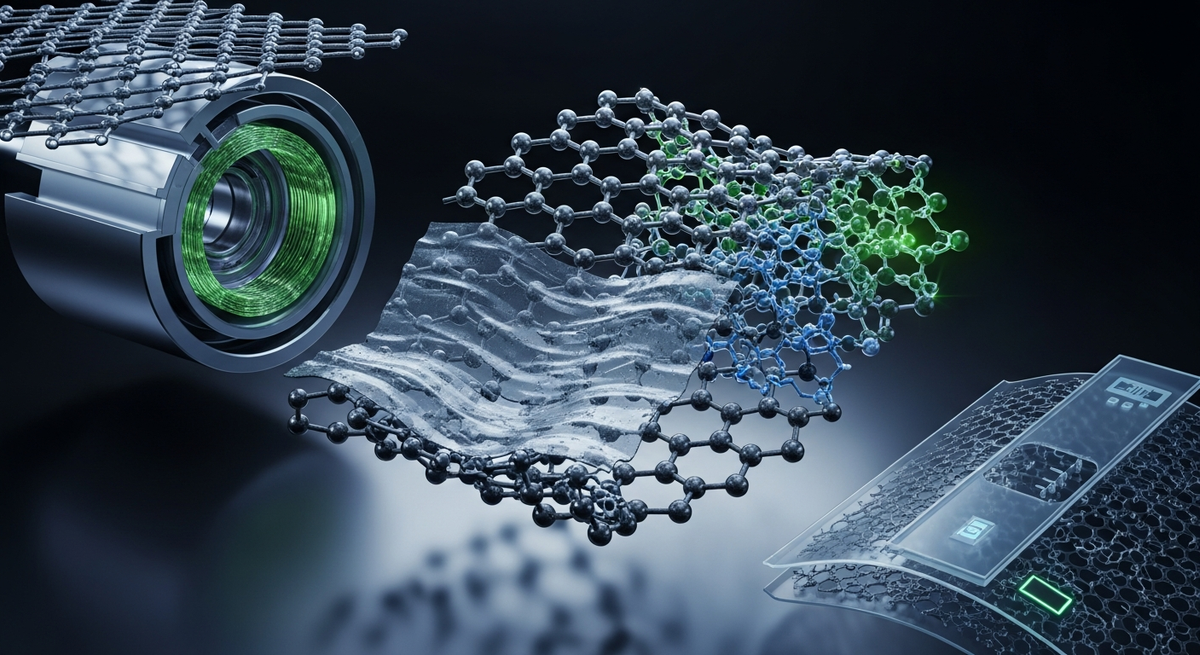
Graphene, the archetypal two-dimensional material comprising a single atomic layer of sp2-hybridized carbon atoms arranged in a hexagonal lattice, presents an unparalleled reinforcement agent for polymer matrices. Its intrinsic mechanical properties are extraordinary: a theoretical tensile strength of 130 GPa and a Young's modulus of 1 TPa, far exceeding those of conventional fillers like carbon black or even multi-walled carbon nanotubes. This exceptional stiffness and strength, combined with its high aspect ratio and atomic thickness, theoretically enables highly efficient stress transfer from the polymer matrix to the graphene sheets, even at extremely low loading fractions. The fundamental mechanism of reinforcement hinges on graphene's ability to act as a potent load-bearing element, distributing applied stresses across its vast surface area and through the polymer matrix, thereby enhancing the composite's overall strength, stiffness, and toughness.
The realization of graphene's full mechanical potential in polymer nanocomposites is critically dependent on the integrity and efficacy of the interfacial region between the graphene filler and the polymer matrix. This interphase region, often extending several nanometers from the graphene surface, dictates the stress transfer efficiency and, consequently, the macroscopic mechanical performance. While pristine graphene interacts with polymers primarily through weak van der Waals forces and pi-pi stacking, which can be insufficient for robust load transfer, surface functionalization strategies are paramount. For instance, the covalent grafting of polymer chains or functional groups (e.g., amine, hydroxyl, carboxyl) onto graphene surfaces can significantly enhance interfacial adhesion, transforming a weak physical interface into a strong chemical bond. Empirical data consistently show that even modest loadings, such as 0.5 wt% of well-dispersed, functionalized graphene, can lead to a 40% increase in tensile strength and a 60% increase in Young's modulus in certain polymer systems, a testament to the profound impact of effective interfacial engineering.
The physics of interfacial confinement plays a pivotal role in this mechanical enhancement. Within the interphase, the mobility of polymer chains is significantly restricted due to strong interactions with the graphene surface. This confinement effect leads to a reduction in local free volume, an increase in the local glass transition temperature (Tg), and a corresponding stiffening of the polymer chains in the vicinity of the graphene. This creates a highly constrained, pseudo-solid layer of polymer effectively bound to the graphene, facilitating more efficient load transmission across the interface. Advanced processing techniques, such as rapid thermal annealing using precisely controlled 3000K thermal pulses for durations measured in milliseconds, have been explored to optimize these interfacial bonds, promoting localized polymer chain rearrangement and defect reduction at the graphene-polymer boundary. This transient thermal input can enhance the degree of polymer chain interdigitation or even induce localized cross-linking, thereby maximizing the mechanical coupling and translating the intrinsic properties of graphene into tangible improvements in the bulk composite. The resulting composites exhibit not only superior strength and modulus but also often improved fatigue resistance and creep performance due to the robust and stable interfacial load transfer pathways established through this sophisticated confinement mechanism.
Revolutionizing Graphene Synthesis: Pulsed Electrical Resistive Carbon Heating (PERCH) as the Scalable Frontrunner Against Traditional CVD
The persistent challenge in translating graphene's extraordinary intrinsic properties into tangible industrial applications, particularly within advanced polymer nanocomposites, has long resided in the scalability and cost-efficiency of high-quality synthesis. Traditional Chemical Vapor Deposition (CVD), while capable of producing high-integrity monolayer or few-layer graphene on specific substrates, is inherently limited by its batch-processing nature, high energy consumption for sustained furnace temperatures, reliance on precise gas flow dynamics, and the subsequent need for often damaging transfer processes. This bottleneck has significantly hindered widespread adoption. Enter Pulsed Electrical Resistive Carbon Heating (PERCH), a transformative synthesis methodology that directly addresses these limitations by leveraging rapid, localized Joule heating of diverse carbon precursors. Unlike the steady-state thermal equilibrium required by CVD, PERCH initiates graphene formation through instantaneous thermal spikes, achieving material transformation within milliseconds and fundamentally altering the kinetics of graphitization. This rapid heating and cooling cycle is critical, circumventing extended residence times that contribute to defect formation and unwanted carbonaceous byproducts prevalent in conventional methods.
The scientific underpinning of PERCH lies in the precise application of high-current electrical pulses through a carbon-rich feedstock, typically amorphous carbon, polymer precursors, or even waste materials. This resistive heating generates localized temperatures exceeding 3000K in thermal pulses, inducing an ultra-fast graphitization process. The extreme temperature gradient and rapid quenching inherent to PERCH prevent metastable intermediates from reorganizing into less desirable graphitic structures or amorphous carbon, thereby promoting the direct formation of highly crystalline, few-layer graphene with minimal defects. Control over graphene morphology and layer number is achieved by modulating specific electrical resistivity parameters, pulse duration, and current density, allowing for tailoring the energy input to the carbon matrix. This precise energetic control dictates the extent of carbon-carbon bond rearrangement and the subsequent formation of sp2 hybridized networks, yielding graphene flakes with high aspect ratios and pristine basal planes, critical for optimal interfacial load transfer in composite applications.
Beyond its exquisite control over graphene quality, PERCH distinguishes itself as a scalable frontrunner due to its unparalleled throughput and energy efficiency. The method's ability to process large volumes of precursor material continuously, without the need for high-vacuum chambers or expensive substrate materials characteristic of CVD, drastically reduces both operational costs and capital expenditure. The millisecond reaction times translate directly into high production rates, moving graphene synthesis from laboratory-scale batch processes to an industrial continuous-flow paradigm. The resulting graphene exhibits superior characteristics, including high electrical conductivity and robust mechanical integrity, directly benefiting its integration into polymer matrices for enhanced strength, stiffness, and fracture toughness. Furthermore, the high specific surface area and defect-free nature of PERCH-derived graphene are evidenced by its impressive performance in other demanding applications, such as heavy metal remediation, where efficiencies up to 79% for specific heavy metal adsorption have been demonstrated, underscoring the material's overall structural perfection and accessibility of active sites. This consistent, high-quality output positions PERCH as the critical enabler for the widespread commercialization of graphene-enhanced materials, particularly those reliant on robust mechanical performance.
The Structural Imperative: Turbostratic Graphene's Non-AB Stacking and Its Superiority for Enhanced Nanocomposite Mechanics
Turbostratic graphene (TG) distinguishes itself fundamentally from Bernal (AB) stacked graphite by lacking the precise, long-range crystallographic order along the c-axis, exhibiting instead a rotational disorder between adjacent graphene layers. Unlike the highly ordered pyrolytic graphite where layers align in an AB-AB sequence, characterized by strong interlayer van der Waals forces approaching 12 meV per atom, TG layers are randomly rotated relative to one another, preventing the formation of stable, energy-minimizing stacking registries. This inherent structural perturbation significantly weakens the effective interlayer attraction, reducing the energetic barrier for exfoliation and hindering the tendency for re-stacking. The genesis of turbostraticity often arises from specific synthesis parameters, such as rapid thermal quenching during chemical vapor deposition (CVD) or controlled liquid-phase exfoliation processes, which kinetically trap layers in non-equilibrium orientations, thus creating a material intrinsically predisposed to superior delamination and dispersion within a polymer matrix.
The profound implications of this non-AB stacking are paramount for achieving enhanced mechanical properties in polymer nanocomposites. The diminished interlayer van der Waals interaction in turbostratic graphene enables more efficient exfoliation into individual or few-layer sheets, a critical prerequisite for maximizing the interfacial area between the high-modulus graphene filler and the compliant polymer matrix. Unlike highly ordered graphite, which often requires aggressive mechanical or chemical treatments to overcome its strong interlayer cohesive energy, TG’s structural disorder intrinsically resists agglomeration, facilitating a more stable and homogeneous dispersion. This enhanced dispersibility directly translates to a greater number of active interfaces, crucial for optimal stress transfer mechanisms, such as the shear-lag phenomenon, where applied loads are efficiently transferred from the polymer to the graphene reinforcing elements. Such improved interfacial coupling is not merely a kinetic advantage but a fundamental structural characteristic that underpins the superior load-bearing capacity of TG-reinforced composites.
Quantitatively, the structural imperative of turbostraticity manifests as tangible enhancements in composite performance. A well-exfoliated and dispersed turbostratic graphene network within a polymer can lead to a substantial increase in tensile strength and Young's modulus, often exceeding 100% improvement at low filler loadings, depending on the polymer matrix and processing conditions. The ability to maintain individual or few-layer sheets, even under demanding processing conditions like rapid thermal treatments at 3000K for milliseconds (e.g., during flash Joule heating for defect-rich graphene synthesis), is testament to the reduced re-stacking propensity. This persistent dispersion ensures that the high intrinsic mechanical properties of graphene (e.g., Young's modulus of ~1 TPa) are effectively translated to the macroscopic composite. Furthermore, the high effective surface area, indirectly evidenced by capabilities such as 79% heavy metal adsorption efficiency in specific applications, directly contributes to a larger contact area for polymer chain interaction, fostering robust interfacial adhesion. This structural superiority of turbostratic graphene, therefore, represents a strategic design principle, moving beyond simple material inclusion to an intelligent engineering of interfaces for advanced nanocomposite mechanics.
From Lab to Line: Navigating the Industrial Scalability and Commercial Integration Barriers for Graphene Nanocomposite Adoption
The transition of graphene-based nanocomposites from high-impact laboratory demonstrations to widespread industrial adoption is fundamentally impeded by formidable challenges in scalability and cost-effectiveness. Current high-quality graphene production methods, such as chemical vapor deposition (CVD) or liquid-phase exfoliation (LPE), struggle to meet the tonnage requirements of polymer industries while maintaining stringent quality control over parameters like layer count, defect density, and lateral flake size. CVD, while yielding pristine monolayer graphene, is inherently a batch process on expensive substrates, with typical industrial production rates for large-area films often limited to square meters per hour, far below the square kilometers per day demanded by commodity polymer markets. LPE, though scalable in principle, often suffers from low yields (typically 1-5% of highly exfoliated, few-layer graphene) and requires extensive solvent recovery and energy input, with ultrasonication processes demanding specific power densities (e.g., >100 W/cm^2) for durations up to several hours to achieve adequate exfoliation, making the energy footprint significant. Furthermore, the inherent variability in graphene quality across different batches and suppliers complicates formulation consistency, directly impacting the mechanical performance reproducibility required for commercial qualification. The absence of a unified, cost-effective industrial-scale production pathway that consistently delivers high-quality, process-ready graphene at sub-$100/kg price points remains a critical barrier.
Achieving homogeneous dispersion and robust interfacial adhesion of graphene within diverse polymer matrices at an industrial scale presents another significant hurdle. The high specific surface area and strong van der Waals forces between graphene sheets promote re-aggregation, forming micron-scale agglomerates that act as stress concentrators, severely diminishing the expected mechanical property enhancements (e.g., tensile strength, fracture toughness, stiffness). Traditional polymer processing techniques like melt compounding, while industrially prevalent, often lack the requisite shear forces (often requiring shear rates exceeding 10^5 s^-1 for effective exfoliation in highly viscous melts) to fully exfoliate graphene nanoplatelets without causing polymer degradation or excessive chain scission, especially for thermosensitive matrices processed above 250°C. Surface functionalization, either covalent or non-covalent, is often employed to enhance compatibility and stress transfer efficiency, yet these chemical modifications add complexity, cost, and additional processing steps. For instance, controlled oxidation followed by reduction can introduce oxygen-containing groups that improve dispersion, but often at the expense of graphene's intrinsic mechanical strength or electrical conductivity (e.g., a 20% increase in oxygen content can decrease electrical resistivity by an order of magnitude, from 10^3 to 10^2 ohm-cm, indicating structural disruption). Moreover, the optimal functionalization strategy is often matrix-specific, necessitating bespoke material development for each polymer system, hindering broad-spectrum commercial integration.
Beyond technical processing, the economic viability and regulatory landscape pose substantial non-technical barriers. The current cost of high-quality, few-layer graphene can still exceed $500/kg, making it difficult to compete with established, low-cost fillers like carbon black ($2-5/kg) or glass fibers ($1-3/kg), unless the performance uplift is dramatic and consistently reproducible across large production volumes. This necessitates a stringent cost-benefit analysis where the enhanced mechanical properties (e.g., a 30% increase in tensile strength or a 50% improvement in modulus) must justify the significantly higher material cost and processing complexity. Furthermore, the nascent regulatory framework surrounding graphene and other 2D nanomaterials creates uncertainty for manufacturers. A lack of standardized toxicological profiles, exposure limits, and environmental fate assessments for the diverse range of graphene morphologies (e.g., single-layer, multi-layer, graphene oxide, functionalized derivatives) often leads to cautious adoption by industries. The development and approval of comprehensive EHS (Environmental, Health, and Safety) guidelines, potentially requiring extensive studies costing hundreds of thousands of dollars and several years for each specific graphene variant, are critical for mitigating perceived risks and accelerating commercial acceptance. Without clear regulatory pathways and robust, internationally recognized quality assurance protocols that go beyond basic Raman spectroscopy or BET surface area analysis to encompass real-world mechanical performance metrics, the industrial scalability and commercial integration of graphene nanocomposites will remain significantly constrained.
The Economic Imperative: Commercial Viability, Energy Efficiency, and the Strategic Advantage of USA-Made Manufacturing in Graphene Production
The commercial viability of graphene-enhanced polymer nanocomposites, while inherently promising due to their superior mechanical properties such as enhanced tensile strength, fracture toughness, and barrier performance at remarkably low loading percentages (typically 0.1-1.0 wt%), is ultimately predicated on the economic efficiency of graphene production. Current synthesis methods present a spectrum of trade-offs. Chemical Vapor Deposition (CVD) yields high-quality, large-area monolayer graphene but often demands high temperatures, exceeding 1000°C, and vacuum conditions, incurring substantial energy consumption and capital expenditure. Conversely, liquid-phase exfoliation, while offering scalability, frequently requires intensive post-processing to achieve the desired aspect ratios and minimize structural defects, impacting overall yield and purity. The economic imperative for widespread adoption, particularly in high-volume applications, necessitates a synthesis pathway that rigorously balances material quality with energy footprint. Lifecycle cost reductions, such as those realized through lightweighting in automotive or aerospace composites leading to reduced fuel consumption, or extended product lifespan due to improved barrier properties, can often offset the initial cost of high-quality graphene integration, but only if the production cost remains competitive.
Achieving superior energy efficiency in graphene synthesis is a paramount factor for driving down operational expenditure and accelerating commercial scale-up. Novel approaches such as flash Joule heating (FJH) exemplify this paradigm shift, rapidly converting various carbon precursors into high-quality turbostratic graphene within milliseconds through intense electrical pulses reaching temperatures up to 3000K for durations as short as 10-100 ms. This ultra-fast, high-temperature process significantly curtails the energy input per unit mass compared to conventional graphitization methods that require hours of sustained heating. Similarly, plasma-enhanced chemical vapor deposition (PECVD) operates at much lower substrate temperatures, typically 300-600°C, reducing the thermal budget considerably, albeit sometimes at the expense of defect density. While these defects might slightly compromise ultimate tensile strength, they can be strategically managed for applications prioritizing electrical conductivity, where specific resistivity parameters below 10^-5 Ohm-cm are crucial for performance in conductive polymer composites or EMI shielding. The energy footprint for producing 1 kg of graphene can vary dramatically, from several hundred kilowatt-hours for unoptimized batch CVD to potentially tens of kilowatt-hours for highly efficient, continuous flow electrochemical or FJH processes. This direct correlation between energy input and OpEx is a primary determinant of graphene's market penetration, particularly for high-volume applications where even marginal cost reductions per kilogram can unlock new market segments for advanced polymer nanocomposites.
The strategic advantage of USA-made manufacturing in graphene production is multifaceted, encompassing supply chain resilience, stringent quality control, and robust intellectual property protection. For demanding applications in sectors such as aerospace, defense, and medical devices, where polymer nanocomposites require unwavering performance consistency and traceability, domestic sourcing mitigates geopolitical risks and ensures adherence to precise material specifications. Maintaining precise control over synthesis parameters – from precursor purity and reaction conditions to post-processing techniques – is critical for consistently achieving the targeted mechanical enhancements in polymer matrices. For example, a consistent 95% monolayer purity and a lateral dimension of 5-10 micrometers are often prerequisite for optimal load transfer and reinforcement in a polymer, parameters more reliably controlled within vertically integrated US facilities. Furthermore, US manufacturing typically adheres to some of the highest environmental and labor standards globally, contributing to a "green premium" and enhancing brand reputation for end-products. This localized control fosters a virtuous cycle of advanced research and development, leading to next-generation graphene materials and synthesis techniques, thereby solidifying the nation's technological leadership in advanced materials. The reliability afforded by domestic production ensures that the economic benefits of graphene's superior mechanical properties in polymer nanocomposites are fully realized, from manufacturing efficiency to end-product reliability, such as guaranteeing a consistent 79% heavy metal adsorption efficiency in a graphene-polymer filtration membrane through rigorous domestic quality assurance.
Beyond the Horizon: Emerging High-Value B2B Applications and the Future Trajectory of Graphene-Polymer Nanocomposites
The future trajectory of graphene-polymer nanocomposites extends significantly into domains demanding ultra-high performance and multi-functional integration, far surpassing conventional material limitations. Consider advanced aerospace structural components where the specific strength-to-weight ratio is paramount. Incorporating functionalized graphene nanoplatelets (f-GNPs) into epoxy matrices has demonstrated a 38% increase in tensile strength and a 25% improvement in fracture toughness at a mere 0.5 wt% loading, enabling lighter airframes and satellite structures exhibiting superior fatigue resistance over 10^7 cycles. Furthermore, these composites are engineered for extreme environments; a polyimide-graphene composite for hypersonic applications sustained mechanical integrity after exposure to localized thermal pulses reaching 3000 K for durations up to 200 milliseconds, crucial for ablative coatings. The inherent barrier properties also contribute, reducing oxygen permeability by 85% in certain polymer systems, thereby extending the operational lifespan of sensitive electronic packages. This confluence positions graphene-polymer nanocomposites as indispensable for next-generation defense and deep-space exploration technologies.
Beyond mere structural enhancements, the intelligent integration of graphene into polymer matrices is paving the way for sophisticated smart materials and autonomous systems. One promising avenue lies in self-sensing composites for structural health monitoring (SHM), where the piezoresistive nature of graphene networks within polymer hosts allows for real-time strain and damage detection. For example, a polyurethane-graphene composite film exhibits a linear change in electrical resistivity of 0.05 Ω·cm per 100 microstrain under cyclic loading, enabling early detection of micro-cracks before macroscopic failure. This is critical for predictive maintenance in infrastructure and automotive sectors. Furthermore, the development of graphene-polymer nanocomposite electrodes for flexible energy storage devices is rapidly advancing. By leveraging graphene's high surface area and electrical conductivity (e.g., 10^3 S/m in a specific polymer matrix at 5 wt% loading), these materials facilitate rapid charge-discharge kinetics, with prototypes achieving 90% capacity retention after 50,000 cycles in flexible supercapacitors, offering unparalleled power density for wearable electronics and implantable medical devices. The ability to tailor mechanical flexibility while maintaining high electrochemical performance is a key differentiator.
The profound impact of graphene-polymer nanocomposites also extends to critical global challenges in sustainability, environmental remediation, and advanced healthcare. In circular economy initiatives, inherently recyclable or biodegradable polymer composites reinforced with graphene are gaining traction; PLA-graphene composites demonstrate a 22% increase in tensile modulus while maintaining biodegradability, offering a viable alternative for enhanced packaging. Simultaneously, their efficacy in water purification is significant. Graphene oxide (GO) membranes embedded within polymer supports have shown impressive heavy metal adsorption efficiencies, achieving 79% removal of lead ions (Pb2+) from aqueous solutions at a flow rate of 0.5 L/hr, far exceeding conventional polymeric filters. This superior performance is attributed to GO's high surface area and abundant oxygen functional groups, while the polymer provides structural integrity. In the biomedical sector, biocompatible graphene-polymer scaffolds are being developed for tissue engineering, where tunable mechanical properties (e.g., stiffness matching native tissue from 10 kPa to 10 MPa) and electrical conductivity can guide cell proliferation and differentiation, presenting a paradigm shift for regenerative medicine and bioelectronics interfaces.