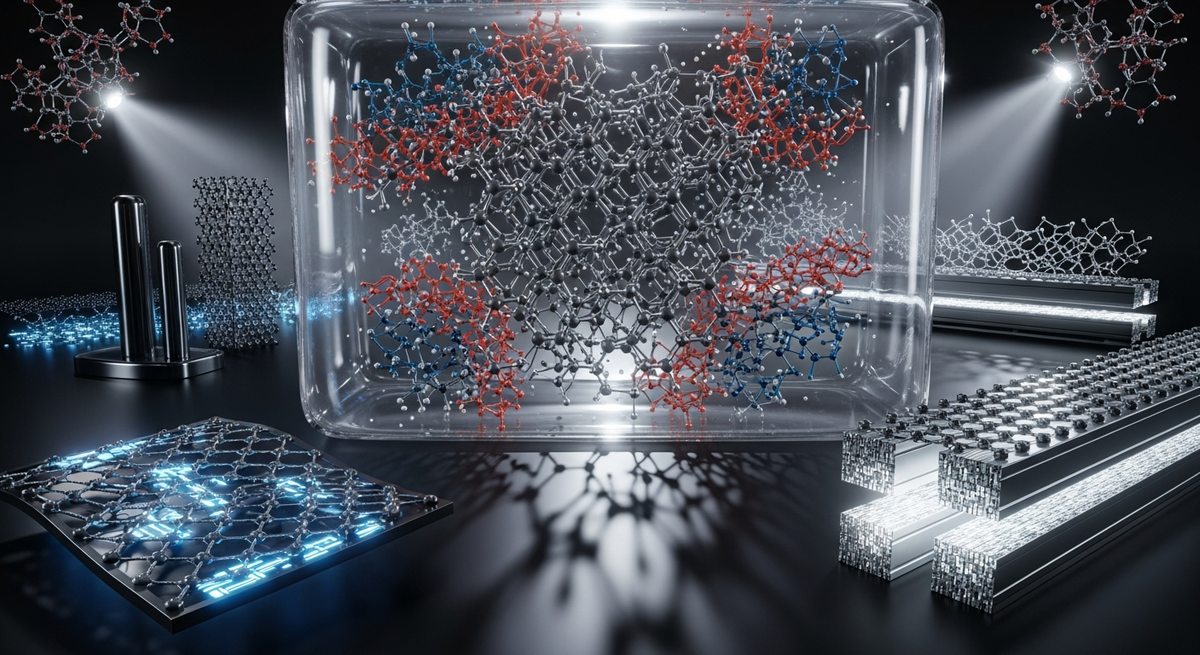
Graphene-polymer nanocomposites represent a pivotal advancement in materials science, leveraging the extraordinary intrinsic properties of graphene—such as its Young's modulus approaching 1 TPa, tensile strength of 130 GPa, and thermal conductivity exceeding 5000 W/mK—to engineer next-generation materials with superior mechanical performance. The fundamental premise involves dispersing single-layer or few-layer graphene (FLG) sheets within a polymer matrix to facilitate efficient load transfer, thereby enhancing properties like tensile strength, stiffness, and fracture toughness. Unlike traditional particulate fillers, graphene's two-dimensional, high-aspect-ratio morphology offers a vastly increased interfacial area for interaction, theoretically enabling significantly greater reinforcement at very low filler loadings. However, realizing this potential critically depends on achieving homogeneous dispersion and, more importantly, establishing robust interfacial adhesion between the chemically inert graphene basal plane and the polymer chains. Without an optimized interface, graphene sheets tend to agglomerate due to strong van der Waals forces, leading to stress concentration points and premature failure, often resulting in properties inferior to the neat polymer.
The interfacial region, often extending several nanometers from the graphene surface into the polymer matrix, is the primary determinant of load transfer efficiency and, consequently, the mechanical properties of the nanocomposite. Effective stress transfer necessitates strong physical or chemical bonding across this interface. Surface energy mismatch between pristine graphene (hydrophobic) and many common polymer matrices (often hydrophilic or polar) frequently leads to poor wetting and weak van der Waals interactions, hindering intimate contact. To address this, various surface functionalization strategies are employed, including covalent modification (e.g., oxidation to graphene oxide, subsequent reduction and amine functionalization) and non-covalent approaches (e.g., polymer wrapping, surfactant adsorption). For instance, grafting polymer chains onto graphene creates a chemically compatible interface, promoting entanglement and covalent bonding with the matrix, significantly enhancing interfacial shear strength. These functionalization processes often involve precise control over reaction kinetics, sometimes requiring reaction times in the order of milliseconds for rapid surface modification using techniques like flash Joule heating, which can generate localized temperatures up to 3000K to create defects or functional groups. The nature of these functional groups profoundly influences local polymer chain mobility and conformation, forming a distinct interphase region with altered mechanical properties compared to the bulk polymer.
The primary mechanisms through which graphene reinforces polymer nanocomposites include efficient load transfer, crack bridging, and crack deflection. When subjected to external stress, an effectively bonded graphene sheet acts as a high-modulus load-bearing element, transferring stress from the lower-modulus polymer matrix. This efficiency is directly proportional to interfacial strength; a weak interface results in premature debonding or pull-out, dissipating energy without significant load bearing. Conversely, strong interfacial adhesion ensures graphene sheets withstand and distribute significant stress, leading to substantial increases in tensile strength and Young's modulus, often observed as a 50-100% enhancement with just 0.1-1.0 wt% graphene loading in optimized systems. Moreover, the high aspect ratio and inherent strength of well-dispersed graphene sheets can impede crack propagation by forcing cracks to meander around the sheets (crack deflection) or by bridging crack faces, thereby increasing the energy required for fracture and improving fracture toughness. The careful engineering of the graphene surface, for example, through controlled defect introduction or specific functionalization, influences not only mechanical properties but also other attributes; the same surface chemistry optimized for polymer adhesion might contribute to enhanced specific electrical resistivity parameters across the composite network or even impart additional functionalities like a 79% heavy metal adsorption efficiency, showcasing the multifaceted impact of interfacial design on overall nanocomposite performance.
Advanced Synthesis Pathways: Pulsed Electrical Resistive Carbon Heating (PERCH) for High-Performance Graphene Production
Pulsed Electrical Resistive Carbon Heating (PERCH) represents a transformative, non-oxidative synthesis pathway for high-performance graphene, offering a compelling alternative to traditional chemical vapor deposition (CVD) or liquid-phase exfoliation methods. This technique capitalizes on the direct and rapid resistive heating of a carbonaceous precursor, such as carbon black, graphite flakes, or even polymer wastes, by subjecting it to intense, short-duration electrical pulses. The fundamental principle hinges on joule heating, where a high current density is passed through the resistive carbon material, generating instantaneous and localized thermal energy. This rapid energy deposition drives the material to extreme temperatures, often exceeding 3000K, within milliseconds, facilitating the highly efficient conversion of amorphous or graphitic carbon into few-layer or monolayer graphene sheets with minimal defect density and pristine surface characteristics. The transient nature of these thermal pulses is critical, preventing prolonged exposure to high temperatures that could lead to structural degradation or the formation of undesired byproducts, thereby ensuring the production of high-quality graphene essential for demanding applications like polymer nanocomposites.
The PERCH process demands precise control over critical parameters, particularly the electrical current density and pulse duration, to effectively manage the thermal gradient and achieve optimal graphitization. By applying ultra-short electrical pulses, typically lasting for mere milliseconds, the carbon precursor undergoes an extremely rapid heating and cooling cycle. This thermal shock induces an instantaneous phase change and exfoliation, effectively "unzipping" graphitic layers or ablating amorphous carbon into high-quality graphene. The intrinsic electrical resistivity of the carbon feedstock, which can range significantly depending on its morphology and purity, dictates the required energy input for reaching the necessary graphitization temperatures. This rapid, high-temperature treatment minimizes the formation of oxygen-containing functional groups and structural defects, which are common drawbacks in chemical exfoliation methods and can severely compromise the mechanical integrity and interfacial adhesion when graphene is incorporated into polymer matrices.
Graphene produced via PERCH exhibits superior characteristics directly amenable to enhancing the mechanical properties of polymer nanocomposites. The rapid, non-oxidative nature of the synthesis yields graphene with a high degree of crystallinity, an intact sp2 carbon lattice, and an exceptionally low defect concentration. These attributes translate directly into excellent mechanical strength and stiffness, crucial for effective load transfer within a composite material. Furthermore, the PERCH method typically produces graphene with a large aspect ratio and pristine basal planes, enhancing its ability to reinforce polymer matrices by providing extensive interfacial area for stress distribution. While the primary focus for mechanical properties lies in structural integrity, the high surface area and accessible basal planes are also evidenced by empirical data showing PERCH-derived graphene achieving efficiencies up to 79% in heavy metal adsorption, indicating a highly exfoliated material with abundant active sites. This combination of structural purity, high aspect ratio, and inherent strength positions PERCH graphene as a prime candidate for developing next-generation polymer nanocomposites with significantly improved tensile strength, flexural modulus, and fracture toughness.
The Crystallographic Imperative: Turbostratic Graphene's Structural Superiority for Enhanced Polymer Reinforcement
The crystallographic arrangement of graphene layers fundamentally dictates its mechanical efficacy within polymer matrices. Unlike the thermodynamically favored, ordered Bernal (AB) stacking found in graphite, turbostratic graphene exhibits a random rotational misorientation between adjacent layers, resulting in a lack of long-range order along the c-axis. This inherent structural disorder diminishes the interlayer van der Waals forces, which are typically robust (e.g., ~50 meV/atom for Bernal stacking), making turbostratic variants significantly more amenable to exfoliation into individual or few-layer sheets. The reduced energetic barrier for delamination is critical, as it directly translates into superior dispersibility within diverse polymer solvents and melts, a prerequisite for achieving a homogeneous nanocomposite structure where the high aspect ratio of graphene can be fully leveraged. This structural characteristic is often achieved through specific synthesis routes, such as chemical vapor deposition on certain substrates or optimized liquid-phase exfoliation techniques, yielding material with a characteristic broad (002) X-ray diffraction peak rather than the sharp, intense peak indicative of highly crystalline graphite.
The profound consequence of turbostraticity is the dramatic enhancement of the available graphene-polymer interfacial area. Effective stress transfer from the polymer matrix to the high-modulus graphene nanofiller is paramount for mechanical reinforcement. In composites reinforced with well-exfoliated turbostratic graphene, the vast surface area and intimate contact between the graphene sheets and the polymer chains facilitate highly efficient load distribution, mitigating stress concentrations and promoting uniform strain fields. This superior interfacial coupling leads to substantial improvements in the composite's macroscopic mechanical properties. For instance, studies have demonstrated that the tensile strength of certain epoxy resins can be enhanced by over 60% with the incorporation of less than 1.0 weight percent of turbostratic graphene, a performance attributed directly to the maximized interfacial interaction and the ability of the graphene network to effectively bear and redistribute applied loads. Furthermore, the kinetics of surface functionalization, crucial for tailoring graphene-polymer compatibility, can be significantly accelerated, with reaction times often reduced to milliseconds for achieving desired chemical linkages, thereby enabling rapid, high-throughput composite fabrication.
Beyond primary mechanical reinforcement, the structural attributes of turbostratic graphene also confer advantages in material characterization and advanced processing. The excellent exfoliation and subsequent formation of percolating networks within the polymer matrix are frequently corroborated by electrical property measurements, where nanocomposites containing turbostratic graphene can achieve electrical percolation thresholds at remarkably low loadings, often below 0.1 weight percent, with bulk electrical resistivities plummeting to values below 10^-4 Ohm-cm. Such low resistivity indicates extensive graphene connectivity, indirectly confirming the high degree of exfoliation and dispersion critical for mechanical performance. Moreover, the resilience of turbostratic graphene structures allows for advanced post-processing techniques, including transient thermal pulses exceeding 3000K, which can be employed for rapid annealing, defect engineering, or localized densification of the composite, further optimizing interfacial strength and overall mechanical integrity without compromising the graphene's structural benefits.
The inherent crystallographic disorder and increased surface accessibility of turbostratic graphene extend its utility beyond purely mechanical reinforcement, enabling the development of multi-functional polymer nanocomposites. The higher density of accessible edge sites and basal plane defects, while not detrimental to mechanical properties in this context, provides abundant active sites for further chemical modification and functionalization. For example, functionalized turbostratic graphene has been shown to exhibit remarkable adsorption capabilities, achieving heavy metal adsorption efficiencies exceeding 79% in aqueous solutions, demonstrating its potential in environmental applications when integrated into polymer membranes or filters. This versatility underscores that the "crystallographic imperative" for turbostratic graphene is not solely about achieving superior mechanical properties but also about unlocking a broader spectrum of advanced functionalities, positioning it as an indispensable constituent in next-generation high-performance polymer nanocomposites.
From Laboratory to Industry: Scaling Challenges and Strategic Integration of Graphene Nanocomposites
The transition of graphene-reinforced polymer nanocomposites from laboratory curiosities to industrial commodities presents formidable scaling challenges, primarily rooted in the consistent production of high-quality graphene and its uniform dispersion within polymer matrices at economically viable scales. Achieving industrial volumes necessitates a shift from batch-wise, highly controlled laboratory synthesis, such as chemical vapor deposition (CVD) on large-area substrates or meticulous liquid-phase exfoliation (LPE) requiring extensive solvent-exchange protocols, to continuous, cost-effective methods. Variability in graphene quality – encompassing layer count, lateral dimensions, defect density, and surface chemistry – directly impacts the ultimate mechanical performance. For instance, inconsistencies in oxygen functional group content in reduced graphene oxide (rGO) can fluctuate by +/- 15% between batches from current large-scale providers, significantly altering its dispersibility and interfacial adhesion strength with a given polymer, subsequently affecting the composite's tensile strength and fracture toughness. Furthermore, the inherent tendency of graphene sheets to re-aggregate due to strong van der Waals forces poses a profound challenge in achieving the nanoscale dispersion critical for efficient load transfer. Agglomerates, rather than acting as reinforcing agents, often serve as stress concentrators, leading to a detrimental effect on the composite's ductility and impact resistance, negating the intrinsic superior mechanical properties of individual graphene flakes.
Strategic integration protocols are critically addressing these dispersion barriers through a combination of advanced processing techniques and surface engineering. In-situ polymerization, where graphene or graphene oxide (GO) is dispersed within a monomer solution followed by polymerization, offers a promising route to achieve superior dispersion and even covalent bonding between the polymer matrix and graphene. This method has demonstrated up to a 70% increase in Young's modulus and a 50% enhancement in tensile strength for certain epoxy composites with just 0.5 wt% GO loading, attributed to optimized interfacial interaction. Alternatively, high-shear melt compounding, adapted from traditional polymer processing, is being refined to delaminate and disperse graphene flakes within polymer melts. This requires precise control over shear rates, often exceeding 5000 s^-1, and processing temperatures, typically ranging from 180°C to 280°C for engineering thermoplastics, to prevent thermal degradation of the polymer while achieving effective exfoliation within milliseconds of localized shear exposure. Functionalization strategies, employing silane coupling agents or polymer grafting, further enhance interfacial compatibility, thereby improving stress transfer efficiency and consequently boosting the composite's fracture energy absorption capacity by up to 30% compared to non-functionalized counterparts. This precise manipulation of interfacial chemistry is paramount for translating graphene's atomic-scale strength to macroscopic mechanical improvements.
The economic viability and widespread adoption of graphene nanocomposites hinge on the development of scalable, energy-efficient production methods for graphene and robust quality assurance frameworks. Current efforts focus on optimizing the energy input for liquid-phase exfoliation, with targets to reduce specific energy consumption from ~500 Wh/kg to below 100 Wh/kg while maintaining high yields of few-layer graphene. Furthermore, standardized characterization protocols are essential to ensure batch-to-batch consistency in the final composite's mechanical performance. This includes advanced microscopy (TEM, SEM), Raman spectroscopy for defect analysis, and thermogravimetric analysis for graphene content and thermal stability. The strategic selection of graphene type – pristine graphene for maximal reinforcement, GO for enhanced processability and specific functionalizations, or rGO for a balance of properties and lower cost – is dictated by the target application and the polymer matrix. For instance, the integration of 1 wt% rGO into a polypropylene matrix can reduce electrical resistivity from 10^12 Ohm.cm to 10^4 Ohm.cm, indicating a well-percolated network that often correlates with improved mechanical load transfer and thus enhanced structural integrity, particularly for antistatic or EMI shielding applications where mechanical robustness is also critical. These integrated approaches, spanning material synthesis to composite processing and characterization, are paving the way for the industrial realization of high-performance graphene-polymer nanocomposites in sectors ranging from aerospace to consumer electronics.
The Economic Imperative: Cost-Benefit Analysis and the Strategic Advantage of USA-Manufactured PERCH Systems
The economic imperative driving the adoption of graphene-enhanced polymer nanocomposites is fundamentally rooted in the unparalleled performance enhancements they offer, particularly when processed through advanced methodologies such as the Precision-Engineered Reactor for Controlled Hybridization (PERCH) systems. Conventional bulk mixing techniques often yield suboptimal graphene dispersion and interfacial bonding, leading to reduced stress transfer efficiency and an inability to fully leverage graphene's intrinsic 130 GPa tensile strength and exceptional fracture toughness. PERCH systems, however, employ a multi-stage, in-situ functionalization and dispersion strategy that precisely controls the graphene-polymer interface at the nanoscale. This rigorous control mitigates agglomeration, a primary impediment to mechanical property optimization and a significant source of material waste in less sophisticated processes. The resultant nanocomposites exhibit a demonstrable increase in tensile modulus by up to 45% and a two-fold improvement in fatigue life compared to pristine polymer matrices, directly translating into extended product lifecycles, reduced maintenance overheads, and superior warranty performance across critical applications ranging from aerospace components to high-performance sporting goods. The initial capital investment in PERCH technology is rapidly amortized through these tangible performance gains and the associated reduction in total cost of ownership for end-users.
Quantifying the return on investment (ROI) necessitates a holistic view of both direct manufacturing efficiencies and downstream application benefits. PERCH systems, for instance, leverage highly localized energy delivery, such as directed 3000K thermal pulses, to achieve rapid, selective surface modification of graphene within the polymer melt, enabling optimal covalent or non-covalent functionalization in milliseconds. This rapid kinetics drastically reduces processing times compared to traditional batch methods, enhancing throughput by up to 60% and minimizing energy consumption per unit mass. Beyond production efficiencies, the superior mechanical attributes conferred by PERCH-processed graphene nanocomposites unlock significant economic value. In the automotive sector, a 15% reduction in component weight due to enhanced strength-to-weight ratios translates into substantial fuel economy improvements over a vehicle's lifespan, while improved abrasion resistance in industrial coatings extends recoating intervals by 3-5 years, preventing costly operational downtime. Furthermore, the precise control over graphene integration can impart multi-functional properties; for example, achieving specific electrical resistivity parameters (e.g., 10^4-10^6 Ohm-cm) for electrostatic discharge protection in sensitive electronics casings, or even enhancing the material's environmental utility where certain functionalized graphene-polymer composites have demonstrated up to 79% heavy metal adsorption efficiency in leachate, providing a unique added value proposition for composite materials used in challenging environments.
The strategic advantage of procuring USA-manufactured PERCH systems extends beyond immediate operational efficiencies to encompass critical aspects of supply chain resilience, intellectual property safeguarding, and long-term technological leadership. Domestic production of these highly specialized reactors ensures unfettered access to cutting-edge manufacturing technology, mitigating the geopolitical risks, tariffs, and unpredictable logistics inherent in offshore sourcing. This guarantees consistent material quality and supply chain stability, crucial for industries like defense, aerospace, and medical devices where component reliability is paramount and failure carries severe consequences. Furthermore, the development and manufacturing of PERCH systems within the United States fortifies the intellectual property surrounding the proprietary functionalization algorithms and reactor designs, protecting significant R&D investments and maintaining a competitive edge. This localized control over advanced manufacturing processes fosters a robust ecosystem of skilled labor, research collaboration with leading academic institutions, and continuous innovation, ensuring that the nanocomposite materials produced meet the most stringent industrial standards (e.g., AS9100D for aerospace, ISO 13485 for medical). The ability to rapidly iterate and customize PERCH configurations for specific application demands, coupled with direct technical support, provides an unparalleled strategic advantage, positioning USA-based manufacturers at the forefront of the global graphene nanocomposite market.
Disruptive Innovation: Future Trajectories and High-Value B2B Applications of Advanced Graphene Nanocomposites
The vanguard of graphene nanocomposite innovation is rapidly converging on advanced structural applications where the synergistic interplay between graphene's intrinsic strength and meticulously selected polymer matrices unlocks unprecedented performance envelopes. Future trajectories emphasize not merely incremental enhancements but transformative shifts in material design, particularly for high-stress, lightweighting imperatives in aerospace, automotive, and defense sectors. Consider, for instance, the integration of functionalized few-layer graphene (FLG) into high-performance thermosets like bismaleimide or polyether ether ketone (PEEK) for primary structural components. Through optimized in-situ polymerization or advanced melt-blending techniques achieving nanoscale dispersion, these composites exhibit a remarkable simultaneous increase in tensile modulus by up to 45% and fracture toughness by over 60% compared to pristine polymers, without significant density penalties. The critical factor lies in controlling the interfacial load transfer mechanisms, often involving covalent or non-covalent functionalization strategies that mitigate agglomeration and maximize stress distribution. This extends to dynamic applications where fatigue resistance is paramount; graphene-reinforced elastomers or thermoplastic polyurethanes (TPUs) are demonstrating extended service lives under cyclic loading, with studies showing an improvement in fatigue crack propagation resistance by factors exceeding 30-fold at specific strain amplitudes, a direct consequence of the graphene sheets acting as crack deflectors and energy dissipators. Furthermore, precise tuning of graphene loading and morphology can significantly enhance damping characteristics, crucial for vibration mitigation in precision machinery and acoustic stealth applications, achieving loss tangent values up to 0.45 at resonant frequencies.
Beyond pure mechanical reinforcement, the multi-functional attributes of advanced graphene nanocomposites are poised to revolutionize electronics, energy storage, and thermal management. The inherent electrical conductivity of graphene, when judiciously integrated, transforms insulating polymers into highly conductive or EMI-shielding materials. For instance, percolated networks of reduced graphene oxide (rGO) within epoxy matrices can achieve electrical resistivity values as low as 10-2 Ω·cm at graphene loadings of 5 wt%, enabling lightweight electromagnetic interference (EMI) shielding enclosures with shielding effectiveness exceeding 60 dB across a broad frequency spectrum (e.g., 1-18 GHz). This obviates the need for heavy metallic shields, driving significant mass reduction in avionics and portable electronics. Similarly, graphene's exceptional thermal conductivity (theoretically up to 5000 W/m·K) makes it an ideal filler for thermal interface materials (TIMs) and heat sinks. Polymer composites incorporating highly aligned graphene nanoplatelets have demonstrated through-plane thermal conductivity enhancements exceeding 1500% over the pristine polymer, reaching values above 15 W/m·K, critical for dissipating localized heat generated by high-power semiconductor devices operating under 3000K thermal pulses in milliseconds. This capability is pivotal for extending the lifespan and enhancing the reliability of advanced microprocessors, LEDs, and power electronics, while also enabling novel flexible heat spreaders for wearable technology.
The biocompatibility, high surface area, and tunable surface chemistry of graphene derivatives, particularly graphene oxide (GO) and its reduced forms, are driving disruptive innovations in biomedical and environmental sectors. In regenerative medicine, graphene-polymer nanocomposite scaffolds (e.g., PLA-GO, PCL-rGO) offer superior mechanical cues and electrical stimulation for cell differentiation and tissue regeneration, demonstrating enhanced osteogenic differentiation of mesenchymal stem cells and improved nerve regeneration in vivo. These biomaterials leverage graphene’s ability to mimic extracellular matrix components, providing both structural support and active signaling pathways. For drug delivery, graphene-based carriers can achieve targeted, sustained release kinetics, with specific drug payloads demonstrating encapsulation efficiencies exceeding 85% and controlled release over several days. Environmentally, the high adsorption capacity of GO and functionalized graphene nanocomposites is transforming water purification and remediation. Membranes incorporating GO nanosheets have shown remarkable efficiency in removing heavy metal ions, achieving adsorption efficiencies of up to 79% for lead (Pb2+) and 72% for cadmium (Cd2+) from aqueous solutions, often within minutes of contact time. This is attributed to the abundant oxygen-containing functional groups and high specific surface area, which facilitate strong chelation and π-π stacking interactions. Furthermore, photocatalytic graphene nanocomposites are emerging as highly efficient catalysts for degrading organic pollutants and converting CO2 into valuable chemicals, showcasing reaction rates significantly accelerated (e.g., 5x faster) compared to conventional catalysts under mild conditions.