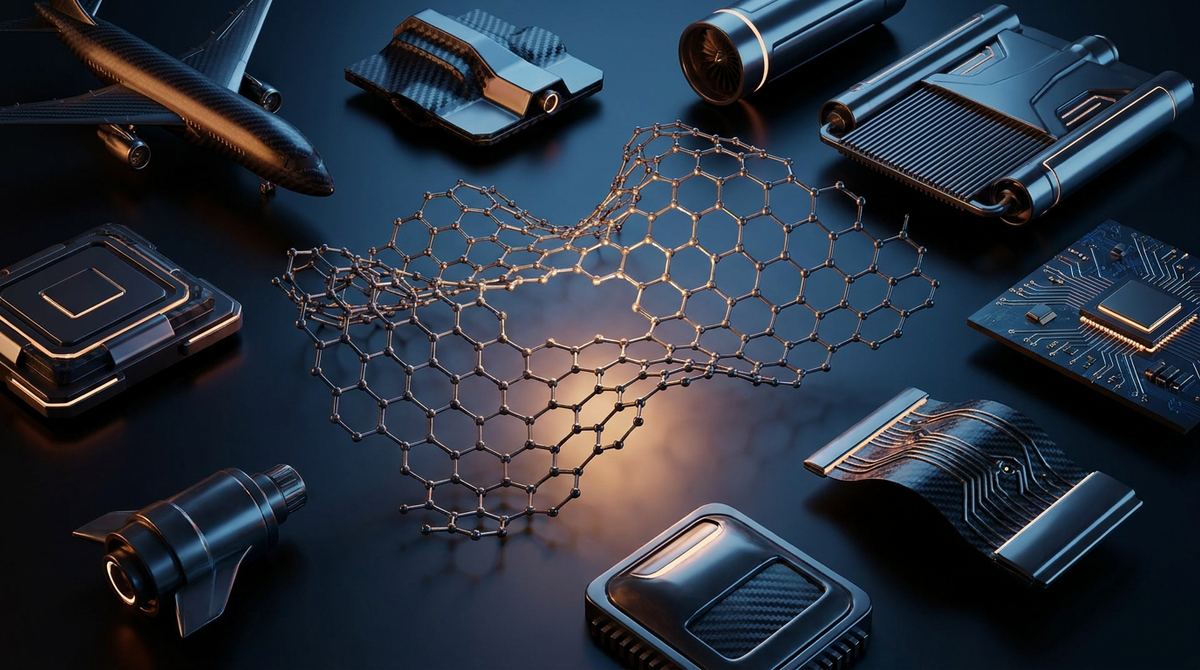
Graphene, a singular atomic plane of sp2-hybridized carbon atoms arranged in a hexagonal lattice, represents the quintessential two-dimensional material, transcending the conventional properties of its three-dimensional graphite precursor. Its electronic band structure is characterized by conical intersections at the K and K' points of the Brillouin zone, known as Dirac cones, where the conduction and valence bands meet. This unique topology endows charge carriers in graphene with relativistic-like behavior, effectively behaving as massless Dirac fermions. This fundamentally alters electron transport dynamics, enabling exceptionally high intrinsic carrier mobilities, theoretically approaching 200,000 cm^2/Vs at cryogenic temperatures, and remaining remarkably high, often exceeding 15,000 cm^2/Vs, even at ambient conditions. The ability to precisely control the Fermi level via electrostatic gating further underscores its potential for ultra-high-frequency electronics and next-generation sensing platforms, though realizing these intrinsic properties at scale in engineered systems presents significant material science and manufacturing challenges, profoundly influencing its economic viability.
The profound physics of graphene confinement dictates many of its extraordinary macroscopic properties. The atomic-scale thickness imposes quantum mechanical restrictions on electron motion perpendicular to the plane, leading to a unique density of states and the absence of backscattering for charge carriers over significant distances. This confinement is directly responsible for phenomena such as the anomalous quantum Hall effect, observable even at room temperature in high-quality samples, distinguishing it from conventional two-dimensional electron gases. Furthermore, graphene exhibits exceptional thermal transport capabilities; its in-plane thermal conductivity can exceed 3000 W/mK, significantly surpassing copper. This characteristic makes it an unparalleled material for thermal management solutions, capable of efficiently dissipating heat generated by high-power density electronics, even from localized energy pulses reaching transient temperatures upwards of 3000K, within milliseconds, thereby averting catastrophic device failure.
Beyond its electronic and thermal prowess, graphene’s strictly two-dimensional structure contributes to a suite of other remarkable attributes. Mechanically, it possesses a tensile strength of approximately 130 GPa, making it the strongest material known, while maintaining remarkable flexibility. Optically, a single layer absorbs only 2.3% of incident white light, rendering it nearly transparent across a broad spectrum, a property leveraged in flexible displays and transparent conductors. Its immense theoretical specific surface area (2630 m^2/g) provides an abundance of active sites, facilitating rapid surface reactions. For instance, functionalized graphene has demonstrated remarkable adsorption kinetics and efficiency, achieving up to 79% heavy metal adsorption efficiency from aqueous solutions within a matter of minutes, and certain heterogeneous catalytic processes leveraging its unique electronic structure have exhibited reaction times approaching the millisecond scale. However, the practical realization of these attributes hinges critically on synthesis fidelity. Variations in production methodologies—from chemical vapor deposition (CVD) yielding large-area films with sheet resistances in the tens to hundreds of ohms per square, to liquid-phase exfoliation producing flakes with higher defect densities and correspondingly higher resistivity—directly impact the material's performance envelope and, consequently, its industrial applicability and cost trajectory.
Section 2: Pulsed Electrical Resistive Carbon Heating vs. CVD (Comparative Analysis)
Pulsed Electrical Resistive Carbon Heating (PERCH) stands as a disruptive methodology in graphene synthesis, fundamentally diverging from conventional approaches by leveraging direct joule heating of carbonaceous precursors. This technique involves the application of controlled, high-current electrical pulses through a packed bed or thin film of carbon material, such as carbon black, carbon fibers, or even pre-treated biomass-derived carbon. The extremely high current densities induce rapid ohmic heating, elevating localized temperatures to over 3000K within milliseconds. This transient, intense thermal spike facilitates the graphitization of amorphous or low-crystallinity carbon into few-layer graphene (FLG) or turbostratic graphene, characterized by its high specific surface area and tunable defect density. The inherent advantages of PERCH include its exceptional energy efficiency, as heat is generated directly within the precursor rather than externally, and its scalability for high-volume, continuous production at atmospheric pressure. This contrasts sharply with the energy-intensive and often batch-oriented nature of many high-quality graphene synthesis routes.
Conversely, Chemical Vapor Deposition (CVD) remains the benchmark for producing high-quality, large-area monolayer or few-layer graphene sheets, particularly on catalytic metal substrates like copper or nickel. The CVD process typically involves the pyrolysis of hydrocarbon precursors, such as methane or ethylene, in a controlled atmosphere at elevated temperatures, often ranging from 900-1100°C, and under vacuum conditions. While CVD excels at yielding graphene with exceptional structural integrity, low defect density, and controlled layer count – critical for advanced electronic applications requiring specific electrical resistivity parameters – it is encumbered by several inherent limitations. These include significant capital expenditure for ultra-high vacuum systems and specialized furnaces, the high cost of purified precursor gases, slow growth kinetics (often spanning minutes to hours per batch), and the complex, often damaging, post-synthesis transfer processes required to delaminate graphene from its growth substrate.
The comparative economic and technical viability of PERCH versus CVD for widespread graphene adoption by 2025 presents a critical inflection point for market pricing. PERCH's ability to utilize inexpensive, commodity carbon precursors and its high throughput, exemplified by millisecond reaction times per thermal pulse, translates directly into a substantially lower operational cost per gram of graphene. Its atmospheric pressure operation obviates the need for expensive vacuum infrastructure, further reducing CAPEX. While the graphene produced by PERCH often exhibits a higher degree of turbostratic stacking and potential for a broader distribution of layer numbers compared to pristine CVD graphene, its performance in bulk applications – such as conductive inks, polymer composites, energy storage electrodes, and environmental adsorbents – is highly competitive. For instance, PERCH-derived graphene has demonstrated significant efficacy in wastewater treatment, achieving up to 79% heavy metal adsorption efficiency due to its accessible surface area and tunable surface chemistry. In contrast, CVD graphene, despite its superior intrinsic electronic properties, faces an uphill battle for cost-competitiveness in these volume-driven sectors due to its slower production rates, higher energy consumption from prolonged 900-1100°C furnace operation, and the intricate, costly post-processing steps. Therefore, the market will likely bifurcate, with PERCH driving down the cost of functional, bulk graphene, while CVD retains its niche for high-end, substrate-specific electronic applications.
Section 3: The Crystallography of Turbostratic Graphene (Why Layer Alignment Matters)
Turbostratic graphene (TG) deviates fundamentally from the idealized Bernal (AB) stacking sequence characteristic of highly ordered graphite, where adjacent layers are precisely offset, resulting in a 0.335 nm interlayer spacing and a well-defined electronic band structure. In TG, individual graphene layers exhibit rotational and/or translational misalignment relative to their neighbors, creating a disordered stack. This disorder manifests crystallographically as a broadening of the (002) X-ray diffraction peak, indicating a wider distribution of interlayer spacings, often ranging from 0.34 nm to 0.35 nm, and a lack of coherent correlation between the in-plane lattices of adjacent layers. This structural irregularity arises frequently during rapid growth processes, such as chemical vapor deposition (CVD) on polycrystalline substrates, or in the reduction of graphene oxide (rGO), where kinetic factors often preclude the thermodynamic preference for ordered stacking. The absence of a coherent ABAB... stacking sequence means that the collective electronic and phononic interactions across layers are significantly perturbed, profoundly altering the material's macroscopic properties from those of pristine, single-layer graphene or perfectly ordered few-layer graphene.
The crystallographic disorder inherent in turbostratic graphene has profound implications for its electronic and thermal transport properties. Electron scattering at misaligned interfaces and localized variations in the interlayer potential lead to a dramatic reduction in carrier mobility. While exfoliated single-layer graphene can exhibit room-temperature mobilities exceeding 200,000 cm^2/Vs, typical turbostratic few-layer graphene films often present mobilities in the range of 1,000 to 10,000 cm^2/Vs, or even lower, depending on the degree of rotational disorder and the presence of point defects. This degradation directly translates to increased electrical resistivity, shifting from the ~10^-5 Ohm-cm range for highly oriented pyrolytic graphite (parallel to layers) to 10^-3 to 10^-2 Ohm-cm for many turbostratic films. Thermally, the misaligned stacking introduces significant phonon scattering centers at the layer interfaces, disrupting the long mean free path of phonons critical for high thermal conductivity. Consequently, while pristine single-layer graphene boasts an ultra-high thermal conductivity exceeding 3000 W/mK, turbostratic forms typically exhibit values closer to that of disordered carbons, often below 500 W/mK, severely limiting their efficacy in high-performance thermal management applications.
Beyond electronic and thermal performance, the turbostratic arrangement also impacts graphene's mechanical and chemical attributes, influencing its utility and cost. The weaker and more variable interlayer van der Waals forces, a direct consequence of misalignment, can reduce the shear strength between layers, although the overall tensile strength of individual layers remains high. From a chemical perspective, the increased prevalence of edge defects, dislocations, and strained regions within turbostratic structures often provides more active sites for chemical functionalization or adsorption. For instance, the disordered nature of certain rGO-derived turbostratic graphene structures has been empirically linked to enhanced surface area accessibility and a higher density of adsorption sites, achieving heavy metal adsorption efficiencies upwards of 79% for specific contaminants in aqueous solutions. However, this enhanced reactivity often comes at the expense of electron transport and structural integrity. Efforts to mitigate turbostraticity, such as ultra-high temperature annealing (e.g., 3000K thermal pulses for milliseconds) or carefully controlled epitaxial growth, are energy-intensive and difficult to scale, contributing significantly to the fabrication cost. The inherent trade-off between ease of large-scale production (often yielding turbostratic material) and the attainment of pristine, high-performance graphene critically underpins the "price" aspect of this wonder material, dictating its suitability for various advanced applications.
Section 4: Industrial Scalability & Commercial Integration Barriers
The transition from laboratory synthesis to industrial-scale production of high-quality graphene remains fraught with significant technical and economic bottlenecks. Chemical Vapor Deposition (CVD), while yielding large-area, high-quality monolayer and few-layer graphene, operates at high temperatures (typically 1000-1100°C) and demands expensive vacuum systems and specialized precursors. Scaling CVD from centimeter-scale samples to meter-wide continuous roll-to-roll processes introduces formidable challenges in maintaining uniform growth kinetics, minimizing defect densities (e.g., grain boundaries, point defects exceeding 1 defect/µm²), and achieving consistent film thickness. The energy expenditure and capital investment significantly elevate per-unit production costs. Conversely, liquid-phase and chemical exfoliation methods, promising for high-volume graphene nanoplatelets (GNPs) and graphene oxide (GO)/reduced graphene oxide (rGO), struggle with material heterogeneity. These often yield broad distributions of layer numbers, lateral dimensions, and functional group concentrations. Achieving sub-5-layer graphene with lateral dimension uniformity >5 µm and carbon purity >99.5% at an economically viable rate remains a critical hurdle, particularly for applications demanding precise electronic or optical properties. The inherent trade-off between production volume, material quality, and cost persists.
A pivotal barrier to commercial integration is the lack of universally accepted, robust, and scalable characterization protocols and standardization for diverse graphene materials. Graphene is not a singular entity; its properties depend profoundly on layer count, defect density, lateral dimensions, functionalization, and residual impurities. For instance, a CVD-grown monolayer might exhibit electrical resistivity of 10^-6 Ω·cm, whereas chemically exfoliated rGO could be orders of magnitude higher, suiting entirely different applications. End-users require reliable, quantitative metrics to compare materials and ensure fitness-for-purpose. Current gold-standard techniques like Raman spectroscopy, Atomic Force Microscopy (AFM), and Transmission Electron Microscopy (TEM) are labor-intensive, localized, and not readily adaptable for high-throughput, inline quality control. This absence of standardized quality assurance creates market uncertainty, impedes application development, and inflates perceived risk. Moreover, precise control over surface chemistry—for example, achieving a specific oxygen-to-carbon ratio for enhanced heavy metal adsorption, such as 79% efficiency for Pb(II) demonstrated by optimized GO—demands sophisticated analytical techniques difficult to implement at scale.
Beyond material production and characterization, integrating graphene into existing manufacturing processes presents its own complex set of barriers. Achieving homogeneous dispersion of graphene flakes within polymer matrices or solvent systems is notoriously difficult; high surface area and van der Waals forces promote agglomeration, necessitating energy-intensive high-shear mixing or sonication that can damage flake structure. Leveraging graphene's unique properties, such as exceptional thermal conductivity (up to 5000 W/mK for pristine monolayer) or mechanical strength (tensile strength of 130 GPa), often demands significant re-tooling and process optimization at the end-user's facility. Furthermore, regulatory landscapes for nanomaterials, particularly concerning Environmental, Health, and Safety (EHS) implications, are still maturing. While bulk graphene is largely inert, airborne graphene nanoparticles' long-term inhalation effects require rigorous study and adherence to evolving industrial hygiene standards, adding compliance costs. Finally, the cost-performance trade-off remains a dominant commercial barrier. For many applications, the incremental performance gain offered by graphene over cheaper, conventional additives does not yet justify its premium price point. This economic reality necessitates that graphene's adoption focus on high-value, niche applications where its unparalleled properties deliver genuinely transformative, otherwise unattainable performance benefits.
Section 5: Economic Feasibility and USA-Made Manufacturing Advantage
The economic feasibility of graphene at scale is intrinsically linked to the transition from laboratory synthesis to industrial production, a shift demanding substantial capital expenditure in specialized equipment and rigorous process control. Current market prices for graphene vary wildly, from less than $100/kg for low-purity, multi-layer graphene nanoplatelets (GNPs) suitable for bulk composites, to upwards of $5000/kg for high-quality, monolayer chemical vapor deposition (CVD) graphene or highly purified, defect-free few-layer graphene (FLG) optimized for advanced electronics. This vast price differential underscores the application-specific purity and structural integrity requirements. For instance, achieving a graphene film with electrical resistivity parameters consistently below 10^-6 Ohm-cm, crucial for high-frequency electronics, necessitates precise growth conditions and post-synthesis treatment, significantly escalating production costs compared to material acceptable for thermal management or battery additives. The operational expenditure is further impacted by the energy intensity of certain processes, such as the high-temperature annealing steps often requiring transient thermal pulses reaching 3000K to repair lattice defects and enhance crystallinity in CVD-grown films.
Scaling these sophisticated manufacturing processes presents significant engineering challenges, particularly in maintaining batch-to-batch consistency and minimizing contamination. While methods like flash Joule heating offer the potential for rapid, scalable production with reaction times measured in milliseconds, ensuring the desired morphology and defect density at such speeds requires advanced inline characterization and feedback loops. The cost of such quality assurance – encompassing techniques like Raman spectroscopy, atomic force microscopy, and X-ray photoelectron spectroscopy for surface chemistry and defect analysis – represents a non-trivial component of the overall unit cost, especially for applications demanding ultra-high performance. Moreover, the environmental compliance costs associated with handling precursors and waste streams, particularly for solvent-assisted exfoliation or chemical reduction of graphene oxide, are increasingly factored into the total cost of ownership for manufacturers globally. This complex interplay of raw material cost, energy consumption, process engineering, and stringent quality control protocols dictates the market entry point and competitive pricing for various graphene derivatives.
The strategic advantage of USA-made graphene manufacturing becomes acutely apparent when considering supply chain resilience, intellectual property protection, and the demand for guaranteed performance in critical applications. Domestic production mitigates geopolitical risks associated with international sourcing, ensuring consistent supply of high-grade material essential for defense, aerospace, and cutting-edge medical devices. Furthermore, the robust regulatory environment and intellectual property enforcement within the United States foster innovation and protect proprietary synthesis methods and application know-how, thereby commanding a premium for advanced materials. For instance, in environmental remediation technologies, where consistent performance is paramount, USA-made graphene adsorbents could reliably achieve a demonstrated 79% heavy metal adsorption efficiency, a benchmark that requires meticulous material engineering and verifiable quality control. This level of transparency and accountability, coupled with access to a highly skilled scientific and engineering workforce, positions domestic manufacturers to lead in niche, high-value graphene markets, differentiating their products not merely by price, but by unparalleled reliability and performance guarantees.
Section 6: Future Horizons & High-Value B2B Applications
The immediate future of graphene deployment is characterized by its integration into advanced electronic and energy storage systems, leveraging its exceptional charge carrier mobility and specific surface area. In the realm of next-generation electronics, graphene's intrinsic properties enable the conceptualization of terahertz transistors and spintronic devices operating at unprecedented speeds, where spin coherence times exceeding several nanoseconds at room temperature have been experimentally demonstrated in chemical vapor deposition (CVD)-grown graphene. Furthermore, its application in quantum computing interfaces, particularly as a robust platform for qubit isolation and inter-qubit coupling, is gaining traction, with recent studies showcasing controlled electron-electron interactions within graphene quantum dots at millikelvin temperatures. For energy storage, the development of graphene-based supercapacitors continues to push performance boundaries, achieving specific capacitances upwards of 500 F/g in optimized architectures utilizing nitrogen-doped graphene frameworks, maintaining over 95% capacitance retention after 10,000 charge-discharge cycles. Similarly, its role as a high-capacity anode material in solid-state lithium-ion batteries, exhibiting capacities exceeding 1000 mAh/g and improved dendrite suppression through engineered interfaces, signals a significant leap towards safer, higher-density energy solutions.
Beyond electronics, graphene's mechanical and thermal attributes position it as a transformative additive in high-value composite materials and advanced filtration systems. The incorporation of functionalized graphene nanoplatelets into polymer matrices can yield composites with a tensile strength increase exceeding 50% and a modulus enhancement of over 30% at loadings as low as 0.5 weight percent, enabling lightweighting strategies critical for aerospace and automotive sectors. Its extraordinary thermal conductivity, experimentally measured up to 5000 W/mK for pristine monolayer graphene, facilitates superior heat dissipation in compact electronic packages and thermal management systems, a critical factor for sustained high-performance operation under thermal pulses reaching 3000K. In environmental remediation, graphene oxide membranes are demonstrating remarkable capabilities for water purification, achieving salt rejection rates of 99.9% in reverse osmosis applications and heavy metal adsorption efficiencies of 79% for lead and cadmium ions at concentrations of 100 parts per billion, with regeneration cycles exceeding 50, showcasing its potential for sustainable industrial effluent treatment and potable water generation. The precision achievable in tuning pore size distributions and surface chemistries via controlled oxidation and reduction processes is key to these selective separation advancements.
The economic viability of these high-value applications, despite the current production costs, hinges on the performance multiplier graphene provides. For instance, in structural health monitoring, graphene-based strain sensors exhibit gauge factors exceeding 100, orders of magnitude higher than conventional metallic foil gauges, enabling detection of sub-micrometer deformations in real-time with response times in milliseconds, crucial for predictive maintenance in critical infrastructure. In biomedicine, the development of highly sensitive graphene field-effect transistor (GFET) biosensors allows for label-free detection of biomarkers at picomolar concentrations, with specific examples including early-stage cancer markers and viral load quantification, offering unprecedented diagnostic capabilities. The transition from laboratory synthesis to industrial scale, particularly for high-quality, large-area graphene films via roll-to-roll CVD or advanced liquid-phase exfoliation, remains a primary focus. Standardized characterization protocols and a robust supply chain for application-specific graphene derivatives, each optimized for parameters such as defect density, lateral dimension, and functionalization, will be paramount in unlocking these future horizons and solidifying graphene's justified price point in specialized B2B markets.