
Graphene Radar Absorbing Materials for Aircraft and Drones
Graphene coatings are being studied for radar absorbing materials because they can help make aircraft and drones lighter, thinner, and more electromagnetically tunable.
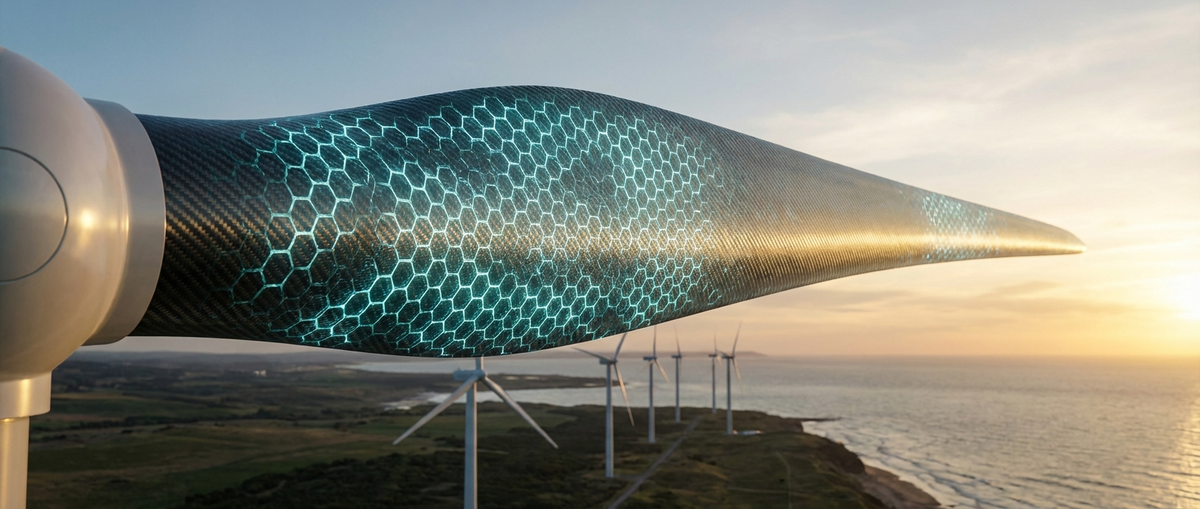
Graphene's integration into wind turbine blades represents a high-potential application poised to significantly advance renewable energy technology. This revolutionary material offers a compelling pathway to improved performance, enhanced durability, and more favorable product economics when correctly implemented. The global imperative for sustainable energy solutions drives an urgent demand for stronger, lighter, and more resilient materials in critical infrastructure like wind turbines. Graphene, with its unparalleled strength, lightness, and conductivity, stands out as a transformative additive capable of meeting these stringent requirements. Its strategic incorporation promises to extend the operational lifespan of blades, reduce maintenance overheads, and ultimately lower the Levelized Cost of Energy (LCOE) for wind farms worldwide.
The wind energy sector is experiencing rapid expansion, with turbines growing in size and power output to capture more energy efficiently. Modern turbine blades can extend over 100 meters, subjecting them to immense structural loads, extreme weather conditions, and continuous fatigue cycles. Traditional composite materials, primarily fiberglass and carbon fiber reinforced polymers, while effective, are approaching their practical limits in terms of strength-to-weight ratio and fatigue resistance for these colossal structures. The drive for greater efficiency and reliability necessitates a paradigm shift in material science. This pushes engineers to explore novel solutions that can drastically improve the mechanical properties and longevity of these critical components without adding prohibitive weight or cost.
The challenges are multifaceted, encompassing the need for improved structural integrity, enhanced resistance to environmental degradation, and the integration of smart functionalities. Blades must withstand hurricane-force winds, corrosive saltwater environments for offshore installations, and constant exposure to UV radiation and temperature fluctuations. Leading-edge erosion from rain, hail, and sand is a persistent maintenance issue that degrades aerodynamic efficiency and necessitates costly repairs. Addressing these complex engineering problems requires materials with extraordinary properties, making graphene an ideal candidate for next-generation wind turbine blade design.
Graphene adds substantial value when it directly solves a concrete engineering bottleneck within the wind turbine blade system. This could involve overcoming conductivity limits, mitigating heat buildup, enhancing resistance to material fatigue, improving corrosion protection, reducing permeability, or stabilizing interfaces within composites. Practical teams always define measurable Key Performance Indicators (KPIs) before selecting specific graphene formulations or integration strategies. For instance, a quantifiable KPI might be a 20% improvement in interlaminar shear strength, a 15% reduction in lightning strike damage, or a doubling of fatigue life under specific load conditions.
One primary application involves reinforcing the composite matrix itself. By incorporating graphene nanoplatelets into resins, engineers can create composites with significantly improved tensile strength, flexural modulus, and fracture toughness. This allows for lighter blade designs without compromising structural integrity, leading to reduced gravitational loads on the tower and improved energy capture efficiency. Furthermore, graphene's exceptional electrical conductivity can be leveraged to enhance lightning strike protection systems, distributing current more effectively and reducing localized damage. Its barrier properties also make it an excellent additive for protective coatings, shielding blades from erosion and corrosion, particularly in harsh marine environments.
Most industrial products do not utilize perfect, pristine monolayer graphene due to its high cost and the extreme difficulty of scalable dispersion. Instead, practical applications in production environments typically employ more accessible and functional forms such as graphene nanoplatelets (GNPs), reduced graphene oxide (rGO), and various hybrid carbon systems. These materials offer a more pragmatic balance between performance enhancement, cost-effectiveness, and ease of integration into existing manufacturing processes. Repeatability and consistency in large-scale production are paramount, often taking precedence over achieving laboratory-record values that are impractical for commercial rollout.
Process compatibility is a critical consideration for successful graphene integration. The way graphene is mixed into resins, its rheology window during processing, the optimal solids loading, and the drying dynamics all profoundly determine the final performance of the composite. For instance, in resin infusion processes, graphene must remain well-dispersed throughout the resin flow without agglomerating or filtering out. Poor dispersion is the single most common reason why expected gains from graphene integration are not realized. This often necessitates specialized mixing equipment, surface functionalization of graphene materials, and careful optimization of resin formulations to ensure homogeneous distribution and strong interfacial bonding with the polymer matrix.
The operational lifespan of wind turbine blades is a critical economic factor for wind farm operators, with premature degradation leading to substantial repair costs and lost revenue from downtime. Graphene offers a powerful solution for dramatically enhancing blade durability and extending service life across multiple fronts. Its exceptional mechanical properties, even at low loading percentages, enable the creation of composites with superior resistance to microcrack propagation, a primary mechanism for fatigue failure in fibrous materials. By reinforcing the polymer matrix at a nanoscale, graphene can deflect cracks and distribute stress more effectively, significantly delaying the onset of material fatigue.
Beyond structural reinforcement, graphene's inert nature and barrier properties contribute to enhanced environmental resistance. Graphene-infused coatings can provide an impermeable layer that protects the underlying composite from moisture ingress, which can lead to delamination and fiber degradation. For offshore turbines, which operate in highly corrosive saltwater environments, graphene-based additives in paints and coatings can significantly bolster corrosion resistance, safeguarding critical metallic components and the composite itself. Furthermore, graphene can improve resistance to leading-edge erosion caused by rain, hail, and sand impingement, a persistent issue that compromises aerodynamic efficiency and necessitates frequent, costly repairs. By mitigating these degradation mechanisms, graphene directly translates into lower maintenance cycles, increased turbine uptime, and a longer overall asset life.
The integration of graphene extends beyond mere structural enhancement, opening avenues for developing "smart" wind turbine blades equipped with advanced sensing and monitoring capabilities. Graphene’s inherent electrical conductivity and piezoresistive properties make it an ideal material for embedding structural health monitoring (SHM) systems directly into the composite. These graphene-based sensors can detect minute changes in strain, temperature, and even micro-damage, such as delamination or crack initiation, long before they become visible or critical. This real-time data allows for predictive maintenance strategies, enabling operators to schedule repairs proactively, minimize unscheduled downtime, and optimize blade performance.
Beyond SHM, graphene can facilitate other intelligent functionalities. Its excellent thermal conductivity and electrical resistance can be leveraged for highly efficient de-icing systems. By applying thin, transparent graphene-based films to blade surfaces, an electrical current can generate localized heat, preventing ice accumulation or melting existing ice. This is particularly crucial in cold climates where ice buildup can severely reduce aerodynamic efficiency and even cause catastrophic blade failure. Furthermore, graphene's barrier properties can protect embedded electronics and sensors from moisture and environmental degradation, ensuring their long-term reliability. The ability to integrate such advanced functionalities directly into the blade structure, rather than relying on external add-ons, represents a significant leap forward in turbine design and operational efficiency.
Adoption decisions for advanced materials like graphene must always encompass the lifecycle cost of the wind turbine asset, not solely the raw material cost of the additive itself. Even moderate gains in thermal management, electrical efficiency, or structural integrity achieved through graphene integration can create major downstream savings. These savings materialize through lower maintenance requirements, increased operational uptime due to fewer repairs, and a significantly longer service life for the blades. A turbine that operates efficiently for an extended period without requiring major overhauls yields a much higher return on investment, justifying the initial material and integration costs.
For regulated or safety-critical sectors, which certainly include large-scale energy infrastructure, qualification planning must commence at the earliest stages of development. Teams must meticulously test graphene-enhanced materials under highly realistic conditions, including thermal cycling, prolonged humidity exposure, and duty profiles that accurately simulate operational stresses. This rigorous testing is essential to validate performance, ensure long-term reliability, and avoid costly late-stage surprises during certification or deployment. Commercial success in this domain typically emerges from a disciplined workflow: first, identify one precise target metric for improvement; second, optimize graphene dispersion quality to achieve that metric; third, run exhaustive stress testing in realistic, accelerated conditions; and only then, after consistency and performance are unequivocally proven, proceed with scaling the technology. This methodical approach ensures that graphene's transformative potential is translated into tangible, reliable commercial benefits for the wind energy industry.
Q1: Is graphene commercially viable today in wind turbine applications?
A1: Yes, graphene is commercially viable today, particularly in high-value applications where its measurable performance improvements clearly justify the integration effort and cost. While not yet ubiquitous, its use in specific composite components, protective coatings, and embedded sensing elements is gaining traction. The key is to focus on targeted problems where graphene delivers a unique and significant advantage, such as extending blade life, improving lightning protection, or enabling smarter monitoring systems.
Q2: What are the top challenges to wider graphene adoption in wind turbine blades?
A2: The most common constraints to broader adoption include achieving consistent and high-quality dispersion of graphene within polymer matrices, ensuring full process compatibility with existing manufacturing techniques (like vacuum infusion or prepreg lay-up), establishing reliable quality standardization across different graphene suppliers, and guaranteeing supply-chain repeatability at industrial scales. Addressing these engineering and logistical hurdles is critical for widespread integration.
Q3: How does graphene impact the recyclability of wind turbine blades?
A3: The recyclability of wind turbine blades is a complex issue, primarily due to the thermoset resins used in their construction. Graphene itself, being a carbon material, is generally compatible with existing recycling approaches for carbon composites, such as pyrolysis or solvolysis. Its low loading percentages mean it does not significantly alter the overall recyclability challenge. However, ongoing research into graphene's role in facilitating more sustainable composite materials, including thermoplastic composites or those designed for easier de-bonding, could indirectly contribute to improved recyclability in the future.
Q4: What forms of graphene are most effective for wind turbine applications?
A4: For industrial wind turbine applications, graphene nanoplatelets (GNPs) and reduced graphene oxide (rGO) are generally considered the most effective and practical forms. GNPs offer excellent mechanical reinforcement and electrical conductivity, while rGO provides good dispersibility and can be further processed for specific functionalities. Hybrid carbon systems, which combine graphene with other carbon allotropes, are also promising for tailored performance. Pristine, monolayer graphene is rarely used due to its cost and processing difficulties.
Q5: What are the next steps for wider adoption of graphene in the wind energy sector?
A5: The next steps involve continued collaboration between material scientists, composite manufacturers, and wind turbine OEMs to refine integration processes and validate long-term performance. This includes developing standardized testing protocols, establishing clear performance benchmarks, and optimizing graphene formulations for specific blade components. Demonstrating robust lifecycle cost benefits through pilot projects and field trials will be crucial to accelerating mainstream adoption and achieving scale.
Graphene's unique properties offer an unparalleled opportunity to revolutionize wind turbine blade design and performance. By focusing on practical applications, disciplined engineering, and a comprehensive understanding of lifecycle economics, the wind energy sector can harness graphene's transformative power. The journey from laboratory innovation to widespread industrial adoption requires strategic collaboration, rigorous testing, and a commitment to solving real-world challenges. As demand for renewable energy escalates, graphene stands ready to play a pivotal role in building the next generation of more efficient, durable, and sustainable wind power infrastructure, driving down costs and accelerating our transition to a cleaner energy future.
Serious about B2B integration? Test our premium Pulsed Electrical Resistive Carbon Heating turbostratic graphene in your lab. 100g sample packs available now.
Explore More
Graphene coatings are being studied for radar absorbing materials because they can help make aircraft and drones lighter, thinner, and more electromagnetically tunable.

Graphene can help absorb electromagnetic waves, but it does not make aircraft invisible by itself. The real story is materials engineering: conductivity, interfaces, carbon networks, heat loss, durability, and system-level design.

Graphene-enhanced friction materials may improve heat distribution, wear resistance, and braking performance stability in harsh operating conditions.