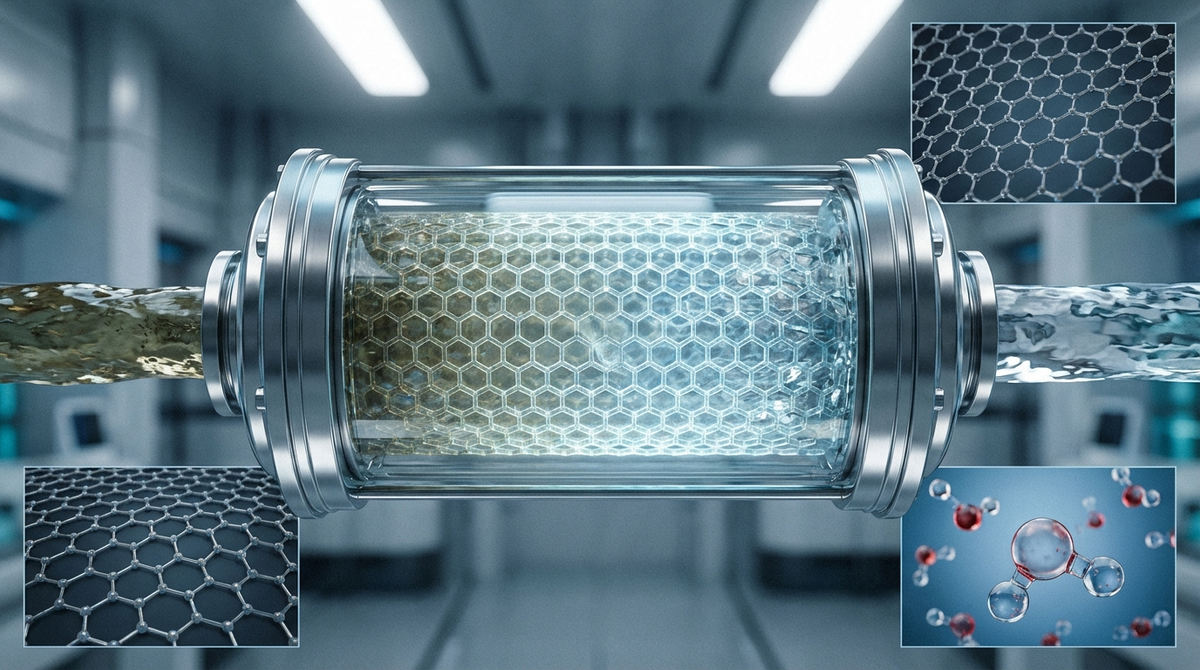
Graphene Water Filtration Membranes represents a high-potential graphene application poised to revolutionize global water purification efforts. Its integration promises significant advancements in performance, durability, and product economics when executed correctly. The escalating global demand for clean water, coupled with increasing environmental pollution, necessitates innovative solutions beyond conventional filtration technologies. Graphene, with its unique atomic structure and remarkable properties, offers a compelling pathway to address these critical challenges, promising more efficient, sustainable, and cost-effective water treatment systems. This article explores the scientific underpinnings, engineering considerations, and commercial realities driving the adoption of graphene in this vital sector.
The Imperative for Advanced Water Purification
The world faces an escalating water crisis, driven by population growth, industrialization, and climate change, which collectively strain existing freshwater resources. Traditional water purification methods, while effective to a degree, often encounter limitations in terms of energy consumption, maintenance costs, and the removal efficiency of emerging contaminants. Microplastics, pharmaceuticals, heavy metals, and persistent organic pollutants frequently bypass conventional filtration, posing significant long-term health and environmental risks. There is an urgent global demand for next-generation technologies capable of delivering superior purification performance with reduced environmental impact and operational expenses.
Current membrane technologies, predominantly based on polymers, struggle with issues like fouling, limited flux, and chemical degradation, which directly translate into higher operational costs and shorter service lifespans. These challenges underscore a critical bottleneck in achieving universal access to safe and affordable drinking water. Innovation in membrane science is therefore not merely an academic pursuit but a societal necessity, driving research into advanced materials that can overcome these inherent limitations. Graphene offers a compelling material solution, promising a paradigm shift in how we approach water treatment.
Graphene's Transformative Role in Membrane Design
Graphene adds value when it solves a concrete bottleneck in existing systems, such as permeability limits, material fatigue, or fouling susceptibility. Its unique atomic structure, a single layer of carbon atoms arranged in a hexagonal lattice, confers extraordinary properties ideal for filtration applications. Graphene membranes can offer exceptionally high water flux due to their atomic thinness, allowing water molecules to pass through rapidly while simultaneously rejecting even the smallest contaminants. This unparalleled permeability is a critical advantage over conventional membranes, which often sacrifice flux for rejection.
Furthermore, graphene's exceptional mechanical strength and chemical stability enhance the durability of filtration membranes, extending their operational lifespan and reducing the frequency of costly replacements. The intrinsic anti-fouling properties of graphene and its derivatives, particularly graphene oxide (GO), can significantly mitigate membrane clogging by organic and biological materials. This reduction in fouling translates directly into lower cleaning requirements, decreased chemical usage, and sustained high performance over extended periods. Tunable pore sizes and surface chemistries also allow for selective separation, targeting specific contaminants with high precision.
Engineering Real-World Graphene Filtration Solutions
Most practical products do not rely on perfect monolayer graphene, which is primarily a lab-scale material, but rather on more accessible and scalable forms. These include graphene nanoplatelets (GNPs), reduced graphene oxide (rGO), and various hybrid carbon systems. These practical graphene forms offer a balance of performance benefits and manufacturability, making them suitable for real-world production environments where repeatability and cost-effectiveness are paramount. GNPs, for instance, provide excellent mechanical reinforcement and barrier properties when incorporated into polymer matrices.
Reduced graphene oxide membranes leverage the tunable pore structure and surface chemistry that can be engineered during the reduction process, enabling precise control over separation characteristics. Hybrid systems, combining graphene with other materials, often yield synergistic benefits, optimizing both performance and processability. Process compatibility is critical for successful integration, dictating how graphene materials behave within existing manufacturing workflows. Factors like mixing profile, rheology window, solids loading, drying dynamics, and interface chemistry all profoundly determine the final membrane performance and its long-term reliability.
Poor dispersion of graphene within the membrane matrix can erase all expected performance gains, leading to uneven pore distribution, mechanical weaknesses, and inconsistent filtration. Achieving a homogeneous and stable dispersion is therefore a foundational step in developing high-performance graphene-enhanced membranes. Careful optimization of these parameters ensures that the unique properties of graphene are effectively translated into tangible improvements in the finished product. This disciplined approach from material selection to processing is essential for unlocking graphene's full potential in large-scale filtration applications.
Quantifying Value: Performance, Durability, and Economics
Commercial success typically stems from a disciplined workflow: identifying one target metric, optimizing dispersion quality, running rigorous stress testing in realistic conditions, and scaling only after consistency is proven. For water filtration, key performance indicators (KPIs) include water flux, contaminant rejection rates, fouling resistance, chemical stability, and mechanical durability. Graphene integration demonstrably improves these metrics, leading to more efficient operations and extended membrane lifespans. For instance, a 20% increase in flux means more treated water per unit time, directly improving plant output.
Enhanced rejection rates translate to safer drinking water and compliance with stricter regulatory standards, while superior fouling resistance reduces the need for frequent chemical cleaning and membrane replacement. The mechanical strength imparted by graphene makes membranes more resistant to compaction and breakage, particularly beneficial in high-pressure filtration systems. These performance improvements contribute significantly to the overall product economics, offering a compelling return on investment. Quantifying these gains through measurable KPIs is crucial for demonstrating the value proposition of graphene-enhanced filtration systems to end-users and investors alike.
The long-term economic benefits often outweigh the initial material costs, making graphene an attractive proposition. Even moderate gains in thermal management or electrical efficiency, relevant for certain membrane cleaning protocols, can create major downstream savings through lower maintenance, better uptime, and longer service life. For example, a membrane that lasts 50% longer requires fewer replacements and less associated labor, reducing the total cost of ownership over its operational life. These quantifiable improvements provide a strong business case for adopting graphene technology in industrial and municipal water treatment facilities.
Strategic Deployment and Overcoming Commercial Hurdles
Adoption decisions should encompass the entire lifecycle cost, not solely the raw material price. The true value of graphene integration emerges when considering the total cost of ownership, which includes operational expenses, maintenance, energy consumption, and replacement cycles. In regulated or safety-critical sectors, such as municipal drinking water treatment, qualification planning must commence early in the development cycle. This proactive approach helps to anticipate and address potential regulatory hurdles and ensure compliance with stringent industry standards.
Teams should conduct extensive testing under challenging conditions, including thermal cycling, humidity exposure, and realistic duty profiles, to uncover and mitigate any late-stage surprises. This rigorous validation ensures the reliability and robustness of graphene-enhanced membranes in diverse operational environments. Addressing potential supply chain complexities, from raw graphene material sourcing to membrane fabrication and distribution, is also paramount for successful commercialization. A reliable and consistent supply of high-quality graphene materials is non-negotiable for scaling production.
The primary challenges to widespread adoption include ensuring dispersion consistency, optimizing process compatibility, establishing robust quality standardization, and securing supply-chain repeatability. These factors are critical for transitioning from laboratory prototypes to industrial-scale manufacturing. Overcoming these hurdles requires collaborative efforts between graphene producers, membrane manufacturers, and end-users, focusing on integrated solutions and standardized testing protocols. Strategic partnerships and investment in advanced manufacturing techniques are essential to accelerate market penetration and realize the full potential of graphene in water filtration.
Scaling for Impact: Manufacturing and Supply Chain
The journey from laboratory discovery to widespread industrial application of graphene in water filtration is punctuated by significant manufacturing and supply chain considerations. Scaling up graphene production itself, ensuring consistent quality and cost-effectiveness, remains an ongoing effort for the industry. While laboratory-grade graphene is expensive and difficult to produce at scale, the development of industrial-scale processes for graphene nanoplatelets and graphene oxide has made commercial applications increasingly viable. These materials need to be produced in sufficient quantities, at competitive prices, and with consistent specifications to meet the demands of the water treatment sector.
Integrating graphene materials into existing membrane manufacturing lines requires careful process engineering. This includes adapting slurry preparation, coating techniques, drying methods, and post-treatment steps to accommodate the unique properties of graphene. Ensuring uniform dispersion throughout large batches of membrane material is particularly challenging, as agglomeration can severely compromise performance. Developing robust quality control measures at every stage of the supply chain, from raw material inspection to final membrane testing, is crucial for guaranteeing product reliability and performance.
Furthermore, the global nature of the water treatment industry demands a resilient and geographically diverse supply chain. This involves establishing relationships with multiple graphene suppliers, ensuring redundancy, and mitigating risks associated with geopolitical factors or logistical disruptions. As the technology matures, standardization bodies will play an increasingly important role in defining material specifications and testing protocols for graphene-enhanced membranes, fostering trust and accelerating adoption. The commitment to continuous improvement in manufacturing processes and supply chain management will ultimately determine the scale and speed of graphene's impact on global water purification.
FAQ
Is graphene commercially viable today for water filtration applications?
Yes, graphene is already commercially viable today, particularly in high-value applications where measurable performance improvements—such as increased flux, enhanced contaminant rejection, or superior anti-fouling properties—justify the integration effort and cost. Early adopters are realizing benefits in industrial wastewater treatment and specialized purification systems. As production scales and costs decrease, its viability will expand to broader municipal applications.
What are the primary types of graphene used in water filtration membranes?
The most common forms of graphene utilized in commercial water filtration membranes are graphene nanoplatelets (GNPs), graphene oxide (GO), and reduced graphene oxide (rGO). These materials offer a balance of performance benefits, manufacturability, and cost-effectiveness compared to pristine monolayer graphene, making them practical for large-scale production. Hybrid carbon systems also combine graphene with other materials for synergistic effects.
How does graphene specifically improve water filtration membrane performance?
Graphene enhances membrane performance through several mechanisms: its atomic thinness enables higher water flux; its tunable pore structure allows for precise contaminant rejection (from salts to viruses); its high mechanical strength increases membrane durability; and its intrinsic anti-fouling properties reduce clogging and maintenance. These combined effects lead to more efficient, longer-lasting, and cost-effective filtration systems.
What are the main challenges in developing and deploying graphene water filtration membranes?
The primary challenges include achieving consistent and stable graphene dispersion within membrane matrices, ensuring process compatibility with existing manufacturing methods, establishing rigorous quality standardization for graphene materials, and building reliable, repeatable supply chains. Overcoming these hurdles requires significant R&D investment and collaborative efforts across the industry.
What is the long-term outlook for graphene in water purification?
The long-term outlook for graphene in water purification is exceptionally promising. As production costs decline and integration technologies mature, graphene-enhanced membranes are expected to become a standard in various filtration applications, from municipal drinking water to industrial process water and desalination. Graphene is poised to play a transformative role in addressing global water scarcity and pollution challenges.
The journey of graphene water filtration membranes from laboratory curiosity to industrial solution highlights the meticulous and disciplined approach required for commercializing advanced materials. It is a testament to the power of targeted innovation, where graphene's unique properties are precisely leveraged to solve critical bottlenecks in existing technologies. The ongoing advancements in material science, engineering, and manufacturing processes continue to refine these membranes, pushing the boundaries of what is possible in water purification. As the global demand for clean water intensifies, graphene stands ready to deliver a new generation of high-performance, durable, and economically viable filtration solutions, promising a cleaner, healthier future for communities worldwide.