Graphene Applications, General & Market
Graphene Trends in 2026: Where Commercial Adoption Is Actually Happening
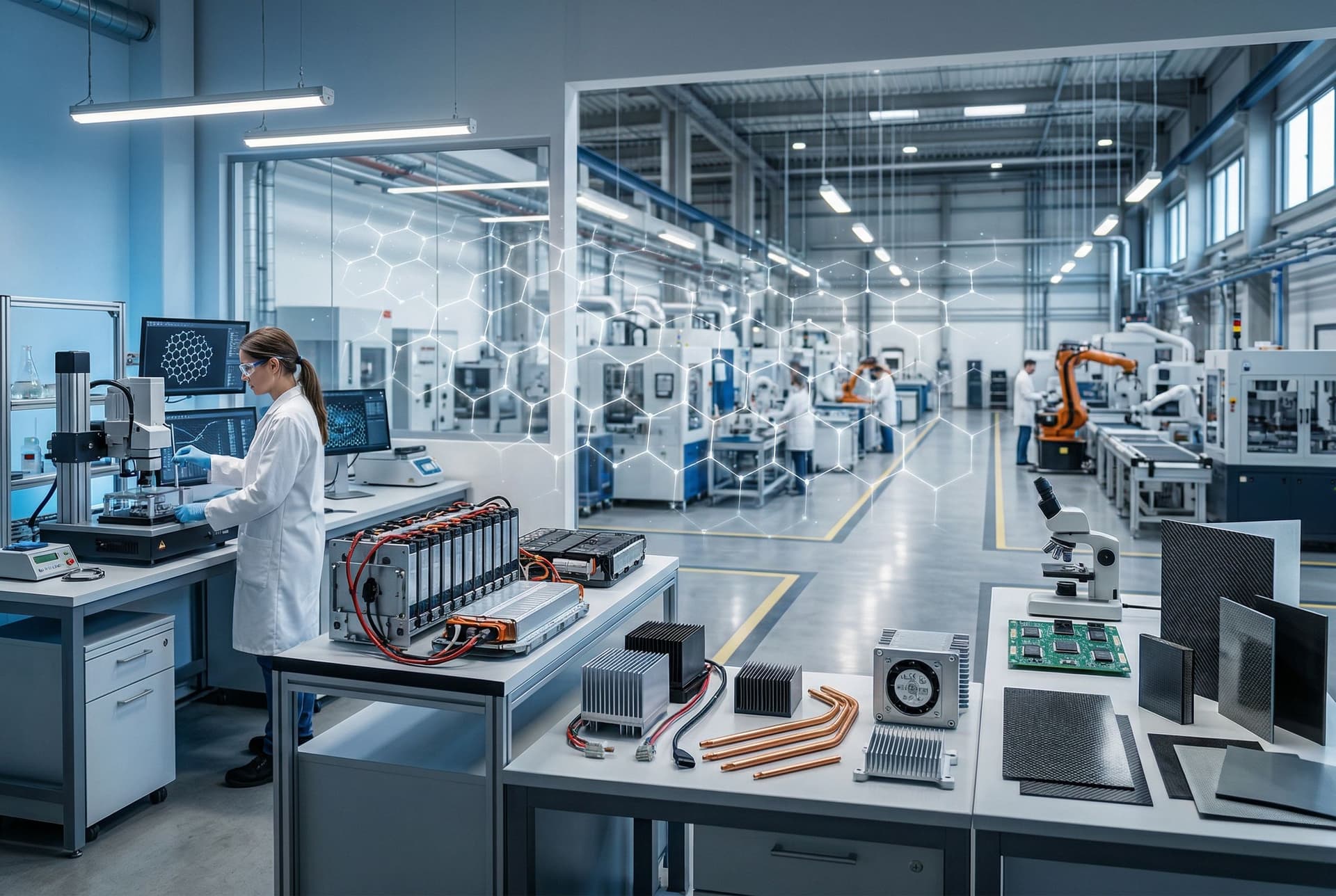
Graphene is still not a magic material that transforms every product category overnight. But in 2026, it is becoming more commercially relevant in exactly the places industrial buyers care about: thermal management, energy storage, coatings, sensors, and high-performance composites. The pattern is consistent. Graphene succeeds when it is used as a functional additive or engineered component that solves a specific performance bottleneck.
That matters because the market is moving away from “graphene as a headline” and toward graphene as a measurable engineering input. Buyers now want better heat spreading, improved conductivity, more durable coatings, lighter parts, or faster sensor response. That shift is what makes 2026 different from the earlier hype cycle.
1) Thermal management is one of the clearest near-term wins
As semiconductors, power electronics, electric vehicles, and data infrastructure push toward higher power density, heat removal becomes a product limitation rather than an afterthought. Graphene is attractive because it combines very high thermal conductivity with low mass and easy blending into composite systems.
In 2026, the strongest commercial opportunities are in:
- thermal interface materials for electronics and packaging
- heat spreaders and heat-dissipation films
- graphene-enhanced polymer compounds for housings and enclosures
- battery thermal management components
The key technical advantage is not that graphene replaces copper or aluminum in every case. It is that graphene can improve through-thickness or in-plane heat transport in materials that already need to be lightweight, thin, flexible, or processable at scale. That is why the most successful products are usually hybrid systems: graphene plus polymer, graphene plus metal, or graphene plus ceramic.
For suppliers, the sales conversation in 2026 is increasingly about thermal resistance, filler loading, dispersion stability, and process compatibility rather than simply surface conductivity numbers.
2) Energy storage keeps graphene on the shortlist
Energy storage remains one of the largest commercial drivers for graphene development. The material is useful in electrode formulations, conductive networks, current collectors, and thermal stabilization strategies. In lithium-ion systems, graphene can help reduce internal resistance, improve rate capability, and support longer cycle life when the formulation is designed correctly.
In 2026, the most realistic battery opportunities are not “graphene batteries” as a separate category. The real business is in graphene-enabled battery materials:
- conductive additives for cathodes and anodes
- silicon-anode support structures
- ultrafast-charge battery architectures
- thermal-control layers around cells and packs
- next-generation supercapacitor and hybrid storage systems
The market is also watching aluminum-ion, sodium-ion, and other beyond-lithium chemistries, where graphene may help with conductivity and cycle stability. But the immediate commercial value is still in incremental improvement of existing cells. That is important for buyers because it means graphene is often a performance upgrade, not a wholesale redesign.
3) Coatings are moving from novelty to practical durability
Graphene coatings are one of the most commercially mature application areas because the use case is easy to understand: better barrier properties, better corrosion resistance, improved wear resistance, and sometimes better electrical or thermal conductivity.
In 2026, the strongest demand is likely to remain in:
- anti-corrosion coatings for marine and industrial assets
- scratch-resistant and abrasion-resistant coatings
- conductive and EMI-shielding coatings
- flame-retardant and protective surfaces
- water-based formulations for lower-VOC manufacturing
The technical challenge is consistency. Graphene improves coatings only when it is properly dispersed and matched to the binder system. Agglomeration, poor wetting, or incompatible loading levels can erase the expected gains. That is why coating formulators increasingly care about graphene form factor: nanoplatelets, graphene oxide, reduced graphene oxide, or hybrid carbon systems.
For commercial buyers, the value proposition is straightforward: longer service life, fewer maintenance cycles, and stronger performance under harsh environmental exposure.
4) Sensors are where graphene’s sensitivity really matters
Graphene has always looked promising for sensing because it is extremely sensitive to changes in charge, strain, temperature, gas adsorption, and surface chemistry. In 2026, the commercial story is becoming more focused: graphene sensors are most attractive where low power, fast response, and flexible form factors matter.
High-value use cases include:
- gas sensing and industrial leak detection
- biosensing and point-of-care diagnostics
- humidity and temperature sensing
- wearable and flexible electronics
- environmental monitoring
The strongest trend is not mass replacement of conventional sensors. It is the emergence of niche applications where graphene gives a meaningful edge in sensitivity, integration, or mechanical flexibility. That makes sensors a good fit for early commercialization because buyers can justify adoption based on a narrow but valuable performance gap.
In practical terms, 2026 is the year graphene sensors move further from “lab demo” and closer to “specialized product line.”
5) Composites remain the workhorse market
If you want the most reliable commercial story for graphene in 2026, composites are still the safest bet. Graphene nanoplatelets are relatively easy to incorporate into polymers, resins, elastomers, and some metals or ceramics, and they can improve multiple properties at once.
Typical benefits include:
- higher stiffness and tensile strength
- improved impact resistance
- better electrical conductivity
- improved thermal management
- enhanced barrier performance
- reduced wear and friction in some systems
This is why graphene continues to show up in automotive parts, aerospace materials, industrial housings, adhesives, sealants, and specialty plastics. Buyers appreciate composites because they are process-friendly. If the formulation works, graphene can be added without replacing the whole manufacturing line.
The limitation is dispersion quality. Poor mixing can turn a promising additive into an expensive filler. So in 2026, the winning suppliers will be the ones that can prove reproducible compounding, not just sell a powder with a spec sheet.
6) Manufacturing is shifting toward scale, standardization, and lower risk
The biggest structural trend in 2026 is not a single application. It is the maturation of manufacturing.
Graphene production is becoming more industrially practical through:
- better chemical vapor deposition for large-area films
- improved exfoliation routes for nanoplatelets
- greener and more scalable production methods
- tighter quality control and application-specific grading
- more interest in recycled-carbon or lower-emission feedstocks
This is where commercialization gets real. Industrial buyers do not want the “best graphene” in a philosophical sense. They want the right graphene for the job, with predictable properties, supply continuity, and a price that matches the value added.
That means 2026 suppliers need to speak the language of:
- purity
- defect density
- lateral size
- surface area
- dispersibility
- moisture content
- conductivity targets
- process compatibility
The market is finally rewarding technical specificity.
What buyers should look for in 2026
If you are sourcing graphene this year, focus on application fit rather than marketing claims. A good supplier should be able to answer:
- What form of graphene is this: nanoplatelet, oxide, reduced oxide, CVD film, or hybrid?
- What property is actually improved in the final system?
- How does loading affect viscosity, dispersion, or processing?
- What testing proves the performance gain?
- Can the supplier scale consistently over multiple batches?
If those questions are difficult to answer, the material is probably not ready for a commercial program.
Final takeaway
The graphene trends of 2026 are less about hype and more about engineering discipline. The strongest applications are the ones where graphene solves a narrow but expensive problem: heat, conductivity, durability, sensitivity, or weight.
That is good news for both buyers and suppliers. It means the market is maturing. It also means graphene is finding its best role—not as a miracle replacement for everything, but as a high-value additive in systems that already need better performance.
In 2026, that is where the real commercial opportunity is.