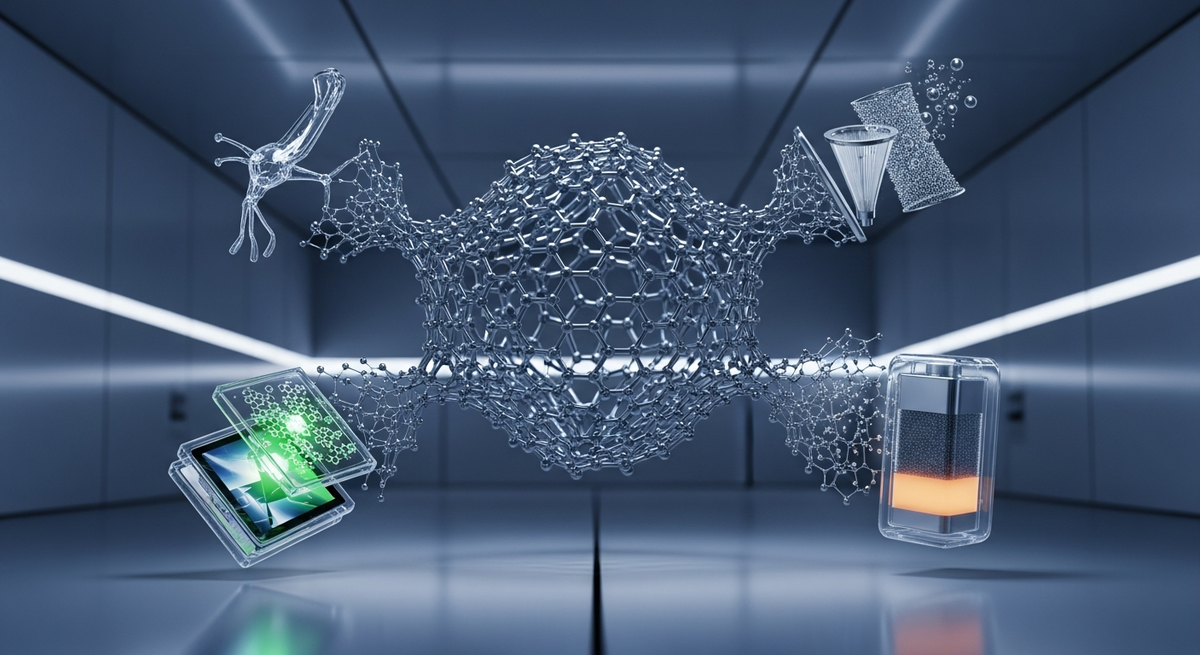
Since its groundbreaking discovery by Geim and Novoselov in 2004, graphene has captivated the scientific and technological world. This extraordinary material, a single two-dimensional (2D) layer of sp2-hybridized carbon atoms arranged in a hexagonal honeycomb lattice, is celebrated for its unparalleled physical and chemical attributes. Often referred to as "the thinnest material in our universe," graphene's unique structure underpins a remarkable suite of properties that are revolutionizing countless industries.
At the core of graphene's appeal are its outstanding electrical conductivity, primarily originating from the delocalized π bonds above and below its basal plane, its colossal specific surface area of 2630 m² g⁻¹, exceptional mechanical strength, and the increasing feasibility of bulk quantity production at relatively low costs. These intrinsic characteristics position graphene as an intriguing and often superior alternative for developing a vast array of cutting-edge technologies. Its versatile nature extends across numerous sectors, including advanced electrical devices, highly sensitive sensors and biosensors, the synthesis of novel nanocomposites, efficient drug delivery systems, powerful catalytic and solid-phase microextraction agents, innovative energy storage materials, and high-performance transparent conducting electrodes. This exploration will delve into the myriad graphene applications that are shaping our future, highlighting the mechanisms and data that underscore its transformative potential.
The Foundational Excellence of Graphene's Unique Properties
Graphene's remarkable versatility stems directly from its fundamental structure and the resultant physical and chemical properties. As a single atomic layer of carbon, meticulously arranged in a hexagonal lattice, it embodies a perfect blend of simplicity and complexity. This sp2-hybridized configuration provides the material with an astonishing combination of strength, lightness, and conductivity, making it a cornerstone for future technological advancements.
Key among these graphene properties is its extraordinary electrical conductivity, measured between 10³ and 10⁴ S m⁻¹. This high conductivity is attributed to the highly mobile electrons within the delocalized π bonds, which allow for rapid charge transport across the material's surface. Such efficiency makes graphene an ideal candidate for high-speed electronics and advanced electrochemical systems, surpassing the performance of many traditional conductive materials.
Furthermore, graphene boasts an enormous specific surface area, providing an abundance of interaction sites crucial for applications like sensing, catalysis, and energy storage. This expansive surface facilitates robust chemical adsorption and enhanced electrochemical reactions. Coupled with its superior mechanical strength, which imparts durability and flexibility, graphene stands out as a material capable of withstanding rigorous operational conditions while maintaining integrity.
Beyond these, the potential for scalable, low-cost production is rapidly advancing, moving graphene from a laboratory curiosity to a viable industrial material. This combination of exceptional electrical, mechanical, and surface properties, alongside its economic accessibility, solidifies graphene's role as a leading material for innovation. Understanding these foundational attributes is key to appreciating the breadth and depth of its practical graphene applications across diverse fields.
Revolutionizing Diagnostics with Graphene Biosensors
One of the most impactful graphene applications is in the field of biosensing, where its unique attributes lead to unprecedented levels of sensitivity, selectivity, and speed. Graphene-based electrochemical sensors consistently outperform traditional materials such as glassy carbon, graphite, and even carbon nanotubes. This superior performance is largely due to the extensive exposure of sp2-like planes and edge defects on graphene nanosheets, which provide abundant active sites and facilitate rapid electron transfer kinetics crucial for accurate detection.
Consider the detection of uric acid, a vital biomarker for various health conditions. Composites of graphene and carbon fiber have demonstrated exceptional results. Studies have shown a significantly higher peak current intensity and a lower oxidation potential for uric acid compared to bare glassy carbon or carbon fiber electrodes, or even graphene-modified glassy carbon electrodes. Further amperometric analysis confirmed a wide linear detection range from 0.194 to 49.68 µM, coupled with a remarkably low detection limit of 0.132 µM (S/N = 3) and a rapid response time. These metrics highlight graphene's capacity to deliver precise and timely diagnostic information.
Another compelling example lies in non-enzymatic ethanol sensing. Nickel nanoparticles deposited on a Nafion/graphene film, hosted on a glassy carbon electrode (GCE), exhibited linear oxidative currents across an ethanol concentration range of 0.43–88.15 mM. The detection limit achieved was an impressive 0.12 mM (S/N = 3), significantly superior to those obtained with other transition metal-based non-enzymatic sensors. This enhanced performance is attributed to the synergistic effect of the highly conductive graphene substrate and the catalytic activity of the well-dispersed nickel nanoparticles, demonstrating the power of graphene nanocomposites in sensor design.
Graphene also excels in the simultaneous determination of complex mixtures. A polydopamine–reduced graphene oxide (RGO) nanocomposite was developed for the simultaneous detection of hydroquinone and catechol. This sensor effectively discriminated between these dihydroxy benzene isomers, exhibiting a clear potential difference (ΔEp) of 103 mV. The peak current for hydroquinone showed linearity over the range of 1.0 × 10⁻⁶ – 2.3 × 10⁻⁴ M, while catechol's peak current was linear from 1.0 × 10⁻⁶ – 2.5 × 10⁻⁴ M. This capability is vital for environmental monitoring and medical diagnostics where multiple analytes need to be precisely quantified in a single sample.
Furthermore, the graphene oxide–manganese dioxide (GO–MnO₂) composite has showcased remarkable improvements in electrochemical sensing. This composite significantly decreased the peak-to-peak separation in cyclic voltammetry for hydroquinone and catechol to approximately 34 and 36 mV, respectively, indicating improved reversibility of the redox processes. In differential pulse voltammetric measurements, the GO–MnO₂-based sensor successfully separated the oxidation peak potentials of hydroquinone and catechol by about 115 mV, even though a bare electrode would yield a single, broad response. This enhanced resolution is attributed to the higher surface area and superior catalytic ability of the GO–MnO₂ composite. The sensor demonstrated excellent linear ranges: 0.01 to 0.7 µM for hydroquinone (in the presence of 0.1 µM catechol) and 0.03 to 1.0 µM for catechol (in the presence of 0.13 µM hydroquinone). Remarkably low detection limits of 7.0 nM for hydroquinone and 10.0 nM for catechol (S/N = 3) further underscore graphene's pivotal role in developing highly sensitive and selective electrochemical sensors for real-world analytical challenges.
Advancing Electronics and Energy Storage with Graphene Nanocomposites
Graphene's unparalleled electrical, mechanical, and surface properties also make it an indispensable material in the advancement of electronics and energy storage materials. Its capacity to form stable and highly functional graphene nanocomposites with various metals opens up a new realm of possibilities for next-generation devices. These hybrid materials combine the inherent strengths of the graphene substrate with the active functionalities of metallic nanoparticles, creating synergistic effects that surpass individual components.
Among the most exciting graphene applications in this domain are memory electronic and optoelectronic transistors. Graphene-supported metal nanocomposites enhance device performance by providing efficient charge transport pathways and robust structural integrity. The stability and excellent conductivity of graphene are crucial for ensuring the reliability and speed required in advanced computing and display technologies. Such materials are integral to fabricating smaller, faster, and more energy-efficient electronic components.
Beyond traditional electronics, graphene plays a crucial role in improving energy storage systems, particularly in next-generation batteries. For instance, when highly insulating metal oxides like Mn₃O₄ are employed as anodes in lithium-ion batteries, maintaining high electrical conductivity throughout charge-discharge cycles can be a challenge. Graphene nanosheets effectively address this by acting as a conductive scaffold. They not only preserve the high electrical conductivity of the electrode but also effectively buffer the mechanical strain caused by the volume changes of the active particles during repeated cycling. This dual action significantly extends the lifespan and enhances the performance of the battery, making graphene a critical component for durable and efficient energy storage materials.
Moreover, graphene's potential as a transparent conducting electrode is immense. Its exceptional transparency combined with its electrical conductivity makes it an ideal candidate for flexible displays, touchscreens, and solar cells, offering a robust and high-performing alternative to traditional indium tin oxide (ITO). The ability to controllably synthesize nanoparticles and disperse them uniformly on the graphene surface further enhances its functionality, enabling the creation of precisely engineered materials for a vast array of specialized electronic and energy applications.
Graphene as a Promising Stationary Phase in Capillary Electrochromatography
The intrinsic properties of graphene extend its utility into highly specialized analytical techniques, notably as a stationary-phase material for open-tubular capillary electrochromatography. This specific application leverages graphene's unique physical and chemical attributes to enhance separation efficiency and analytical precision in complex chemical analyses. Capillary electrochromatography (CEC) is a hybrid separation technique that combines the advantages of high-performance liquid chromatography (HPLC) and capillary electrophoresis (CE), offering high resolution and efficiency.
Graphene's suitability as a stationary phase material arises primarily from its ultrahigh specific surface area and its strong π−π electrostatic stacking property. The vast surface area provides an abundance of interaction sites for analyte molecules, facilitating enhanced separation capabilities. This translates to more effective discrimination between similar compounds, which is critical for analyzing complex biological or environmental samples. The large surface-to-volume ratio in an open-tubular format allows for minimized resistance to mass transfer, leading to faster and more efficient separations.
Furthermore, the strong π−π electrostatic stacking property of graphene allows for robust interactions with aromatic and π-electron-rich compounds. This selective interaction mechanism can be finely tuned, offering a powerful tool for separating molecules based on their electronic structure and aromaticity. By utilizing graphene as the stationary phase, researchers can achieve improved peak resolution, reduced analysis times, and higher column efficiencies compared to conventional stationary phases. This makes graphene a highly promising material for developing next-generation analytical platforms in fields ranging from pharmaceuticals to environmental science, further expanding the diverse spectrum of graphene applications.
Conclusion: The Unfolding Future of Graphene Applications
The journey through graphene's profound properties and its diverse applications underscores its position as one of the most exciting materials of the 21st century. From its foundational excellence rooted in sp2-hybridized carbon to its transformative impact on advanced technologies, graphene continues to push the boundaries of what is possible. Its unparalleled electrical conductivity, immense surface area, mechanical strength, and cost-effective production potential collectively pave the way for revolutionary advancements across numerous sectors.
The detailed exploration of graphene applications in biosensing reveals its superior capabilities in detecting vital biomarkers and complex analytes with unmatched sensitivity and selectivity, outperforming traditional materials. In the realm of electronics and energy storage, graphene nanocomposites are driving innovation in memory devices, optoelectronic transistors, and next-generation batteries, offering solutions for enhanced performance, durability, and efficiency. Moreover, its role as an advanced stationary phase in capillary electrochromatography highlights its precision in analytical separations.
As research continues to unveil new facets of this remarkable 2D material, the scope for future graphene applications appears limitless. Its ability to solve complex problems across industries, coupled with ongoing advancements in scalable production, ensures that graphene will remain at the forefront of material science and technological innovation for decades to come. The future is undoubtedly being built, atom by atom, with graphene.
To learn more about how usa-graphene.com is driving innovation with advanced graphene solutions, explore our cutting-edge products and research initiatives today. Visit usa-graphene.com to discover the potential that graphene holds for your industry and to partner with us in shaping tomorrow's technologies.