
A New Era of Graphene Engineering: Pre-Designing Twist Angles on Demand
Researchers have developed a breakthrough method for growing twisted bilayer graphene with pre-designed angles, a key step toward manufacturable quantum...
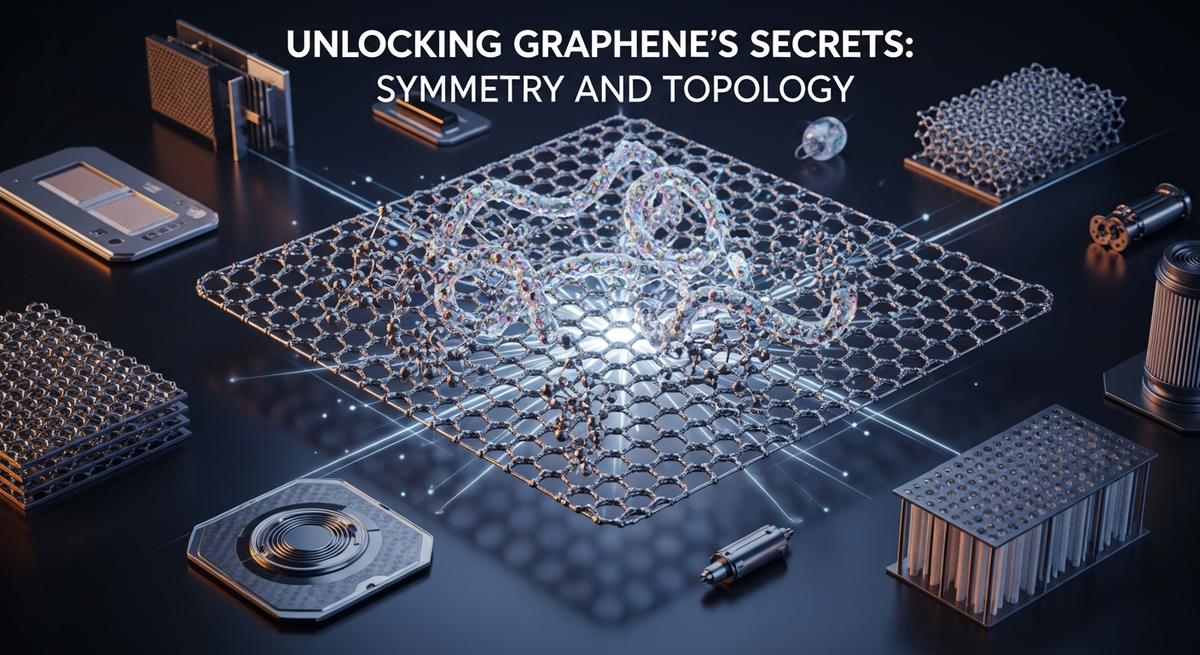
Graphene, the remarkable single-layer allotrope of carbon, has captivated the scientific community since its isolation. Its unique two-dimensional structure, arranged in a perfect hexagonal lattice, gives rise to an array of unparalleled electronic, mechanical, and thermal properties. Yet, to truly comprehend and harness graphene's full potential, we must delve beyond its visual simplicity into the intricate mathematical frameworks that define its very essence: symmetry and topology. These aren't just abstract concepts for theoretical physicists; they are fundamental tools that allow researchers to predict, understand, and ultimately engineer graphene-based materials for a new generation of technologies. From advanced electronics to robust composites, the blueprint for graphene's future lies embedded within its geometric and relational patterns.
The study of graphene's symmetry and topology is a cornerstone of modern mathematical physics. It provides a rigorous language to describe how the carbon atoms are arranged and how these arrangements dictate the material's behavior. By understanding the underlying mathematical principles, scientists can design novel graphene structures with tailored properties, moving from discovery to deliberate innovation. This exploration will unpack how these mathematical notions—from the basic definition of a graph to complex symmetry groups and topological indices—are applied to graphene, revealing the profound connection between abstract mathematics and tangible material science.
Graphene is universally recognized for its iconic structure: a single layer of carbon atoms meticulously arranged in a regular hexagonal pattern. This arrangement is not arbitrary; it is the source of many of graphene's celebrated properties. Each carbon atom is covalently bonded to three neighbors, forming a robust and incredibly thin sheet. This two-dimensional architecture is essentially a molecular graph, where the carbon atoms serve as vertices and the chemical bonds act as edges.
In mathematical terms, a graph G is defined by a set of vertices V(G) and a set of edges E(G). For graphene, this translates directly to atoms and bonds. The entire structure is 'connected,' meaning you can trace a path between any two atoms within the sheet. Furthermore, graphene is a '2-connected' graph, indicating that removing any single carbon atom will not disconnect the entire lattice. This inherent connectivity is a key aspect of its structural integrity and electrical conductivity, ensuring a continuous pathway for electrons.
Another crucial characteristic of graphene is its 'planarity.' A graph is planar if it can be drawn on a two-dimensional surface without any edges crossing. Graphene perfectly embodies this, existing as a flat, two-dimensional sheet. This planarity is not just a visual attribute; it has profound implications for its electronic band structure and allows for the seamless flow of charge carriers, contributing to its exceptional conductivity. Understanding these basic graph theory definitions lays the groundwork for appreciating the deeper mathematical insights that symmetry and topology offer.
Symmetry, at its core, describes the invariance of an object under certain transformations. For a physical object like graphene, a symmetry is a permutation that leaves the distance between any two points unchanged. Imagine rotating a snowflake; it looks the same after certain rotations. This rotational invariance is a form of symmetry. In the context of graphene, symmetry operations can include rotations, reflections, and translations that map the atomic lattice onto itself, making it indistinguishable from its original state.
Mathematically, the set of all such symmetry elements forms a 'group' under the operation of composition. This concept of a group is central to understanding the full extent of graphene's ordered structure. A group is a set with a binary operation that satisfies three conditions: associativity, existence of an identity element, and existence of an inverse for every element. For graphene, the 'automorphism group' of its molecular graph, denoted Aut(G), comprises all one-to-one functions that map the vertices (atoms) onto themselves while preserving the connections (bonds). This group quantifies the inherent structural regularity of the material.
Different graphene structures exhibit different types of symmetry groups. For instance, a regular n-gon has a 'dihedral symmetry group' of order 2n, which includes both rotations and reflections. As we explore more complex graphene forms, we find these precise mathematical descriptions allow us to categorize and differentiate them based on their underlying order. The symmetry of a graphene lattice is not just an aesthetic feature; it is a powerful predictor of its physical and chemical properties, influencing everything from electron flow to chemical reactivity.
The academic chapter highlights specific classes of graphene lattices and their associated symmetry groups, demonstrating how varying geometries lead to distinct mathematical descriptions. One important class, denoted Hn, represents hexagonal systems formed by a central hexagon surrounded by n-1 layers of hexagonal cells. Examples include benzene (n=1), coronene (n=2), and circumcoronene (n=3). These structures possess a high degree of symmetry.
Theorem 10.2 states that the hexagonal graph Hn possesses a dihedral group symmetry of order 12. This means these molecules exhibit a specific set of rotations and reflections that leave their structure invariant, indicating a high level of intrinsic order. This type of symmetry is crucial for understanding the stability and electronic properties of these polycyclic aromatic hydrocarbons, which serve as foundational building blocks for larger graphene domains. The predictable, repeating patterns are what make these materials so robust and versatile.

Another class of graphene structures discussed is the hexagonal-parallelogram, P(n, k). The symmetry of these parallelograms depends on their dimensions. Theorem 10.3 reveals that if n = k (meaning the parallelogram is symmetrical in both dimensions), it exhibits a 'Klein symmetry group' (K4), an abelian group generated by two elements of order two. However, if n ≠ k, the symmetry is reduced to a 'cyclic symmetry group of order two.' This means only a limited set of rotations (or a single 180-degree rotation) will map the structure onto itself. This distinction in symmetry directly influences how these graphene nanoribbons might behave, for instance, in terms of their edge states and electronic transport properties.
Furthermore, the chapter introduces hexagonal jagged-rectangles (HJR) of types I, K, and J, which are characterized by alternating numbers of hexagonal cells in their rows. Theorems 10.4 specifies that HJR types I and K also possess Klein symmetry groups, while HJR type J has a cyclic symmetry group of order 2. These differences, subtle as they may seem in their mathematical definition, translate into tangible variations in the material's physical characteristics. For instance, the edges of these jagged structures, defined by their symmetry, play a critical role in determining their electronic bandgap, which is vital for semiconductor applications. Precisely defining these symmetries allows scientists to predict and control these properties during synthesis.
While symmetry describes what an object looks like after a transformation, topology focuses on properties that remain invariant under continuous deformations, such as stretching or bending, without tearing or gluing. For graphene, topology primarily concerns the connectivity and relationships between its atoms and bonds, irrespective of the precise geometric angles or distances. It's about the 'neighborhood' of atoms and how they are linked.
Central to topological analysis is the concept of 'topological distance' between two vertices (atoms) in a graph. This is defined as the length of the shortest path connecting them. From this, other topological indices are derived, such as the 'diameter' (D(G)), which is the maximum topological distance between any two vertices, and the 'radius' (R(G)), the minimum maximum distance from a central vertex. These distance-based topological indices are invariant under automorphisms, meaning they are inherent properties of the graph's structure itself, regardless of how it's oriented in space.
The chapter introduces a specific topological relation for edges in hexagonal systems: 'parallelism.' An edge 'e' is parallel to an edge 'f' if the minimum distance from each endpoint of 'e' to 'f' is equal. This definition is quite nuanced. Theorem 10.1 states that this parallelism relation is reflexive (an edge is parallel to itself) and symmetric (if e || f, then f || e), but importantly, it is not transitive. This non-transitivity means that if e || f and f || g, it does not necessarily imply that e || g. This is demonstrated with a polyhex nanotorus example, highlighting the complex, non-Euclidean nature of "parallelism" within these hexagonal lattices. This specific mathematical characteristic informs how stresses might propagate or how electronic pathways might branch within complex graphene structures, guiding engineers in designing resilient materials.

The set of all edges parallel to a given edge 'e' is denoted P(e), and its size, N(e) = |P(e)|, serves as another distance-based topological index. Such indices are incredibly valuable because they condense complex structural information into a single number. These numbers can then be correlated with various physicochemical properties of graphene, enabling researchers to quantify and compare different graphene derivatives and predict their behavior without needing to perform extensive physical experiments. For example, specific topological indices can correlate with the material's stability, electronic band structure, or even its reactivity, providing a powerful computational tool for material design.
The rigorous mathematical descriptions of graphene's symmetry and topology are far from academic curiosities; they are indispensable tools for advancing material science and engineering. Understanding these inherent properties allows scientists to predict, explain, and ultimately manipulate the macroscopic behavior of graphene-based materials from their atomic arrangements. This predictive power is a cornerstone of rational material design, moving beyond trial-and-error experimentation.
For instance, the symmetry of a graphene sheet dictates its electronic band structure. Perfect hexagonal symmetry leads to the famous Dirac cones, responsible for graphene's massless Dirac fermion behavior and extraordinarily high electron mobility. Any disruption to this symmetry, whether through defects, edges, or chemical functionalization, alters the band structure, potentially opening a bandgap and transforming graphene from a conductor into a semiconductor. Knowing the symmetry group of a particular graphene nanoribbon or quantum dot allows precise tuning of its electronic and optical properties for applications in transistors, sensors, and optoelectronics.
Topological indices, derived from distances and connectivity, provide quantitative measures that correlate with mechanical strength, thermal conductivity, and even chemical reactivity. A higher diameter might indicate a larger structure, while specific parallelism patterns could relate to how cracks propagate or how heat disperses. By computing these indices for various graphene derivatives, researchers can establish structure-property relationships, guiding the synthesis of materials with enhanced performance characteristics. This computational approach significantly accelerates the discovery and development cycle for new graphene applications, from ultra-strong composites to efficient energy storage devices.
The ability to mathematically classify and characterize different graphene structures—from the simple coronene to complex hexagonal-parallelograms and jagged-rectangles—based on their symmetry and topology provides a universal language for the scientific community. It ensures consistency in describing new materials and allows for systematic exploration of the vast chemical space of graphene derivatives. This deep understanding is not just about appreciating the elegance of mathematics; it is about building the foundation for the next generation of graphene-enabled technologies that will shape our future.
Q1: What is the primary difference between symmetry and topology in the context of graphene?
A1: Symmetry describes the transformations (like rotations or reflections) that leave graphene's atomic arrangement unchanged, focusing on its geometric regularity. Topology, on the other hand, focuses on properties that remain invariant under continuous deformations (stretching, bending without tearing), primarily concerning the connectivity and relationships between atoms, regardless of precise distances or angles.
Q2: How does the symmetry group of a graphene structure influence its properties?
A2: The symmetry group of a graphene structure directly dictates many of its physical properties. For example, the perfect hexagonal symmetry of pristine graphene leads to its unique electronic band structure and high electron mobility. Breaking this symmetry (e.g., in nanoribbons or by defects) can open a bandgap, altering its electrical conductivity and making it suitable for semiconductor applications. Symmetry also affects optical and vibrational properties.
Q3: What are "topological indices," and why are they important for graphene research?
A3: Topological indices are numerical values derived from the graph representation of a molecule (like graphene) that are invariant under automorphisms. They quantify structural features like connectivity, branching, and distances. For graphene, these indices are crucial because they can be correlated with various physicochemical properties (e.g., stability, reactivity, electronic characteristics), allowing scientists to predict material behavior computationally without extensive experimental synthesis.
Q4: Can you give an example of how a specific graphene geometry relates to its symmetry type?
A4: Certainly. A circumcoronene molecule, which is a hexagonal system Hn with n=3, exhibits a dihedral group symmetry of order 12. In contrast, a hexagonal-parallelogram graphene structure P(n,k) will have a Klein symmetry group if its dimensions are equal (n=k), but only a cyclic symmetry group of order two if its dimensions are unequal (n≠k). These different symmetry types correspond to distinct arrangements of atoms and bonds, influencing material behavior.
Q5: What does it mean that the "parallelism" relation for edges in graphene is not transitive?
A5: In the context of graphene's hexagonal lattice, two edges are defined as "parallel" based on their topological distance relationships to each other. While this relation is reflexive (an edge is parallel to itself) and symmetric (if edge A is parallel to edge B, then B is parallel to A), it is not transitive. This means that if edge A is parallel to B, and B is parallel to C, it does not necessarily follow that A is parallel to C. This non-transitivity highlights the complex, non-Euclidean nature of spatial relationships within the hexagonal lattice, which has implications for understanding stress distribution and electron pathways.
The journey into the symmetry and topology of graphenes reveals a profound truth: the most groundbreaking material science often rests upon sophisticated mathematical foundations. Graphene, with its deceptively simple hexagonal pattern, is a testament to this principle. Its extraordinary properties—from unparalleled electrical conductivity to exceptional mechanical strength—are not mere accidents of nature but direct consequences of its inherent symmetry and intricate topological relationships.
By meticulously dissecting graphene's structure using the tools of group theory, graph theory, and topology, scientists can move beyond empirical discovery to a realm of predictive engineering. Understanding whether a particular graphene derivative exhibits dihedral, Klein, or cyclic symmetry, or how its distance-based topological indices dictate its behavior, provides the intellectual framework necessary for innovation. This mathematical precision empowers researchers to design and synthesize novel graphene structures with tailored properties for specific applications, accelerating the development of next-generation technologies. The future of graphene, undeniably, is being written in the language of symmetry and topology, solidifying its role as a material of endless possibilities.
Serious about B2B integration? Test our premium Pulsed Electrical Resistive Carbon Heating turbostratic graphene in your lab. 100g sample packs available now.
Explore More
Researchers have developed a breakthrough method for growing twisted bilayer graphene with pre-designed angles, a key step toward manufacturable quantum...

Learn how deep learning is revolutionizing the structural characterization of twisted bilayer materials, accelerating the development of next-generation...

Learn to build a prototype graphene FET biosensor for sensitive DNA detection. This guide covers materials, fabrication, and testing for point-of-care...