
A New Era of Graphene Engineering: Pre-Designing Twist Angles on Demand
Researchers have developed a breakthrough method for growing twisted bilayer graphene with pre-designed angles, a key step toward manufacturable quantum...
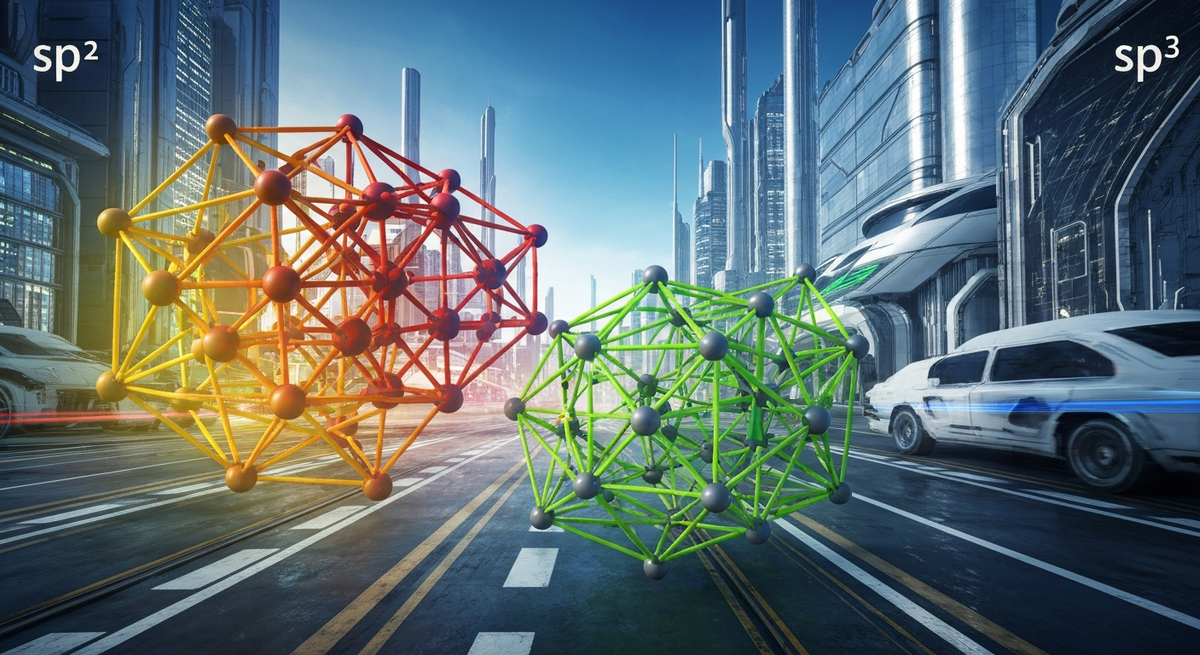
Graphene, a remarkable material composed of a single atomic layer of carbon atoms arranged in a hexagonal lattice, has captivated the scientific community for its extraordinary properties. Its unique electronic structure, characterized by massless Dirac fermions and exceptionally high carrier mobility, promised a new era in materials science. However, graphene's inherent semimetallic nature, meaning it possesses a zero bandgap, presents a significant hurdle for its direct application in conventional electronic devices that rely on distinct 'on' and 'off' states. Overcoming this limitation, by engineering a tunable bandgap, has become a central focus of research.
The pursuit of electronic structure engineering in graphene-like nanofilms is not merely an academic exercise; it is a fundamental pathway to unlocking a vast spectrum of functionalities. While various methods exist for tuning graphene's properties – including substrate interaction, atomic doping, molecular doping, and nanoscale patterning – one particular approach stands out for its profound impact: the sp2 to sp3 phase transformation. This chemical and structural alteration fundamentally changes the bonding characteristics of carbon atoms, pushing graphene beyond its inherent limitations and paving the way for advanced electronic and spintronic devices. Understanding this transformation is crucial for anyone keen on the future of two-dimensional materials.
At the heart of graphene's unique properties lies its sp2 hybridization. In this configuration, each carbon atom forms three strong covalent sigma bonds with its neighbors, lying perfectly flat in a two-dimensional plane. The remaining p-orbitals, one from each carbon atom, overlap above and below this plane to form delocalized pi-bonds, creating the characteristic electron cloud that gives graphene its exceptional electrical conductivity. This specific bonding arrangement results in a honeycomb lattice where electrons behave as massless Dirac fermions, leading to phenomena like the half-integer quantum Hall effect and ambipolar electric field effects.
While these properties are fascinating, the zero bandgap of pristine graphene poses a significant challenge for its integration into semiconductor-based electronics. Conventional transistors, for instance, require a clear energy gap between the valence and conduction bands to switch current flow effectively. Without this gap, graphene cannot be easily turned 'off', limiting its utility in digital logic circuits. Therefore, methods to introduce and precisely control a bandgap are indispensable for transitioning graphene from a laboratory curiosity to a cornerstone of next-generation technology. The ability to modify this fundamental electronic characteristic opens doors to applications currently beyond reach.
The sp2 to sp3 phase transformation represents a fundamental shift in the bonding environment of carbon atoms within graphene. In sp2 hybridization, carbon atoms are trigonal planar, forming double bonds and remaining largely flat. In contrast, sp3 hybridization involves four single covalent bonds arranged tetrahedrally, similar to the structure found in diamond. This transformation is typically induced through chemical functionalization, where foreign atoms or molecules bond covalently to the carbon atoms of the graphene lattice. These new bonds disrupt the planar sp2 network and force the carbon atoms to adopt a more three-dimensional sp3 configuration.
When carbon atoms transition from sp2 to sp3, the delocalized pi-electron system that defines graphene's semimetallic behavior is broken. The electrons become localized in the new covalent bonds, fundamentally altering the material's electronic properties. This structural change is not merely cosmetic; it directly dictates whether the material behaves as a metal, a semiconductor, or even an insulator. The precise control over this transformation, often achieved by varying the type and density of functionalizing agents, allows for fine-tuning of the resulting material's characteristics, offering an unprecedented level of material design.

The most straightforward application of sp2 to sp3 transformation in graphene involves its single-layer form. Early theoretical predictions in 2008 by Sofo et al. introduced the concept of graphane, a fully hydrogenated single-layer graphene. In graphane, every carbon atom is sp3-hybridized, covalently bonded to a hydrogen atom on either side of the plane in an alternating 'chair-like' configuration. This complete saturation of the carbon network effectively destroys the original pi-band system, transforming graphene from a semimetal into a wide-bandgap insulator, with a predicted gap of 3.5 eV (GGA) and a more accurate 5.4 eV (GW calculations). Experimental validation quickly followed, with Elias et al. synthesizing graphane via hydrogen plasma, demonstrating its insulating properties.
Beyond full hydrogenation, partial functionalization offers even more intriguing possibilities. When only half of the hydrogen atoms are removed from graphane, the resulting material, known as graphone, exhibits a fascinating combination of properties. Graphone is a ferromagnetic semiconductor with a small indirect bandgap of 0.46 eV. Here, the hydrogenated carbon atoms are sp3-hybridized, while the unhydrogenated carbons remain sp2-hybridized, leaving localized, unpaired electrons that give rise to ferromagnetism. This demonstrates how a controlled mix of sp2 and sp3 regions can yield materials with both semiconducting and magnetic characteristics, a crucial step for spintronics.
Fluorination offers a parallel pathway to modify graphene's properties. Fluorographene, analogous to graphane, is a fully fluorinated single-layer graphene where all carbon atoms are sp3-hybridized and covalently bonded to fluorine atoms. Like graphane, it is predicted to be a wide-bandgap insulator, with a direct gap of 3.20 eV (GGA) or 7.42 eV (GW). Experiments by Jeon et al. confirmed the insulating nature of partially fluorinated graphene, showing a bandgap of 3.8 eV. Interestingly, semifluorinated graphene, where only a portion of carbon atoms are bonded to fluorine, displays distinct behavior compared to semihydrogenated graphene, exhibiting magnetic and metallic characteristics. This magnetism arises from the exchange splitting of dangling bonds on unfluorinated carbon atoms, coupled with impurity states induced by the fluorine adatoms. These examples underscore the versatility of chemical functionalization in engineering graphene's electronic and magnetic landscapes.
The concept of sp2 to sp3 transformation extends beyond single-layer graphene to more complex architectures, such as bilayer graphene and heterostructures. Functionalizing bilayer graphene can lead to intriguing new materials, including 'diamondized' graphene bilayers. In these structures, the sp2 carbon atoms in both layers can be induced to form sp3 bonds not only with functionalizing agents but also with each other, creating interlayer covalent bonds that mimic the diamond structure. This transformation can dramatically alter the electronic properties, moving the material from a magnetic semiconductor towards a nonmagnetic metal, showcasing a remarkable tunability.
Another promising area involves hybrid structures, such as graphene-boron nitride (graphene-h-BN) heterobilayers. Hexagonal boron nitride (h-BN) is an insulating 2D material with a lattice structure very similar to graphene. When these two materials are stacked, their interaction can be further engineered through functionalization, leading to sp2 to sp3 transformations that bridge the layers or modify individual layers. This opens avenues for creating novel devices with tailored electronic and magnetic properties. The precise control over interlayer interactions and hybridization states in these heterostructures offers a fertile ground for exploring new physics and designing integrated functionalities previously unattainable with single-component materials. This approach leverages the strengths of multiple 2D materials, creating synergistic effects.
The principles of sp2 to sp3 phase transformation are not exclusive to carbon-based graphene. Similar 2D structures, such as silicon carbide (SiC) nanofilms, also exhibit fascinating property changes upon functionalization. Unlike graphene, sp2-hybridized SiC sheets are already semiconductors with a large direct energy gap. This inherent semiconducting nature provides a different starting point for engineering, allowing researchers to build upon existing bandgap properties rather than solely creating one.
One particularly exciting development involves hydrogenated wurtzite SiC nanofilms. These materials are predicted to be two-dimensional bipolar magnetic semiconductors. A bipolar magnetic semiconductor is a material where the magnetic properties, specifically the spin polarization, can be conveniently controlled by an external electric field or gate voltage. This means that the material's magnetism can be switched 'on' or 'off', or even reversed, simply by applying a voltage. Such exquisite control over spin makes these hydrogenated SiC nanofilms exceptionally promising candidates for advanced spintronic devices, where information is encoded not just in electron charge but also in its spin state. The ability to control magnetism electrically is a holy grail for many technological applications, including high-density data storage and quantum computing. This represents a significant leap forward in designing materials with active magnetic functionalities.
The journey of understanding and harnessing sp2 to sp3 phase transformations in graphene-like nanofilms has been significantly propelled by advanced computational methods. First-principles calculations, particularly Density Functional Theory (DFT), have played a pivotal role in predicting the existence, stability, and electronic properties of these functionalized materials. For instance, the initial prediction of graphane by Sofo et al. was entirely based on such calculations. More sophisticated methods like GW calculations have been used to refine bandgap predictions, offering higher accuracy than standard GGA approaches.
Furthermore, the Nonequilibrium Green's Function (NEGF) method, often combined with DFT, allows for the exploration of transport properties in these functionalized systems, providing insights into their potential as high-performance 2D spintronics devices. These theoretical predictions are not abstract; they serve as critical blueprints for experimentalists. The subsequent experimental synthesis and characterization of materials like graphane and fluorinated graphene have consistently validated these computational models, creating a powerful feedback loop. This synergy between theoretical prediction and experimental verification accelerates the discovery and development of new materials with tailored functionalities, ensuring that research translates effectively into tangible advancements.

The sp2 to sp3 phase transformation represents a pivotal concept in the engineering of graphene-like nanofilms, transcending the inherent limitations of pristine graphene. By manipulating the fundamental bonding characteristics of carbon atoms through chemical functionalization, researchers have successfully converted graphene from a semimetal into insulators, semiconductors, and even magnetic metals. This profound ability to tune electronic and magnetic properties offers an unprecedented toolkit for material design.
From the creation of wide-bandgap graphane and fluorographene to the emergence of ferromagnetic graphone and the intricate behavior of functionalized bilayers and SiC nanofilms, the insights gained are transforming our understanding of 2D materials. The demonstrated tunability of electronic and magnetic properties, often predicted through rigorous first-principles calculations and validated by experimental synthesis, is not merely a scientific curiosity. It is a direct pathway to constructing the next generation of graphene-based electronics and spintronics devices, promising a future where materials are precisely engineered for specific, high-performance applications.
Serious about B2B integration? Test our premium Pulsed Electrical Resistive Carbon Heating turbostratic graphene in your lab. 100g sample packs available now.
Explore More
Researchers have developed a breakthrough method for growing twisted bilayer graphene with pre-designed angles, a key step toward manufacturable quantum...

Learn how deep learning is revolutionizing the structural characterization of twisted bilayer materials, accelerating the development of next-generation...

Learn to build a prototype graphene FET biosensor for sensitive DNA detection. This guide covers materials, fabrication, and testing for point-of-care...