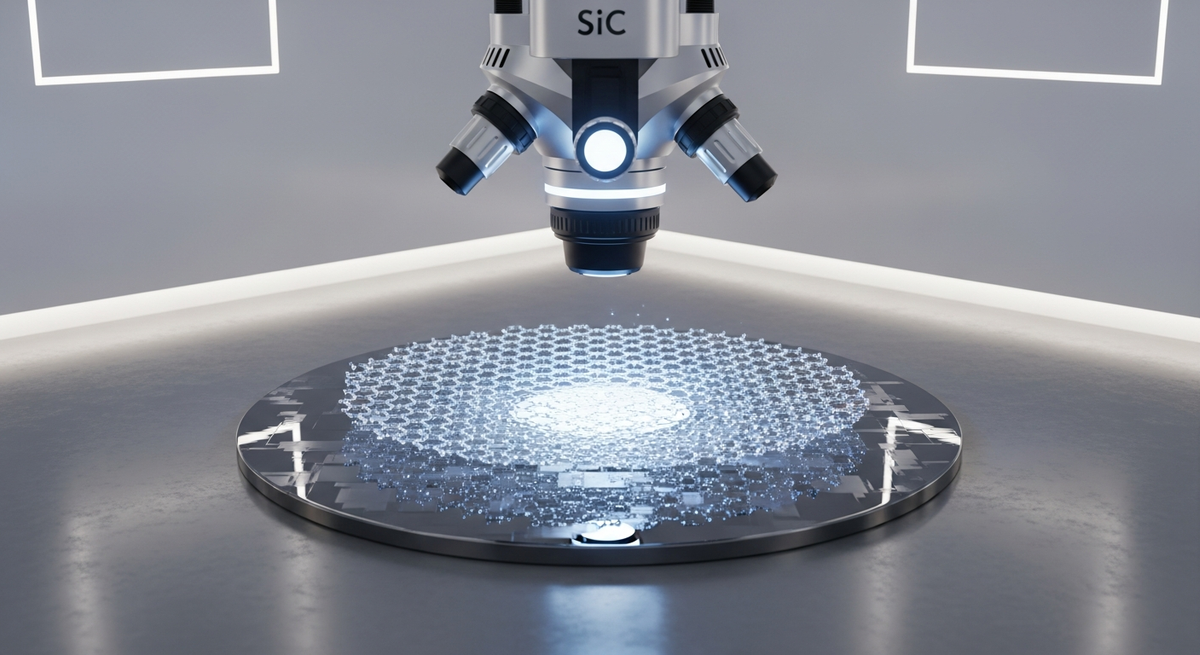
Graphene, the two-dimensional marvel of carbon, holds the key to revolutionizing countless technologies, particularly in the realm of high-speed electronics and advanced sensing. Its exceptional properties, such as massless Dirac fermions and incredible electron mobility, promise devices that far surpass current capabilities. However, translating this theoretical potential into practical, high-performance applications requires meticulous control over its fundamental structure, especially when integrated onto suitable substrates. Among these, silicon carbide (SiC) stands out as a highly promising foundation, offering a unique interplay between substrate and graphene that profoundly impacts device functionality.
This article delves into the critical influence of graphene's structural properties when grown on SiC surfaces, examining how atomic arrangement, stacking configurations, and the presence of defects dictate its electronic behavior. For engineers, material scientists, and business leaders focused on the future of electronics, understanding these intricate relationships is not just academic; it is essential for developing the next generation of ultrafast processors, highly sensitive molecular sensors, and robust, integrated circuits. We will explore the challenges and advancements in harnessing graphene on SiC, paving the way for unprecedented technological innovation.
The Promise of Graphene and the SiC Foundation for Advanced Electronics
The allure of graphene in high-tech applications stems from its extraordinary electronic characteristics. Unlike conventional semiconductors, electrons in single-layer graphene behave as “massless Dirac fermions,” moving at speeds approximately 1/300th the speed of light. This phenomenon arises from its unique linear dispersion relation near the K-point in its electronic band structure, enabling extremely fast charge transport with minimal scattering. Such properties are ideal for constructing devices capable of high-speed signal processing and swift detection, pushing the boundaries of what is currently possible in electronics.
However, realizing these ambitious goals demands more than just isolated graphene flakes. Practical electronic devices require stable, integrated platforms that can reliably support graphene over extended periods, making the choice of substrate critical. Silicon carbide (SiC) emerges as an exceptionally attractive substrate for epitaxial graphene synthesis due to several compelling reasons. SiC can be easily doped to create n-type, p-type, or semi-insulating layers, offering versatility for various device architectures. Furthermore, good-quality, large-size SiC wafers are commercially available, a crucial factor for scalable industrial production. While the current cost of SiC substrates can be relatively high, its benefits for high-tech, high-value applications often justify the investment, positioning SiC as a cornerstone for advanced graphene-based electronics.
The natural synthesis technique involving the evaporation of silicon from SiC at high temperatures presents a promising avenue for creating desired graphene-SiC systems. This approach facilitates the direct growth of graphene layers on a compatible substrate, streamlining the fabrication process. The seamless integration of graphene with SiC allows for the development of highly complex and integrated circuits, crucial for high-performance computing and sensing. Despite its initial promise, translating this simple roadmap into consistently high-performing devices has proven to be a complex and arduous challenge, demanding a deeper understanding of the material's fundamental structural properties.
Unpacking Graphene's Structural Properties on SiC Surfaces
The fundamental electronic properties of graphene, particularly its characteristic linear dispersion relation, are intricately tied to its atomic structure. For single-layer graphene, this Dirac dispersion is responsible for its massless fermion behavior, crucial for ultra-fast electronics. However, when multiple layers of graphene are synthesized on a substrate like SiC, their stacking arrangement, angular orientation, and even their attachment to the substrate dramatically alter these crucial electronic characteristics. Understanding these structural nuances is paramount for tuning graphene's properties for specific applications.
The core difference lies between single-layer graphene and its multilayered counterparts, which can often resemble graphite. While single-layer graphene possesses a closed bandgap and linear (Dirac) dispersion, multilayer systems, depending on their stacking, typically exhibit an open bandgap and parabolic dispersion relations, characteristic of massive electron transport. This distinction is critical because the promising perspectives of graphene in fast electronics cannot be fulfilled by materials behaving like conventional graphite. The transition from linear to parabolic dispersion, and the opening of a bandgap, fundamentally changes how electrons propagate through the material, hindering high-speed operation.
Theoretical approaches, including tight-binding and density functional theory (DFT) calculations, consistently explain this behavior. The sixfold symmetry of a single graphene plane, originating from its π-bonded pz orbitals, is essential for maintaining the linear dispersion relation. When this symmetry is broken, such as in typical Bernal (AB) or rhombohedral (ABC) stacking of multilayer graphite, the overlap of wave functions between neighboring layers disrupts this symmetry, leading to massive transport. Interestingly, studies have shown that AA-stacked sp2 carbon layers can preserve the sixfold symmetry, retaining the Dirac dispersion even in multilayer form, both for self-standing graphene and when synthesized on the Si-terminated face of SiC. Any form of symmetry breaking, whether from hydrogen adsorption or the presence of a differently stacked neighboring layer, can be sufficient to open a bandgap and introduce effective mass to the carriers, thereby diminishing graphene's unique electronic advantages.
The Detrimental Impact of Defects on Graphene Performance
While graphene's ideal structure promises extraordinary electronic performance, the reality of synthesized graphene often presents a different picture. Extended defects, which are currently ubiquitous in epitaxially grown graphene layers on SiC, pose significant challenges to harnessing its full potential. These imperfections are not merely cosmetic; they are highly detrimental to the mobility of charge carriers, acting as scattering centers that disrupt the ballistic transport of Dirac fermions. Consequently, devices fabricated from such imperfect graphene layers fail to meet the stringent speed and efficiency requirements of high-tech applications, underscoring the critical need for defect mitigation.
The influence of local orientational disorder on average electron transport properties is a major concern. Such disorder can arise from slight misalignments between graphene domains or layers, creating irregularities in the atomic lattice. These deviations from perfect hexagonal symmetry impede the smooth flow of electrons, leading to reduced carrier velocities and increased energy dissipation. Furthermore, this disorder is often intimately related to the formation of grain boundaries, which are essentially interfaces composed of chains of these extended defects. Grain boundaries can be categorized into low-angle and high-angle types, depending on the degree of misorientation between adjacent graphene grains.
Structural analysis, often employing advanced techniques like transmission electron microscopy (TEM) in plan-view observations, has been instrumental in elucidating the principal types of these defects. TEM studies reveal the atomic-scale structure of these imperfections, providing critical insights into how they form and how they impede electronic transport. The creation of such defects is not random but can be attributed to several factors inherent in the growth process. Built-in strain, which accumulates as graphene layers grow and interact with the SiC substrate, can induce structural deformations and defect formation. Additionally, the coalescence of independently growing graphene nuclei during synthesis often leads to the formation of grain boundaries where these nuclei merge imperfectly, creating extended defects at their interfaces. Effectively addressing these underlying causes of defect creation is fundamental to advancing the performance of graphene-based electronic devices.
Advanced Synthesis and Characterization for High-Performance Graphene on SiC
The journey toward high-performance graphene electronics hinges on perfecting the synthesis process on SiC substrates. While the method of evaporating silicon at high temperatures from SiC offers a direct pathway, it has proven to be painstakingly arduous in practice. Achieving the desired structural properties – specifically, uniform, defect-free graphene with controlled stacking sequences – remains a significant hurdle. The quality of graphene synthesized on both the silicon-terminated and carbon-terminated faces of SiC requires considerable improvement and modification to meet the demands of advanced electronic applications.
Ongoing research focuses heavily on refining growth parameters, such as temperature, pressure, and the use of specific atmospheres, to minimize defect formation and promote desired stacking arrangements. For instance, creating AA-stacked graphene, which preserves the crucial Dirac dispersion, is a key objective that requires precise control over the initial nucleation and subsequent layer growth. Understanding the mechanisms behind defect creation, including built-in strain and the coalescence of growing graphene nuclei, directly informs the development of more sophisticated synthesis techniques. Researchers are exploring various growth methodologies, including altered SiC surface preparation, controlled growth kinetics, and even post-growth annealing, to enhance structural integrity and uniformity across large SiC wafers.
Advanced material characterization techniques play an indispensable role in this optimization process. Transmission Electron Microscopy (TEM), for example, provides invaluable insights into the atomic-scale structure of graphene on SiC, allowing researchers to visualize extended defects, grain boundaries, and the precise stacking of multilayer graphene. This detailed structural feedback is critical for correlating synthesis parameters with material quality and electronic performance. Similarly, spectroscopic techniques help analyze the electronic band structure and carrier properties, confirming the presence of Dirac fermions or the opening of a bandgap. By combining theoretical modeling with experimental characterization and precise synthesis control, the industry is steadily moving towards producing high-quality graphene on SiC that can fulfill its promise in next-generation electronic devices, ensuring reliability and scalability for future applications.
Bridging Structure to Electronic Applications and Future Prospects
The ultimate goal of meticulously controlling graphene’s structural properties on SiC is to unleash its full potential in a new era of electronic applications. The fundamental insights gained from theoretical calculations and experimental observations directly translate into strategies for designing and fabricating superior devices. High-tech applications like ultra-high-speed processors and highly sensitive molecular sensors critically depend on graphene’s ability to conduct massless fermions without intensive scattering by charged or neutral defects. Currently, existing graphene-based devices often fall short of these stringent requirements, primarily due to uncontrolled structural imperfections.
By ensuring the structural perfection of graphene—specifically, minimizing extended defects and promoting favorable stacking arrangements that preserve Dirac dispersion—we can unlock unparalleled device performance. This means achieving devices that not only operate at superior speeds but also possess the ability to switch on and off with unprecedented efficiency, a critical feature for digital electronics. The vision includes the construction of reliable, high-integration circuits that can function robustly over extended periods, moving beyond the limitations of self-standing graphene flakes to fully integrated systems on SiC. The inherent compatibility of SiC, with its dopability and availability of large wafers, further supports the realization of these complex, high-performance circuits.
Future advancements will focus on a holistic approach, integrating optimized synthesis techniques with sophisticated device architectures. Imagine microprocessors operating at terahertz frequencies, or molecular sensors capable of detecting single molecules with exceptional precision – these are the frontiers that structurally optimized graphene on SiC is poised to conquer. The ongoing research into understanding and mitigating defect creation, coupled with a deep knowledge of how layer stacking impacts electronic behavior, is essential for transforming these ambitious prospects into commercial realities. This continuous refinement of material science and engineering will ultimately pave the way for graphene to become a foundational technology in the next generation of high-speed and ultra-sensitive electronic systems.
Conclusion
The journey to fully harness graphene’s extraordinary electronic potential on silicon carbide is a testament to the intricate interplay between fundamental material science and advanced engineering. From the elusive behavior of massless Dirac fermions to the detrimental impact of extended defects, every aspect of graphene’s structural properties on SiC profoundly influences its suitability for high-speed electronics and advanced sensing applications. While the path has been arduous, significant strides in understanding and controlling stacking, symmetry, and defect formation are steadily bringing us closer to realizing this transformative vision.
Precise control over synthesis, informed by detailed characterization techniques and rigorous theoretical modeling, is crucial for bridging the gap between theoretical promise and practical application. By mitigating the pervasive challenges of structural imperfections, we can unlock graphene’s unparalleled capabilities, ushering in an era of ultra-fast processing, highly integrated circuits, and exceptionally sensitive detection systems. The future of high-tech electronics is inextricably linked to our ability to master the atomic-scale engineering of graphene on SiC, promising innovations that will redefine industries and everyday life.
To explore cutting-edge graphene materials and discover how they can transform your innovations, visit usa-graphene.com today.