Electronics & Photonics, Sensors & Biomedical
Graphene Receivers for 6G Wireless Could Enable Faster Sub-THz Links
SEO title: Graphene Receivers Could Help Power 6G Wireless
Slug: graphene-receivers-6g-wireless
Excerpt: A graphene-based sub-THz receiver shows how compact, passive hardware could help enable faster short-range wireless links for 6G and beyond.
Meta description: A graphene-based sub-THz receiver could enable compact, passive, high-speed wireless links for 6G, chip-to-chip communication, and beyond.
Graphene Receivers Could Help Power 6G Wireless
Wireless data traffic keeps growing, and with it comes pressure to build faster, smaller, and more efficient communication hardware. One of the most promising paths forward is sub-terahertz (sub-THz) wireless communication — the ultra-high-frequency range that may help power 6G and beyond.
A recent graphene-based receiver design shows why graphene remains interesting for advanced electronics. The device is not trying to replace every part of a wireless system. Instead, it demonstrates that graphene can be part of a compact, passive, direct-detection receiver that works at sub-THz frequencies.
That matters because as wireless systems move into higher-frequency territory, conventional hardware becomes harder to scale. Devices get more complex, more power-hungry, and often less practical for tightly integrated applications.
Why sub-THz wireless matters
Sub-THz carrier frequencies can carry more information than lower-frequency wireless systems. In simple terms, higher frequency can mean more bandwidth, and more bandwidth can mean higher data rates.
That makes sub-THz attractive for applications such as:
- short-range high-speed wireless communication
- chip-to-chip interconnects
- device-to-device communication
- future 6G networks
This is the kind of space where the next generation of electronics could start to look very different from today’s phones, routers, and data links.
The tradeoff is that higher frequencies are harder to work with. Signals attenuate differently, receiver design gets more demanding, and conventional solutions may not be efficient enough for practical systems.
How the graphene receiver works
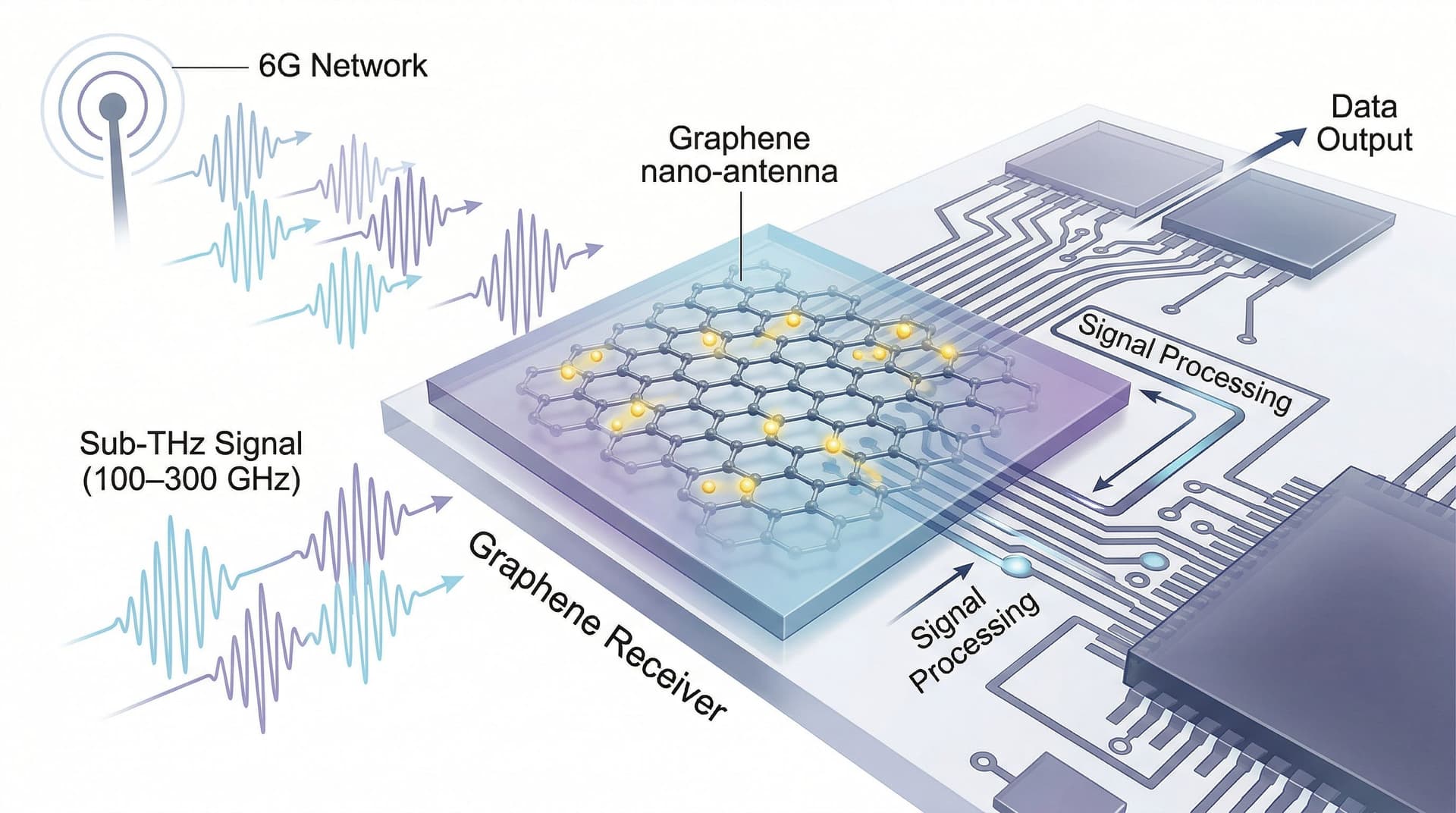
The device in this paper is more than just a graphene strip exposed to radiation. It combines several engineering ideas into one receiver: a split-gate graphene pn-junction that also acts as a half-wavelength dipole antenna, a cavity-like structure to boost absorption, and a back mirror under the silicon substrate to encourage multiple reflections.
That design matters because graphene on its own does not absorb sub-THz radiation very strongly. The receiver solves that problem by concentrating the incoming field onto a very small active area. In other words, the system is built so the graphene has a better chance to interact with the signal.
The receiver works through the photothermoelectric effect. Sub-THz radiation heats the graphene unevenly, and the resulting temperature gradient generates a voltage signal. Because the device is designed with doping asymmetry across the channel, that photoresponse becomes stronger. The result is a direct-detection receiver that can operate at zero bias, with no local oscillator and no upconversion stage.
That is a big deal for practical systems. A simpler receiver chain usually means lower power, fewer moving parts, and better compatibility with CMOS-style integration.
What the graphene receiver does differently
The graphene-based receiver in this study takes a different approach from many traditional high-frequency receiver designs.
Its main advantages include:
- direct detection, rather than a more complex receiver architecture
- passive operation, which reduces the need for power-hungry active circuitry
- compact size, which is important for integration into real devices
- an antenna-plus-cavity design that helps overcome graphene’s low absorption at sub-THz frequencies
In plain English: the system is engineered so the graphene interacts with the signal more effectively.
That is a recurring theme in graphene device research. The material is usually most useful when it is part of a larger engineered system, not when it is expected to solve everything by itself.
The performance results
The reported receiver achieved multigigabit-per-second data rates and could operate at a maximum distance of about 3 meters from the transmitter.
The study also highlights a classic engineering tradeoff between bandwidth and responsivity:
- low-responsivity devices reached a 40 GHz bandwidth
- high-responsivity devices achieved a maximum responsivity of 0.16 A/W but with a 2 GHz bandwidth
That tradeoff is not surprising, but it is important. In high-frequency electronics, you often have to choose whether the priority is:
- maximum speed, or
- maximum sensitivity
Getting both at once is difficult, especially in compact receiver designs.
The measurements also make clear that the receiver is not just a lab curiosity. The group showed eye diagrams, bit-error-rate behavior, and signal-to-noise ratios, which are the kinds of metrics you care about when asking whether a device can actually handle real data streams.
Why this matters for 6G
The real value of this work is not just that graphene functions at sub-THz frequencies. It is that the device architecture may actually be useful for future systems.
Potential applications include:
- chip-to-chip communication
- close-proximity device communication
- short-range high-speed wireless links
- parts of future 6G infrastructure
Those are exactly the kinds of use cases where compact, passive receivers could be a major advantage.
If a communication system can be made smaller, simpler, and more energy-efficient, that opens the door to new kinds of hardware integration. Think less about giant standalone antennas and more about wireless links built directly into packages, boards, and devices.
Graphene’s role is architectural, not magical
It is tempting to describe graphene as a miracle material, but that misses the point.
The interesting part of this research is not just that the receiver uses graphene. It is that graphene is being used in a carefully designed sub-THz architecture that overcomes one of its natural limitations: weak absorption at these frequencies.
That makes the result more credible and more useful. It suggests that graphene may be especially valuable in applications where device geometry, resonance, and field concentration can be engineered around its strengths.
In other words, the future of graphene in wireless may depend less on raw material properties and more on smart device design.
What this means going forward
This is still early-stage technology, but it points in a promising direction. The combination of graphene, cavity engineering, and direct detection could become part of the toolkit for future wireless systems.
The most interesting takeaway is that the next leap in wireless communication may not come from one single breakthrough component. It may come from new architectures that make better use of advanced materials like graphene.
That is especially true in sub-THz communication, where performance, size, and power consumption all matter at the same time.
Final thoughts
Graphene is not replacing today’s wireless hardware overnight. But this kind of research shows why the material keeps attracting attention in advanced electronics.
By enabling a compact, passive, high-speed receiver at sub-THz frequencies, graphene may help support the short-range, high-bandwidth links that future 6G systems will need.
The big picture is simple: graphene is becoming more useful not as a standalone miracle, but as a building block in better engineered communication systems.
That may be the most important lesson here. In the next generation of wireless hardware, the winners may be the devices that combine advanced materials with clever architecture rather than trying to rely on one material alone.