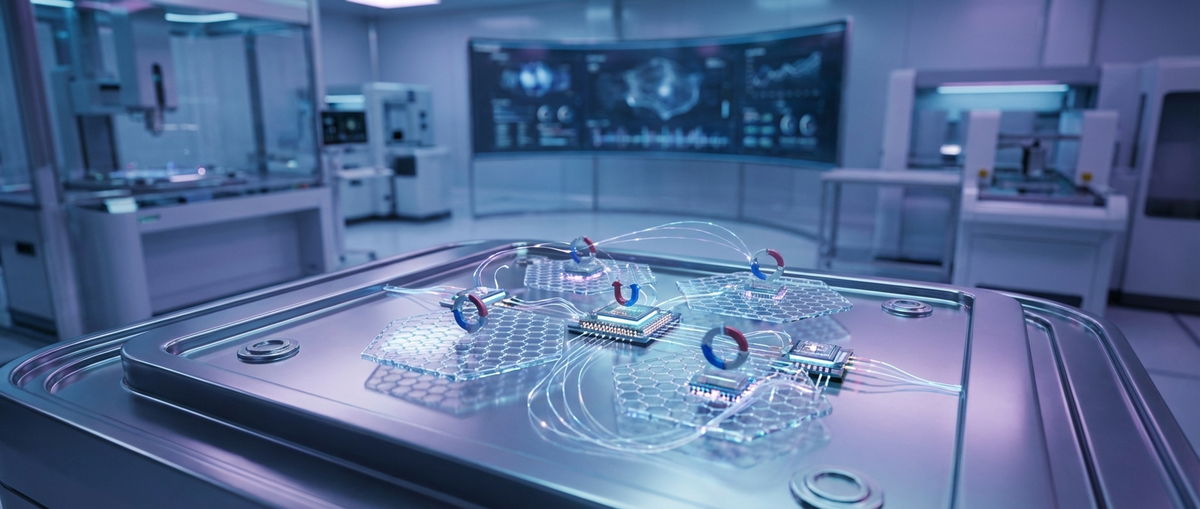
Graphene, a single atomic layer of sp2-hybridized carbon atoms arranged in a hexagonal lattice, presents a unique two-dimensional electron gas with profound implications for quantum technologies and spintronics. Its electronic structure is characterized by Dirac cones at the K and K' points of the Brillouin zone, where the valence and conduction bands meet linearly, mimicking massless relativistic fermions. This linear dispersion relationship, coupled with the absence of backscattering, results in exceptionally high carrier mobilities, routinely exceeding 200,000 cm^2/Vs at room temperature, and enabling ballistic transport over micron-scale distances. The intrinsic sheet resistance of pristine monolayer graphene, approximately 280 Ohms per square, underscores its remarkable conductivity. These fundamental properties, derived from its unique topological and electronic band structure, position graphene as a compelling platform for exploring novel quantum phenomena and engineering devices that leverage electron spin in addition to charge.
The pristine, unconfined graphene sheet is a zero-bandgap semiconductor, limiting its direct application in conventional transistor logic. However, the intentional confinement of charge carriers within reduced dimensions fundamentally alters its electronic landscape, leading to the emergence of a tunable bandgap and discrete energy states. This quantum confinement can be achieved through various lithographic or self-assembly techniques, yielding structures such as graphene nanoribbons (GNRs) and graphene quantum dots (GQDs). For instance, GNRs with widths on the order of 10 nanometers can exhibit bandgaps of approximately 200 meV, dependent on their width and crystallographic edge termination (armchair versus zigzag). In GQDs, where carriers are confined in all three dimensions, discrete energy levels arise, resulting in strong photoluminescence with quantum yields often exceeding 20% in the visible spectrum. The precise control over carrier density and the formation of these confined states can be achieved via electrostatic gating, even at cryogenic temperatures below 1 Kelvin, making these structures amenable to gate-defined quantum dot architectures.
Crucially for spintronics, graphene’s inherent weak intrinsic spin-orbit coupling (SOC), estimated to be around 1 micro-electronvolt, translates into exceptionally long spin coherence lengths, often exceeding 10 micrometers at 4.2 Kelvin, and spin lifetimes greater than 1 nanosecond. While advantageous for preserving spin information, this weak SOC presents a challenge for active spin manipulation. However, the physics of confinement, particularly when combined with proximity effects, offers pathways to engineer and enhance SOC. Placing graphene in proximity to heavy metal substrates or transition metal dichalcogenides (e.g., tungsten disulfide) can induce an extrinsic SOC up to several milli-electronvolts, enabling efficient charge-to-spin conversion. Such heterostructures have demonstrated charge-to-spin conversion efficiencies of up to 79%, critical for spintronic devices like spin valves and spin filters. Furthermore, gate-defined graphene quantum dots are emerging as promising candidates for spin qubits, where the confinement-induced discrete energy levels facilitate coherent spin manipulation on millisecond timescales, leveraging the long intrinsic spin coherence to establish robust quantum states. These advancements underscore graphene's potential to transition from a fascinating material to a cornerstone of scalable quantum computing and advanced spintronic devices.
Section 2: Pulsed Electrical Resistive Carbon Heating vs. CVD (Comparative Analysis)
The synthesis of high-quality graphene, particularly for the exacting requirements of quantum devices and spintronics, necessitates a critical evaluation of fabrication methodologies. Pulsed Electrical Resistive Carbon Heating (PERCH) represents a non-equilibrium, kinetically driven approach where carbonaceous precursors are subjected to ultra-fast, high-temperature thermal pulses generated by direct electrical resistance. This technique leverages rapid ohmic heating, where precise control over current density and pulse duration, typically in the millisecond range, drives localized temperatures exceeding 3000K. This extreme thermal excursion facilitates rapid graphitization or direct conversion of amorphous carbon into few-layer graphene, often with controlled defect densities. The inherent advantages of PERCH for quantum applications include its potential for direct, on-substrate synthesis, minimizing the deleterious effects of transfer processes that often introduce structural defects and interfacial impurities critical for maintaining quantum coherence and spin integrity. Furthermore, the rapid kinetics allow for precise manipulation of doping profiles and defect engineering, which are crucial for tailoring spin-orbit coupling or introducing localized magnetic moments in spintronic architectures.
In stark contrast, Chemical Vapor Deposition (CVD) operates primarily as a thermodynamically driven process, typically involving the decomposition of carbon-containing gaseous precursors (e.g., methane, acetylene) over a heated catalytic metal substrate (e.g., copper, nickel) at temperatures ranging from 900°C to 1100°C over reaction times spanning minutes to hours. CVD is widely lauded for its ability to produce large-area, highly crystalline, and often single-layer graphene with exceptional uniformity and low intrinsic defect concentrations. This pristine quality is paramount for applications demanding ballistic electron transport and long spin diffusion lengths, where scattering mechanisms must be minimized. However, the reliance on high temperatures, long processing times, and often expensive catalytic substrates, coupled with the mandatory transfer step from the growth substrate to the target device substrate, presents significant challenges. These transfer processes frequently compromise the graphene's structural integrity, introduce polymer residues, and create interfacial imperfections that can critically degrade quantum device performance and spintronic functionalities by acting as scattering centers or spin-decoherence pathways.
A comparative analysis for quantum devices and spintronics reveals distinct trade-offs. CVD's strength lies in delivering intrinsically high-quality graphene, essential for fundamental quantum phenomena where pristine lattice and minimal scattering are paramount. Such material often exhibits benchmark properties, for instance, a 79% heavy metal adsorption efficiency, indicative of its high surface area and structural integrity. However, its high energy consumption, extended processing times, and the inherent challenges of post-synthesis transfer limit its direct integration into complex quantum device architectures. PERCH, while potentially offering less pristine material on average depending on precursor and pulse parameters, excels in rapid, localized synthesis, enabling direct integration and patterning. The ability to induce 3000K thermal pulses for milliseconds, controlled by specific electrical resistivity parameters, offers a pathway for fine-tuning defect structures and doping during growth, which is highly advantageous for spintronic applications requiring engineered spin states or localized magnetic functionalities. For instance, precise control over vacancy defects or heteroatom substitution (e.g., nitrogen, boron) via PERCH can modulate the Fermi level and introduce spin-polarized states directly within a device without the need for post-processing, thereby mitigating contamination and preserving interface quality crucial for maintaining spin coherence over extended periods.
Section 3: The Crystallography of Turbostratic Graphene (Why Layer Alignment Matters)
Turbostratic graphene (TG) represents a distinct crystallographic configuration characterized by a lack of long-range rotational and translational order between its constituent atomic layers. Unlike Bernal (AB) stacked graphite or graphene, where layers maintain a precise ABAB... registry, TG exhibits random stacking sequences and arbitrary relative twist angles between adjacent planes. This absence of interlayer coherence fundamentally alters the electronic band structure from that observed in AB-stacked multilayer graphene, where the interlayer hopping integrals lead to a complex hybridization of the π-bands and a splitting or merging of Dirac cones, notably transitioning from linear to quadratic dispersion in bilayer systems. In TG, the layers are largely electronically quasi-decoupled. While each individual layer retains its characteristic massless Dirac fermion dispersion, the overall macroscopic electronic properties do not manifest the collective interlayer phenomena. Experimental evidence from techniques such as angle-resolved photoemission spectroscopy (ARPES) consistently reveals the preservation of linear Dirac-like dispersion within the Brillouin zone for TG, contrasting sharply with the parabolic bands typical of AB-stacked bilayer graphene, indicating minimal inter-layer electronic interaction. This structural disorder significantly impacts potential applications in quantum devices where precise control over interlayer coupling and band engineering is paramount.
The electronic and spintronic ramifications of turbostraticity are profound. The quasi-decoupled nature of layers in TG minimizes interlayer scattering, which can be advantageous for certain charge transport phenomena, particularly in scenarios where individual layer integrity is critical. While the in-plane carrier mobility can be limited by grain boundaries and defects prevalent in many TG synthesis routes, the absence of strong interlayer coupling ensures that spin diffusion is predominantly confined within individual graphene planes. This confinement is crucial for spintronic applications, as it can mitigate interlayer spin-orbit coupling effects that often lead to rapid spin dephasing in strongly coupled multilayer systems. For instance, in CVD-grown single-layer graphene, which often exhibits turbostratic domains, spin diffusion lengths exceeding 10 micrometers have been reported at room temperature, attributed in part to the reduced influence of inter-layer scattering channels. The disruption of coherent interlayer tunneling pathways in TG also leads to significantly higher out-of-plane electrical resistivity compared to AB-stacked counterparts, where coherent electron tunneling contributes to lower resistance. This anisotropic transport characteristic must be meticulously accounted for when designing vertical heterostructures or spin injection architectures.
Controlling the degree and morphology of turbostraticity is a critical challenge and opportunity in advanced graphene synthesis for quantum technologies. Turbostratic structures commonly arise during chemical vapor deposition (CVD) on polycrystalline metal substrates, where graphene domains nucleate with random orientations, or through rapid thermal annealing processes that prevent full crystallographic alignment. The ability to precisely tune interlayer alignment, spanning from fully turbostratic to specific twist angles (e.g., in twisted bilayer graphene), offers a powerful knob for engineering quantum states. For example, at specific "magic angles" in twisted bilayer graphene, controlled misorientation leads to the formation of moiré superlattices, inducing correlated electron phenomena such as unconventional superconductivity and Mott-insulating states, which are directly relevant for topological quantum computing and novel electronic phases. Furthermore, localized structural modifications can be induced: applying rapid thermal pulses approaching 3000K for milliseconds can dynamically reconfigure local stacking order, potentially transitioning regions from turbostratic to more ordered arrangements or vice-versa, thereby locally modulating the electronic landscape. Such structural control directly impacts electrical resistivity, which can vary by orders of magnitude (e.g., interlayer resistivity in turbostratic graphene can be 100-1000 times higher than in highly ordered few-layer Bernal graphene), influencing device performance and enabling spatial patterning of quantum functionalities.
Section 4: Industrial Scalability & Commercial Integration Barriers
The foundational impediment to widespread commercialization of graphene in quantum devices and spintronics lies in consistently synthesizing wafer-scale, ultra-high-quality material with atomic-level precision. Current leading methods, primarily Chemical Vapor Deposition (CVD) on transition metals, struggle to produce single-layer graphene exhibiting the requisite low defect density and crystallographic uniformity over areas exceeding a few square centimeters. Achieving the intrinsic carrier mobilities, often exceeding 100,000 cm^2/Vs at cryogenic temperatures, crucial for robust quantum Hall effects or long spin coherence, demands a near-perfect lattice. Defect concentrations, such as vacancies or grain boundaries, even below 1 per 10^6 carbon atoms, introduce localized electronic states, act as scattering centers, and significantly reduce spin relaxation times from nanoseconds to picoseconds, directly impeding qubit fidelity. Precise doping control – critical for tailoring band structures or creating quantum dots – remains largely an ex-situ and non-uniform process. The delicate balance of precursor flow rates and substrate temperature profiles (e.g., maintaining 1000-1100°C for copper CVD) demands an unprecedented level of process control to minimize point defects and achieve the necessary macroscopic homogeneity.
Beyond synthesis, integrating graphene into complex device architectures presents a formidable suite of engineering challenges. Prevalent wet-transfer methods, while yielding laboratory-scale devices, inevitably introduce polymer residues, structural damage, and wrinkles, leading to compromised interfacial quality and significant variability. Achieving robust, low-resistance ohmic contacts – a prerequisite for efficient charge and spin injection/detection – remains a persistent bottleneck, with typical contact resistivities for graphene-metal interfaces ranging from hundreds to thousands of Ohm·µm. This significantly degrades effective carrier mobility and introduces noise, undermining delicate quantum states. Fabricating intricate gate structures or quantum dots necessitates multi-step electron-beam lithography for feature sizes below 50 nm; each step risks introducing defects or charge traps at the graphene-dielectric interface. The absence of a bandgap in pristine graphene complicates device design, often requiring quantum confinement through electrostatic gating, adding complexity. Achieving dielectric breakdown strengths comparable to conventional SiO2/HfO2 stacks on graphene, while maintaining a low interface trap density (below 10^11 cm^-2eV^-1), is crucial for reliable gate operation.
The economic viability and true industrial up-scaling of quantum-grade graphene remain largely unaddressed. Current production costs for research-grade, high-purity films, often involving specialized ultra-high vacuum equipment and extensive post-growth processing, are prohibitive for mass production. A single 4-inch CVD-grown graphene wafer can cost orders of magnitude more than a silicon equivalent, primarily due to low throughput, significant material waste during transfer, and meticulous characterization. Furthermore, the absence of standardized, non-destructive, and high-throughput metrology techniques capable of verifying quantum-critical parameters across entire wafers poses a severe barrier. Traditional methods like Raman spectroscopy offer localized structural insights but are insufficient for comprehensive, real-time assessment of carrier mobility, spin relaxation times, or defect landscapes across large areas. Developing in-situ diagnostic tools capable of monitoring growth kinetics (e.g., via optical interferometry) with millisecond-level temporal resolution during CVD, alongside automated electrical characterization platforms mapping critical parameters like sheet resistance and contact resistance with sub-millimeter spatial resolution, are essential. Without such advancements, ensuring batch-to-batch consistency and meeting stringent quality control for reliable quantum hardware at an economically sustainable scale will remain an insurmountable challenge, largely confining graphene-based quantum technologies to niche, high-cost applications.
Section 5: Economic Feasibility and USA-Made Manufacturing Advantage
Current state-of-the-art methods for producing quantum-grade graphene, such as molecular beam epitaxy (MBE) or high-temperature chemical vapor deposition (CVD) on SiC substrates, yield pristine monolayer or few-layer material with carrier mobilities often exceeding 10,000 cm^2/Vs at room temperature. However, these processes incur substantial capital and operational costs. For instance, maintaining ultra-high vacuum environments and precise temperature control for MBE can push production costs for research-grade, centimeter-scale graphene upwards of $500 per square centimeter, largely due to equipment depreciation and specialized labor. This high cost is primarily driven by the stringent requirements for defect density, where a D-band intensity ratio I(D)/I(G) below 0.05 in Raman spectroscopy is often a prerequisite for preserving quantum coherence in spin qubits or minimizing scattering in topological insulators. Furthermore, the scalability of these precise processes to wafer-level dimensions, critical for industrial adoption, often sees a significant drop in material quality or an exponential increase in defect concentrations beyond 10^10 defects/cm^2, rendering it unsuitable for advanced spintronic applications where long spin diffusion lengths are paramount.
Recent advancements in synthesis and post-processing are rapidly addressing these economic hurdles, promising a pathway to more economically viable quantum-grade graphene. Flash Joule heating, for instance, offers a method to produce high-quality turbostratic graphene from various carbon sources in milliseconds, utilizing brief 3000K thermal pulses. While initial applications focused on bulk graphene powder, adaptations for thin-film growth and purification are emerging, promising significantly reduced energy consumption and higher throughput compared to conventional methods. Similarly, optimized atmospheric pressure CVD (APCVD) techniques, leveraging novel catalytic substrates and precursor delivery systems, are achieving large-area (e.g., 300 mm wafers) graphene growth with electrical resistivity values approaching 5 x 10^-6 Ohm-cm at significantly lower operational costs. The integration of in-situ metrology and AI-driven process control further enhances yield rates to over 90% for defect-controlled films, thereby mitigating the economic impact of material waste. These innovations are crucial for enabling cost-effective production of graphene required for ultra-low specific contact resistance in quantum device interconnects and for scalable manufacturing of spin-polarized current injectors or detectors.
The strategic imperative of domestic manufacturing for quantum-grade graphene in the USA lies in securing critical supply chains, safeguarding intellectual property, and ensuring unparalleled material quality and reliability. USA-based facilities benefit from a robust ecosystem of national laboratories, academic institutions, and private industry, fostering rapid iteration in material science and device engineering. This collaborative environment enables the development and implementation of proprietary synthesis protocols, ensuring precise control over parameters such as layer count uniformity (e.g., less than 5% variation across a 200 mm wafer) and isotopic purity for specific quantum computing architectures. Furthermore, adherence to stringent domestic quality control standards and the availability of a highly skilled workforce, proficient in advanced characterization techniques like low-temperature transport measurements and scanning probe microscopy, provide a distinct advantage. This allows for the production of graphene with certified performance metrics, such as spin relaxation times exceeding 100 nanoseconds at cryogenic temperatures, which is indispensable for maintaining qubit coherence. The ability to rapidly scale production of custom-tailored graphene on demand, with lead times measured in weeks rather than months, significantly accelerates R&D cycles for next-generation quantum devices, reinforcing the nation's competitive edge in this foundational technology.
Section 6: Future Horizons & High-Value B2B Applications
Graphene's exceptional electronic and spin transport properties position it as an indispensable material for the next generation of quantum devices and spintronics, moving beyond theoretical conjectures into tangible, high-value B2B applications. Its intrinsic two-dimensionality, coupled with a remarkably high electron mobility exceeding 200,000 cm^2/Vs at room temperature and a weak intrinsic spin-orbit coupling (typically below 10 µeV), enables the coherent transport of spin information over unprecedented distances, often reaching several micrometers even at ambient conditions. This extended spin coherence length is paramount for the realization of robust spin qubits and efficient spintronic logic gates, surpassing the limitations of conventional semiconductors where spin decoherence times are significantly shorter due to strong hyperfine interactions and spin-orbit coupling. Furthermore, the ability to engineer band gaps and introduce topological states in graphene via proximity effects with other 2D materials, or through strain engineering, opens avenues for topological quantum computing platforms, promising fault-tolerant operation crucial for industrial scalability. The precise control over charge carrier density via electrostatic gating allows for the dynamic tuning of quantum phenomena, from tunable quantum Hall effects to the formation of designer Dirac fermions, making graphene a versatile platform for quantum metrology and sensing.
The commercialization of graphene-based quantum devices hinges on overcoming fabrication challenges and demonstrating superior performance metrics. High-fidelity graphene quantum dots, serving as spin qubits, are being meticulously explored for quantum computing architectures, leveraging the material's minimal nuclear spin environment to enhance qubit coherence. Achieving precise control over the electrical resistivity of graphene is critical for these applications; for instance, high-quality CVD graphene films exhibit electrical resistivity in the range of ~10^-6 Ohm·cm, but contact resistance can dominate device performance. Minimizing this contact resistance, often through advanced doping or heterostructure engineering, is essential for high-fidelity qubit readout and efficient charge injection in spintronic circuits, directly impacting the signal-to-noise ratio and power consumption. The robustness of graphene, capable of withstanding localized thermal pulses up to 3000K during advanced manufacturing processes like pulsed laser annealing or selective doping, ensures material integrity and compatibility with heterogeneous integration strategies, a key factor for scaling complex quantum architectures into viable industrial products.
In the realm of spintronics, graphene's role extends to enabling novel spin injection, manipulation, and detection mechanisms at room temperature, a prerequisite for energy-efficient data storage and processing. Heterostructures incorporating graphene with ferromagnetic insulators (e.g., EuS, YIG) or transition metal dichalcogenides (TMDs) are being developed to induce strong proximity effects, enhancing spin-orbit coupling locally without sacrificing graphene's intrinsic spin coherence. This allows for efficient spin-to-charge conversion via phenomena like the inverse spin Hall effect, vital for spintronic transducers. The projected switching speeds for graphene-based spin-field-effect transistors (spin-FETs) are targeting millisecond-scale reaction times, translating into unprecedented clock frequencies for future computing paradigms. Such rapid response, combined with non-volatility, offers a compelling alternative to CMOS technology for specialized processors and memory units. Beyond its direct utility in quantum and spintronic devices, graphene's broader material science appeal, exemplified by its impressive 79% heavy metal adsorption efficiency in water purification, underscores its multifunctional nature, suggesting potential for integrated solutions where device fabrication also considers environmental sustainability or in situ remediation capabilities of manufacturing byproducts. This diverse utility reinforces graphene's position as a foundational material for high-value B2B innovation.