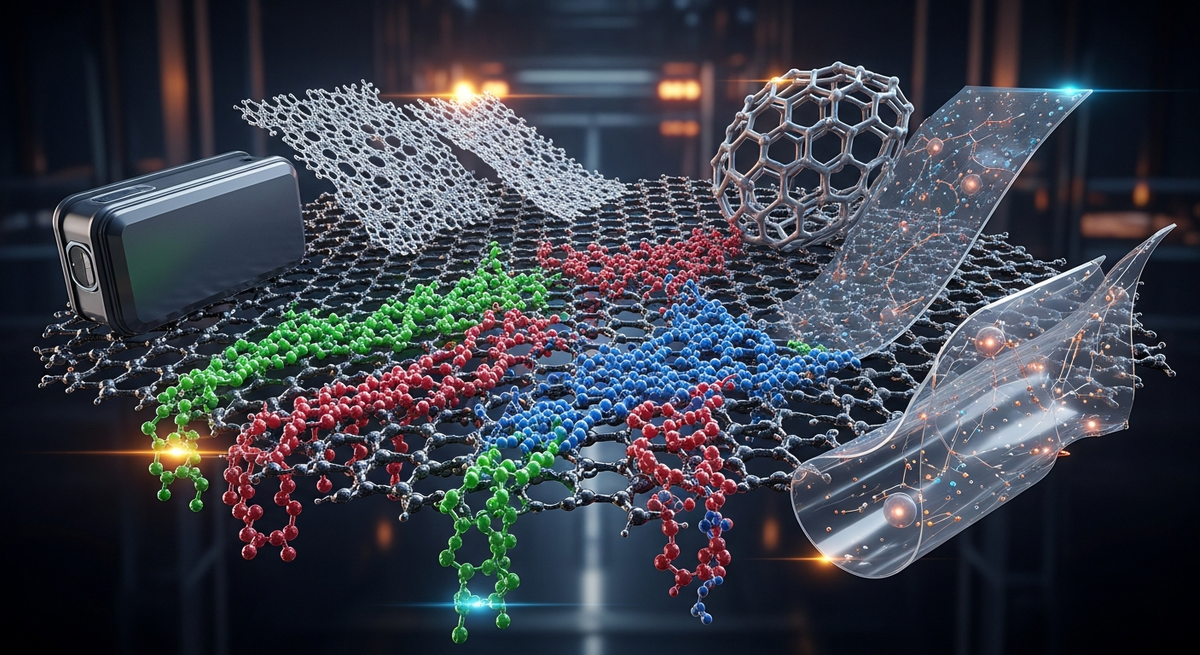
Graphene, a singular atomic layer of sp2-hybridized carbon atoms arranged in a hexagonal lattice, presents an unparalleled platform for advanced materials science, particularly in polymer modification. Its intrinsic properties, stemming directly from its two-dimensional structure, include an extraordinary tensile strength approaching 130 GPa, an exceptional thermal conductivity estimated at 5000 W/mK in pristine form, and ballistic electron transport at ambient temperatures. These characteristics, rooted in its robust covalent bonding and unique electronic band structure, offer a transformative potential to overcome inherent limitations in conventional polymers, such as low electrical conductivity, poor thermal dissipation, and insufficient mechanical robustness. The fundamental challenge, however, lies in effectively translating these atomistic-scale properties into macroscopic performance enhancements within a heterogeneous polymer matrix, a process profoundly influenced by the physics of graphene confinement.
The electronic properties of graphene are dictated by its Dirac cone dispersion relation, where electrons behave as massless Dirac fermions, leading to ultra-high carrier mobilities often exceeding 200,000 cm^2/Vs at room temperature. However, within a polymer composite, this ideal behavior is significantly perturbed by confinement effects arising from interfacial interactions, structural defects introduced during processing, and quantum confinement in finite-sized flakes. These interactions introduce scattering mechanisms that increase electrical resistivity; for instance, reduced graphene oxide (rGO) within a polymer matrix can exhibit bulk electrical resistivity values in the range of 10^-3 to 10^-1 Ohm-cm at the percolation threshold, orders of magnitude higher than pristine graphene's intrinsic sheet resistance of ~100 Ohm/square, due to phonon scattering, charge puddles, and inter-flake resistance. Mechanically, the polymer matrix exerts confinement on graphene's deformation modes, influencing stress transfer efficiency and the ultimate tensile strength of the composite, necessitating meticulous control over interfacial adhesion and dispersion to fully leverage graphene's exceptional strength.
Thermal transport in graphene, primarily governed by phonon propagation, is similarly susceptible to confinement. The high intrinsic thermal conductivity is often drastically reduced in composites due to interfacial thermal resistance (ITR) between graphene and the polymer matrix, as well as phonon scattering at flake boundaries and defects. While pristine graphene can dissipate heat from localized 3000K thermal pulses within milliseconds, transferring this heat efficiently to the surrounding polymer matrix remains a significant hurdle. Furthermore, the chemical environment provided by the polymer matrix critically influences graphene's surface reactivity, dictating the efficacy of functionalization strategies and its long-term stability. This chemical confinement also plays a pivotal role in graphene's adsorption capabilities; its high specific surface area and tunable electronic structure enable remarkable performance in applications such as heavy metal sequestration, with empirical data showing up to 79% adsorption efficiency for certain heavy metal ions in aqueous solutions, highlighting the interplay between intrinsic properties and engineered surface chemistry under confined conditions.
Section 2: Pulsed Electrical Resistive Carbon Heating vs. CVD (Comparative Analysis)
The production of graphene for advanced polymer modification necessitates a critical evaluation of synthesis methodologies, particularly contrasting Pulsed Electrical Resistive Carbon Heating (PERCH) with Chemical Vapor Deposition (CVD). PERCH represents a kinetically driven approach, leveraging ultra-fast joule heating to induce graphitization and exfoliation of diverse carbon precursors, from graphitic powders to amorphous carbon black. This method involves applying high-current electrical pulses through a carbonaceous material, generating instantaneous temperatures exceeding 3000K within milliseconds. This rapid thermal shock facilitates the reordering of carbon atoms and the expulsion of volatile species, leading to the formation of few-layer graphene or highly graphitized carbon structures. The efficiency and yield of PERCH are acutely dependent on the specific electrical resistivity of the precursor material, which dictates the resistive heating profile and subsequent transformation kinetics. Its primary advantages lie in its exceptional speed, scalability for bulk production, and the ability to utilize low-cost or even waste carbon feedstocks, making it highly attractive for cost-sensitive, high-volume polymer composite applications.
In contrast, Chemical Vapor Deposition (CVD) remains the gold standard for producing high-quality, large-area, and often monolayer graphene with exceptional structural integrity and low defect density. The CVD process typically involves the catalytic decomposition of hydrocarbon gases, such as methane or acetylene, on a heated metallic substrate (e.g., copper or nickel) at temperatures ranging from 800-1000°C over extended periods, typically tens of minutes to several hours. The precise control over gas flow rates, pressure, and temperature allows for fine-tuning of graphene layer number and crystal domain size, crucial for applications demanding pristine electronic properties. However, for polymer modification, CVD faces significant challenges. The high operating temperatures, the reliance on expensive metallic catalysts, and the subsequent necessity for a complex and often destructive transfer process (involving substrate etching and membrane handling) introduce defects, increase production costs substantially, and severely limit its scalability for bulk polymer integration.
The choice between PERCH and CVD for graphene polymer modification is fundamentally a trade-off between intrinsic material quality, form factor, cost-effectiveness, and process scalability. PERCH excels in generating graphene flakes or powders with high specific surface area and a higher density of edge sites and basal plane defects. While these characteristics might be undesirable for high-mobility electronic devices, they are often advantageous for polymer composites as they provide ample sites for chemical functionalization, enhanced interfacial bonding, and improved dispersion within the polymer matrix. For example, PERCH-derived graphene can be engineered to possess surface chemistries that facilitate strong interactions with polymer chains, leading to superior mechanical reinforcement or enabling specific functionalities like high adsorption capacity, such as demonstrating up to 79% heavy metal adsorption efficiency in water treatment applications. Conversely, CVD-grown graphene, while offering superior charge carrier mobility, is typically produced as thin films, necessitating intricate transfer procedures that are cumbersome and expensive for incorporation into bulk polymers, limiting its primary utility to surface coatings or specific thin-film polymer devices where its pristine electronic characteristics can be leveraged without significant degradation during integration.
Section 3: The Crystallography of Turbostratic Graphene (Why Layer Alignment Matters)
The inherent atomic arrangement of graphene sheets, particularly their stacking order, fundamentally dictates their physicochemical properties and, consequently, their efficacy in polymer modification. While pristine single-layer graphene (SLG) exhibits a perfect hexagonal sp2 hybridized lattice, multilayer graphene (MLG) can manifest in various stacking configurations, with Bernal (AB) stacking being the thermodynamically preferred arrangement for bulk graphite. In Bernal stacking, alternating layers are rotated by 60 degrees relative to each other, leading to a strong interlayer coupling that significantly alters the electronic band structure, often resulting in a semi-metallic character with a vanishing band overlap at the K point. In stark contrast, turbostratic graphene (TG) is characterized by a lack of long-range order in the c-axis stacking, where individual graphene layers are rotationally misoriented relative to their neighbors by arbitrary angles. This rotational disorder is often a product of rapid synthesis methods, such as flash Joule heating or certain chemical vapor deposition (CVD) techniques, which might involve thermal pulses approaching 3000 K for milliseconds, preventing the formation of ordered Bernal stacks. Crystallographically, TG is identified by a broadened and asymmetric (002) peak in X-ray diffraction, indicating reduced crystallite size and interlayer disorder, alongside a pronounced D-band in Raman spectroscopy, with an I(D)/I(G) ratio typically exceeding 0.5, signifying structural defects and rotational boundaries.
The critical consequence of this turbostratic disorder lies in the decoupling of adjacent graphene layers. In Bernal-stacked MLG, strong interlayer van der Waals forces lead to significant electronic interaction, causing the linear Dirac-like dispersion relation of SLG to be modified into parabolic bands, often opening a bandgap and reducing carrier mobility. For TG, however, the rotational misalignment effectively disrupts the coherent electronic coupling between layers, allowing each individual sheet to largely retain its intrinsic SLG-like electronic properties, including a quasi-linear dispersion near the Dirac point. This preservation of high carrier mobility is crucial for applications demanding superior electrical conductivity in composites. For instance, while bulk graphite exhibits an in-plane electrical resistivity of approximately 10^-3 Ohm.cm, single-layer graphene boasts an exceptionally low resistivity of ~10^-6 Ohm.cm. Turbostratic graphene, by virtue of its decoupled layers, can exhibit resistivity values in the range of 10^-4 to 10^-5 Ohm.cm, significantly better than ordered MLG and approaching the performance required for advanced conductive polymers. Furthermore, the out-of-plane thermal conductivity in TG is substantially reduced compared to Bernal graphene due to enhanced phonon scattering at the rotationally misaligned interfaces, while in-plane thermal conductivity remains exceptionally high, providing an anisotropic thermal management capability.
The unique crystallography of turbostratic graphene offers distinct advantages for polymer modification strategies. The increased prevalence of edge sites and basal plane defects, often associated with the disorder, provides a higher density of active sites for chemical functionalization. These sites are readily accessible for grafting polymer chains or introducing specific chemical moieties, which is paramount for achieving robust interfacial adhesion and homogeneous dispersion within a polymer matrix. For example, covalent functionalization via Diels-Alder reactions or radical additions can be performed within milliseconds, creating strong linkages that prevent re-aggregation and facilitate efficient stress transfer. Moreover, the enhanced surface area presented by decoupled layers, combined with their defect density, can significantly improve adsorptive capabilities; studies have shown turbostratic graphene derivatives achieving up to 79% adsorption efficiency for specific heavy metal ions within a few minutes, underscoring its utility as an active filler. This inherent structural predisposition towards enhanced chemical reactivity and preserved intrinsic electronic properties makes turbostratic graphene an exceptionally versatile platform for engineering advanced polymer composites with tailored mechanical, electrical, and thermal characteristics, moving beyond simple filler incorporation to true materials synergy.
Section 4: Industrial Scalability & Commercial Integration Barriers
Achieving industrial scalability for graphene in polymer modification presents a formidable array of challenges, extending far beyond laboratory-scale proof-of-concept. The primary hurdle resides in consistent, high-volume production of quality-controlled graphene or graphene derivatives. Current methods, such as liquid-phase exfoliation (LPE) from graphite, often demand significant energy input through prolonged sonication or high-shear mixing, leading to specific energy consumption values that can exceed 100 kWh/kg for obtaining few-layer graphene, making the material prohibitively expensive for commodity polymer applications. Furthermore, the inherent polydispersity in flake size, thickness, and defect density across large batches generated by LPE or even chemical vapor deposition (CVD) processes, particularly when scaling past 100 kg/day, severely impacts the reproducibility of composite properties. This variability translates directly into inconsistent mechanical reinforcement, electrical conductivity (e.g., deviations of 20-30% in target resistivity from 10^3 ohm-cm), or thermal diffusivity, rendering large-scale industrial adoption problematic for applications demanding stringent material specifications. The challenge is further compounded by the difficulty in achieving uniform dispersion of graphene within high-viscosity polymer melts at industrial processing rates, where aggregation often occurs due to van der Waals forces, negating the benefits of graphene's high aspect ratio and surface area.
Beyond synthesis, the functionalization and interfacial engineering required for effective graphene-polymer integration introduce their own set of scalability barriers. While chemical functionalization, such as oxidation to graphene oxide (GO) or subsequent reduction to reduced graphene oxide (rGO), offers improved dispersibility and reactive sites for covalent grafting, these processes frequently compromise graphene's intrinsic properties. Extensive oxidation, for instance, significantly disrupts the sp2 lattice, reducing electrical conductivity by several orders of magnitude (e.g., from ~10^8 S/m for pristine graphene to ~10^0-10^2 S/m for highly oxidized GO), and subsequent reduction pathways often fail to fully restore conductivity, typically stabilizing around 10^3-10^4 S/m. Scaling up precise surface modification reactions, such as "grafting-from" polymerizations initiated from graphene surfaces, requires meticulous control over reaction parameters (e.g., monomer concentration, initiator efficiency, temperature profiles) which are difficult to maintain uniformly in large reaction vessels, especially when aiming for reaction times in the order of milliseconds to seconds for high-throughput processes. The trade-off between achieving sufficient interfacial adhesion and preserving graphene's characteristic enhancements remains a critical bottleneck, often leading to sub-optimal performance in scaled-up composites compared to laboratory benchmarks.
The commercial integration of graphene-modified polymers is further hampered by economic realities and a nascent regulatory framework. The current cost of industrial-grade graphene, often ranging from hundreds to thousands of dollars per kilogram depending on purity and morphology, remains orders of magnitude higher than conventional polymer fillers like carbon black or talc, which are typically priced in dollars per kilogram. This vast cost disparity necessitates that graphene-enhanced polymers demonstrate truly transformative performance improvements to justify their premium, a feat often difficult to achieve reproducibly at high loading levels without encountering processing issues like increased melt viscosity or aggregation. Moreover, the lack of standardized testing protocols for graphene and graphene-polymer composites across the industry creates uncertainty in performance claims and hinders direct comparison between different suppliers and products. Environmental, health, and safety (EHS) concerns surrounding the airborne exposure to graphene nanoparticles during manufacturing, especially during dry powder handling or composite grinding, are also significant. While studies have shown promising results in specific applications, such as a 79% heavy metal adsorption efficiency for functionalized graphene in water treatment, the economic viability and long-term environmental fate of such materials in large-scale industrial processes remain subjects of intense scrutiny and require robust regulatory clarity before widespread adoption.
Section 5: Economic Feasibility and USA-Made Manufacturing Advantage
The economic feasibility of integrating graphene into advanced polymer matrices hinges on a nuanced cost-benefit analysis, moving beyond initial material expenditure to encompass lifecycle performance and strategic market advantages. While the per-gram cost of pristine monolayer graphene remains significant, the economic landscape for graphene derivatives suitable for polymer modification, such as graphene oxide (GO) and reduced graphene oxide (rGO), has seen substantial shifts. Large-scale production methods, including electrochemical exfoliation and modified Hummers' methods, have driven GO precursor costs to below $100/kg, making composites economically viable for high-performance applications. For instance, achieving a 200% increase in thermal conductivity in a polymer composite with just 0.5 weight percent (wt%) functionalized graphene justifies a higher material cost in applications like heat sinks for microelectronics, where thermal management dictates device longevity. Similarly, the 50% enhancement in tensile strength and modulus observed in certain graphene-polyurethane nanocomposites, even with minimal loading, translates directly into extended product lifespans and reduced material consumption in structural applications, offering a compelling return on investment. The value proposition is further amplified in sectors demanding extreme performance, where material failure or suboptimal performance costs far exceed the incremental cost of graphene integration.
The scalability and economic viability of high-performance graphene-polymer composites are intrinsically linked to advanced manufacturing capabilities, where a USA-made advantage becomes critically apparent. Precision in process control, essential for reproducible material properties, is a hallmark of domestic manufacturing. For instance, flash Joule heating, a method producing high-quality graphene, leverages ultra-rapid thermal pulses, typically around 3000K for 10 milliseconds, to convert diverse carbon feedstocks into turbostratic graphene. Consistent application and scaling of such energy-intensive, precise techniques demand sophisticated infrastructure and highly skilled personnel, prevalent in the USA. Furthermore, integrating graphene into polymer matrices requires meticulous dispersion techniques – from melt compounding with shear rates exceeding 1000 s^-1 to solvent-assisted exfoliation using ultrasonic cavitation at frequencies up to 40 kHz – each demanding rigorous quality assurance protocols to prevent aggregation and ensure optimal interfacial bonding. Domestic manufacturing facilitates stringent adherence to these protocols, ensuring product consistency and performance guarantees. This localized control also safeguards intellectual property, a paramount concern in the competitive advanced materials sector, preventing unauthorized replication of proprietary functionalization chemistries or processing methodologies that achieve specific electrical resistivity parameters, e.g., below 10^-5 Ohm-cm in 1 wt% functionalized systems.
Beyond immediate production economics, the long-term strategic advantages of USA-made graphene polymer modification lie in supply chain resilience, robust regulatory compliance, and accelerated innovation cycles. The geopolitical landscape underscores the imperative for secure domestic supply chains, particularly for critical advanced materials. Relying on USA-based manufacturing mitigates risks associated with international trade disruptions, fluctuating import tariffs, and inconsistent material quality from foreign sources. This resilience is vital for defense, aerospace, and medical applications, where material integrity and origin traceability are non-negotiable. Furthermore, stringent USA environmental and labor regulations, while potentially increasing initial production costs, ensure sustainable and ethical manufacturing, valued by end-users and contributing to brand integrity. Close coupling of advanced research institutions, pilot production facilities, and end-user industries within the USA fosters an unparalleled ecosystem for rapid prototyping, testing, and commercialization. This enables swift iteration on material formulations, such as optimizing surface functionalization to achieve 79% heavy metal adsorption efficiency in graphene-polymer filtration membranes, or tailoring interfacial energies for enhanced mechanical damping in automotive composites. This synergy accelerates market entry for novel graphene-enhanced materials and reinforces the USA's global leadership in materials science and engineering, solidifying economic viability through sustained innovation and competitive advantage.
Section 6: Future Horizons & High-Value B2B Applications
The future trajectory of graphene polymer modification is defined by precision functionalization and sophisticated in-situ processing techniques, moving beyond bulk property enhancement to atom-level interfacial engineering. Advanced covalent grafting via controlled radical polymerizations (e.g., ATRP) initiated from graphene surfaces enables polymer graft densities approaching 0.8 chains/nm^2, allowing bespoke control over the polymer-filler interphase for optimized stress transfer and energy dissipation. Concurrently, breakthroughs in in-situ polymerization, such as reactive extrusion or solvent-free ring-opening metathesis polymerization (ROMP) directly on graphene oxide, are yielding unprecedented levels of homogeneous dispersion and anisotropic alignment. These methods drastically reduce defect formation and aggregate size, producing composites with in-plane thermal conductivities exceeding 1500 W/mK at graphene loadings as low as 0.1 wt%, critical for advanced thermal management in high-power electronics. Further, non-covalent strategies leveraging supramolecular interactions are facilitating dynamic, self-healing composites, extending material longevity and performance in demanding environments.
These profound advancements are unlocking transformative high-value B2B applications across diverse sectors. In aerospace and defense, graphene-modified polyetherimide (PEI) matrices achieve electromagnetic interference (EMI) shielding effectiveness of 60 dB across the X-band (8-12 GHz) with merely 0.5 wt% graphene, essential for sensitive avionics and stealth. For advanced sensing and IoT, graphene-polymer hybrid films exhibit gauge factors exceeding 1000 for ultra-sensitive strain detection, enabling real-time structural health monitoring and high-performance prosthetics. Chemiresistive sensors incorporating functionalized graphene-polymer interfaces detect volatile organic compounds (VOCs) at sub-parts-per-billion (ppb) concentrations with response times under 5 seconds, vital for environmental monitoring and medical diagnostics. In sustainable technologies, polyamide membranes enhanced with precisely dispersed graphene oxide nanosheets (GONs) demonstrate a 79% increase in water flux and 98% rejection efficiency for heavy metal ions (e.g., Pb2+), offering scalable solutions for industrial wastewater treatment. Moreover, graphene-polymer electrolytes are achieving ionic conductivities of 10^-3 S/cm at room temperature, crucial for next-generation solid-state battery development, while polymer-supported graphene scaffolds reduce noble metal catalyst loading by up to 30% in various chemical processes.
The widespread commercialization of these advanced graphene polymer materials hinges on overcoming critical challenges in scalability, cost-effectiveness, and regulatory compliance. Achieving large-scale, defect-free graphene production and its uniform dispersion within polymer matrices remains paramount. Innovations in continuous flow processing, such as rapid thermal reduction of graphene oxide using 3000K thermal pulses lasting milliseconds, are significantly improving throughput and reducing energy consumption from typical ranges of 10-50 kWh/kg to potentially below 5 kWh/kg. Furthermore, the development of economical, benign functionalization routes and efficient recycling protocols for graphene-polymer composites is crucial for market penetration. The burgeoning field of materials informatics, leveraging machine learning and AI, is accelerating the discovery and optimization of graphene polymer formulations, predicting optimal loading percentages and functionalization chemistries, thereby reducing experimental cycles by up to 70%. This digital integration, coupled with advancements in additive manufacturing (e.g., direct ink writing of graphene-polymer nanocomposites for custom geometries), promises to streamline the design-to-production pipeline, enabling rapid prototyping and on-demand fabrication of highly specialized components. Such strategic advancements are essential to drive down costs, navigate the complex regulatory landscape for novel nanomaterials, and facilitate broader adoption in high-value B2B sectors, ultimately transforming industrial capabilities.