Graphene in Polymer Devices: Powering Solar & Storage
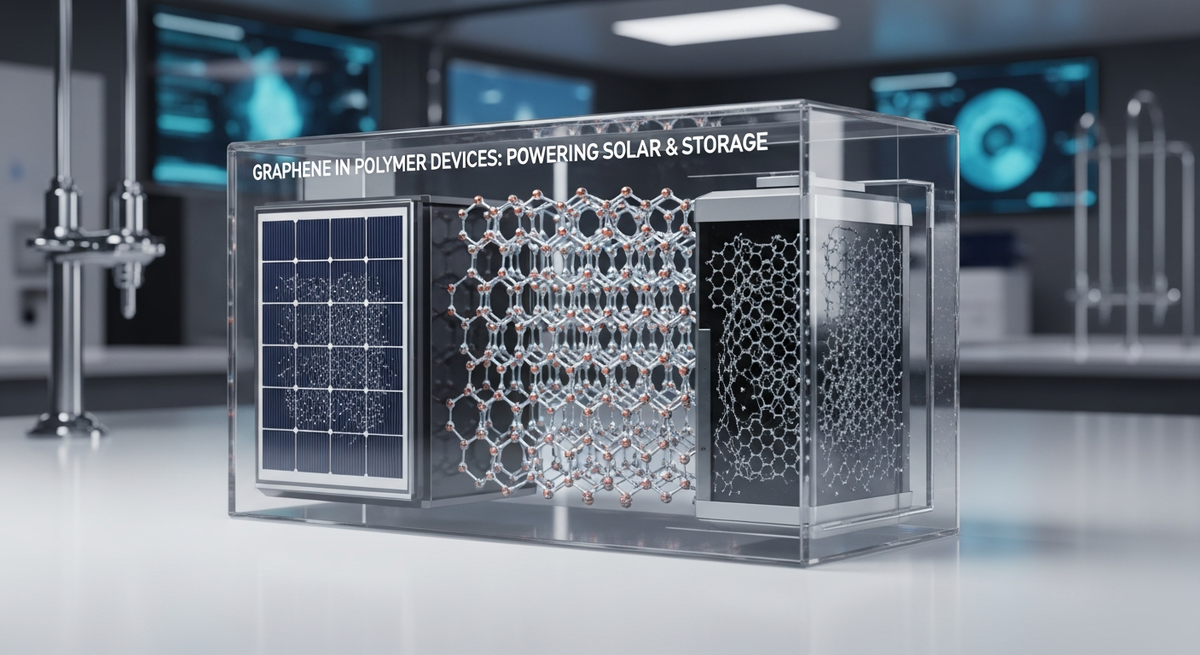
The quest for sustainable energy solutions and efficient energy storage has never been more critical. As conventional energy sources dwindle and environmental concerns mount, the world is increasingly turning to advanced materials to power a cleaner, more resilient future. At the forefront of this revolution stands graphene, a material boasting an unparalleled suite of electrical, optical, thermal, and mechanical properties that are reshaping the landscape of modern engineering.
Since its isolation, graphene has captivated scientists and engineers alike with its extraordinary characteristics. Its zero-band-gap semiconductivity, coupled with exceptionally high carrier mobility, allows for rapid electron transport with minimal energy loss. Furthermore, its remarkable optical transparency, robust tensile strength, and impressive thermal conductivity position it as a foundational material for next-generation technologies. These unique attributes make graphene an ideal candidate for enhancing the performance of various electronic and electroenergetic devices, particularly in the realm of polymer devices such as solar cells and ultracapacitors.
At usa-graphene.com, we are committed to exploring and disseminating the latest advancements in graphene science and its industrial applications. This post delves into how graphene is integrated into polymer solar cells and ultracapacitors, analyzing its multifaceted roles—as an additive to polymer matrices, as transparent conductive electrodes, and as critical interface layers. We draw insights from pioneering research, emphasizing new and important trends that underscore graphene's potential to drive revolutionary changes in energy conversion and storage.
Graphene's Transformative Role in Polymer Solar Cells
Polymer solar cells (PSCs), also known as organic photovoltaic devices (OPVs), represent a promising avenue for low-cost, flexible, and lightweight renewable energy generation. However, their widespread adoption has historically been limited by efficiency and stability challenges. Graphene, with its unique set of properties, offers compelling solutions to overcome these hurdles, significantly boosting the performance and durability of PSCs.
One of the most impactful applications of graphene in PSCs is its use as transparent conductive electrodes (TCEs). Traditional PSCs often rely on indium tin oxide (ITO) for their electrodes, which, despite its excellent conductivity and transparency, suffers from brittleness, high cost, and indium scarcity. Graphene, in contrast, offers superior mechanical flexibility, making it ideal for flexible solar cell applications, alongside comparable electrical and optical properties. For instance, high-quality graphene multilayers can achieve a sheet resistance of 30 Ω/◻ with an optical transmittance of 90%, closely rivaling ITO's typical values of 10 Ω/◻ with 85% transmittance. While achieving these benchmark figures consistently at scale remains an area of active research, the rapid advancements in graphene synthesis, particularly through methods like Chemical Vapor Deposition (CVD), are making it an increasingly viable alternative. CVD-prepared graphene films exhibit superior electrical and surface properties crucial for high-efficiency organic photovoltaics.
Beyond its role as a direct replacement for ITO, graphene functions effectively as both an anode and a cathode in PSCs. As an anode, graphene's high work function and excellent hole mobility facilitate efficient hole extraction and transport, minimizing energy losses at the interface with the active layer. Its chemical tunability allows for surface functionalization, further optimizing energy alignment and improving charge selectivity. Similarly, when employed as a cathode, graphene or reduced graphene oxide (rGO) can be engineered to possess a lower work function, promoting efficient electron collection. This dual capability underscores graphene's versatility and its potential to streamline the manufacturing processes for PSCs.
The integration of graphene as an interface layer within PSCs represents another critical advancement. These ultra-thin layers are strategically placed between the active material and the electrodes to enhance charge extraction, block undesirable charge recombination, and improve device stability. Functionalized graphene, with its tunable electronic properties and large surface area, proves particularly effective in this role. By engineering the chemical groups on the graphene surface, researchers can precisely control the work function and surface energy, creating optimal energy level alignment with the adjacent active layers. This optimization leads to reduced series resistance, improved fill factors, and ultimately, higher power conversion efficiencies for the solar cell device.
Finally, graphene and its derivatives are being explored as an acceptor material within the active layer of PSCs. In a typical bulk heterojunction PSC, an electron donor material (often a polymer) and an electron acceptor material (like fullerene derivatives) form an interpenetrating network. Graphene’s unique electronic structure, particularly its tunable bandgap (when modified or functionalized), high electron mobility, and excellent charge separation capabilities, make it a compelling candidate to replace or supplement traditional fullerene acceptors. Functionalized graphene can enhance light absorption across a broader spectrum, facilitate more efficient exciton dissociation, and provide superior electron transport pathways, contributing to improved device performance and stability. The adaptability of graphene to various functionalizations allows for fine-tuning its electronic properties to match specific polymer donors, opening new avenues for high-performance, cost-effective organic solar cells.
Powering the Future: Graphene in Ultracapacitors
In the realm of energy storage, ultracapacitors (UCs), also known as supercapacitors, are rapidly gaining prominence due to their high power density, rapid charge/discharge rates, and exceptional cycle life, far surpassing traditional batteries in these aspects. As the demand for efficient and durable energy storage solutions grows—from electric vehicles and portable electronics to grid-scale energy management—graphene emerges as a pivotal material for advancing UC technology. Its unique structural and electrical properties offer an unparalleled advantage in creating high-performance ultracapacitors.
One of the primary applications of graphene in UCs is in Electric Double-Layer Capacitors (EDLCs). EDLCs store energy by accumulating ions at the electrode-electrolyte interface, a process that relies heavily on the available surface area of the electrode material. Graphene, with its theoretical specific surface area of 2630 m²/g (the highest of any known material), provides an extraordinarily vast and accessible surface for ion adsorption. This expansive surface, combined with graphene's exceptional electrical conductivity, enables the formation of highly efficient double layers, leading to significantly enhanced capacitance values. The two-dimensional nature of graphene sheets also minimizes ion diffusion pathways, facilitating rapid ion movement and contributing to the remarkable power density characteristic of graphene-based EDLCs. Furthermore, the mechanical robustness of graphene ensures that these devices can withstand numerous charge-discharge cycles without significant degradation, leading to extended operational lifetimes.
Beyond EDLCs, graphene is also integral to Electrochemical Capacitors with Pseudocapacitance. These hybrid capacitors combine the electrostatic charge storage of EDLCs with faradaic redox reactions occurring at the electrode surface, thereby achieving higher energy densities. Graphene acts as an excellent conductive scaffold or host material for pseudocapacitive materials, enhancing their electrochemical performance. The high conductivity of graphene ensures efficient electron transport to and from the redox-active sites, while its large surface area and porous structure accommodate the volume changes that often accompany pseudocapacitive reactions, thereby improving cycling stability.
In this context, graphene is frequently combined with electro-conducting polymers such as polyaniline, polypyrrole, or poly(3,4-ethylenedioxythiophene) (PEDOT). These polymers exhibit pseudocapacitance through reversible doping and dedoping processes. When integrated with graphene, the polymer chains are anchored onto the graphene sheets, preventing aggregation and ensuring uniform distribution. Graphene’s high conductivity synergistically enhances the overall electron transport within the composite electrode, allowing for faster redox kinetics and more complete utilization of the polymer’s pseudocapacitive capacity. The resulting graphene-polymer composites demonstrate improved energy density, power density, and cyclability compared to the pristine polymer or graphene alone.
Similarly, graphene composites with metal oxides like ruthenium oxide (RuO2), manganese oxide (MnO2), or nickel oxide (NiO) represent another promising class of pseudocapacitive materials. These metal oxides are known for their high theoretical specific capacitance but often suffer from poor electrical conductivity and volume expansion during cycling. By incorporating graphene, researchers can create hybrid electrodes where graphene provides a highly conductive network that facilitates electron transfer to the redox-active metal oxide nanoparticles. The graphene matrix also helps to buffer the volume changes of the metal oxides, preventing mechanical degradation and improving the long-term stability of the ultracapacitor. These graphene-metal oxide composites are pivotal in pushing the boundaries of energy density for ultracapacitors, making them competitive with some battery technologies while retaining the high power characteristics of capacitors.
Beyond the Basics: Graphene's Versatility in Polymer Device Integration
The integration of graphene into polymer devices extends far beyond its roles as electrodes or direct active materials; it encompasses its application as an addition to polymers to impart new functionalities or significantly enhance existing ones. This approach leverages graphene's unique properties to create composite materials with superior performance characteristics, opening up a broad spectrum of applications in various fields.
When graphene is incorporated into a polymer matrix, even in small quantities, it can dramatically alter the composite's electrical, thermal, mechanical, and optical properties. For example, adding graphene can transform an insulating polymer into a conductive one, creating novel materials for flexible electronics, sensors, and electromagnetic shielding. The high aspect ratio and exceptional strength of graphene flakes act as reinforcing agents, significantly improving the mechanical strength and stiffness of polymers, making them more durable and resistant to wear. This is particularly valuable in devices where mechanical flexibility and resilience are paramount, such as wearable electronics and flexible solar cells.
The method of graphene preparation profoundly influences the performance of these devices, underscoring the importance of tailored synthesis for specific applications. Generally, two main categories of graphene synthesis exist: top-down and bottom-up methods. Top-down approaches, such as exfoliation of graphite, are often cost-effective for producing graphene oxide (GO) or reduced graphene oxide (rGO) in large quantities, suitable for bulk additives or solution-processed interface layers. Bottom-up methods, like Chemical Vapor Deposition (CVD), are favored for producing high-quality, large-area graphene films with superior electrical and surface properties, which are critical for high-efficiency transparent conductive electrodes in organic photovoltaics.
The choice of synthesis method directly impacts graphene's morphology, defect density, and electrical conductivity, which in turn dictate its effectiveness in polymer devices. For instance, high-quality, defect-free CVD graphene offers unparalleled carrier mobility and mechanical flexibility, making it an ideal candidate for high-performance flexible electrodes. In contrast, functionalized graphene produced via top-down methods can be chemically tailored to serve as efficient charge transport layers or active materials, optimizing specific interfacial interactions within the device structure. The ability to select and fine-tune graphene’s properties through various synthetic routes provides engineers with immense flexibility in designing advanced polymer-graphene hybrid systems.
The Path Forward: Challenges, Advancements, and Future Prospects for Graphene Energy Solutions
The journey of integrating graphene into polymer devices for energy conversion and storage, though remarkably promising, is not without its challenges. The research conducted between 2007 and 2014 laid a robust foundation, demonstrating graphene's potential in solar cells and ultracapacitors. However, the path to widespread industrialization requires continuous innovation and overcoming specific technical hurdles, particularly in achieving commercial-grade performance and cost-effectiveness.
One of the foremost challenges, especially for graphene as transparent conductive electrodes, is achieving consistently low sheet resistance while maintaining high optical transparency across large areas. While laboratory-scale demonstrations have shown graphene sheet resistance as low as 30 Ω/◻ with 90% transmittance, comparable to ITO, the typical values for large-area graphene plates obtained in the past were often in the range of a few hundred Ω/◻ at 80% transparency. This gap between research prototypes and industrially scalable products highlights the need for further advancements in graphene synthesis and processing techniques to consistently yield high-quality, low-resistance graphene films. Overcoming this will unlock graphene's full potential to displace conventional materials and enable truly flexible, high-performance devices.
Another critical aspect is the precise control over graphene's morphology and electronic properties, especially when it acts as an interface layer or an active component within a polymer matrix. The intricate interplay between graphene, the polymer, and other device layers necessitates sophisticated material engineering. Functionalization strategies, defect engineering, and optimized composite formulations are essential to achieve the desired energy level alignment, charge transport kinetics, and long-term stability in complex device architectures. Atomic Force Microscopy (AFM) and other advanced characterization techniques play a vital role here, allowing researchers to analyze the nanoscale properties of graphene-based materials and their impact on device performance, providing invaluable feedback for material design and optimization.
Despite these challenges, the rapid evolution of graphene science offers a highly optimistic outlook. The continuous development of novel synthesis methods, improved functionalization techniques, and advanced composite manufacturing processes are steadily pushing the boundaries of what is possible. Graphene’s inherent advantages—high carrier mobility, superior mechanical flexibility, and abundant raw material (carbon)—position it as a frontrunner for future energy technologies. We can anticipate significant breakthroughs in the efficiency and durability of graphene-enhanced polymer solar cells, making them a more competitive and sustainable energy source. Similarly, graphene-based ultracapacitors are poised to offer unprecedented levels of energy and power density, revolutionizing everything from portable electronics to grid-scale energy storage solutions.
The collaborative efforts between academic research and industrial application will be crucial in accelerating the transition of graphene from the laboratory to commercial products. The insights gained from years of dedicated research, focusing on the fundamental properties and applied performance of graphene in polymer devices, continue to fuel innovation. As our understanding of this remarkable material deepens, so too does our capacity to engineer it for maximum impact, making robust, efficient, and environmentally friendly energy solutions a tangible reality.
Conclusion
Graphene stands as a truly unique material, offering an extraordinary blend of electrical, optical, and mechanical properties that are reshaping the future of energy. Its integration into polymer solar cells is enhancing efficiencies and enabling flexible designs through its roles as transparent conductive electrodes, crucial interface layers, and innovative acceptor materials. Concurrently, graphene is revolutionizing energy storage by powering the next generation of ultracapacitors, delivering unprecedented power density and extended cycle life through its expansive surface area and exceptional conductivity.
From improving the performance of renewable energy conversion to dramatically boosting the capabilities of energy storage devices, graphene is at the heart of the global shift towards sustainable energy. The continuous research and development in graphene synthesis, functionalization, and integration methods are critical for unlocking its full potential and addressing the remaining challenges for industrial scale-up. As we look towards a future powered by clean and renewable sources, graphene will undoubtedly play an indispensable role in making this vision a reality.
Explore the transformative power of this advanced material and discover how usa-graphene.com is driving innovation. For more information on high-quality graphene products and their applications, visit usa-graphene.com today and join us in building the future of energy.
Evaluate Our Quality
Serious about B2B integration? Test our premium Pulsed Electrical Resistive Carbon Heating turbostratic graphene in your lab. 100g sample packs available now.
Explore More
Related Research & Articles


Graphene-Based Solar Cells: Architecture and Efficiency
Explore the molecular theory of graphene chemical modification and discover how precise oxidation framing enhances advanced solar cell efficiency.
