
A New Era of Graphene Engineering: Pre-Designing Twist Angles on Demand
Researchers have developed a breakthrough method for growing twisted bilayer graphene with pre-designed angles, a key step toward manufacturable quantum...
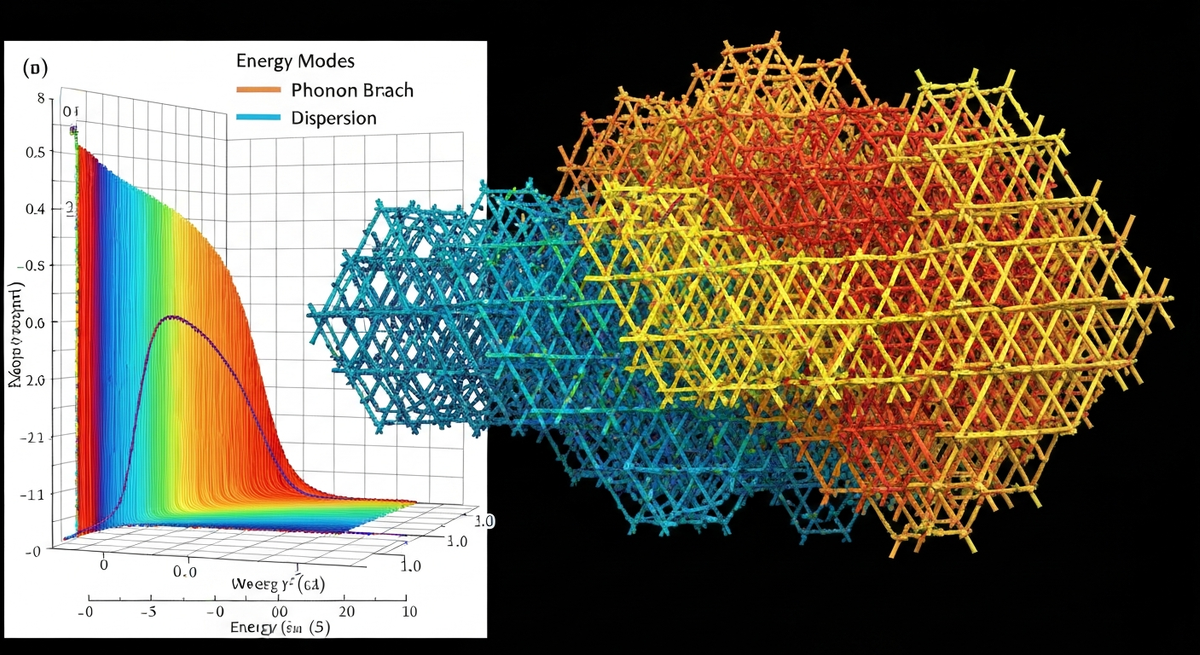
Graphene, the two-dimensional marvel of carbon, continues to captivate scientists and engineers with its extraordinary properties. While much attention often focuses on its electronic and mechanical strengths, an equally crucial yet often less explored aspect lies in its vibrational dynamics – specifically, its phonon spectrum and the resulting thermodynamic characteristics. Understanding how atoms vibrate within graphene's pristine lattice, and how these vibrations change in multi-layered nanofilms, is not merely an academic exercise; it forms the bedrock for unlocking the material's full potential in diverse nanotechnological applications. At usa-graphene.com, we recognize that true innovation stems from a deep comprehension of fundamental physics. The intricate dance of phonons, the quantized units of vibrational energy, governs everything from heat conduction and material stability to electron-phonon interactions that can influence superconductivity. This deep dive into the phonon spectrum and vibrational thermodynamics of graphene nanofilms will illuminate the complex interplay of structure, defects, and thermal behavior, offering a profound appreciation for graphene's unique properties and its promising future.
Phonons represent the collective excitations of atoms in a crystal lattice, essentially sound waves at the atomic scale. In graphene and its multi-layered counterparts, these vibrations are particularly complex and fascinating. Unlike bulk materials, graphene’s two-dimensional nature introduces unique anisotropic acoustic properties, meaning its vibrational behavior differs significantly depending on the direction of wave propagation. This anisotropy is not just a theoretical curiosity; it profoundly impacts how energy, particularly heat, moves through the material. Researchers have identified a distinct “non-sound” behavior in the dispersion of elastic waves polarized normally to the graphene plane, known as out-of-plane flexural phonons or ZA modes. These ZA modes exhibit a quadratic dispersion relation at long wavelengths, contrasting sharply with the linear dispersion typical of acoustic phonons in 3D materials.
This quadratic dispersion of ZA phonons is a direct consequence of graphene's two-dimensional structure and its extreme flexibility. It implies that these low-energy out-of-plane vibrations become particularly dominant at finite temperatures. Their presence is fundamental to graphene's stability, contributing significantly to its entropic elasticity and even its negative thermal expansion coefficient observed at certain temperatures. Beyond the flexural modes, graphene also possesses in-plane acoustic (LA and TA) and optical (LO and TO) phonon branches, arising from vibrations within the plane of the sheet. Optical phonons, characterized by higher energies, involve atoms within the unit cell vibrating out of phase, and are particularly important for understanding Raman spectroscopy signatures and electron-phonon scattering at higher energies.
The complete phonon spectrum of graphene is a complex fingerprint of its atomic structure and bonding. These collective atomic motions are dictated by the strong carbon-carbon covalent bonds and the hexagonal symmetry of the lattice. Understanding the full dispersion curves – the relationship between phonon energy and wavevector – is crucial for predicting and explaining graphene's thermal, electronic, and mechanical properties. Theoretical calculations, often employing techniques like Density Functional Theory (DFT) and Molecular Dynamics (MD) simulations, are vital tools for mapping this intricate vibrational landscape, complementing experimental observations from techniques such as inelastic X-ray and neutron scattering. The insights gained from these studies are not merely academic; they inform the design of graphene-based devices with tailored performance characteristics.
Graphene stands alone among known materials for its exceptionally high thermal conductivity, a property almost entirely governed by its phonon transport. The strong in-plane covalent bonds and the absence of scattering centers in a pristine 2D lattice allow phonons to travel with very long mean free paths, facilitating rapid heat dissipation. This makes graphene an ideal candidate for thermal management applications, where efficient heat spreading is paramount, such as in high-performance electronics and next-generation battery systems. The specific contributions of the various phonon branches, particularly the acoustic modes, determine the overall thermal conductivity.
The ultra-high thermal conductivity of single-layer graphene can reach values exceeding 3000 W/mK at room temperature, dwarfing that of conventional materials like copper. However, this impressive figure is highly sensitive to various factors. Defects, such as vacancies or impurities, introduce scattering centers that impede phonon propagation, significantly reducing thermal conductivity. Similarly, grain boundaries in polycrystalline graphene, inevitable in large-scale production, act as barriers for phonons, diminishing the material’s ability to conduct heat efficiently. Interface scattering with a substrate or encapsulation layer also plays a critical role, as phonons can scatter at these boundaries, altering the overall thermal transport.
Beyond structural imperfections, the anharmonicity of lattice vibrations is another crucial factor limiting thermal conductivity. Phonon-phonon scattering, where phonons interact and exchange energy, becomes more prevalent at higher temperatures, causing thermal resistance. The unique quadratic dispersion of flexural phonons (ZA modes) also contributes to this complexity. While initially thought to limit thermal conductivity due to enhanced scattering, careful theoretical and experimental work has revealed their substantial contribution to heat transport, especially at lower temperatures. Effectively managing these scattering mechanisms – through material synthesis, defect control, and interface engineering – is central to harnessing graphene's full thermal potential for advanced technological applications.
Electron-phonon coupling describes the fundamental interaction between the electrons, which carry charge, and the lattice vibrations (phonons) within a material. In graphene, this interaction is particularly strong and plays a critical role in determining many of its electronic properties, including electrical resistivity, carrier mobility, and even the emergence of exotic phenomena like superconductivity in specific twisted configurations. Understanding the nature and strength of this coupling is essential for designing high-performance graphene electronic devices.
When electrons move through the graphene lattice, they inevitably interact with the phonons, exchanging energy and momentum. This interaction leads to scattering events that contribute significantly to electrical resistance, especially at higher temperatures. Phonons act as a "drag" on electron flow, reducing carrier mobility. However, this coupling is not solely detrimental; it is also responsible for the cooling of hot electrons in graphene, a crucial process for preventing overheating in high-frequency electronic devices. The specific phonon modes involved in electron scattering dictate the efficiency of this cooling mechanism, with optical phonons often playing a dominant role due to their higher energies.
The strength of electron-phonon coupling can be precisely tuned through various means, including strain engineering, chemical functionalization, or by creating heterostructures with other 2D materials. For instance, applying mechanical strain can alter the phonon frequencies and modify the electronic band structure, thereby changing the electron-phonon interaction. In the exciting field of "twistronics," where two layers of graphene are stacked with a small twist angle, specific angles can lead to unprecedentedly strong electron-phonon coupling. This coupling is believed to be a key ingredient in the emergence of unconventional superconductivity observed in magic-angle twisted bilayer graphene, opening new avenues for quantum technologies.
While graphene's extraordinary strength and stiffness are often attributed to its robust sp2 hybridized carbon bonds, the dynamic interplay of phonons also plays a vital, albeit often overlooked, role in its mechanical stability and behavior, especially at finite temperatures. Phonons contribute significantly to the entropic elasticity of graphene, where thermal fluctuations and vibrational modes influence the material's response to external forces and its overall integrity. This dynamic aspect differentiates it from purely static mechanical models.
The unique flexural phonons (ZA modes) are particularly important for graphene’s mechanical properties. These out-of-plane vibrations contribute to a phenomenon known as "puckering" or ripples, which are always present at finite temperatures. These ripples, while seemingly small, are crucial for graphene's thermodynamic stability in two dimensions, as they relieve stress and prevent the material from collapsing into a lower energy 3D state. They also influence graphene's effective mechanical properties, making it appear softer at larger scales than its intrinsic bond strength would suggest. The presence and dynamics of these ripples are intrinsically linked to the material's phonon spectrum.
Furthermore, phonon dynamics are directly implicated in the mechanisms of fracture and defect propagation in graphene. High-energy phonons can locally increase atomic vibrations to the point where bonds can break, initiating or propagating cracks. Understanding the pathways of vibrational energy flow and localization around defects is critical for predicting the fatigue life and failure mechanisms of graphene-based composites and coatings. By engineering the phonon spectrum, it may be possible to enhance graphene's resistance to mechanical degradation and extend its operational lifetime in demanding environments, pushing the boundaries of material durability.
The ability to manipulate the phonon spectrum of graphene offers a powerful pathway to customize its properties for specific technological applications. This intentional control, often referred to as phonon engineering, moves beyond merely understanding inherent properties to actively designing materials with desired thermal, electrical, and mechanical characteristics. Researchers are exploring several innovative strategies to tune graphene's vibrational landscape, opening doors to advanced functionalities.
One effective method involves isotopic doping, where some carbon-12 atoms are replaced with carbon-13 isotopes. Since atomic mass directly influences vibrational frequencies, changing the isotopic composition alters the phonon dispersion, affecting phonon-phonon scattering rates and consequently the thermal conductivity. This technique allows for subtle yet significant modifications to thermal transport without altering the electronic properties. Another powerful approach is strain engineering, where mechanical stress is applied to the graphene lattice. Strain can shift phonon frequencies, modify phonon velocities, and even change the symmetry of the vibrational modes, thereby influencing heat flow and electron-phonon interactions.
Surface functionalization, by attaching different chemical groups to the graphene surface, and creating heterostructures with other 2D materials like hexagonal boron nitride (hBN), also provide avenues for phonon engineering. These modifications introduce new vibrational modes, alter existing ones, and create interfaces that scatter phonons in specific ways, enabling precise control over thermal and electronic transport. Moreover, in multi-layered graphene nanofilms, the stacking order, interlayer distance, and especially the twist angle between layers offer a rich parameter space for tuning phonon behavior, which has profound implications for thermal management in complex device architectures and even for novel phononic devices.
While single-layer graphene often dominates scientific discourse due to its pristine 2D nature, multi-layer graphene nanofilms are of immense practical importance. They are more readily produced, offer enhanced mechanical robustness, and present a tunable platform where interlayer interactions significantly modify the phonon spectrum compared to a single isolated sheet. Understanding these differences is crucial for translating graphene's remarkable properties into real-world applications.
In multi-layer graphene, the weak van der Waals forces between adjacent layers introduce new interlayer phonon modes that are absent in single-layer graphene. These low-energy shear and breathing modes arise from the relative motion of the layers and significantly influence the overall phonon dispersion. The presence of these additional modes, along with increased phonon-phonon scattering at interlayer interfaces, generally leads to a reduction in the in-plane thermal conductivity compared to single-layer graphene, though it still remains impressively high. However, these interlayer modes also provide a unique opportunity for engineering thermal transport across the film thickness, offering anisotropic heat conduction properties.
The specific stacking sequence and the degree of turbostratic disorder (random orientation between layers) in graphene nanofilms profoundly impact their phonon spectrum. Bernal (AB) stacking, the most common configuration in graphite, exhibits distinct phonon characteristics compared to randomly oriented layers. Furthermore, the ability to control the number of layers and the twist angle between them in bilayer and few-layer graphene provides an exquisite level of control over the phonon properties. This tunability is especially relevant for applications requiring specific thermal profiles or for creating phononic crystals and waveguides, where precise manipulation of vibrational energy is desired. Thus, multi-layer graphene nanofilms represent a versatile and practical platform for advanced phonon engineering.
What is a phonon?
A phonon is a quantized unit of vibrational energy in a crystal lattice, essentially a quantum of sound wave. It represents the collective excitation of atoms vibrating in a solid material, responsible for phenomena like heat conduction and contributing to material stability and mechanical properties.
Why are phonons particularly important in graphene?
Phonons are critical in graphene because they are the primary carriers of heat, giving graphene its ultra-high thermal conductivity. They also strongly interact with electrons, influencing electrical resistivity and contributing to exotic phenomena like superconductivity. Furthermore, unique flexural phonons are crucial for graphene's thermodynamic stability in two dimensions.
How does multi-layer graphene differ from single-layer in terms of phonons?
Multi-layer graphene introduces new interlayer phonon modes due to van der Waals interactions between layers, such as shear and breathing modes. These modify the phonon spectrum, generally reducing in-plane thermal conductivity compared to single-layer graphene but offering tunable anisotropic thermal transport properties.
Can we control or engineer phonons in graphene?
Yes, phonon engineering in graphene is an active research area. Methods include isotopic doping (replacing 12C with 13C), applying mechanical strain, surface functionalization, creating heterostructures, and precisely controlling the number of layers and twist angles in multi-layer nanofilms.
What are the practical applications of understanding graphene phonons?
Understanding graphene phonons enables the development of advanced thermal management solutions for electronics, high-performance thermoelectric devices for energy harvesting, and novel phononic crystals for sound and heat manipulation. It also informs the design of more robust mechanical composites and paves the way for new quantum computing architectures.
The vibrational symphony of graphene, orchestrated by its intricate phonon spectrum, is far more than a scientific curiosity; it is a fundamental determinant of the material's extraordinary properties and its vast potential in future technologies. From dictating its unparalleled thermal conductivity to influencing electron transport and ensuring its mechanical stability, phonons are at the heart of graphene's unique character. The detailed understanding of these atomic vibrations, especially within the context of multi-layered nanofilms, is not just a scientific endeavor but a strategic imperative for technological advancement.
At usa-graphene.com, we recognize that mastering the art of phonon engineering – through strain, doping, functionalization, and precise layer stacking – will be key to unlocking the next generation of high-performance graphene applications. This includes creating more efficient thermal interfaces, designing novel thermoelectric devices, advancing quantum technologies, and developing materials with unprecedented mechanical resilience. The journey into graphene's vibrational dynamics continues to reveal new insights, propelling us closer to a future where graphene plays an indispensable role in revolutionizing countless industries.
Serious about B2B integration? Test our premium Pulsed Electrical Resistive Carbon Heating turbostratic graphene in your lab. 100g sample packs available now.
Explore More
Researchers have developed a breakthrough method for growing twisted bilayer graphene with pre-designed angles, a key step toward manufacturable quantum...

Learn how deep learning is revolutionizing the structural characterization of twisted bilayer materials, accelerating the development of next-generation...

Learn to build a prototype graphene FET biosensor for sensitive DNA detection. This guide covers materials, fabrication, and testing for point-of-care...