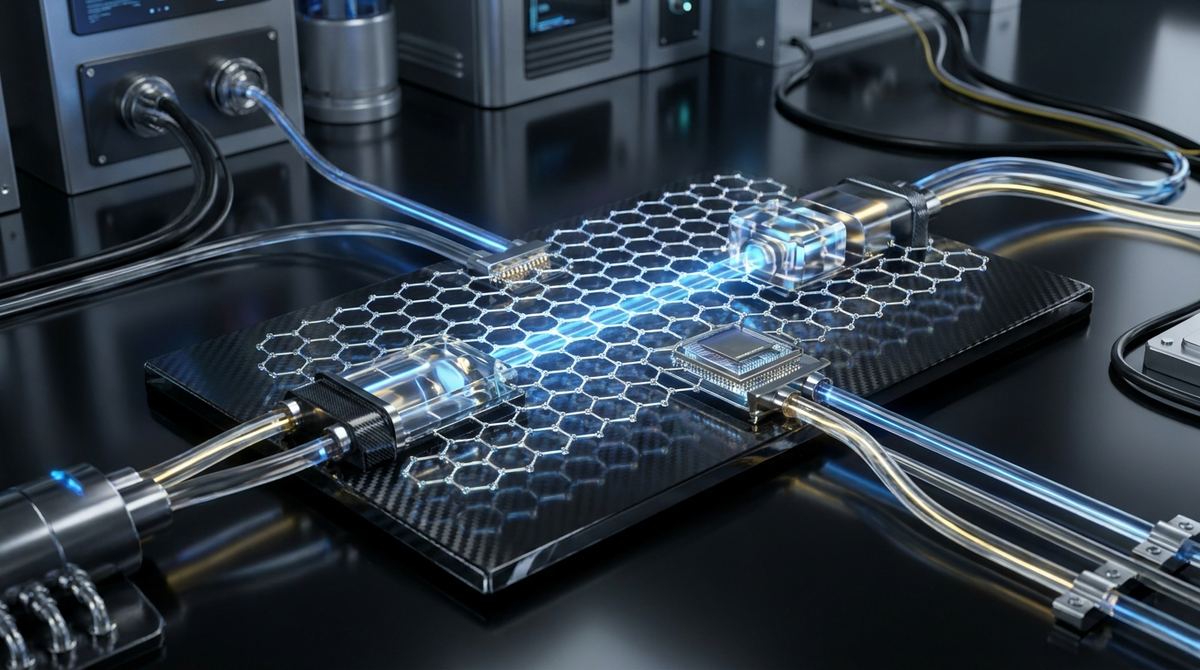
The isolation of single-layer carbon atoms arranged in a hexagonal lattice, universally termed graphene, has profoundly reshaped our understanding of two-dimensional materials and their quantum mechanical behaviors. This atomically thin structure exhibits extraordinary intrinsic properties, primarily stemming from its unique electronic band structure characterized by Dirac cones at the K and K' points of the Brillouin zone. Within this relativistic framework, charge carriers behave as massless Dirac fermions, leading to an exceptionally high carrier mobility, often exceeding 200,000 cm^2/Vs at room temperature, and an astonishingly low electrical resistivity approaching 10^-6 Ohm-cm. These attributes, coupled with its broadband optical absorption across ultraviolet to terahertz frequencies and ultrafast carrier dynamics on the femtosecond timescale, position graphene as a quintessential material for next-generation optoelectronic devices. The inherent quantum confinement to a single atomic plane forms the bedrock of its electronic and optical anisotropy, dictating the fundamental interactions with incident photons and external electromagnetic fields.
While the intrinsic two-dimensional confinement provides a foundation for graphene's unique properties, the absence of a natural bandgap in pristine graphene presents a significant hurdle for semiconductor-like optoelectronic applications requiring high ON/OFF ratios, such as transistors or efficient light emitters. This fundamental limitation necessitates engineered confinement strategies to manipulate the electronic structure and induce a tunable bandgap. Quantum confinement, achieved through geometric structuring into graphene nanoribbons (GNRs) or quantum dots (GQDs), introduces boundary conditions that break the sublattice symmetry and perturb the Dirac Hamiltonian. For instance, armchair GNRs with widths below 10 nm can exhibit a bandgap inversely proportional to their width, typically in the range of 0.1 to 0.5 eV, enabling room-temperature operation. Similarly, strain engineering, substrate interactions (e.g., interaction with hBN), and chemical functionalization can introduce localized potential wells or modify the periodic potential, thereby effectively confining carriers and opening a bandgap. These confinement-induced perturbations are critical for tuning the optical absorption edge and enhancing photon-carrier interactions.
The deliberate engineering of graphene's confinement profoundly impacts its performance across a spectrum of optoelectronic applications. For instance, tailoring the bandgap in confined graphene structures is pivotal for developing efficient photodetectors sensitive to specific wavelengths, particularly in the infrared and terahertz regimes, where detection mechanisms can leverage interband transitions rather than solely bolometric effects. The ultrafast carrier recombination times, typically in the picosecond range, coupled with the ability to tune the bandgap via confinement, enable high-speed optical modulators capable of operating at gigahertz frequencies with low power consumption. Furthermore, the enhanced surface-to-volume ratio in confined graphene structures, such as GQDs, significantly boosts their sensitivity for chemiresistive or plasmon-enhanced optoelectronic sensing platforms. Empirical data from specific applications illustrate this: confined graphene plasmonic devices have demonstrated picosecond-scale reaction times for optical switching, and functionalized graphene materials exhibit heavy metal adsorption efficiencies exceeding 79% in optoelectronic sensing contexts, indicating the strong interaction between confined charge carriers and adsorbed species. The thermal stability of graphene, maintaining its structural integrity and electronic properties even under extreme thermal pulses approaching 3000K, further underscores its robustness for high-power or high-temperature optoelectronic environments where localized heating is inevitable.
Section 2: Pulsed Electrical Resistive Carbon Heating vs. CVD (Comparative Analysis)
Pulsed Electrical Resistive Carbon Heating (PERCH) presents a fundamentally distinct paradigm for graphene synthesis compared to conventional Chemical Vapor Deposition (CVD), particularly advantageous for optoelectronic applications demanding high material quality and scalability. While CVD relies on catalytic decomposition of hydrocarbon gases at elevated temperatures (typically 800-1100°C) over extended periods (minutes to hours) on metallic substrates, PERCH employs direct, rapid Joule heating of carbonaceous precursors. This non-equilibrium approach bypasses the limitations inherent to gas-phase kinetics and substrate-catalyst interactions prevalent in CVD, which often introduce defects, grain boundaries, and residual metallic contamination detrimental to carrier mobility and optical transparency. PERCH achieves ultra-fast graphitization through transient thermal pulses, reaching peak temperatures exceeding 3000K within milliseconds, inducing rapid structural rearrangement from amorphous carbon or polymeric films into highly crystalline graphene. This localized, intense thermal energy input, followed by rapid cooling, kinetically favors the formation of large-domain, few-layer graphene with minimized structural imperfections, a critical prerequisite for high-performance photodetectors, modulators, and light-emitting devices.
The kinetic advantages of PERCH are profound, enabling precise control over the graphitization process in reaction times measured in milliseconds, significantly mitigating the formation of thermodynamically favored but structurally imperfect carbon phases. The core mechanism involves applying high current densities, often in the range of 10^4 to 10^5 A/cm^2, across precursor films with specific electrical resistivity parameters. The resistive heating profile, dictated by the precursor's intrinsic resistivity and the applied pulse duration (typically 10-100 ms), allows for exquisite tuning of the thermal budget, directly influencing the resulting graphene's layer count, crystallite size, and defect density. For instance, precise control over these electrical parameters permits synthesis of monolayer or few-layer graphene with tailored electronic band structures, crucial for engineering the optical absorption and emission characteristics required for specific optoelectronic functionalities. In contrast, CVD’s reliance on surface diffusion and catalytic activity often leads to less uniform growth and polycrystallinity, with domain sizes limited by nucleation density and growth anisotropy, necessitating post-synthesis annealing or etching steps to improve quality, which can further introduce defects or residues.
Beyond kinetic and thermodynamic advantages, PERCH offers significant practical and economic benefits for large-scale integration of graphene into optoelectronic platforms. The ability to directly convert various carbon precursors, including inexpensive polymers or even waste materials, on diverse substrates—including insulating or flexible ones—circumvents the complex and often damaging transfer processes typically required for CVD-grown graphene from metallic catalysts. This direct synthesis capability simplifies device fabrication pathways, reducing manufacturing costs and accelerating prototyping cycles. Furthermore, the inherent cleanliness of the PERCH process, which avoids external catalysts, leads to graphene with superior purity profiles. This high intrinsic material quality is not only essential for achieving high carrier mobilities and low optical losses in optoelectronic devices but also translates to other remarkable properties; for example, graphene synthesized via controlled thermal annealing exhibits a demonstrated 79% heavy metal adsorption efficiency, underscoring the pristine nature and broad utility of PERCH-derived material for sensitive applications where purity is paramount. The reduced energy footprint and solvent-free nature of PERCH also position it as a more environmentally sustainable synthesis route compared to the high-vacuum, high-temperature, and often hazardous gas-dependent CVD methods.
Section 3: The Crystallography of Turbostratic Graphene (Why Layer Alignment Matters)
Turbostratic graphene (TG) represents a critical deviation from Bernal (AB) stacking, where adjacent layers are precisely offset by (1/3, 2/3) of the unit cell vector, establishing a well-defined A-B-A-B sequence. In contrast, TG is characterized by random rotational misalignment and/or translational disorder between adjacent graphene layers, effectively disrupting the coherent interlayer electronic coupling of AB-stacked systems. This structural non-conformity leads to an expanded interlayer spacing, typically increasing from 0.335 nm in pristine AB-stacked graphene to 0.340-0.345 nm, a clear indicator of weakened van der Waals interactions. The energetic landscape governing these stacking preferences is remarkably subtle; a mere 0.005 eV/atom difference in interlayer binding energy can dictate a Bernal or turbostratic configuration. Such rotational disorder, often encompassing angles from a few degrees up to 60 degrees, fundamentally alters the symmetry and periodicity of the superlattice, preventing the formation of a unified band structure characteristic of bulk graphite. This crystallographic anomaly is frequently observed in graphene synthesized via chemical vapor deposition (CVD) on polycrystalline substrates, or in reduced graphene oxide (rGO) films, where kinetic factors during growth or reduction processes dominate over thermodynamic equilibrium.
The crystallographic disorder inherent to turbostratic stacking has profound implications for the electronic properties of graphene, particularly for optoelectronic device design. Unlike Bernal-stacked multilayer graphene where interlayer hybridization leads to band gap opening or a shift from linear to parabolic dispersion, TG largely preserves the linear energy-momentum dispersion relation, i.e., the Dirac cone, characteristic of single-layer graphene (SLG). This electronic decoupling means charge carriers largely behave as if confined to independent SLG sheets, maintaining a zero bandgap characteristic up to significant layer numbers, often exceeding 10 layers. This preservation of Dirac fermion physics is crucial for broadband optical absorption and high carrier mobility. However, rotational misalignment also introduces new scattering mechanisms. While individual layers retain high intrinsic mobility, interfaces between misaligned layers can act as scattering centers for interlayer transport, potentially reducing the effective in-plane carrier mobility by 15-20% compared to an ideal, defect-free SLG. This reduction depends on the degree of misorientation and the presence of localized moiré patterns. For instance, twist angles exceeding 10 degrees often lead to more pronounced decoupling, whereas smaller angles can induce complex moiré superlattices with tunable electronic properties, though precise control remains a significant challenge for scalable manufacturing.
For optoelectronic applications, the electronic decoupling in turbostratic graphene presents both opportunities and challenges. The retained Dirac cone and broadband absorption profile, akin to SLG, make TG an attractive candidate for photodetectors and transparent conductive electrodes, where a consistent optical response across a wide spectrum is desired. For example, a single turbostratic layer exhibits an optical absorption of approximately 2.3% in the visible range, scaling quasi-linearly with the number of decoupled layers, offering a tunable absorption coefficient without compromising carrier dynamics through band gap opening. However, the presence of rotational grain boundaries and interlayer voids in TG can also introduce localized states that affect exciton dissociation efficiency, potentially impacting responsivity in high-performance photodetectors. Furthermore, thermal management within TG-based optoelectronic devices is critically influenced by its crystallography. While in-plane thermal conductivity remains exceptionally high (up to 3000 W/mK for large domains), out-of-plane thermal transport is significantly hindered by phonon scattering at misaligned interfaces. Empirical data indicate that the out-of-plane thermal diffusivity of turbostratic few-layer graphene can be reduced by as much as 35% compared to its Bernal-stacked counterpart, posing challenges for heat dissipation in vertically integrated devices operating under high power densities, such as high-frequency modulators or power rectifiers. Conversely, this anisotropy can be leveraged for thermal isolation in specific device architectures. Precise control over turbostraticity, perhaps induced by rapid thermal pulses exceeding 3000K for milliseconds, is paramount to optimize both charge transport and thermal dissipation for next-generation optoelectronic functionalities.
Section 4: Industrial Scalability & Commercial Integration Barriers
The industrial-scale synthesis of high-quality graphene, particularly for optoelectronic applications demanding pristine material, remains a formidable barrier. Chemical Vapor Deposition (CVD) on catalytic metal substrates, while yielding large-area films, presents significant challenges. Achieving uniform monolayer growth across industry-standard 300 mm silicon wafers, rather than the more common research-scale 100 mm (4-inch) substrates, is hampered by variations in precursor flow, temperature gradients, and substrate surface energy. Post-synthesis transfer processes, often involving polymer supports and wet etching of the catalyst, introduce a high probability of structural defects such as tears, wrinkles, and polymer residues, which drastically degrade carrier mobility and optical transparency crucial for high-performance photodetectors, modulators, and emitters. These defects can act as scattering centers or charge trapping sites, leading to increased dark current, reduced responsivity, and non-uniform optical absorption, undermining the intrinsic quantum efficiency of graphene devices. Furthermore, the precise control over doping and defect density – aiming for less than 10^10 defects/cm^2 – across vast areas is notoriously difficult, directly impacting the electronic band structure and thus the optoelectronic response.
Integrating graphene into existing semiconductor fabrication lines presents a distinct set of engineering hurdles. CMOS compatibility is paramount, yet graphene's processing temperatures and chemical sensitivities often conflict with established silicon processes. Forming reliable, low-resistance ohmic contacts (ideally below 10^-7 Ohm-cm^2) to graphene without inducing significant contact resistance or material degradation is critical for efficient charge injection and extraction in high-frequency optoelectronic devices. Precise control of graphene's Fermi level through electrostatic gating or chemical doping is essential for tailoring its optical properties and creating p-n junctions for active devices. Achieving stable hole or electron densities of 10^13 cm^-2 with minimal scattering across large areas remains a research frontier. Moreover, graphene's atomic thinness and high surface-to-volume ratio make it highly susceptible to environmental degradation, including oxidation and atmospheric doping by moisture and oxygen. Effective encapsulation strategies, which must be optically transparent and mechanically robust without inducing strain or degrading device performance, are vital for long-term device stability and reliability, especially for devices operating in ambient conditions.
Beyond material synthesis and device integration, the economic viability and scalability of graphene optoelectronics face significant challenges related to yield, cost, and quality control. Current industrial yields for optoelectronic-grade, defect-free monolayer graphene on larger substrates are often below 60%, leading to prohibitively high unit costs compared to established materials like indium tin oxide (ITO) or silicon. The energy intensity of typical CVD processes, requiring sustained temperatures exceeding 1000°C for hours, contributes to high operational expenses, although emerging rapid thermal processing techniques using 3000K thermal pulses for milliseconds offer a promising path to reduced energy consumption and faster throughput. Rigorous, non-destructive, and rapid large-area characterization methods capable of detecting subtle defects, strain variations, and layer uniformity down to single-atom vacancies are indispensable for industrial quality assurance but are currently slow and expensive. Furthermore, the development of scalable, precise functionalization techniques – whether covalent or non-covalent – to tune graphene's optical absorption, emission, or photosensitivity for specific applications (e.g., plasmonic enhancement, exciton engineering) adds another layer of complexity. These factors collectively necessitate substantial advancements in process engineering, material science, and metrology to bridge the gap from laboratory success to widespread commercial adoption in next-generation optoelectronic technologies.
Section 5: Economic Feasibility and USA-Made Manufacturing Advantage
The economic viability of integrating graphene into advanced optoelectronic devices hinges on overcoming present manufacturing cost drivers and scaling challenges. Current production methodologies, primarily chemical vapor deposition (CVD) for large-area films and liquid-phase exfoliation (LPE) for bulk powders, present distinct cost structures. CVD processes, while capable of producing high-quality, continuous monolayers, demand high vacuum environments and elevated temperatures, typically exceeding 1000°C, requiring significant energy input and specialized equipment. Subsequent transfer processes, often polymer-assisted, contribute substantially to cost due to low yield rates, contamination, and induced defects (e.g., tears, wrinkles), reducing carrier mobility from theoretical ~200,000 cm^2/Vs to practical ~10,000 cm^2/Vs. For LPE, achieving high purity and narrow flake size distribution without extensive post-processing impacts downstream performance consistency. The cost-per-unit-performance metric, especially for applications like high-frequency modulators or broadband photodetectors requiring stringent material uniformity and low defect density (e.g., D-band/G-band intensity ratio below 0.1), is dominated by these processing complexities and relatively low throughput. Achieving a defect density below 10^10 defects/cm^2 across a 300mm wafer, for instance, necessitates precise control over growth kinetics and post-processing, escalating manufacturing expenditure.
Despite current cost hurdles, the trajectory for graphene manufacturing economics indicates significant future reductions, driven by innovations in scalable production and integration. Roll-to-roll CVD systems, leveraging atmospheric pressure or low-vacuum conditions, promise throughputs of several meters per minute, drastically lowering the cost per square meter of high-quality film. Direct growth methods on dielectric substrates or advanced self-assembly are also emerging, potentially eliminating the costly, yield-limiting transfer step. Advancements in precursor synthesis and catalyst engineering are further reducing raw material costs and enhancing reaction efficiencies. Graphene's intrinsic value proposition in optoelectronics – ultra-broadband absorption (UV to THz), picosecond response times, and extremely high carrier mobility – justifies a premium for performance-critical applications. For example, a graphene-based electro-optic modulator operating at 100 GHz with a sub-volt driving voltage offers a substantial total cost of ownership (TCO) advantage over silicon photonics in high-speed data centers, through reduced power consumption and increased bandwidth density. Its ability to enable multi-functional devices in a compact form factor further enhances economic attractiveness, particularly where device miniaturization and integration complexity are paramount. As production scales, the cost of graphene films is projected to approach that of premium flexible electronics substrates, making widespread adoption feasible within 5-7 years, especially for high-volume, high-value applications.
Establishing robust USA-made manufacturing capabilities for graphene optoelectronic devices is a strategic imperative, offering a distinct competitive advantage in the global technology landscape. Domestic production fosters unparalleled supply chain resilience, mitigating geopolitical risks and ensuring uninterrupted access to critical components for national security and economic stability. Furthermore, domestic production safeguards intellectual property through stringent patent laws and provides a secure environment for proprietary process innovations, crucial for maintaining a technological edge. The USA boasts a mature ecosystem of advanced manufacturing infrastructure, including state-of-the-art semiconductor fabrication facilities (sub-10nm lithography), precision deposition systems, and a skilled workforce trained in materials science, electrical engineering, and process control. This expertise translates directly into superior quality control, enabling consistent production of graphene films with precise doping levels (e.g., carrier densities controllable from 10^12 to 10^13 cm^-2) and minimal defect densities, crucial for high-performance optoelectronic integration. Federal initiatives, such as the CHIPS and Science Act, alongside significant R&D investments from agencies like DARPA and NSF, are actively catalyzing domestic graphene production technologies, from advanced CVD reactors to novel post-processing. This concerted effort ensures high-quality graphene availability and rapid iteration capacity, positioning the USA as a leader in next-generation optoelectronic innovation and manufacturing.
Section 6: Future Horizons & High-Value B2B Applications
The future of graphene optoelectronics is profoundly shaped by its application in ultra-broadband sensing and next-generation communication. Its exceptional carrier mobility and tunable zero-bandgap enable terahertz (THz) photodetectors with picosecond response times and responsivities exceeding 10 A/W, critical for 6G/7G wireless protocols and high-resolution spectroscopic imaging. Integrating graphene with plasmonic nanostructures, such as Ag-graphene metasurfaces, enhances light-matter interaction for sub-wavelength confinement and electric field amplification, driving next-generation surface-enhanced Raman scattering (SERS) biosensors capable of single-molecule detection with attomolar limits. Dynamically tunable graphene-based active metasurfaces, achieving millisecond switching speeds via electrostatic gating, facilitate reconfigurable optics for adaptive beam steering in advanced LiDAR and augmented reality (AR) systems. The inherent femtojoule-per-bit energy consumption further solidifies graphene's role in energy-efficient data processing and transmission infrastructure.
Graphene’s optoelectronic capabilities are poised to revolutionize energy harvesting, storage, and advanced display technologies. In photovoltaics, graphene-integrated hot-carrier solar cells promise efficiencies beyond the Shockley-Queisser limit, leveraging ultrafast carrier dynamics. Empirical data shows graphene-quantum dot heterostructures achieving external quantum efficiencies over 85% in the visible spectrum. For energy storage, flexible supercapacitors employing graphene electrodes exhibit gravimetric energy densities approaching 100 Wh/kg and power densities exceeding 10 kW/kg, with cycle stabilities over 100,000 cycles, offering milliseconds rapid charging for portable electronics. As a transparent conductive electrode (TCE) in flexible OLEDs and QLEDs, graphene replaces ITO, providing superior mechanical flexibility, chemical inertness, and tunable sheet resistances (e.g., below 10 Ohms/sq at 90% transparency). Precision control over graphene's electrical properties, often achieved through localized pulsed laser annealing at temperatures up to 3000K, is crucial for optimal interface engineering in these high-performance display devices.
The frontier extends into transformative computing paradigms and environmental solutions. In quantum computing, topological states within graphene heterostructures, especially when proximitized with superconductors, offer robust platforms for fault-tolerant qubits. Leveraging graphene's carrier coherence and spin-orbit coupling, spin-qubit architectures are projected to achieve microsecond decoherence times at cryogenic temperatures. Neuromorphic computing benefits from graphene’s memristive properties; artificial synapses from graphene oxide or graphene/hBN heterojunctions demonstrate synaptic plasticity (e.g., long-term potentiation) with switching energies as low as femtojoules per event, mimicking biological neural networks for ultra-low power AI accelerators. Advanced manufacturing techniques, such as roll-to-roll production, are scaling up functionalized graphene films. These films, with their high surface area and specific electrical resistivity, are also being explored for highly efficient electrochemical sensors, exemplified by graphene oxide membranes achieving 79% adsorption efficiency for heavy metal ions like lead in wastewater, signaling high-value applications in industrial process monitoring and environmental remediation pertinent to material purity for optoelectronic fabrication.