
Beyond Perfection: How Electrons Hop in Real-World Graphene Electronics
Discover how hopping-mediated charge transport explains graphene's electrical behavior beyond the ideal ballistic regime, a key insight for creating...
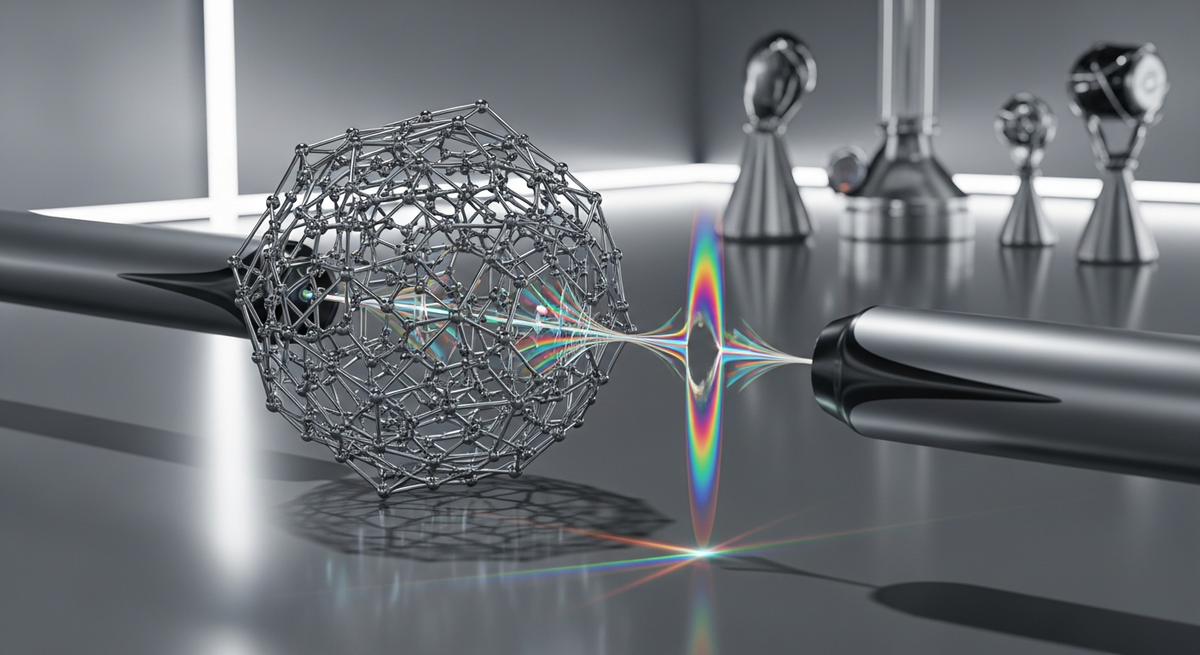
In the rapidly evolving landscape of advanced materials, graphene stands as a singular entity, continuously pushing the boundaries of what's possible in electronics, mechanics, and increasingly, photonics. This two-dimensional crystalline solid, composed of a single-atom-thick hexagonal lattice of carbon atoms, possesses an array of unparalleled properties that make it a compelling candidate for next-generation optical technologies. Its unique electronic structure, characterized by massless Dirac fermions and exceptional electron mobility, directly translates into novel light-matter interactions with profound implications for the future of optical signal processing, transmission, and detection.
The profound potential of graphene in photonics stems from its exceptional characteristics, including a remarkable optical damage threshold of 3 × 10^6 MW/cm², far surpassing many conventional materials. Furthermore, many of its crucial optical properties remain constant across broad wavelength ranges, offering unprecedented versatility. These foundational attributes, coupled with its inherent tunability, position graphene at the forefront of innovation, driving advancements in everything from high-speed optical modulators to ultra-sensitive photodetectors and efficient light confinement systems. Understanding these fundamental optical properties and the sophisticated methods used to model them is paramount to unlocking graphene's full transformative power in the photonic domain.
Graphene's extraordinary interaction with electromagnetic fields is fundamentally rooted in its distinct electric conductivity, which arises from two primary physical mechanisms: intraband and interband electronic transitions. The intraband transitions, which occur within the same electronic band, are precisely described by a Drude-type frequency model. This model effectively captures the behavior of charge carriers within graphene, analogous to the free electron gas in metals, and is critical for understanding the material's response at lower frequencies and when carriers are abundant.
In contrast, interband electronic transitions involve electrons transitioning between different electronic bands. This mechanism contributes significantly to graphene's conductivity, particularly in the optical and near-infrared regimes. The mathematical description of these interband transitions is more complex and does not conform directly to the simple Drude model, posing a challenge for direct implementation in time-domain numerical simulations. The interplay between these two mechanisms gives graphene a remarkably broad and tunable optical response, making it highly attractive for active photonic devices.
Crucially, graphene's optical absorption and the spectral features of its permittivity are highly tunable. This remarkable characteristic is achieved through the control of its chemical potential, a property that can be adjusted via external direct current (DC) electric or magnetic fields, as well as through chemical doping. The ability to dynamically modify the chemical potential allows for precise, on-demand control over how graphene interacts with light, enabling functionalities that are challenging or impossible with fixed-property materials. This tunability is a cornerstone of graphene's potential for active photonics.
This tunable response has led to intense study and exciting applications, notably in the field of nonlinear optics. Graphene exhibits nonlinear-saturable absorption properties, meaning its absorption decreases with increasing light intensity. This effect has been successfully leveraged in demonstrations of passively mode-locked lasers, emitting around 1.5 µm with pulse durations shorter than 1 ps. Graphene-based saturable absorbers offer distinct advantages over traditional semiconductor-saturable absorber mirrors, including a significantly higher optical damage threshold, broader operational bandwidth, and lower manufacturing costs, making them a superior choice for high-performance laser systems.
To accurately predict and engineer graphene-based photonic devices, sophisticated numerical simulation methods are indispensable. The finite-difference time-domain (FDTD) method is a powerful and widely adopted numerical approach for simulating the interaction of electromagnetic fields with complex materials, including graphene. This method discretizes Maxwell's equations in both space and time, allowing for a detailed evolution of electromagnetic waves through a simulated environment. However, graphene's dispersive electric material response, where its properties vary with frequency, demands special care for accurate implementation within a time-domain framework like FDTD.
The linear electric material response of graphene, particularly its frequency-dependent conductivity, makes direct FDTD implementation challenging. To address the intraband electronic transitions, which are well-described by the Drude model, researchers employ the auxiliary differential equation (ADE) method. ADE allows for the incorporation of frequency-dependent material responses into time-domain simulations by introducing additional differential equations that describe the material's polarization dynamics. This technique effectively translates the frequency-domain Drude model into a form compatible with the FDTD's time-stepping scheme, ensuring accurate representation of intraband conductivity.
The more complex interband conductivity term, however, does not possess a form directly amenable to the standard ADE technique. To overcome this hurdle, innovative fitting approaches are employed, such as Padé interpolation. Padé interpolation is a rational function approximation method that provides highly accurate representations of complex functions. By using Padé interpolation, the intricate frequency dependence of the interband conductivity can be fitted and then transformed into a sum of simple pole terms, which can then be incorporated into the FDTD method using the ADE technique. This clever combination of fitting and ADE ensures that both fundamental mechanisms of graphene's conductivity are accurately captured in time-domain simulations.
This advanced modeling framework, combining FDTD with ADE and Padé interpolation, is crucial for unlocking a deeper understanding of graphene's optical behavior. It enables the accurate simulation of surface plasmon polariton (SPP) modes in various graphene structures, including finite-width graphene waveguides. Through these simulations, engineers and scientists can predict critical performance parameters such as propagation loss and waveguide dispersion, which are essential for designing efficient and high-performance graphene photonic components operating at specific wavelengths, such as the near-infrared regime for highly doped graphene.
Graphene's exceptional electronic properties pave the way for its role as a novel plasmonic material, offering significant advantages over traditional noble metals like gold or silver. Plasmonics is a field dedicated to the study and application of surface plasmon polaritons (SPPs) – collective oscillations of electrons that couple with electromagnetic waves at a metal-dielectric interface. These SPPs enable the confinement of light to sub-wavelength dimensions, far beyond the diffraction limit, which is critical for miniaturized photonic devices and ultra-fast optical circuits.
Traditionally, noble metals have dominated plasmonics research due to their delocalized electron distributions, which behave much like a plasma. This plasma behavior leads to a negative real part of the electric permittivity for frequencies below the plasma frequency, a prerequisite for the formation of SPPs. While noble metals offer strong SPP confinement, their properties are largely fixed, limiting their tunability and dynamic control once fabricated. This is where graphene emerges as a transformative alternative, offering unparalleled flexibility.
Using graphene for SPP devices introduces a paradigm shift. Unlike noble metals, the material properties of graphene are exquisitely tunable via external electric or magnetic fields and chemical doping. This tunability allows for dynamic control over the SPP propagation characteristics, including their wavelength, intensity, and even direction, a capability largely absent in conventional metallic plasmonics. This dynamic reconfigurability opens doors for active plasmonic devices, such as electrically tunable filters, modulators, and sensors that can adapt to changing operational requirements.
Recent research has focused on highly doped graphene to enable surface plasmon modes that propagate effectively at near-infrared wavelengths. This spectral region is particularly important for optical communications and various sensing applications. The ability to model and engineer finite-width graphene waveguides, predicting both their propagation loss and waveguide dispersion, is critical for realizing practical graphene-based plasmonic circuits. Such advances promise to facilitate the creation of highly integrated, low-loss, and high-speed photonic components that leverage the unique advantages of graphene's light-matter interaction at the nanoscale.
The unique optical and electrical properties of graphene, coupled with advanced modeling capabilities, have catalyzed a wave of innovation across numerous photonic technologies. Graphene's ability to interact with light in novel ways makes it an ideal candidate for a diverse range of applications, from high-speed data communication to advanced sensing and laser technology.
One significant area of impact is in optical modulation. Hybrid silicon-graphene electroabsorption near-infrared modulators have been demonstrated with impressive performance metrics, achieving modulation rates as high as 1 GHz within an incredibly compact 25 µm² footprint. This level of performance and miniaturization is critical for increasing data throughput and reducing the size and power consumption of optical interconnects in data centers and high-performance computing. The ability to integrate graphene directly onto silicon photonics platforms further enhances its appeal for industrial scalability.
In the realm of light detection, graphene-based photodetectors are showcasing remarkable capabilities. Devices capable of operating at frequencies as high as 40 GHz at a wavelength of 1.55 µm have been successfully demonstrated. Researchers even estimate the peak bandwidth of a graphene photodetector could extend to an astonishing 500 GHz, far exceeding the capabilities of many traditional photodetectors. Subsequent work has further validated this potential, demonstrating error-free detection at data rates of 10 Gbps. The efficiency and speed of these photodetectors make graphene a strong contender for ultra-fast optical communication systems.
Beyond modulation and detection, graphene's influence extends to specialized optical components. Quasi-transverse electromagnetic modes of graphene-based parallel-plate waveguides have been theoretically described, offering pathways for terahertz frequency operation, crucial for imaging, sensing, and future wireless communications. Moreover, graphene has been shown to enhance and modify photonic metamaterials. Placing a single layer of graphene over a split-ring resonator metamaterial resulted in significant resonance shifts and transmission enhancement compared to devices without graphene, opening avenues for dynamically reconfigurable metamaterials.
The development of graphene-based in-line fiber polarizers exemplifies its versatility, achieving a substantial 27-dB extinction ratio. The unique conical electronic band structure of graphene enables transverse electric (TE)-pass functionality, offering precise control over light polarization in optical fiber systems. Furthermore, its robust nonlinear optical properties have led to experimental observations of optical bistability, regenerative oscillations, and four-wave mixing in silicon photonic crystal microcavities coated with single-layer graphene. These phenomena are vital for all-optical signal processing and advanced quantum computing applications.
Graphene's remarkable confluence of electronic and optical properties has firmly established it as a transformative material for the future of photonics. From its unique electron transport mechanisms that govern its tunable electric conductivity to its ability to support highly localized surface plasmon polaritons, graphene offers unprecedented flexibility and performance in manipulating light. The advancement of sophisticated numerical modeling techniques, such as FDTD combined with ADE and Padé interpolation, is continuously refining our understanding and predictive capabilities, paving the way for optimized device designs.
Its high optical damage threshold, broadband operation, and dynamic tunability via chemical potential make it a superior choice for a wide array of applications. The demonstrated successes in high-speed optical modulators, ultra-fast photodetectors, efficient fiber polarizers, and advanced laser technologies are merely a glimpse into the vast potential that graphene holds. As research progresses, we anticipate graphene will continue to redefine the limits of light-matter interaction, leading to smaller, faster, and more energy-efficient photonic devices that will underpin the next generation of technological innovation.
Explore the cutting-edge of graphene science and discover how this incredible material is shaping the future of technology. Visit usa-graphene.com today to learn more about our advanced graphene materials and how they can empower your next breakthrough research or product development.
Serious about B2B integration? Test our premium Pulsed Electrical Resistive Carbon Heating turbostratic graphene in your lab. 100g sample packs available now.
Explore More
Discover how hopping-mediated charge transport explains graphene's electrical behavior beyond the ideal ballistic regime, a key insight for creating...

A practical guide to fabricating a flexible graphene fiber sensor for the simultaneous detection of nitric oxide and H2O2, key cancer biomarkers.

Explore a new low-noise Pauli-consistent ensemble Monte Carlo simulation for graphene, a powerful computational tool for designing next-generation...