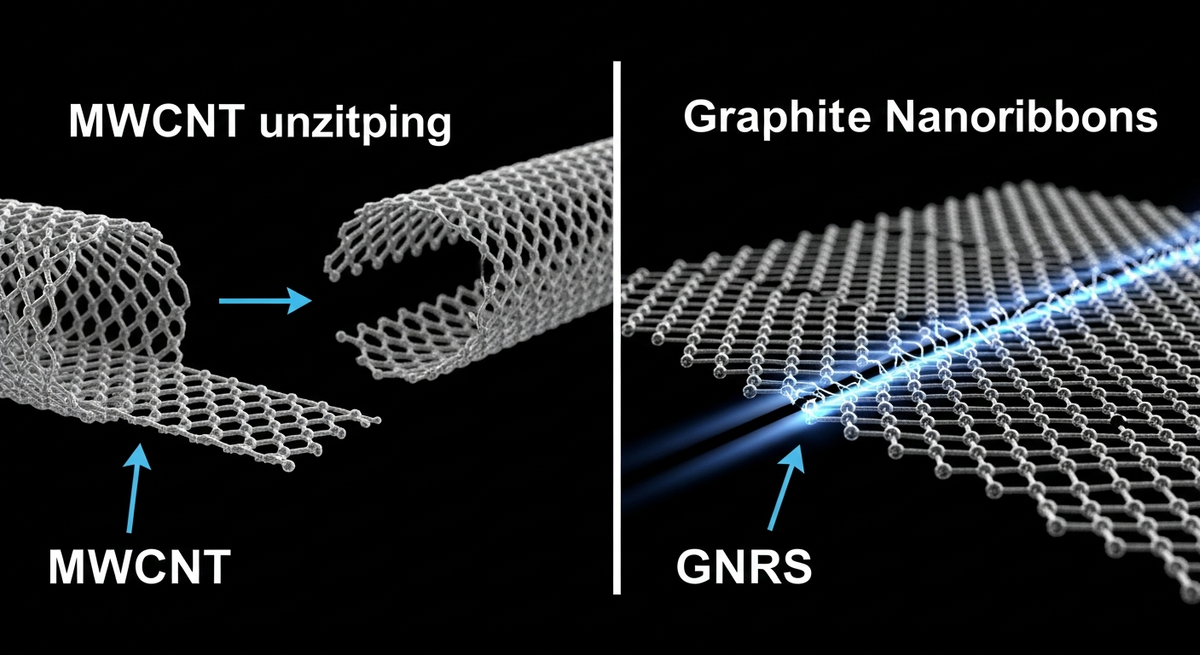
The advent of graphene, with its unparalleled electronic and mechanical properties, heralded a new era in materials science. However, the inherent zero band gap of bulk graphene sheets presents a significant hurdle for its direct application in digital electronic and photonic devices requiring a robust on/off ratio at room temperature. This fundamental challenge has propelled intensive research into strategies for inducing a tunable band gap in graphene, paving the way for its integration into high-performance semiconductor technologies. Among the most promising solutions are Graphene Nanoribbons (GNRs) – one-dimensional strips of graphene meticulously crafted to exhibit semiconducting behavior. By confining electron wave functions laterally and leveraging specific edge configurations (zigzag or armchair), GNRs effectively open a band gap, making them ideal candidates for advanced transistors and other essential electronic components. The precise control over GNR dimensions and edge structures is paramount, driving the exploration of innovative and scalable synthesis methods. This exploration leads us to two distinct yet powerful Graphene Nanoribbons synthesis techniques: the controlled application of gamma irradiation to graphene and the strategic unzipping of multiwall carbon nanotubes (MWCNTs). Both methods offer unique advantages in shaping GNRs with specific characteristics, demanding a comprehensive analysis to fully understand their potential. This deep dive will uncover the structural nuances, mechanistic pathways, and characterization insights crucial for engineers and R&D professionals aiming to harness GNRs for groundbreaking applications.
Graphene Nanoribbons: The Key to Unlocking Graphene's Electronic Potential
While graphene's extraordinary conductivity makes it a wonder material, its semimetallic nature, characterized by a zero band gap, limits its utility in digital logic where a clear on/off switching mechanism is required. This limitation necessitates the creation of a band gap, a fundamental property of semiconductors that allows for controlled switching of electrical current. Bulk graphene’s electrons behave more like photons, lacking the energy barrier needed to distinguish between 'on' and 'off' states. The ability to precisely control electron flow is essential for building complex integrated circuits and high-performance electronic devices.
Graphene Nanoribbons address this fundamental issue by introducing quantum confinement effects. When graphene is narrowed down to strips just a few nanometers wide, the electrons' movement across the width of the ribbon becomes restricted. This lateral confinement forces electrons into discrete energy levels, effectively opening a band gap. The specific width and the atomic arrangement of the edges (known as edge chirality, either zigzag or armchair) critically determine the size of this band gap. Armchair GNRs (AGNRs) exhibit a band gap inversely proportional to their width, while zigzag GNRs (ZGNRs) can be metallic or semiconducting depending on their width and other factors.
The capability to tailor the band gap through precise control of GNR dimensions makes them exceptionally promising for next-generation electronics. Imagine transistors operating at unprecedented speeds with minimal power consumption, or efficient optoelectronic devices that seamlessly integrate light and electricity. GNRs are envisioned as the building blocks for logic gates, field-effect transistors (FETs), and even advanced sensors. Their high carrier mobility, combined with a tunable band gap, positions them as a superior alternative to traditional silicon-based semiconductors in many future applications. The challenge lies in developing scalable and precise synthesis methods that consistently yield GNRs with desired properties.
Gamma Irradiation: A Top-Down Approach to GNR Fabrication
Gamma irradiation presents a compelling top-down strategy for fabricating Graphene Nanoribbons, leveraging high-energy photons to induce controlled structural modifications in graphene materials. This method typically begins with graphene oxide (GO) or reduced graphene oxide (rGO) sheets, which serve as a precursor. The energetic gamma rays interact with the carbon lattice, primarily causing ionization and excitation events within the material. These interactions lead to the formation of defects, such as vacancies and atomic displacements, which can subsequently be exploited for nanoribbon formation.
The mechanism behind GNR formation through gamma irradiation involves two key aspects: controlled degradation and preferential etching. Exposure to gamma radiation in a specific environment, often an inert atmosphere or even vacuum, can lead to the scission of C-C bonds and the removal of oxygen-containing functional groups in GO. These induced defects act as nucleation sites for oxidative etching or preferential cleavage. By carefully controlling the gamma dose, dose rate, and irradiation atmosphere, researchers can direct the cutting of larger graphene sheets into narrower ribbons. The process essentially "cuts" the graphene sheets along specific defect lines or weaker bonds.
One significant advantage of gamma irradiation is its potential for scalability and process simplicity once optimized. Unlike chemical methods that require harsh reagents, gamma irradiation is a "clean" process that can be applied to large quantities of graphene material. It also offers a pathway for simultaneous functionalization, as the induced defects can serve as attachment points for various chemical groups, further tailoring the GNR properties for specific applications. Researchers have demonstrated the ability to produce GNRs with widths ranging from tens to hundreds of nanometers using this technique.
However, challenges persist in achieving ultra-precise control over ribbon width and edge uniformity with gamma irradiation. The stochastic nature of radiation-induced damage makes it difficult to consistently produce GNRs with atomically precise edges, which are critical for predictable electronic behavior. Furthermore, high doses of gamma radiation can lead to excessive defects or even complete degradation of the graphene structure, compromising the material's integrity. Ongoing research focuses on fine-tuning the irradiation parameters and exploring post-irradiation treatment methods to enhance the quality and uniformity of the resulting GNRs.
Unzipping Carbon Nanotubes: A Template-Guided Bottom-Up Strategy
The unzipping of carbon nanotubes (CNTs), particularly multiwall carbon nanotubes (MWCNTs), offers an elegant template-guided bottom-up route to Graphene Nanoribbons. This technique capitalizes on the inherently well-defined cylindrical structure of CNTs, transforming them into linear graphene strips. The rationale is straightforward: if a CNT can be cut longitudinally along its axis, its walls will unfurl to form a GNR, potentially inheriting the chirality and structural integrity of the parent nanotube. This method promises GNRs with relatively smooth edges and controlled widths, dictated by the diameter of the original CNT.
Several methods have been developed for longitudinally unzipping MWCNTs. One prominent approach involves chemical oxidation, typically using strong oxidizing agents like potassium permanganate (KMnO4) in concentrated sulfuric acid (H2SO4). This aggressive chemical treatment selectively attacks the carbon-carbon bonds along the nanotube walls, causing them to cleave open. The reaction conditions, including temperature, concentration, and reaction time, must be meticulously controlled to ensure complete unzipping without excessive degradation of the resulting GNRs. The intermediate formation of graphene oxide nanoribbons (GONRs) is common, which can then be reduced to rGONRs.
Beyond chemical oxidation, other innovative unzipping techniques have emerged. Plasma etching, for instance, utilizes reactive plasma species to selectively etch the CNT walls, creating longitudinal cuts. Intercalation methods involve inserting foreign atoms or molecules between the layers of MWCNTs, causing them to expand and then unzipping them through subsequent sonication or chemical treatment. Electro-sparking, a more recent physical method, employs electrical discharges to induce localized heating and mechanical stress, leading to the longitudinal opening of CNTs. Each technique offers distinct advantages and presents its own set of challenges regarding scalability, yield, and GNR quality.
The key advantage of CNT unzipping lies in its potential to create GNRs with well-defined widths and often crystalline edges, directly inheriting from the parent CNT's structure. This can lead to GNRs with predictable electronic properties. However, challenges include the difficulty in achieving complete unzipping of all layers in MWCNTs, leading to a mixture of partially unzipped nanotubes and GNRs. Purification of the resulting GNRs from unreacted CNTs and other byproducts is often complex and labor-intensive. Furthermore, controlling the number of graphene layers in the final nanoribbon remains an area of active research.
Characterization of Graphene Nanoribbons: Ensuring Precision
Precise and comprehensive characterization is paramount for validating the successful synthesis of Graphene Nanoribbons and understanding their structural and electronic properties. Given the nanoscale dimensions and the critical importance of features like width, edge morphology, and defect density, a suite of advanced analytical techniques is indispensable. Researchers must confirm not only the formation of ribbons but also their quality and suitability for specific applications. This meticulous analysis ensures that the synthesized GNRs meet the stringent requirements for high-performance electronic devices.
Atomic Force Microscopy (AFM) is a primary tool for determining the physical dimensions of GNRs, including their width and thickness. AFM provides high-resolution topographical images that allow direct visualization of individual nanoribbons deposited on a substrate. By measuring the height profile, researchers can ascertain the number of graphene layers present, distinguishing single-layer from multi-layer ribbons. Width measurements, crucial for band gap control, are precisely obtained from AFM scans. Scanning Electron Microscopy (SEM) offers complementary information on the overall morphology and distribution of GNRs, especially over larger areas.
Transmission Electron Microscopy (TEM) offers invaluable insights into the atomic structure, crystallinity, and edge morphology of GNRs. High-resolution TEM (HRTEM) can directly visualize the atomic lattice, allowing identification of armchair or zigzag edges, as well as the presence of structural defects within the ribbon. Selected Area Electron Diffraction (SAED) patterns obtained from TEM provide information on the crystallinity and orientation of the GNRs. This technique is particularly critical for confirming the successful longitudinal unzipping of CNTs, revealing the transformation from tubular to planar structures.
Raman Spectroscopy is a powerful, non-destructive technique for characterizing the structural integrity and electronic properties of GNRs. The Raman spectrum provides characteristic peaks related to the carbon lattice (G band), structural defects (D band), and overtone modes (2D band). The ratio of the D to G band intensity (ID/IG) is a common metric for quantifying the defect density, which is particularly relevant for GNRs synthesized via gamma irradiation. The position and shape of the 2D band can offer insights into the number of graphene layers and any strain present within the ribbons. Specific Raman signatures can also indicate the presence of different edge configurations.
Further characterization includes X-ray Photoelectron Spectroscopy (XPS) for elemental composition and chemical bonding states, especially for GNRs derived from graphene oxide or functionalized variants. Electrical transport measurements, such as I-V characteristics of GNR-based field-effect transistors, directly probe the electronic properties, allowing for the determination of the band gap and carrier mobility. This experimental validation of electronic behavior is the ultimate confirmation of GNR functionality. Combining these techniques offers a holistic understanding of the synthesized GNRs, guiding further optimization of synthesis parameters.
Comparative Analysis and Future Outlook
Both gamma irradiation and CNT unzipping offer distinct pathways to Graphene Nanoribbons, each with its own set of advantages and limitations. A comparative analysis reveals that these methods are not mutually exclusive but rather complementary, catering to different application requirements and research priorities. Understanding their respective strengths and weaknesses is crucial for selecting the most appropriate synthesis strategy for a given goal. The future of GNR production may involve hybrid approaches that leverage the best aspects of multiple techniques.
Gamma irradiation stands out for its potential scalability and simplicity, particularly when dealing with bulk production of graphene precursors. It is a top-down method that can induce defects and subsequent cutting across large areas, making it attractive for industrial processes where precise atomic-level control is less critical than high throughput. The ability to simultaneously functionalize the GNRs during or after irradiation adds another layer of versatility. However, achieving ultra-narrow, atomically precise GNRs with consistent edge chirality remains a challenge, often resulting in ribbons with a distribution of widths and higher defect densities. This can lead to variability in electronic properties, making it more suitable for applications where some defect tolerance or statistical averaging is acceptable.
Conversely, CNT unzipping offers a bottom-up approach that can yield GNRs with more defined widths and potentially cleaner edges, particularly when starting with high-quality single-chirality CNTs. The unzipping process, whether chemical or physical, leverages the existing tubular structure, which can translate into more uniform ribbon dimensions. This precision makes unzipped GNRs highly attractive for fundamental research into quantum transport and for high-performance electronic devices where exact band gap engineering is critical. The primary drawbacks include the challenges of obtaining high-quality, diameter-controlled CNTs as precursors, the often harsh chemical treatments involved, and the intricate purification steps required to isolate the GNRs from unreacted nanotubes and byproducts. Scalability can also be an issue, particularly for methods requiring complex chemical synthesis or individual manipulation.
The ongoing research aims to mitigate the current limitations of both methods. For gamma irradiation, efforts focus on developing more controlled radiation schemes and post-treatment protocols to enhance edge quality and uniformity. For CNT unzipping, advancements are being made in milder unzipping chemistries, more efficient purification techniques, and the direct synthesis of GNRs from specific CNT types. Hybrid approaches, such as using gamma irradiation to selectively weaken CNT walls before chemical unzipping, could combine the benefits of both. The ultimate goal is to develop methods that are scalable, cost-effective, and capable of producing GNRs with precisely controlled width, edge structure, and minimal defects, enabling their widespread integration into next-generation electronic and photonic devices. The continued innovation in GNR synthesis is vital for realizing the full potential of graphene in advanced technologies.
Frequently Asked Questions (FAQ)
Q1: What is the primary limitation of bulk graphene for electronics, and how do GNRs address it?
A1: The primary limitation of bulk graphene is its inherent zero band gap, meaning it behaves like a semimetal and cannot be easily switched between 'on' and 'off' states like a semiconductor. Graphene Nanoribbons (GNRs) address this by introducing quantum confinement effects when graphene is narrowed to nanoscale strips, thereby opening a tunable band gap that allows for controlled electronic switching.
Q2: How do Graphene Nanoribbons open a band gap?
A2: GNRs open a band gap primarily through two mechanisms: quantum confinement and edge effects. Lateral confinement of electrons within the narrow ribbon width quantizes their energy levels, creating an energy gap. Additionally, the specific atomic arrangement of the edges (zigzag or armchair chirality) significantly influences the size and presence of this band gap, with armchair GNRs generally exhibiting a band gap inversely proportional to their width.
Q3: What are the main advantages of using gamma irradiation for GNR synthesis?
A3: Gamma irradiation offers several advantages for GNR synthesis, including its potential for scalability and process simplicity for bulk production of graphene precursors. It is a "clean" method that avoids harsh chemical reagents and can allow for simultaneous functionalization of the GNRs. This technique provides a top-down approach to cutting larger graphene sheets into ribbons.
Q4: Why is unzipping carbon nanotubes considered an attractive method for GNRs?
A4: Unzipping carbon nanotubes (especially MWCNTs) is attractive because it offers a template-guided bottom-up approach, potentially yielding GNRs with well-defined widths and crystalline edges, inheriting the structural integrity of the parent nanotube. This method can lead to GNRs with predictable electronic properties, crucial for high-performance applications.
Q5: What are the key challenges in current Graphene Nanoribbon synthesis methods overall?
A5: Key challenges in GNR synthesis include achieving ultra-precise control over ribbon width and edge uniformity, minimizing defect density, and ensuring the scalability of production. Additionally, complex purification steps, controlling the number of graphene layers, and obtaining consistent electronic properties across batches remain significant hurdles for industrial adoption.
The journey to harness graphene's full electronic potential is intrinsically linked to the mastery of Graphene Nanoribbons. Both gamma irradiation and the unzipping of carbon nanotubes represent powerful, albeit distinct, avenues for fabricating these critical one-dimensional materials. Gamma irradiation offers a scalable, top-down route with robust defect induction for broader applications, while CNT unzipping provides a template-guided, bottom-up approach capable of producing GNRs with more precise edge control and potentially superior electronic performance. The continuous advancements in characterization techniques provide the necessary insights to refine these synthesis methods. As researchers push the boundaries of materials science, the convergence of these techniques and the development of novel hybrid strategies will undoubtedly pave the way for high-quality, scalable GNR production. This ongoing innovation positions GNRs at the forefront of the next generation of semiconductors, promising to revolutionize digital electronics and photonic devices.