
Graphene Radar Absorbing Materials for Aircraft and Drones
Graphene coatings are being studied for radar absorbing materials because they can help make aircraft and drones lighter, thinner, and more electromagnetically tunable.
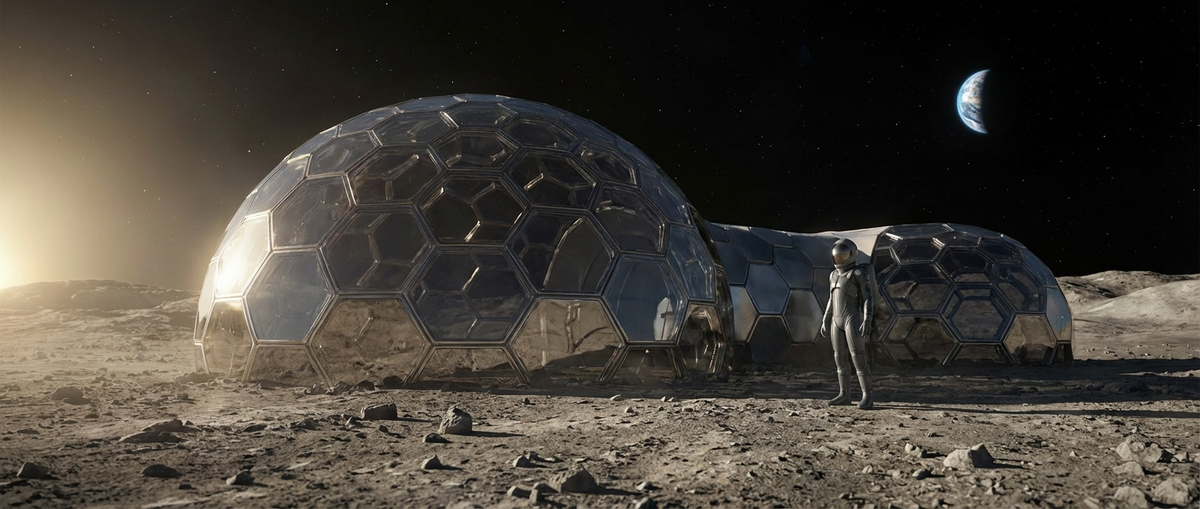
Graphene for Lunar Habitat Materials is not merely a theoretical concept; it represents a high-potential application poised to redefine off-world construction. This advanced carbon material offers unparalleled opportunities to improve the performance, durability, and long-term economics of lunar infrastructure when integrated correctly. The extreme conditions of the Moon necessitate materials that far exceed terrestrial standards, demanding innovation in structural integrity, thermal regulation, radiation shielding, and operational longevity. Graphene, with its extraordinary properties, emerges as a frontrunner in addressing these complex engineering challenges, offering a pathway to safer, more sustainable, and ultimately more expansive human presence beyond Earth.
Establishing a permanent human presence on the Moon requires materials capable of withstanding one of the most hostile environments known. The lunar surface presents a relentless assault on conventional materials, characterized by extreme temperature fluctuations from -173°C to 127°C, which induce severe thermal cycling stress. A near-perfect vacuum means materials are susceptible to outgassing and sublimation, leading to structural degradation and component failure over time. These conditions alone render many standard construction techniques and materials ineffective or prohibitively expensive to maintain.
Beyond thermal extremes and vacuum, lunar habitats must contend with relentless radiation exposure. Without a protective atmosphere or strong magnetic field, the Moon is bombarded by solar energetic particles (SEPs) from solar flares and galactic cosmic rays (GCRs), both highly damaging to biological life and electronic systems. Micrometeoroid impacts, though small, occur constantly and can cause cumulative damage to habitat exteriors, leading to potential breaches. Furthermore, the ubiquitous lunar regolith is highly abrasive, electrostatically charged, and can penetrate seals and damage moving parts, posing a significant challenge to mechanical systems and surface integrity.
Graphene offers a suite of properties uniquely suited to mitigating the challenges of lunar habitation, providing multifaceted advantages across critical aspects of habitat design. Its exceptional strength-to-weight ratio is paramount for lunar construction, where every kilogram transported from Earth incurs immense cost. By reinforcing composites, concrete, or polymers with graphene, engineers can create lighter yet significantly stronger structural components, reducing launch mass while increasing resilience against micrometeoroid impacts and internal pressures. This structural enhancement extends the lifespan of habitats and reduces maintenance cycles, which are especially difficult and costly in a lunar setting.
Graphene's extraordinary thermal conductivity, superior to any known material, makes it invaluable for managing the Moon's drastic temperature swings. Integrated into habitat walls or thermal blankets, graphene-enhanced materials can efficiently dissipate excess heat during the lunar day or distribute warmth during the frigid lunar night, maintaining stable internal temperatures for occupants and sensitive equipment. This precise thermal control is critical for energy efficiency and the operational reliability of all onboard systems, minimizing the power draw from limited lunar energy sources. The ability to create smart thermal management systems through embedded graphene layers could revolutionize habitat climate control.
The pressing need for radiation shielding finds a compelling solution in graphene composites. While graphene alone does not block all forms of radiation, its high density when integrated into polymers or ceramics can significantly enhance the shielding effectiveness of these materials. Researchers are exploring multi-layered graphene structures or graphene-infused hydrogen-rich polymers that could attenuate harmful SEPs and GCRs more effectively than traditional bulk materials, offering a lighter and more adaptable shielding solution. This could reduce the required thickness and mass of protective layers, making habitats more practical to deploy and expand.
Graphene's exceptional electrical conductivity also opens avenues for integrated smart habitat features. Embedding graphene into structural elements allows for distributed sensing networks capable of monitoring structural health, detecting micrometeoroid impacts, or identifying subtle material fatigue before critical failure. These smart materials could self-diagnose and report issues, enabling predictive maintenance and enhancing astronaut safety. Furthermore, graphene can improve the efficiency of solar panels and energy storage systems, crucial for sustainable power generation on the Moon. Its impermeability also proves beneficial, protecting internal environments from the vacuum and preventing outgassing from habitat materials over extended periods.
The journey from laboratory discovery to practical application in lunar habitats requires a pragmatic approach to graphene integration. Most commercial products do not utilize perfect monolayer graphene; instead, they employ practical forms such as graphene nanoplatelets (GNPs), reduced graphene oxide (RGO), or hybrid carbon systems. These forms are chosen because they offer a balance of performance, cost-effectiveness, and, critically, scalability and repeatability in manufacturing environments. Achieving laboratory-record values is less important than consistent, reliable performance in a production setting. Engineers prioritize robust material specifications and predictable behavior across batches, which is often more achievable with these practical graphene derivatives.
Process compatibility stands as a critical determinant of final performance. The way graphene is introduced and integrated into a host material—be it a polymer, ceramic, or metal matrix—profoundly influences the resulting properties. Key considerations include the mixing profile, which dictates how uniformly graphene is distributed, and the rheology window, ensuring the composite material maintains desirable flow characteristics during processing. Solids loading, the percentage of graphene added, must be carefully optimized, as too little may yield negligible benefits, while too much can degrade other properties or make processing difficult.
Drying dynamics are also essential, particularly for solutions or coatings, to prevent aggregation and ensure even film formation. The interface chemistry between graphene and the host material is perhaps the most crucial factor; strong, stable bonding is necessary for effective load transfer and property enhancement. Poor dispersion of graphene within the matrix is a common pitfall that can completely negate expected performance gains, turning a promising advanced material into a costly inert filler. Therefore, meticulous control over every processing step is indispensable for harnessing graphene's potential in space applications.
Adoption decisions for advanced materials in space exploration must extend beyond the initial raw material cost to encompass the entire lifecycle cost. For lunar habitats, even moderate gains in thermal management, structural integrity, or electrical efficiency can translate into major downstream savings. These savings materialize through lower maintenance requirements, improved uptime for critical systems, and significantly longer service life for habitat components. When missions last for decades and repairs are exceptionally difficult or impossible, the long-term value proposition of graphene-enhanced materials becomes undeniable, justifying the initial investment in research and integration.
In highly regulated and safety-critical sectors like aerospace, qualification planning must commence at the earliest stages of material development. Teams cannot afford late-stage surprises; comprehensive testing under simulated operational conditions is non-negotiable. This includes rigorous testing under thermal cycling profiles that mimic the lunar day-night transitions, prolonged exposure to vacuum conditions, and specific humidity exposures if relevant for internal habitat environments. Materials must also be evaluated under realistic duty profiles, experiencing the mechanical stresses, radiation doses, and abrasive forces they would encounter on the Moon.
Protocols must be established to assess resistance to lunar regolith adhesion and abrasion, as well as the long-term stability of properties under constant radiation bombardment. These extensive qualification procedures are designed to ensure that graphene-enhanced materials will perform reliably and safely throughout the habitat's operational lifespan, providing confidence in their deployment. The upfront investment in this rigorous testing minimizes risks and ensures the sustained viability of lunar missions, protecting both astronaut lives and multi-billion-dollar infrastructure.
The successful integration of graphene into lunar habitat materials hinges not only on scientific breakthroughs but also on the establishment of a robust and scalable industrial ecosystem. Developing a consistent and reliable supply chain for graphene materials is paramount. This involves ensuring that high-quality graphene forms, suitable for specific applications, can be produced in sufficient quantities and with repeatable characteristics from multiple sources. Supply chain robustness is particularly critical for space missions, where logistics are complex and failure to source materials can have cascading impacts on project timelines and budgets.
Quality standardization presents another significant challenge. With various production methods yielding different types of graphene, establishing universally accepted standards for material characterization, purity, and performance metrics is essential. This allows aerospace engineers to confidently select and integrate graphene products, knowing that they will meet stringent performance requirements regardless of the supplier. Collaborative efforts between material scientists, aerospace engineers, and industry consortia are vital to define these standards and accelerate the adoption of graphene across the space sector.
Furthermore, scaling graphene for lunar ambitions requires a concerted effort to optimize manufacturing processes for large-scale production. This includes developing cost-effective synthesis methods, efficient dispersion techniques, and reliable integration strategies that are compatible with existing aerospace manufacturing infrastructure. The long-term vision involves not just importing graphene from Earth but potentially leveraging in-situ resource utilization on the Moon itself to produce graphene or graphene precursors. This could transform lunar construction economics, moving towards a self-sustaining off-world industrial capability, with graphene as a foundational material for this future lunar economy.
Is graphene commercially viable today for space applications?
Yes, graphene is commercially viable today, particularly in high-value applications where its measurable performance improvements, such as increased strength, thermal regulation, or electrical conductivity, justify the integration effort and cost. While large-scale structural applications in space are still under development, specialized components and coatings are already seeing deployment or advanced testing.
What are the top challenges for integrating graphene into lunar habitats?
The top challenges include achieving consistent and uniform dispersion of graphene within host materials, ensuring process compatibility with existing manufacturing techniques, establishing rigorous quality standardization across different graphene forms, and developing repeatable supply-chain logistics for demanding space applications. Long-term performance validation under lunar conditions also presents a significant hurdle.
How does graphene compare to other advanced materials for lunar construction?
Graphene offers a unique combination of extreme strength, light weight, thermal and electrical conductivity, and potential for radiation shielding, often outperforming conventional materials in these specific metrics. While other advanced materials like carbon fiber composites or specialized alloys have their place, graphene's versatility and enhancement potential make it a highly competitive and complementary option for lunar infrastructure.
What forms of graphene are most practical for these applications?
Practical forms of graphene such as graphene nanoplatelets (GNPs), reduced graphene oxide (RGO), and hybrid carbon systems are often preferred for lunar applications. These forms offer a balance of performance, manufacturability, and cost-effectiveness compared to pristine monolayer graphene, providing repeatable and scalable solutions for industrial integration.
What is the timeline for seeing graphene in actual lunar habitats?
While some graphene-enhanced components are already being tested in simulated space environments, widespread integration into full-scale lunar habitats is likely a medium to long-term prospect. Initial applications could appear within the next 5-10 years in critical sub-systems or specialized coatings, with larger structural elements potentially seeing deployment in the 10-20 year timeframe as manufacturing and qualification mature.
Graphene stands as a transformative material poised to significantly advance humanity's aspirations for lunar habitation. Its ability to enhance structural integrity, precisely manage thermal loads, offer advanced radiation protection, and enable smart, resilient systems addresses the most formidable challenges of off-world construction. The diligent work of material scientists and aerospace engineers, focused on practical integration, rigorous qualification, and scalable production, is steadily paving the way for graphene-enabled lunar habitats. This advanced material promises to be a cornerstone of future lunar infrastructure, facilitating a more durable, efficient, and ultimately sustainable human presence on the Moon and beyond.
Serious about B2B integration? Test our premium Pulsed Electrical Resistive Carbon Heating turbostratic graphene in your lab. 100g sample packs available now.
Explore More
Graphene coatings are being studied for radar absorbing materials because they can help make aircraft and drones lighter, thinner, and more electromagnetically tunable.

Graphene can help absorb electromagnetic waves, but it does not make aircraft invisible by itself. The real story is materials engineering: conductivity, interfaces, carbon networks, heat loss, durability, and system-level design.

Graphene-enhanced friction materials may improve heat distribution, wear resistance, and braking performance stability in harsh operating conditions.