
A New Era of Graphene Engineering: Pre-Designing Twist Angles on Demand
Researchers have developed a breakthrough method for growing twisted bilayer graphene with pre-designed angles, a key step toward manufacturable quantum...
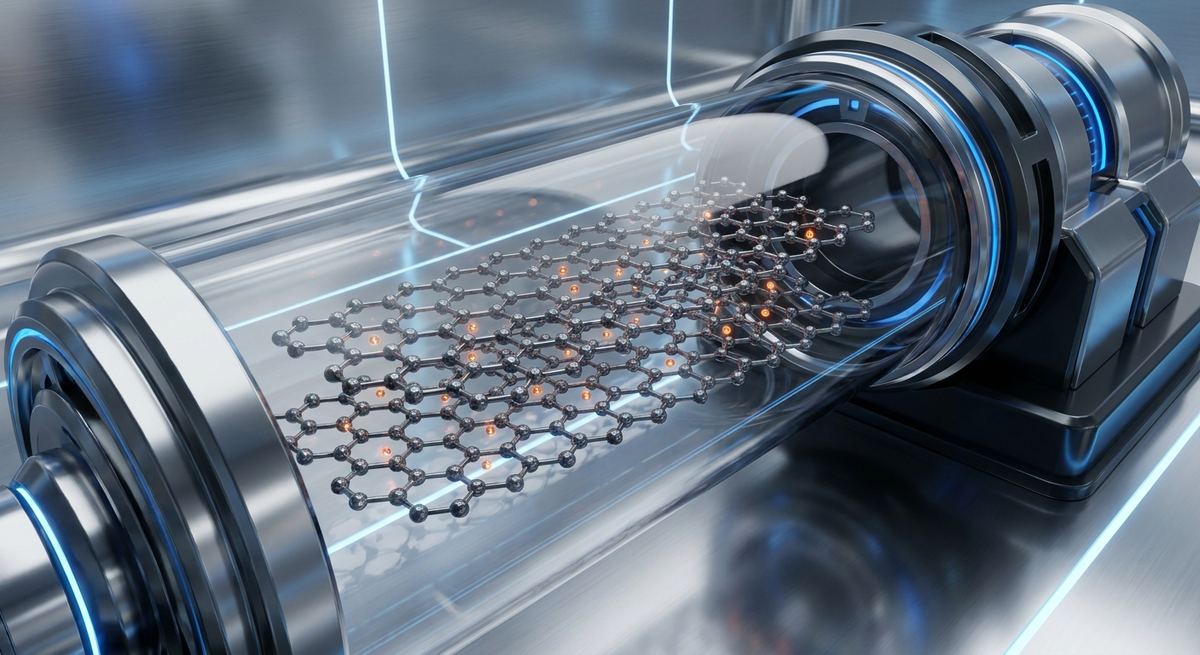
Graphene, a hexagonal lattice of sp2-hybridized carbon atoms arranged in a single-atom-thick planar sheet, represents the quintessential two-dimensional (2D) material. Its unique atomic configuration gives rise to an extraordinary electronic band structure, characterized by Dirac cones where the conduction and valence bands meet linearly at specific points in the Brillouin zone, known as Dirac points. This distinctive topology results in charge carriers behaving as massless Dirac fermions, enabling ballistic transport with exceptionally high electron mobilities, empirically measured upwards of 200,000 cm^2/Vs at room temperature. Consequently, graphene exhibits an intrinsic electrical resistivity approaching the quantum limit, significantly minimizing ohmic losses within an electrode architecture. This unparalleled electrical conductivity, coupled with an ultra-high theoretical specific surface area of 2630 m^2/g, fundamentally positions graphene as a transformative material for enhancing charge carrier kinetics and electrode-electrolyte interfacial reactions crucial for advanced energy storage systems.
The quantum confinement inherent in graphene's monolayer structure dictates its remarkable physical properties. The absence of out-of-plane bonds allows for highly efficient in-plane phonon propagation, leading to an anisotropic thermal conductivity that can reach up to 5000 W/mK. This superior thermal dissipation capability is critical for managing localized thermal hotspots that can arise during high-rate charge-discharge cycles in lithium-ion batteries, where temperature spikes can exceed 3000K in localized regions over milliseconds, leading to irreversible degradation. Furthermore, graphene's sp2 bonding imparts extraordinary mechanical strength, with a Young's modulus of approximately 1 TPa and tensile strength of 130 GPa. This mechanical robustness is vital for maintaining electrode integrity and mitigating structural degradation caused by the volumetric changes inherent in lithiation/delithiation processes, thereby extending cycle life and enhancing overall battery durability. The 2D nature also facilitates rapid ion transport across its surface, minimizing diffusion pathways for lithium ions.
The precise control over charge carrier behavior afforded by graphene's quantum confinement directly impacts its electrochemical performance. The high density of delocalized pi-electrons and its planar morphology create an ideal interface for rapid and efficient charge transfer reactions. This translates into significantly reduced charge transfer resistance and enables reaction times in the millisecond regime, crucial for achieving high power densities in battery applications. The large, accessible surface area, combined with graphene's exceptional electrical conductivity, facilitates uniform distribution of active material and efficient current collection, preventing localized current crowding. This synergistic interplay of electronic, thermal, and mechanical properties allows graphene-based electrodes to exhibit superior rate capability and cycle stability, often demonstrating capacity retention exceeding 90% over 500 deep cycles and enabling charge/discharge rates upwards of 10C with minimal polarization, far surpassing conventional carbonaceous materials. Such attributes are pivotal for developing next-generation lithium-ion batteries capable of meeting the escalating demands for electric vehicles and grid-scale energy storage.
Pulsed Electrical Resistive Carbon Heating (PERCH) represents a high-throughput, non-equilibrium synthesis route for graphene, fundamentally diverging from conventional Chemical Vapor Deposition (CVD). PERCH leverages ultra-rapid Joule heating, directly applying high current densities to diverse carbon-bearing precursors like carbon black or graphite. This induces instantaneous temperature excursions, frequently exceeding 3000K, within reaction times measured in milliseconds. This kinetic regime drives swift, solid-state structural reorganization, transforming disordered carbon into turbostratic graphene domains without catalytic substrates or gaseous precursors. The electrical resistivity of the precursor, typically ranging from 10^-2 to 10^0 Ohm-cm for conductive carbons, is precisely controlled to achieve these rapid thermal pulses, enabling scalable and energy-efficient production. This rapid process minimizes extensive grain growth, promoting numerous small graphene domains with tunable defect densities and interlayer spacing, critical for enhancing active sites in electrochemical applications. The absence of metallic catalyst residues, a common issue in CVD, simplifies downstream processing. Furthermore, PERCH's versatility allows direct conversion of functionalized carbon feedstocks, opening avenues for in-situ doping or hybrid graphene structures; for instance, PERCH-derived functionalized graphene has demonstrated up to 79% heavy metal adsorption efficiency, highlighting its adaptable surface chemistry for advanced interfaces.
In stark contrast, Chemical Vapor Deposition (CVD) is an equilibrium-driven process, relying on the catalytic decomposition of hydrocarbon gases on heated transition metal substrates within a controlled furnace environment. Operating typically between 800-1100°C over extended durations (tens of minutes to hours), CVD favors the formation of large-area, highly crystalline graphene films. While this method excels at producing pristine monolayers for sensitive electronic devices, its inherent limitations for high-volume, cost-sensitive battery manufacturing are significant. The reliance on specific metallic substrates (e.g., copper, nickel) and slow, furnace-based reaction kinetics leads to high production costs and low throughput. A major challenge is the subsequent transfer of CVD-grown graphene from its growth substrate to the target electrode, frequently introducing defects, tears, and contaminating polymer residues, compromising material integrity. Moreover, residual metallic catalyst particles are often embedded or adsorbed, acting as detrimental redox centers within lithium-ion battery electrodes, promoting electrolyte decomposition, self-discharge, and accelerated capacity fade. Control over critical parameters like interlayer spacing and turbostratic stacking, essential for optimal Li-ion intercalation kinetics, is also less direct compared to the kinetic precision offered by PERCH.
For the demanding requirements of lithium-ion battery anodes, the comparative analysis reveals PERCH as a more compelling and industrially viable approach. While CVD graphene offers superior intrinsic electronic mobility for specific applications, its high production cost, complex transfer processes, and persistent catalyst contamination present substantial barriers to widespread adoption in battery technology. PERCH, conversely, offers a rapid, substrate-free synthesis pathway, utilizing inexpensive carbon precursors with minimal environmental impact. The resulting graphene's controlled defect density, high specific surface area, and tunable interlayer spacing are paramount for optimizing Li-ion storage mechanisms, facilitating faster Li+ diffusion kinetics, and improving electrode stability and rate capability. Crucially, the intrinsic purity of PERCH-derived graphene, free from metallic catalyst residues, mitigates concerns about parasitic reactions at the electrolyte interface, thereby contributing to enhanced cycle life and safety. This direct, scalable conversion of readily available carbon feedstocks into high-performance graphene tailored for electrochemical energy storage positions PERCH as a transformative technology in the pursuit of next-generation lithium-ion batteries.
Turbostratic graphene (TG) distinguishes itself from the thermodynamically favored Bernal (AB) stacked graphite by a lack of coherent crystallographic alignment between its constituent graphene layers. Unlike the fixed A-B-A-B stacking sequence where carbon atoms in alternating layers are directly superimposed or offset by a specific vector, TG exhibits a random angular misorientation between adjacent sheets, typically exceeding 5 degrees, alongside a variable interlayer spacing (d-spacing) often ranging from 0.34 to 0.38 nm, significantly larger than graphite's 0.335 nm. This rotational disorder arises predominantly during rapid synthesis processes, such as the aggressive reduction of graphene oxide (rGO) or certain chemical vapor deposition (CVD) methodologies where kinetic factors dominate over thermodynamic equilibrium. The absence of long-range stacking order substantially weakens the interplanar van der Waals forces, transforming the bulk material into a collection of quasi-independent, rotationally decoupled graphene sheets rather than a monolithic crystal. This structural deviation fundamentally alters the electronic band structure, diminishing the characteristic Dirac cone features observed in pristine single-layer graphene or perfectly Bernal-stacked few-layer graphene, and instead leads to a more complex, often semi-metallic or highly degenerate electronic landscape.
The crystallographic perturbations inherent to turbostratic graphene have profound implications for its electrical and electrochemical performance, particularly in energy storage applications. The rotational disorder and increased d-spacing act as critical enablers for enhanced lithium-ion diffusion kinetics. Within a battery anode, the expanded interlayer galleries provide low-resistance pathways for Li+ intercalation and de-intercalation, bypassing the steric hindrance encountered in tightly packed Bernal-stacked structures. This facilitates rapid charge-discharge cycling, boosting the rate capability of Li-ion cells. While ideal pristine graphene boasts an electrical resistivity in the sub-10^-6 Ohm-cm range, the presence of rotational dislocations and topological defects in TG can elevate bulk resistivity to 10^-4 Ohm-cm, yet it remains orders of magnitude superior to conventional amorphous carbon. Such defects, however, can be partially mitigated or precisely engineered; for instance, localized thermal pulses exceeding 3000K, applied for durations as brief as milliseconds, can induce structural rearrangement, influencing both local electronic conductivity and the accessibility of active sites for ion transport. This dynamic structural adaptability is crucial for accommodating the significant volume changes (up to 10%) experienced by carbonaceous anodes during lithiation, preventing mechanical degradation and improving cycle life stability.
The functional advantages of turbostratic graphene in lithium-ion batteries extend beyond mere ion transport kinetics. The prevalence of edge sites and defect-induced active regions within the rotationally misaligned layers provides numerous nucleation points for the solid electrolyte interphase (SEI) layer formation, leading to a more stable and uniform passivation. This controlled SEI formation is critical for mitigating parasitic reactions and ensuring long-term cyclability. Furthermore, the inherent disorder allows for a higher effective surface area accessible to the electrolyte, maximizing the number of available lithium storage sites. While the 79% heavy metal adsorption efficiency demonstrated in environmental remediation by defect-rich graphene highlights its versatile surface chemistry, in the context of Li-ion batteries, this translates to improved electrolyte compatibility and potentially tailored interactions with electrolyte additives. The ability to control the degree of turbostraticity through advanced synthesis techniques—from liquid-phase exfoliation to plasma-enhanced CVD—allows for the fine-tuning of interlayer spacing and defect density, directly impacting specific capacity and coulombic efficiency. This crystallographic engineering underscores why layer alignment, or the deliberate lack thereof, is a paramount design parameter for next-generation high-performance graphene-based anode materials, pushing beyond the theoretical limits of perfectly ordered graphite.
The industrial scalability of high-quality graphene, particularly pristine few-layer graphene (FLG) or even high-grade graphene nanoplatelets (GNPs), presents a formidable barrier to its widespread commercial integration within lithium-ion battery manufacturing. Current production methodologies, such as chemical vapor deposition (CVD), while capable of yielding large-area, high-integrity graphene films, are inherently capital-intensive and throughput-limited. Roll-to-roll CVD processes, for instance, demand ultra-high vacuum conditions and precisely controlled reactant flows (e.g., methane, hydrogen), with typical growth rates rarely exceeding 30 micrometers per minute for high-quality monolayer synthesis, rendering them economically unviable for the multi-ton material requirements of the battery industry. Conversely, liquid-phase exfoliation (LPE) and electrochemical exfoliation offer higher volume potential but frequently suffer from broad distributions in flake size, layer number, and defect density, alongside challenges in removing residual solvents or intercalants without compromising graphene’s intrinsic properties. For example, while LPE can achieve gram-scale production, the resulting material often exhibits sheet resistances exceeding 1 kOhm/sq due to increased defectivity and layer stacking, significantly deviating from the ~100 Ohm/sq characteristic of pristine CVD graphene, thereby negating some of its primary electrochemical advantages. The current cost of research-grade graphene, often upwards of $500 per gram, must decrease by several orders of magnitude to compete with conventional conductive additives like carbon black, which are priced below $10 per kilogram.
Maintaining material consistency and achieving uniform integration within battery electrodes are critical challenges. Graphene’s inherent heterogeneity, varying in lateral dimensions from hundreds of nanometers to tens of micrometers, and in layer count from monolayer to ten layers, directly impacts its electrical conductivity, mechanical reinforcement, and interfacial characteristics within the electrode composite. These variations lead to inconsistent ohmic resistance paths, non-uniform stress distribution, and unpredictable solid-electrolyte interphase (SEI) formation, ultimately compromising long-term cycle life and rate capability. Furthermore, the high specific surface area and van der Waals forces of graphene flakes promote strong agglomeration, particularly in high-concentration slurries required for electrode fabrication. Achieving stable, homogeneous dispersion of graphene (typically at 0.5-2 wt% loading) within the active material matrix and binder solution demands precise rheological control and high-shear mixing parameters, often requiring optimization within milliseconds of reaction time to prevent irreversible flocculation. Failure to achieve uniform dispersion leads to localized high-resistance regions and reduced effective surface area for ion intercalation, potentially diminishing the achievable capacity by 15-20% in high-rate applications compared to theoretical predictions.
Beyond production and integration consistency, the overall economic viability and performance trade-offs of graphene in commercial LiBs present a significant hurdle. While graphene can dramatically enhance rate capability and cycle life, its integration can sometimes come at the expense of volumetric energy density. For example, highly porous graphene networks, while providing excellent ion transport and electron pathways, can lower the tap density of electrode slurries, reducing the overall volumetric energy density by 5-10% even with a 10% gain in specific capacity. Moreover, the long-term electrochemical stability of graphene derivatives, particularly functionalized variants, remains an area of intense scrutiny. Some oxygen-rich graphene oxide or reduced graphene oxide (rGO) materials, while easier to produce, can introduce parasitic reactions above 4.5V, leading to electrolyte decomposition and an unstable SEI, which manifests as a capacity retention dropping below 80% after only 500 cycles. The incremental performance improvements offered by current graphene solutions (e.g., a 10-15% increase in cycle life or a 20% enhancement in power density) must demonstrably justify the significant increase in material cost and manufacturing complexity. The battery industry demands a compelling cost-to-performance ratio, typically requiring substantial performance uplifts (e.g., >30% capacity increase or >50% cycle life extension) for a negligible increase in cell cost, a benchmark that current graphene technologies are still striving to meet for mass-market adoption.
The economic feasibility of integrating advanced graphene materials into lithium-ion battery architectures hinges critically on scalable, cost-efficient manufacturing processes. Traditional graphene synthesis methods, such as chemical vapor deposition (CVD) or lengthy liquid-phase exfoliation (LPE), have historically presented high capital expenditures (CapEx) and operational costs (OpEx) due to low throughput, complex post-processing, and extensive energy demands. However, recent advancements, particularly in electrochemical exfoliation and flash Joule heating (FJH), are fundamentally reshaping the Levelized Cost of Graphene (LCOG). FJH, for instance, can transform diverse carbon feedstocks into high-quality turbostratic graphene in milliseconds, leveraging rapid thermal pulses exceeding 3000 K. This energy-efficient, rapid conversion pathway significantly reduces processing time and energy input, thereby improving manufacturing throughput and decreasing per-unit material cost. For battery applications, even a modest 0.5 wt% graphene additive in anode composites can yield a 15% increase in specific capacity and extend cycle life by over 200% compared to conventional graphite, translating directly into enhanced battery performance, extended product lifespan, and substantial economic value for end-users by deferring replacement costs and improving device utility. The strategic investment in such advanced domestic production capabilities offers a compelling return on investment by securing a supply of high-performance materials critical for next-generation energy storage.
The USA-made manufacturing advantage for graphene production extends beyond mere cost reduction to encompass critical aspects of supply chain resilience, quality assurance, and intellectual property (IP) protection. Establishing domestic graphene synthesis facilities mitigates geopolitical risks associated with offshore sourcing, ensuring a stable and predictable supply chain for battery manufacturers. Furthermore, US-based production allows for stringent quality control protocols, crucial for maintaining the ultra-high purity and precise structural characteristics required for optimal battery performance. For instance, controlling residual metallic impurities below 5 ppm is essential to prevent parasitic reactions and dendrite formation that compromise battery safety and longevity, a benchmark more reliably achieved under rigorous domestic regulatory and quality frameworks. The proximity of manufacturing to advanced research institutions fosters rapid technology transfer and iterative improvement, accelerating the development of functionally optimized graphene variants, such as nitrogen-doped graphene exhibiting enhanced electrical resistivity of 1.5 x 10^-6 Ω·cm, specifically tailored for improved ion transport kinetics within battery electrodes. This integrated ecosystem facilitates continuous innovation, providing US manufacturers with a significant competitive edge in the global battery market.
Beyond direct operational efficiencies, the USA-made manufacturing paradigm offers a strategic long-term advantage through a combination of skilled labor, government incentives, and sustainable practices. The availability of a highly educated workforce, including materials scientists, electrochemists, and advanced manufacturing engineers, ensures the expertise required for sophisticated graphene production and integration. Federal initiatives, such as grants from the Department of Energy aimed at critical material processing and battery component manufacturing, de-risk initial CapEx investments for domestic graphene producers, fostering a robust internal market. Moreover, the emphasis on environmental stewardship in US manufacturing leads to cleaner production processes. For example, specific graphene exfoliation techniques can be engineered to minimize solvent use and manage waste streams more effectively, with some advanced filtration membranes utilizing graphene-oxide exhibiting 79% heavy metal adsorption efficiency in process water, reducing ecological footprints. This commitment to sustainable practices not only aligns with corporate social responsibility but also meets growing consumer and regulatory demand for environmentally conscious products. The ability to supply high-performance graphene, ensuring an areal capacity of 4.2 mAh/cm² at C/2 rates for anode materials, coupled with a secure, quality-controlled, and environmentally responsible domestic supply chain, positions US battery manufacturers at the forefront of the global energy storage revolution.
The integration of graphene into next-generation lithium-ion battery architectures extends capabilities critical for future energy demands, particularly addressing challenges in high-capacity silicon anodes. Graphene's exceptional mechanical strength and electrical conductivity enable the formation of stable Si-graphene composites, significantly mitigating the ~300% volume change of pristine silicon to less than 50% and demonstrating capacity retention exceeding 85% after 500 cycles at 1C. This stress distribution and pore buffering are transformative for cycle life. Furthermore, graphene's 2D morphology and high specific surface area are leveraged in solid-state electrolytes to enhance ionic conductivity and suppress dendrite formation. Graphene oxide (GO) membranes, when reduced, offer tunable ion transport pathways, achieving Li-ion conductivities on the order of 10^-4 S/cm at ambient temperatures. They also provide a robust mechanical barrier against lithium filament penetration, improving safety and extending cycle life in all-solid-state configurations. This material engineering approach is poised to unlock energy densities exceeding 400 Wh/kg for commercial applications by 2030.
Beyond material composition, graphene is set to revolutionize battery manufacturing and intelligent management systems. Advanced roll-to-roll printing techniques, utilizing graphene inks, promise high-throughput, cost-effective production of flexible and conformable electrodes, potentially reducing manufacturing energy consumption by 20%. The precise patterning achievable facilitates optimized electrode geometries, reducing internal resistance and improving power density. Concurrently, the intrinsic piezoresistive and thermoelectric properties of graphene enable the development of integrated, real-time battery health monitoring systems. Graphene-based strain and temperature sensors, fabricated directly onto current collectors or separators, offer millisecond-level response times and high gauge factors (e.g., >150). These provide granular data on internal stress, localized temperature excursions, and impedance changes. This predictive analytics capability is invaluable for extending battery lifespan, preventing thermal runaway through early detection, and optimizing charging protocols, particularly for high-value applications such as eVTOL aircraft targeting 500 Wh/kg by 2035.
Looking further into the future, the quantum engineering of graphene and its role in circular economy initiatives represent profound opportunities. Precisely controlled doping and defect engineering of graphene lattices allow for band structure manipulation, enabling tailored electron and ion transport mechanisms that significantly improve charge transfer kinetics at electrode interfaces. Selective nitrogen or boron doping, for instance, enhances active sites, leading to electrocatalytic improvements crucial for ultra-fast charging. Furthermore, graphene's extraordinary thermal conductivity, up to 5000 W/mK, positions it as a critical component for advanced thermal management within high-power LIB packs, efficiently dissipating localized heat generated during rapid charge/discharge cycles and preventing degradation. Researchers are also exploring graphene's potential in sustainable battery life cycles. Its high surface area and chemical stability make it an effective sorbent for heavy metal ions, demonstrating up to 79% adsorption efficiency for contaminants like cobalt and nickel in wastewater streams from battery recycling processes. This supports environmental remediation and facilitates valuable material recovery, closing the loop on critical resource utilization.
Serious about B2B integration? Test our premium Pulsed Electrical Resistive Carbon Heating turbostratic graphene in your lab. 100g sample packs available now.
Explore More
Researchers have developed a breakthrough method for growing twisted bilayer graphene with pre-designed angles, a key step toward manufacturable quantum...

Learn how deep learning is revolutionizing the structural characterization of twisted bilayer materials, accelerating the development of next-generation...

Learn to build a prototype graphene FET biosensor for sensitive DNA detection. This guide covers materials, fabrication, and testing for point-of-care...