General & Market, Energy Storage, Coatings & Materials
Graphene in Thermal Interface Materials: Why TIM Formulators Are Paying Attention
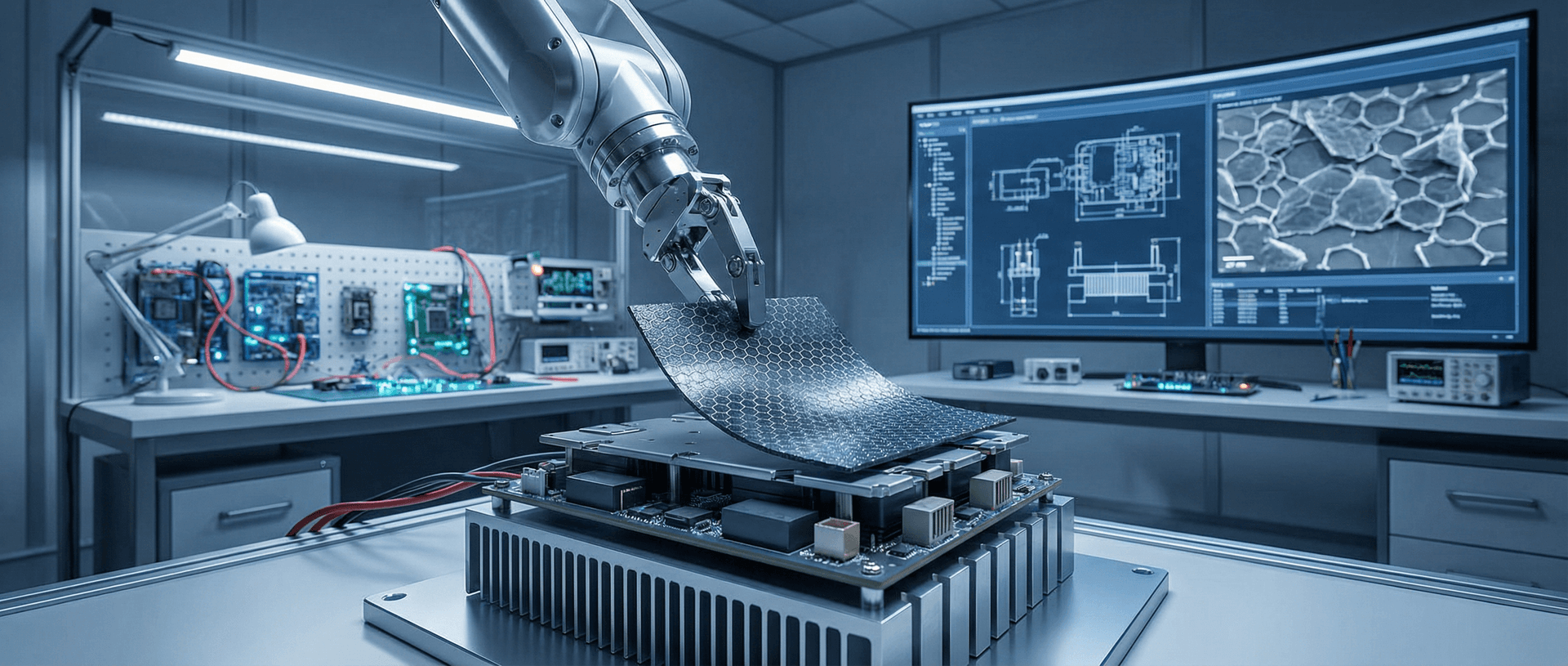
Graphene in thermal interface materials has moved from an academic curiosity to a serious commercial question because modern electronics keep pushing heat density upward. Power modules, EV electronics, AI hardware, telecom equipment, LED systems, and compact industrial devices all create the same engineering problem: heat must leave the component quickly, but the interface between two surfaces is often the real bottleneck. Air gaps, roughness, poor wetting, and insufficient filler networks can limit thermal transfer even when the bulk substrate looks capable on paper.
That is why thermal interface materials, or TIMs, matter so much. Greases, pads, gap fillers, phase-change materials, adhesives, and encapsulants are all designed to reduce thermal resistance across imperfect contact surfaces. The commercial interest in graphene comes from the possibility that it can improve heat spreading, reinforce filler networks, and help formulators achieve better performance without relying entirely on traditional filler strategies.
The important point, though, is that graphene is not automatically a magic thermal additive. In TIMs, success depends on platelet structure, dispersion, loading, viscosity control, and how graphene interacts with the rest of the formulation. So the real question is not whether graphene has high thermal conductivity in theory. It is whether graphene can help real thermal interface materials perform better in real manufacturing.
Why thermal interface materials are hard to optimize
A good TIM needs more than high conductivity in isolation. It must also wet the surface, fill microscopic voids, maintain stable contact under thermal cycling, and remain processable during manufacturing. In many products, the formulator is trying to balance several competing demands at once:
- lower thermal resistance
- manageable viscosity or softness
- reliable dispensing, coating, or converting
- low bleed or pump-out
- acceptable electrical behavior
- long-term mechanical stability
- cost that fits the device economics
That is why traditional TIM formulations often use combinations of alumina, aluminum nitride, boron nitride, zinc oxide, silver, or other conductive fillers. Each has strengths and weaknesses. Some deliver solid thermal conductivity but require high loading. Some increase viscosity too aggressively. Some are too expensive for mass-market hardware. Some create density or brittleness issues.
Graphene becomes interesting in this context because it offers a high-aspect-ratio, two-dimensional filler that can contribute to heat spreading and interfacial network formation differently from more conventional particles.
What graphene can do inside a TIM formulation
Graphene is especially attractive in thermal interface materials because its geometry is not the same as spherical or irregular mineral fillers. Thin platelet structures can help create thermally useful pathways at lower incremental loading than some conventional additives, at least when they are well dispersed and properly integrated into the rest of the system.
Potential benefits include:
- improved in-plane heat spreading
- support for through-network thermal conduction when combined with other fillers
- lower total filler demand in selected formulations
- reinforcement of soft matrices without the same penalty as some coarse fillers
- better balance between thermal and mechanical properties in hybrid systems
In practice, graphene often works best as part of a hybrid filler package rather than as the only thermal filler. For example, a formulator may combine graphene with boron nitride, alumina, or other established fillers to improve packing, create bridges between particles, and reduce thermal resistance across the composite. In that kind of system, graphene may not replace the incumbent filler outright. It may make the incumbent filler system work better.
Where graphene can add value in different TIM formats
Thermal greases and pastes
In greases and pastes, the main challenge is often reducing interfacial resistance while keeping the material dispensable and stable over time. Graphene can help with heat spreading and conductive pathway development, but too much can increase viscosity or create handling problems. Well-designed graphene additions may improve performance at moderate loading, especially when paired with conventional ceramic fillers.
Gap fillers and soft pads
Gap fillers need compliance as well as conductivity. This is a delicate balance because high filler loading tends to stiffen the system. Graphene can be valuable when the goal is to improve thermal transport without making the material unmanageably dense or rigid. The actual benefit depends heavily on the polymer matrix, the platelet size, and the orientation created during processing.
Thermally conductive adhesives
Adhesives introduce another layer of complexity because bond strength, cure behavior, shrinkage, and adhesion all matter. Graphene can contribute to both thermal and mechanical performance, which is why it attracts attention in adhesive TIM systems for electronics assembly. But the dispersion quality must be excellent. Poorly dispersed graphene can create weak points rather than performance gains.
Phase-change and specialty interface systems
In higher-end electronics, some phase-change or specialty interface materials are tuned for precise thermal response. Here graphene may be useful as a heat-spreading additive, especially when the developer wants broader functional performance rather than maximum bulk conductivity from a single filler alone.
Why dispersion is everything
The biggest mistake in marketing graphene for TIMs is treating the intrinsic conductivity of ideal graphene as if it automatically translates into formulation performance. It does not. If graphene agglomerates, folds, restacks, or disperses unevenly, much of the expected benefit disappears.
TIMs are especially unforgiving because the interface is already a narrow performance bottleneck. A poorly distributed additive can raise viscosity, disrupt wetting, or create local defects without materially improving heat flow. That means buyers should look beyond simple conductivity claims and ask more practical questions:
- What type of graphene is being used?
- What is the platelet thickness and lateral size?
- Is the graphene surface-modified?
- How stable is the dispersion during storage and processing?
- Does the supplier have data inside an actual TIM matrix rather than in isolation?
- How does the material affect viscosity, pump-out, and compression behavior?
A supplier that understands formulation behavior is far more valuable than one selling only theoretical thermal numbers.
Graphene versus boron nitride, alumina, and silver
Graphene is not the only advanced thermal filler under consideration. Boron nitride remains very attractive because it offers strong thermal performance with electrical insulation. Alumina is still widely used because it is affordable and well understood. Silver performs well but is too expensive for many uses and can create electrical concerns.
So where does graphene fit?
Graphene is most interesting when the product does not need a direct one-for-one substitute but a smarter filler architecture. It can complement boron nitride or alumina, help reduce loading in selected systems, and deliver mechanical or barrier side benefits that conventional fillers do not. If electrical insulation is absolutely mandatory, graphene may need careful use or may be the wrong choice. But in systems where controlled electrical behavior is acceptable, graphene can be a very strategic additive.
What buyers should ask graphene suppliers for TIM projects
Before qualifying graphene for thermal interface materials, buyers should ask for application-relevant data rather than general nanomaterial claims. Important questions include:
- Is the graphene optimized for thermal applications or borrowed from another segment?
- What formulations has it been tested in?
- Does the supplier have viscosity data, thermal resistance data, or long-term cycling data?
- What loading range is realistic?
- Can the material be supplied as powder, masterbatch, or dispersion?
- How does it affect compressibility, adhesion, or pump-out?
- Is lot-to-lot consistency good enough for production qualification?
TIM projects live or die by repeatability. A graphene material that looks promising in a lab but varies from lot to lot will slow commercial adoption dramatically.
The commercial outlook for graphene in thermal interface materials
The strongest commercial case for graphene in TIMs is not hype about record thermal conductivity. It is the idea that graphene can help build more efficient, lower-resistance, multifunctional interface systems in increasingly heat-constrained electronics. As chips, modules, and power devices become more compact, interface engineering becomes more valuable. That makes advanced filler design more important as well.
Graphene is especially promising where developers want a hybrid route: better heat spreading, better mechanical integrity, and the possibility of lower overall filler burden than legacy approaches alone. In those use cases, graphene can create value even if it is not the dominant filler by weight.
Final perspective
So, why are formulators paying attention to graphene in thermal interface materials? Because TIM performance is now one of the limiting factors in many high-value electronics, and graphene offers a way to rethink filler architecture instead of just adding more conventional powder. The opportunity is real, but it is formulation-dependent. Success depends on graphene structure, dispersion quality, matrix compatibility, and manufacturing discipline.
For companies building next-generation thermal greases, pads, adhesives, and gap fillers, graphene is worth taking seriously not as a miracle additive, but as a potentially high-leverage tool inside a well-engineered thermal system.