
Graphene Radar Absorbing Materials for Aircraft and Drones
Graphene coatings are being studied for radar absorbing materials because they can help make aircraft and drones lighter, thinner, and more electromagnetically tunable.
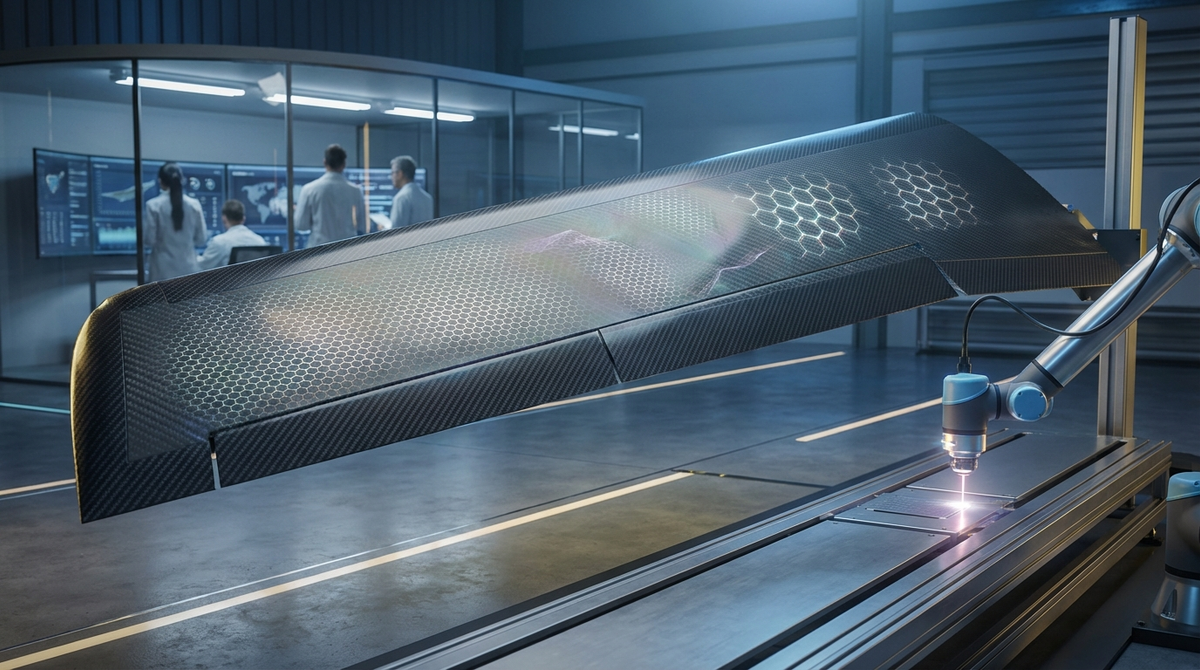
The aerospace industry continually seeks materials that push the boundaries of performance, durability, and efficiency. Structural composites, already ubiquitous in modern aircraft and spacecraft, are now poised for their next major evolution with the integration of graphene. This revolutionary carbon allotrope offers an unparalleled suite of properties capable of transforming everything from airframe components to engine nacelles and satellite structures. By enhancing mechanical strength, thermal management, electrical conductivity, and barrier properties, graphene-infused composites promise to unlock new paradigms in design, operational economics, and safety within this demanding sector.
Aerospace platforms operate under extreme conditions, demanding materials that can withstand immense mechanical stresses, wide temperature fluctuations, harsh radiation, and corrosive environments. Traditional materials, while highly optimized, often present inherent trade-offs between weight, strength, stiffness, and functionality. For instance, increasing mechanical strength typically adds weight, directly impacting fuel efficiency and payload capacity—critical metrics for both commercial aviation and space exploration. The relentless pursuit of lighter, stronger, and more durable materials drives innovation, seeking solutions that can extend service life, reduce maintenance costs, and improve overall operational effectiveness.
Current advanced composites, typically polymer matrices reinforced with carbon or glass fibers, have significantly contributed to weight reduction and performance gains. However, even these materials face limitations, particularly concerning inherent electrical conductivity, thermal dissipation, impact damage tolerance, and susceptibility to environmental degradation. Aircraft are susceptible to lightning strikes and electromagnetic interference, requiring additional shielding solutions that add weight and complexity. The accumulation of static charge, ice formation, and micro-cracking under cyclic loading further present ongoing challenges that impact safety and require costly, frequent inspections. Addressing these bottlenecks without compromising structural integrity or significantly increasing manufacturing complexity is the core challenge.
Graphene’s unique atomic structure, a single layer of carbon atoms arranged in a hexagonal lattice, imbues it with extraordinary properties that directly address many of the aerospace industry's material limitations. When integrated correctly into polymer matrices, it acts as a multifunctional additive, imparting improvements across a spectrum of critical performance indicators. This makes graphene a high-potential application for structural composites in aerospace, offering avenues for significant enhancements in performance, durability, and product economics. The key is to leverage graphene's specific attributes to solve concrete bottlenecks such as conductivity limits, heat buildup, material fatigue, corrosion, permeability, or interface instability.
One of graphene's most compelling contributions is its ability to dramatically enhance mechanical properties. With an intrinsic tensile strength far exceeding that of steel and exceptional stiffness, even small loadings of graphene nanoplatelets or reduced graphene oxide can significantly improve the strength, stiffness, and fracture toughness of composite materials. This translates into lighter structures capable of carrying higher loads or resisting greater impacts without delamination, which is a common failure mode in traditional layered composites. Improved fatigue resistance, crucial for components undergoing millions of stress cycles, further extends the operational lifespan of critical aircraft parts.
Beyond mechanical reinforcement, graphene's exceptional electrical and thermal conductivities open doors for integrating smart functionalities directly into structural components. Composites can gain intrinsic electromagnetic interference (EMI) shielding capabilities, protecting sensitive avionics from external interference and mitigating lightning strike damage without heavy metallic layers. The ability to dissipate heat efficiently can prevent localized hot spots in high-performance components, prolonging their operational life and reducing the risk of thermal runaway. Furthermore, integrated graphene networks can enable de-icing systems, static charge dissipation, and even embed structural health monitoring sensors that detect damage in real-time, providing unprecedented insight into material integrity.
Graphene also serves as an outstanding barrier material, offering enhanced resistance to corrosion and reduced permeability to gases and liquids. Its impermeable nature, even at nanoscale thicknesses, can significantly improve the longevity of composites exposed to harsh atmospheric conditions, jet fuel, or hydraulic fluids. This reduces the need for frequent protective coatings and diminishes material degradation over time, directly impacting maintenance cycles and operational readiness. The combined effect of these enhancements allows engineers to design structures that are not only stronger and lighter but also smarter, safer, and more resilient in the face of diverse environmental challenges.
The transition of graphene from academic laboratories to industrial production lines requires a pragmatic approach, recognizing that ideal monolayer graphene is often not the most practical form for bulk composite applications. Instead, commercial success typically relies on practical forms such as graphene nanoplatelets (GNPs), reduced graphene oxide (rGO), and hybrid carbon systems. These materials offer a balance of performance, scalability, and cost-effectiveness, enabling repeatable and consistent manufacturing processes. Engineering teams prioritize forms that can be reliably produced, integrated, and characterized under industrial conditions, where repeatability matters more than achieving lab-record values for individual flakes.
The critical challenge in realizing graphene's full potential in composites lies in achieving uniform and stable dispersion within the polymer matrix. Graphene's strong tendency to re-agglomerate due to Van der Waals forces can lead to non-uniform distribution, creating localized stress points and diminishing expected performance gains. Effective dispersion techniques, including sonication, high-shear mixing, and solvent-assisted methods, are meticulously developed and optimized for specific polymer systems. The goal is to separate graphene sheets without damaging their structure, ensuring maximum surface area interaction with the matrix and enabling efficient load transfer or conductive pathways.
Process compatibility is paramount when integrating graphene into existing composite manufacturing workflows. The chosen graphene form and dispersion method must not adversely affect the rheology window, cure kinetics, or processing parameters of the resin system. For instance, high loadings of graphene can significantly increase resin viscosity, complicating infusion processes and potentially leading to incomplete wet-out of reinforcing fibers. Careful consideration of solids loading, drying dynamics, and interface chemistry is essential to ensure that the graphene enhances, rather than hinders, the manufacturing process. Poor dispersion or incompatible processing can entirely erase the expected performance improvements, leading to wasted effort and resources.
Manufacturing teams define measurable Key Performance Indicators (KPIs) early in the development cycle, such as tensile strength improvement, thermal conductivity increase, or EMI shielding effectiveness. Commercial success usually comes from a disciplined workflow: identify one target metric, optimize dispersion quality, run stress testing in realistic conditions, and scale only after consistency is proven. This iterative approach ensures that the fundamental material science is robustly translated into a manufacturable product. The focus remains on achieving consistent, predictable performance across batches, which is non-negotiable in safety-critical sectors like aerospace.
Adoption decisions in the aerospace industry extend far beyond the raw material cost of an additive like graphene; they fundamentally include the lifecycle cost of the entire component or system. While graphene materials may initially present a higher per-kilogram cost than traditional fillers, even moderate gains in thermal management, electrical efficiency, or mechanical durability can create major downstream savings. These savings materialize through lower fuel consumption due to lighter structures, extended maintenance intervals, better uptime, and significantly longer service life for high-value assets such such as aircraft and spacecraft. The total cost of ownership becomes the decisive metric.
For example, a slight reduction in overall aircraft weight through graphene-enhanced composites translates directly into lower fuel burn over the aircraft's multi-decade operational life, yielding enormous economic and environmental benefits. Improved resistance to fatigue and corrosion means components require less frequent inspection and replacement, reducing labor and material costs associated with maintenance. Enhanced thermal management can extend the life of sensitive electronic components, avoiding costly failures and ensuring mission reliability. These indirect savings often far outweigh the initial investment in advanced materials, making graphene a compelling economic proposition for high-value aerospace applications.
In regulated and safety-critical sectors, such as commercial aviation and space exploration, qualification planning must begin early in the development process. The rigorous certification requirements from bodies like the FAA (Federal Aviation Administration) or EASA (European Union Aviation Safety Agency) necessitate extensive testing and validation. Teams must test graphene-enhanced composites under a comprehensive range of thermal cycling, humidity exposure, chemical resistance, and realistic duty profiles to avoid late-stage surprises that can derail entire programs. Full traceability of materials, processes, and test data is essential for achieving certification and ensuring public safety.
Deployment strategy also involves careful consideration of the supply chain and manufacturing scalability. Ensuring a consistent supply of high-quality graphene materials, from reliable and reputable producers, is crucial for sustained production. Establishing robust quality control protocols at every stage, from graphene synthesis to composite fabrication, is essential to meet the stringent standards of the aerospace industry. Only through a holistic approach that considers technical performance, economic viability, regulatory compliance, and supply chain robustness can graphene truly achieve widespread adoption in aerospace structural composites.
While the potential of graphene in aerospace composites is immense, several challenges remain that require concerted effort from researchers, material producers, and industry integrators. One of the primary hurdles is ensuring consistent quality and standardization of graphene materials. The term "graphene" encompasses a broad family of materials with varying numbers of layers, defect levels, and functionalizations, all of which can drastically influence performance. Establishing industry-wide standards for characterization, purity, and performance metrics is essential to build confidence and streamline material selection for specific applications.
Another significant challenge involves scaling up production of both high-quality graphene and graphene-infused composites. Moving from laboratory-scale batches to industrial volumes requires robust, cost-effective manufacturing processes that maintain material integrity and performance consistency. This includes developing advanced dispersion techniques suitable for large-scale composite fabrication and ensuring that graphene integration does not introduce prohibitive costs or significantly complicate existing manufacturing lines. Continued research into novel, more efficient graphene production methods will be key to driving down costs and increasing accessibility.
Looking to the future, the integration of graphene opens exciting avenues for next-generation aerospace systems. Beyond passive enhancements, graphene's unique properties could enable truly smart composites with integrated capabilities such as self-healing materials that autonomously repair microscopic damage, or active aerodynamic surfaces that change shape in response to flight conditions. Embedded graphene networks could facilitate advanced structural health monitoring, providing real-time data on material integrity and predicting potential failures before they occur. The ability to tailor material properties at the nanoscale offers unprecedented control over composite performance, paving the way for revolutionary aerospace designs.
Ultimately, the successful adoption of graphene in aerospace will hinge on collaborative efforts across the entire value chain. Material scientists, composite engineers, aerospace manufacturers, and regulatory bodies must work in concert to overcome technical challenges, establish robust qualification pathways, and develop scalable production solutions. As understanding and manufacturing capabilities mature, graphene-enhanced structural composites are poised to become a cornerstone of future aerospace innovation, contributing to aircraft and spacecraft that are lighter, stronger, safer, and more efficient than ever before.
Is graphene commercially viable today in aerospace applications?
Yes, graphene is commercially viable today, especially in high-value aerospace applications where measurable performance improvements justify the integration effort and cost. Its benefits in weight reduction, enhanced durability, and multi-functionality translate into significant long-term operational and economic advantages, making the investment worthwhile for critical components.
What are the top challenges for integrating graphene into aerospace composites?
The primary challenges include achieving consistent and uniform graphene dispersion within polymer matrices, ensuring process compatibility with existing composite manufacturing techniques, establishing quality standardization across different graphene suppliers, and maintaining supply-chain repeatability for large-scale production. These factors are critical for predictable performance and regulatory approval.
How does graphene contribute to aircraft safety?
Graphene enhances aircraft safety by improving structural integrity through increased strength and fatigue resistance, reducing the risk of material failure. It also provides intrinsic electromagnetic interference (EMI) shielding and lightning strike protection, safeguarding sensitive avionics. Furthermore, its potential for integrated structural health monitoring can enable early detection of damage.
What forms of graphene are typically used in aerospace composites?
Most aerospace composite applications do not use perfect monolayer graphene. Instead, practical forms such as graphene nanoplatelets (GNPs), reduced graphene oxide (rGO), and hybrid carbon systems are commonly employed. These forms offer a balance of performance, manufacturability, and cost-effectiveness suitable for industrial-scale integration.
How does graphene impact the environmental footprint of aerospace?
By enabling lighter and more fuel-efficient aircraft, graphene contributes to a reduced carbon footprint and lower emissions over the operational life of an aerospace platform. Additionally, enhanced durability and extended component lifespan can decrease waste from maintenance and replacement, further supporting environmental sustainability goals within the industry.
Graphene's journey from a scientific marvel to an industrial enabler in aerospace composites represents a profound technological shift. Its unparalleled ability to impart multi-functionality, from superior mechanical performance to advanced thermal and electrical properties, positions it as a critical material for the next generation of aircraft and spacecraft. While the path to widespread adoption demands rigorous engineering, meticulous qualification, and strategic economic evaluation, the transformative benefits—lighter structures, enhanced durability, improved safety, and reduced operational costs—are undeniable. As the industry continues to refine dispersion techniques, standardize material specifications, and scale production, graphene-enhanced composites will undoubtedly become integral to achieving the ambitious performance and sustainability targets of future aerospace endeavors.
Serious about B2B integration? Test our premium Pulsed Electrical Resistive Carbon Heating turbostratic graphene in your lab. 100g sample packs available now.
Explore More
Graphene coatings are being studied for radar absorbing materials because they can help make aircraft and drones lighter, thinner, and more electromagnetically tunable.

Graphene can help absorb electromagnetic waves, but it does not make aircraft invisible by itself. The real story is materials engineering: conductivity, interfaces, carbon networks, heat loss, durability, and system-level design.

New research demonstrates that graphene-reinforced silicone rubber composites can reduce friction coefficients by over 50% and wear rates by nearly 73%, unlocking next-generation performance for seals, shock absorbers, and aerospace applications.