Coatings & Materials, Transport, Aerospace & Defense
Graphene in Rubber Compounds: Tires, Seals, Gaskets, and Wear-Resistant Elastomers
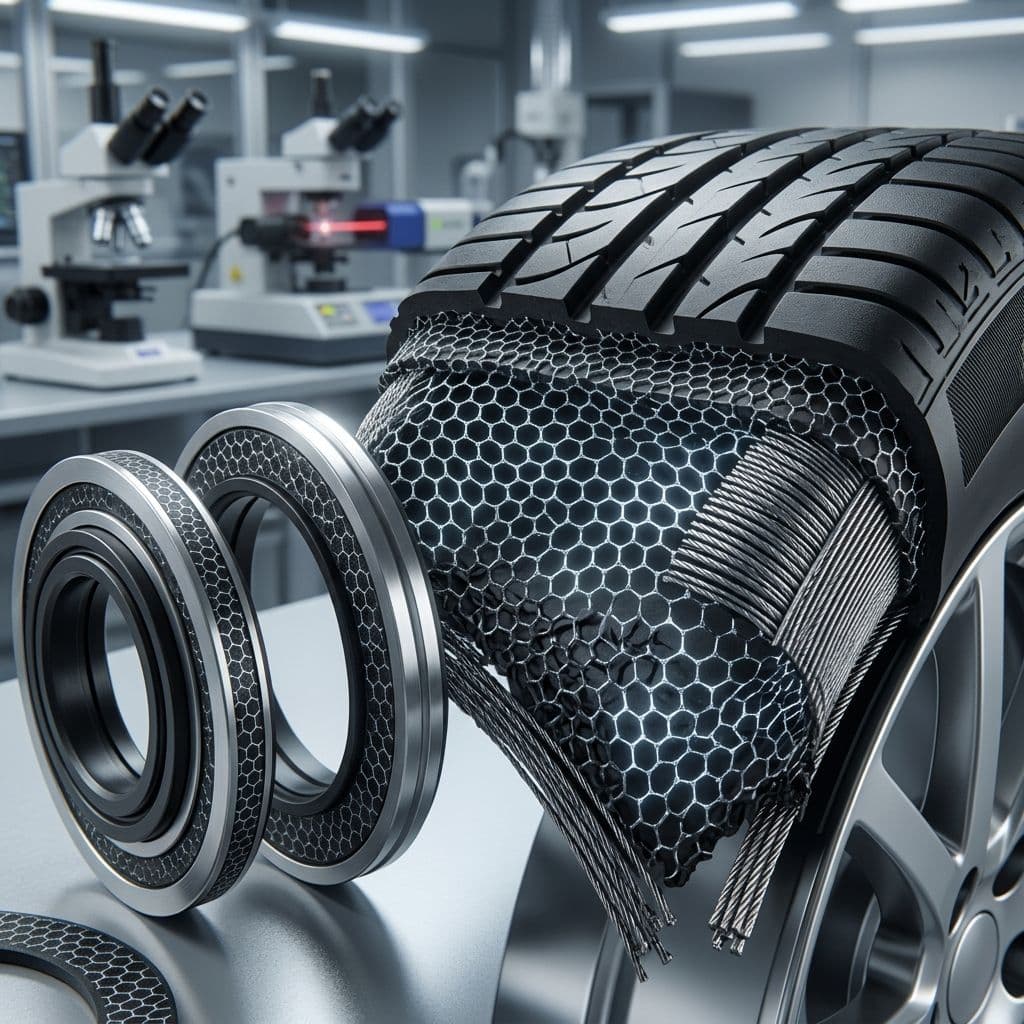
Rubber compounds are everywhere in engineering, even when they are easy to overlook. Tires, seals, gaskets, hoses, vibration dampers, industrial rollers, and protective components all rely on elastomer systems with the right balance of flexibility, wear resistance, and durability. Graphene is attracting attention in rubber because it can improve those properties without forcing elastomers to stop behaving like elastomers.
One of the strongest arguments for graphene in rubber compounds is wear resistance. Rubber parts often fail gradually rather than suddenly. Abrasion, repeated flexing, heat buildup, and fatigue slowly reduce performance. Graphene can reinforce the compound matrix and improve how stress is distributed, which may increase durability and slow material degradation. In practical terms, this matters for tires, seals, and industrial parts exposed to repeated mechanical demand.
Tire technology is one of the most visible areas. Tire compounds need rolling efficiency, grip, durability, heat management, and predictable wear. Graphene offers a possible route toward balancing some of those competing properties. While it is not a stand-alone solution, it can act as a performance-enhancing additive alongside established fillers and elastomer systems.
Seals and gaskets are another logical application. These components need to stay flexible while resisting compression set, wear, and environmental exposure. Graphene reinforcement may help improve service life and reduce failure in demanding conditions. In automotive, industrial, and energy systems, even a modest improvement in seal reliability can matter a lot.
Thermal behavior is another reason graphene matters in rubber. Heat buildup is a problem in many elastomer systems because it accelerates degradation and affects performance. Graphene can help improve thermal conductivity and support more stable operating behavior in selected compounds. That is particularly useful in applications involving repeated deformation, friction, or elevated temperatures.
Electrical and antistatic functions are also relevant. Some rubber applications need conductivity for static dissipation, sensing, or EMI-related performance. Graphene can provide conductive pathways at relatively low loading levels compared with conventional fillers, depending on formulation quality.
As always, formulation is everything. The right loading, dispersion, and compatibility with the base elastomer system determine whether graphene improves the material or creates inconsistency. But when used correctly, graphene in rubber compounds can support tougher, longer-lasting, and more multifunctional elastomer systems.
Graphene in rubber matters because elastomers are foundational to transport, machinery, sealing, and protective systems. An additive that improves wear, durability, and functional performance in such widely used materials has clear commercial relevance.