3D printing, Coatings & Materials
Graphene in PLA 3D Filament: Why This Composite Matters for Better Prints
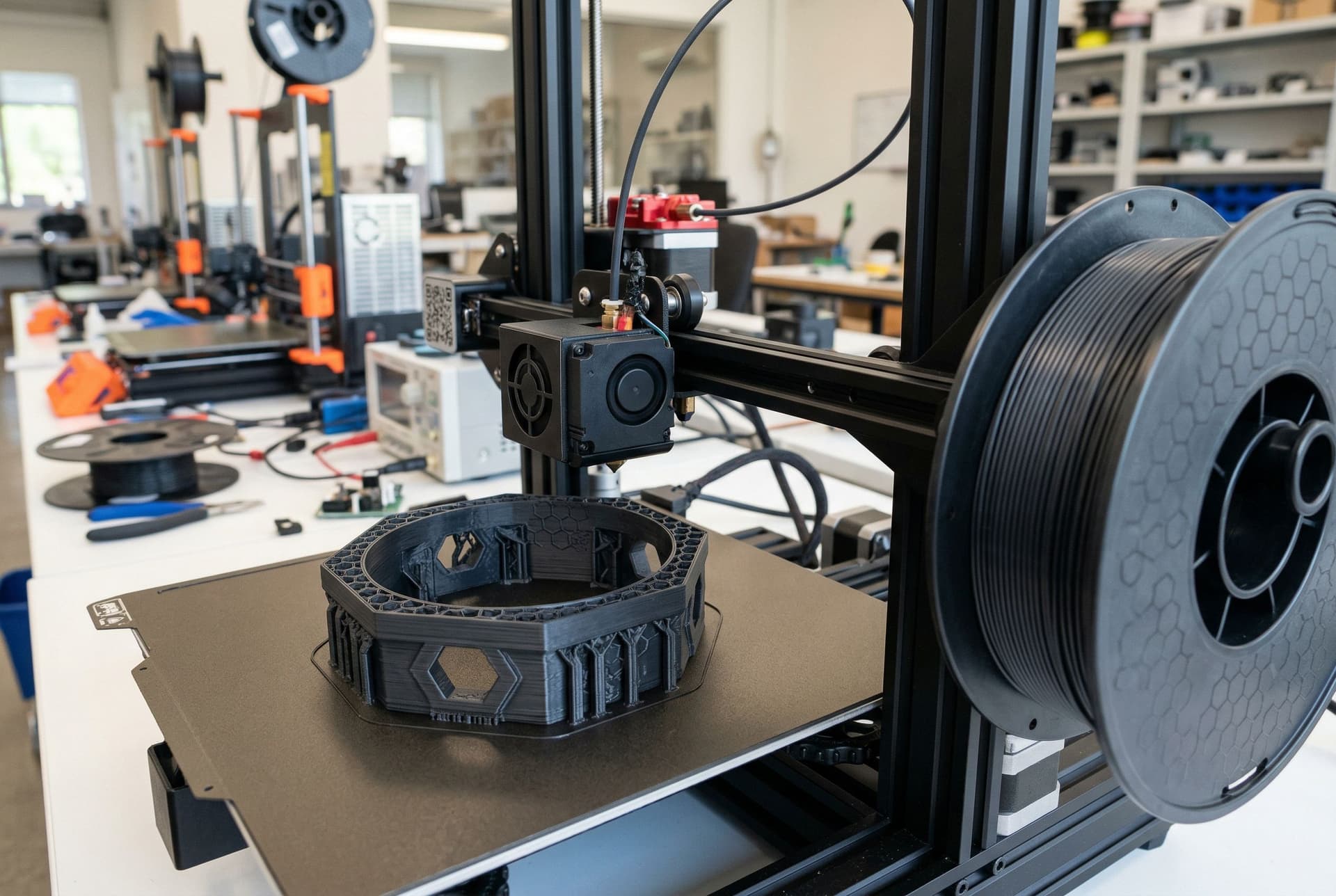
PLA is one of the most widely used materials in desktop 3D printing because it is easy to print, inexpensive, dimensionally stable, and widely available. For hobbyists, engineers, educational labs, and product designers, PLA is often the first material used when turning a concept into a physical part. But standard PLA also has clear limitations. It can be brittle, relatively soft under heat, electrically insulating, and less useful for advanced functional parts than more technical polymers. That is why graphene-filled PLA filament has attracted attention. It offers a way to keep much of PLA’s printability while improving selected performance characteristics.
Graphene is a carbon nanomaterial made of atom-thin layers arranged in a hexagonal structure. It is known for exceptional strength, electrical conductivity, thermal conductivity, and high surface area. When graphene is incorporated into a polymer like PLA, it can act as a reinforcing and functional additive. In practice, this means a graphene-PLA filament may offer advantages beyond cosmetic printing. It can become stiffer, more durable, more thermally responsive, or in some cases more electrically functional than ordinary PLA.
That does not mean graphene-PLA turns a desktop print into a miracle-grade engineering part. The value of graphene in PLA depends heavily on dispersion quality, filler loading, base resin quality, and the intended use of the printed part. But when well formulated, graphene-enhanced PLA can be a meaningful step up from standard hobby filament.
One of the biggest reasons graphene is added to PLA filament is mechanical reinforcement. Standard PLA prints well and holds shape nicely, but it can be brittle under impact or repeated loading. Graphene can improve stiffness and structural integrity by reinforcing the polymer matrix and helping distribute stress more efficiently through the material. In printed parts, that can translate into crisper, more rigid components that feel less toy-like and more functional.
This matters in practical applications such as brackets, mounts, housings, jigs, fixtures, and custom components where shape alone is not enough. A printed part may need to resist bending, support moderate load, or maintain dimensional stability during handling and use. Graphene-filled PLA can help bridge the gap between “easy-to-print model” and “usable technical part.”
Another advantage of graphene in PLA filament is improved interlayer performance in some formulations. One of the weaknesses of fused filament fabrication is anisotropy: printed parts are often weaker between layers than within them. Composite additives sometimes alter melt behavior and bonding in ways that help the printed structure behave more consistently. The degree of improvement depends on the specific material system, but this is one reason advanced PLA composites can be more useful than plain PLA even when they print on the same class of machine.
Graphene-PLA is also interesting because it may provide better thermal behavior than ordinary PLA. PLA is still fundamentally a low-temperature polymer compared with nylons, polycarbonate, or high-performance engineering plastics, so graphene does not eliminate its heat limitations. However, graphene can improve heat transfer through the material and may make printed parts more suitable for applications involving mild thermal loads, electronics housings, or components where a little extra temperature handling is useful. It can also help spread localized heat more effectively than neat PLA, which can matter in enclosures or sensor-related parts.
Electrical functionality is another reason graphene-PLA gets attention. PLA is normally an insulator, but graphene can provide conductive pathways when loading and formulation are tuned correctly. Most graphene-PLA filaments will not approach metal conductivity, and many so-called conductive filaments only provide limited or specialized conductivity. Even so, there are use cases where that is enough. Antistatic components, touch-sensitive prototypes, low-current sensor parts, EMI-aware housings, and experimental printed electronics can all benefit from a printable composite that is at least partially conductive.
This is especially valuable in prototyping. Engineers and makers often need to test functional concepts quickly, not just make visual models. A graphene-PLA filament can enable more realistic prototype behavior when the part needs a combination of structure and functionality. Instead of printing a dummy enclosure and then retrofitting all electrical behavior later, a more capable filament can simplify the design loop.
The surface and wear properties of graphene-PLA can also be helpful. Printed parts that slide, rub, or face repeated handling often wear faster than expected. Graphene may improve wear resistance and surface durability by reinforcing the material and changing how the composite responds to friction. That makes graphene-filled PLA useful for guides, holders, wear surfaces, or repeated-use custom accessories. Even when the improvement is incremental, it can be enough to make a printed component last longer in actual use.
From a manufacturing perspective, graphene-PLA remains attractive because it often preserves much of PLA’s user-friendly print behavior. Compared with carbon-fiber nylon, glass-filled engineering plastics, or high-temperature composite systems, a graphene-PLA filament can still be accessible to standard desktop printers. This lowers the barrier to entry for users who want improved material performance without moving immediately to more difficult print platforms.
That combination of better functionality and manageable processability is a major reason graphene-PLA matters. Many users do not need the absolute maximum strength or temperature resistance available in the market. They need a material that prints reliably and performs somewhat better than standard PLA. Graphene-PLA fits that need well.
There are also educational and R&D uses for graphene-filled PLA. Because PLA is so common in schools, prototyping labs, and maker environments, a graphene-enhanced version offers a simple way to expose users to functional composites without requiring industrial equipment. It helps bridge the conceptual gap between hobby-grade printing and advanced materials engineering. Students and early-stage product teams can experiment with conductive, reinforced, or more technically capable materials using a familiar printing workflow.
Even so, graphene-PLA is not perfect. The first issue is dispersion quality. If graphene is poorly mixed into the polymer, the filament may show inconsistent extrusion, weak spots, poor surface finish, or uneven performance. High-quality compounding is essential. The best graphene additive on paper means little if the final filament is not uniform.
Another issue is marketing inflation. Some materials are branded with graphene labels even when the actual additive level or formulation quality does not justify strong performance claims. Users should look for actual property data, not just buzzwords. If a filament claims conductivity, stiffness improvement, or better durability, those claims should be backed by test results or at least realistic technical documentation.
Print tuning can also change. Graphene-filled PLA may require adjusted temperature, flow, or speed settings compared with ordinary PLA. Depending on the filler system, nozzle wear may also increase slightly over time, especially if other reinforcing fillers are present. While graphene-PLA is usually far more accessible than heavily fiber-filled engineering materials, it still benefits from calibration and realistic expectations.
There is also the matter of application fit. Graphene-PLA is useful, but it does not replace every other material. If a part must survive high temperatures, repeated outdoor exposure, major mechanical shock, or chemically harsh environments, other polymers may still be more appropriate. Graphene improves PLA, but it does not erase PLA’s fundamental chemistry.
The best use cases today are the ones where standard PLA almost works, but falls a little short. Graphene-PLA is particularly attractive for:
- stronger functional prototypes
- rigid enclosures and housings
- antistatic or semi-conductive parts
- sensor and electronics-related prototypes
- wear-resistant custom components
- educational or R&D composite printing
- lightweight technical parts that benefit from higher perceived quality and stiffness
In all of these cases, the value is not just that graphene sounds advanced. The value is that it improves the filament enough to make more printed parts genuinely useful.
Looking ahead, graphene in PLA filament represents a broader trend in additive manufacturing: smarter materials, not just better machines. Desktop printers are becoming increasingly capable, but material performance remains one of the biggest limits on what printed parts can actually do. Composite filaments that add conductivity, reinforcement, and improved thermal behavior expand the practical reach of 3D printing.
For many users, graphene-PLA may become a natural next step after standard PLA. It is familiar enough to print without major workflow changes, yet advanced enough to support more serious applications. That makes it one of the more interesting gateway materials between hobby-grade 3D printing and functional additive manufacturing.
Graphene usage in PLA 3D filament matters because it pushes one of the world’s most common printing materials in a more capable direction. It does not turn PLA into a universal engineering polymer. But it does make it more useful for real prototyping, more interesting for functional parts, and more relevant to advanced product development. In that sense, graphene-PLA is not just a novelty filament. It is part of the ongoing shift toward smarter, more multifunctional printable materials.