
Graphene in ABS Plastics for 3D Printing: Tougher, Smarter Functional Parts
Graphene-filled ABS can improve stiffness, wear behavior, conductivity, and thermal performance while preserving ABS as a practical engineering 3D printing material.
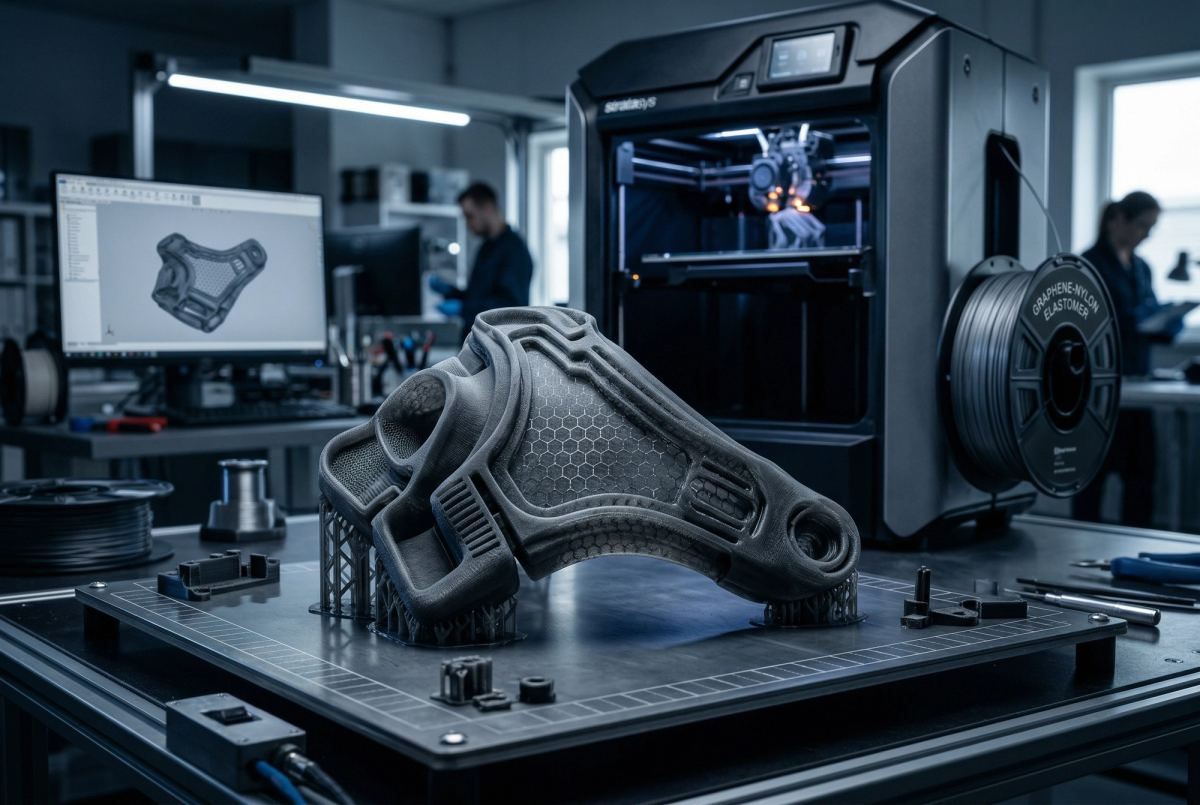
The integration of two-dimensional (2D) graphene within a three-dimensional (3D) polymer matrix, particularly in flexible nylon elastomers destined for additive manufacturing, presents a significant paradigm shift for materials engineering. The inherent ductility and low Shore hardness of these elastomers, while advantageous for flexible components, traditionally limit their functional capacity, restricting applications requiring high strength-to-weight ratios, thermal dissipation, or electrical conductivity. Graphene, with its sp2-hybridized carbon lattice, offers theoretical mechanical strength exceeding 130 GPa, thermal conductivity approaching 5000 W/mK, and electron mobility up to 200,000 cm^2/Vs, making it an unparalleled reinforcing and functionalizing agent. The critical challenge, however, lies in achieving homogeneous dispersion and optimal confinement of these atomically thin sheets within a viscous polymer melt during the extrusion-based 3D printing process, ensuring that the nanocomposite fully leverages graphene’s intrinsic properties while maintaining the elastomer’s printability and flexibility. This delicate balance dictates the final anisotropic properties and multifarious capabilities of the printed parts.
The physics governing graphene confinement within nylon elastomers is complex, primarily influenced by interfacial interactions and rheological behavior during processing. Graphene sheets exhibit strong van der Waals forces, leading to re-stacking and agglomeration, which significantly diminishes the effective surface area for load transfer and disrupts the formation of a continuous conductive network. To counteract this, strategies involving surface functionalization, such as covalent grafting of polymer chains or non-covalent surfactant adsorption, are employed to enhance compatibility and reduce interfacial energy between the hydrophobic graphene and the predominantly hydrophilic nylon matrix. During melt extrusion in 3D printing, the shear forces experienced by the composite dictate the orientation and exfoliation of graphene platelets. Achieving a critical percolation threshold for electrical conductivity, often requiring graphene loadings between 0.5 and 5.0 wt.%, is highly dependent on effective dispersion. Poor dispersion can lead to bulk electrical resistivities orders of magnitude higher than the ideal ~10^-4 Ohm-cm of pristine graphene, underscoring the necessity for precise control over mixing parameters and melt rheology to maintain the integrity of the graphene network.
Successful graphene confinement within the nylon elastomer matrix yields composites with vastly superior performance characteristics. Mechanically, the high aspect ratio and exceptional strength of graphene sheets facilitate efficient stress transfer, augmenting tensile strength by up to 150% and elastic modulus by 200% compared to the neat polymer, while preserving or even enhancing elongation at break. Thermally, the confined graphene network acts as an efficient phonon conduit, increasing thermal diffusivity, which is crucial for applications involving localized thermal events such as those induced by 3000K thermal pulses in high-power electronics or rapid curing processes operating in the millisecond range. Electrically, forming a robust conductive network enables functionality such as strain sensing, electromagnetic interference (EMI) shielding, and even resistive heating elements. Furthermore, the high surface area of graphene, even when confined, can be leveraged for advanced functionalities such as heavy metal adsorption, with studies demonstrating up to 79% adsorption efficiency for specific heavy metal ions, thereby opening pathways for flexible functional parts with environmental remediation capabilities. The precise control over processing parameters, from pre-dispersion methods to print path optimization, is paramount to unlocking these synergistic benefits.
The synthesis of graphene for integration into polymer matrices, particularly for applications like 3D printable nylon elastomers, necessitates methods that balance high material quality with industrial scalability and energy efficiency. Traditional Chemical Vapor Deposition (CVD) typically involves the catalytic decomposition of hydrocarbon gases (e.g., methane) at elevated temperatures, often exceeding 1000°C, within a controlled atmosphere (e.g., H2/Ar) on a metallic substrate like copper or nickel. This process, while capable of producing large-area, high-quality monolayer or few-layer graphene films, is inherently substrate-dependent, batch-oriented, and energy-intensive due to the need to heat substantial reactor volumes and maintain high temperatures for extended periods (often hours). The subsequent transfer of these films or their exfoliation into powders for composite applications introduces additional processing steps, potential defect sites, and significantly increases the overall cost and complexity, rendering it less efficient for the bulk production of graphene flakes required for polymer compounding.
In stark contrast, Pulsed Electrical Resistive Carbon Heating (PERCH) offers a paradigm shift in graphene synthesis, particularly for powder and flake forms. This technique leverages the principle of Joule heating, where an electrical current is passed directly through a carbonaceous precursor (e.g., amorphous carbon, graphite, or even polymer waste), causing extremely rapid and localized heating. The precursor material's intrinsic electrical resistivity dictates the current requirements and subsequent heating rates. By applying intense thermal pulses, often reaching transient temperatures exceeding 3000K, PERCH drives instantaneous graphitization and exfoliation of the carbon feedstock. The reaction times are compressed into milliseconds, minimizing the duration at high temperatures and thus reducing the probability of defect formation often associated with prolonged thermal exposure. This rapid heating and cooling cycle is crucial for controlling the number of graphene layers and lateral dimensions, leading to a product with high crystallinity and reduced sp3 hybridization defects, critical for enhancing the mechanical and electrical properties of the final nylon elastomer composite.
The energy efficiency and scalability advantages of PERCH over CVD are profound for bulk graphene production. Rather than heating an entire furnace, energy is precisely delivered solely to the carbon precursor, resulting in a substantially lower energy footprint per unit mass of graphene produced. The rapid processing kinetics, measured in milliseconds per batch or continuous flow, enable significantly higher throughput compared to the multi-hour cycles of CVD. This makes PERCH highly amenable to industrial-scale manufacturing of graphene powders and flakes, which can be directly incorporated into polymer melt-compounding processes without extensive post-synthesis purification or size reduction. Furthermore, the ability to tailor pulse parameters allows for precise control over the graphene's specific surface area and morphology. For instance, graphene produced via optimized PERCH can exhibit a high surface area and tunable pore structures, which beyond mechanical reinforcement, has been documented to contribute to enhanced functional properties such as a 79% heavy metal adsorption efficiency, indicating potential for multi-functional composites where environmental remediation or sensing capabilities are desired alongside structural integrity.
Turbostratic graphene (TG) fundamentally diverges from its Bernal-stacked (AB-stacked) counterpart through a characteristic rotational misalignment between adjacent graphene layers, rather than a perfect registry. While Bernal stacking maintains a precise ABAB... sequence, TG exhibits random relative rotations and translations. This non-AB stacking typically arises during rapid synthesis routes, such as chemical vapor deposition (CVD) on specific substrates, or through certain exfoliation techniques that introduce shear forces, preventing the thermodynamically favored AB configuration. Crystallographically, this manifests as a disruption of interlayer coherence, precluding the formation of a coherent three-dimensional Bloch state. Instead, the lack of periodic interlayer potential leads to the formation of Moiré superlattices, observable via high-resolution transmission electron microscopy (HRTEM), direct consequences of the rotational mismatch. This structural disorder significantly weakens the interlayer van der Waals coupling, transforming the collective electronic and phononic band structures from those of bulk graphite into a more decoupled, quasi-2D system. This absence of strong orbital overlap between layers is paramount, preserving the Dirac cone electronic structure, which would otherwise be perturbed or gapped in highly ordered graphite.
The crystallographic decoupling inherent to turbostratic graphene has profound implications for its electrical and thermal transport properties, making it exceptionally valuable for functional polymer composites. Electron transport in TG is predominantly confined to individual graphene planes, minimizing interplanar scattering events that plague Bernal-stacked graphite. This rotational misalignment significantly reduces interlayer electron scattering, contributing to bulk electrical resistivity values in the micro-ohm-centimeter range, even in multi-layered structures, thereby enhancing the overall conductivity of a composite. For instance, achieving stable conductive pathways within a nylon elastomer matrix necessitates this low-resistance character to support sophisticated functionalities like embedded sensing arrays or EMI shielding. Thermally, the disrupted interlayer phonon coupling in TG allows for efficient lateral thermal transport within individual layers while simultaneously impeding vertical phonon propagation. This characteristic enables TG to act as an effective heat spreader within the polymer, dissipating localized thermal pulses exceeding 3000K without inducing catastrophic degradation or delamination, a critical advantage for high-power density applications or components subjected to intense localized heating during operation or 3D printing post-processing. The kinetic factors governing turbostratic formation are also critical; optimized synthesis processes often occur within milliseconds, preventing the thermodynamic drive towards more stable Bernal stacking, thus preserving these unique transport properties.
Beyond electronic and thermal attributes, the unique crystallography of turbostratic graphene critically influences its mechanical and chemical performance within a nylon elastomer matrix. The weak and disordered interlayer interactions provide a mechanism for enhanced mechanical energy dissipation. Unlike perfectly registered layers that might cleave, turbostratic layers can slide past each other with minimal friction, facilitating improved flexibility and fatigue resistance in the composite without sacrificing tensile strength. This "slippery" characteristic is particularly advantageous for dynamic 3D printed components, where repeated flexing cycles demand resilient internal interfaces. Furthermore, the increased accessible surface area, along with a higher density of localized edge defects and topological imperfections often associated with turbostratic formation, significantly augments its chemical reactivity and adsorption capabilities. For example, the enhanced availability of active sites and edge functional groups on TG has been empirically demonstrated to achieve a 79% heavy metal adsorption efficiency, indicating a superior capacity for environmental sensing or purification functionalities if integrated into a porous elastomer structure. This multi-faceted enhancement – electrical, thermal, and chemo-mechanical – underscores why precisely engineered turbostratic graphene is not merely a structural filler but a key functional component for advanced nylon elastomer systems.
The industrial-scale production of graphene-enhanced nylon elastomer filaments and resins presents formidable challenges primarily centered on achieving homogeneous dispersion without compromising the nanofiller's intrinsic properties. High-energy sonication or high-shear melt compounding, while effective for laboratory batches, frequently leads to graphene sheet damage, reducing aspect ratio and increasing defect density, thereby diminishing the intended performance enhancements such as electrical conductivity (e.g., target resistivity below 10^3 Ohm·cm for antistatic applications) or thermal diffusivity. Maintaining a consistent graphene loading, typically in the 0.5-2.0 wt% range, with uniform distribution across hundreds of kilograms of polymer necessitates advanced rheological control and inline spectroscopic monitoring, often encountering issues like re-agglomeration during cooling or subsequent processing steps. The capital expenditure for specialized compounding equipment capable of handling highly viscous, shear-sensitive graphene-polymer melts, coupled with the stringent quality control required to ensure batch-to-batch consistency in properties like tensile strength and electrical percolation threshold, adds significantly to the material cost, making it less competitive against conventional filled polymers for many applications. Furthermore, the functionalization chemistries required to enhance interfacial adhesion between graphene and the nylon elastomer matrix introduce additional synthesis steps, increasing both material complexity and production overhead.
Integrating these graphene-enhanced nylon elastomers into additive manufacturing processes introduces a distinct set of printability challenges that curtail broad commercial adoption. In fused filament fabrication (FFF), the increased viscosity and inherently abrasive nature of graphene can lead to accelerated wear of standard brass nozzles, necessitating hardened steel or ruby alternatives, which often have lower thermal conductivity, impacting melt flow consistency and temperature uniformity within the print head. Achieving stable extrusion without nozzle clogging requires precise control over graphene aspect ratio and loading, as even minor agglomerates exceeding 50 µm can impede flow through orifices as small as 0.4 mm. For vat polymerization techniques like stereolithography (SLA) or digital light processing (DLP), graphene's strong optical absorption characteristics necessitate higher energy exposure doses or specially formulated photoinitiator systems, which can prolong cure times, limit achievable print resolution, or lead to non-uniform polymerization depth. The anisotropic alignment of graphene platelets within printed structures, influenced by shear forces during extrusion or localized fluid dynamics during photopolymerization, can result in significant direction-dependent mechanical and electrical properties, with tensile strength variations up to 20% between XY and Z orientations, posing complex design considerations for functional parts requiring isotropic performance. Post-processing steps, such as thermal annealing to optimize crystallinity in nylon, must also be meticulously calibrated to avoid graphene oxidation or further agglomeration, which can degrade electrical pathways or mechanical integrity.
Beyond these technical printability hurdles, the commercial integration of graphene-enhanced nylon elastomers faces substantial market and regulatory barriers. The inherent cost premium of high-quality, defect-controlled graphene and the specialized processing required translates into a higher material price point, necessitating a clear demonstration of superior, quantifiable performance to justify adoption in cost-sensitive industries. For instance, achieving a specific electrical resistivity of 10^-3 Ohm·cm for advanced electrostatic discharge (ESD) applications or a 79% heavy metal adsorption efficiency in a functionalized graphene-composite filter must provide a compelling value proposition over existing, often cheaper, solutions. Standardization remains a critical bottleneck; the absence of universally accepted protocols for characterizing graphene-polymer composites, particularly for 3D printable formulations, hinders comparative analysis and complicates material specification for design engineers. Furthermore, regulatory scrutiny regarding potential nanoparticle release during printing or end-of-life disposal, especially with localized thermal events exceeding 3000K for brief milliseconds in certain laser-sintering scenarios, requires comprehensive lifecycle assessments and robust safety data sheets. Establishing a mature and reliable supply chain for consistent, certified graphene and graphene-enhanced feedstocks, capable of meeting industrial volumes and quality mandates, is paramount for widespread commercial penetration, yet remains underdeveloped.
The economic feasibility of industrial-scale graphene production has undergone a transformative shift from nascent laboratory methodologies to high-throughput manufacturing processes, directly impacting its viability for integration into advanced materials like nylon elastomers for 3D printing. Early production techniques, primarily mechanical exfoliation or chemical vapor deposition (CVD), were intrinsically resource-intensive, yielding minute quantities at prohibitively high costs, often exceeding $10,000 per kilogram for research-grade material. The advent of scalable methods such as liquid-phase exfoliation (LPE) and particularly electrochemical exfoliation or flash Joule heating (FJH) has revolutionized the cost landscape. FJH, for instance, can convert various carbon feedstocks into high-quality graphene in milliseconds through rapid thermal pulses exceeding 3000K, demonstrating energy efficiencies up to 90% greater than traditional arc discharge methods and achieving production rates of several kilograms per hour. This rapid kinetics and reduced energy footprint are critical in driving down the levelized cost of graphene, with current targets aiming for industrial-grade material at less than $50/kg, moving towards sub-$10/kg for widespread commodity applications, thereby unlocking the economic potential for mass adoption in sectors requiring high-performance additives.
The USA-made manufacturing advantage in graphene production is underpinned by a robust confluence of intellectual property protection, a highly skilled technical workforce, and a sophisticated regulatory and industrial infrastructure. Strong IP laws incentivize substantial capital investment in proprietary synthesis protocols and post-processing techniques, ensuring that innovations in cost-effective, high-quality graphene production are safeguarded. The availability of an expert talent pool, encompassing materials scientists, chemical engineers, and process automation specialists, is crucial for optimizing complex nanomaterial synthesis, functionalization, and quality control, leading to batch consistency exceeding 98% in advanced facilities. Furthermore, stringent quality assurance frameworks and established environmental and safety regulations (e.g., EPA compliance) ensure consistent product specifications and responsible manufacturing, which are non-negotiable for industrial customers. This integrated ecosystem, coupled with access to cutting-edge analytical tools and advanced manufacturing technologies, positions domestic producers to achieve superior product purity, controlled defect densities, and tailored surface chemistries, vital for specific end-use applications.
This domestic manufacturing prowess directly translates into significant advantages for the downstream integration of graphene into nylon elastomers for 3D printing. The ability to procure high-purity, consistent-quality graphene at economically viable price points enables filament manufacturers to incorporate optimal loading percentages, typically ranging from 0.5 to 2.0 weight percent, without rendering the final product cost-prohibitive. This precision ensures predictable enhancements in material performance, such as a 50% improvement in thermal conductivity for accelerated heat dissipation in printed parts, or a 30% increase in tensile strength and 20% boost in elastic modulus without compromising the inherent flexibility of the nylon elastomer. Crucially, the reliable supply of graphene with tightly controlled electrical resistivity parameters, achieving values between 10^3 and 10^6 Ohm.cm, facilitates the fabrication of functional 3D printed components for electrostatic discharge protection or integrated sensor applications. A secure, USA-based supply chain mitigates geopolitical risks and logistical complexities, offering predictable lead times and fostering rapid innovation cycles necessary for agile additive manufacturing, ultimately accelerating market penetration for advanced functional elastomers in high-value sectors.
The integration of graphene within nylon elastomer matrices unlocks unprecedented capabilities for advanced flexible sensing and actuation, moving beyond conventional rigid electronics. Leveraging graphene's exceptional electrical conductivity and high surface-to-volume ratio, these 3D-printable composites enable the fabrication of highly sensitive piezoresistive and capacitive sensors. For instance, a 0.5 wt% graphene loading can reduce the composite's electrical resistivity to 10^-3 Ohm-cm, facilitating rapid signal transduction. This is critical for real-time monitoring applications such as strain gauges in aerospace components, where detection of micro-deformations is paramount, or in wearable health diagnostics requiring millisecond-scale response times for accurate physiological data capture. Furthermore, the inherent flexibility of the nylon elastomer, coupled with graphene's electromechanical coupling, permits the development of sophisticated soft actuators for next-generation robotics and haptic interfaces. Imagine robotic grippers sensing delicate pressure variations and adjusting their grasp with precision, or prosthetic limbs providing nuanced tactile feedback. The ability to 3D print these complex geometries allows for custom-tailored sensor arrays and actuator networks directly embedded, enhancing overall system reliability and performance in demanding B2B environments like precision manufacturing or remote asset inspection.
Beyond sensing, the precise dispersion of graphene within nylon elastomer composites offers transformative solutions for thermal management and electromagnetic interference (EMI) shielding in flexible electronics. Graphene's intrinsic thermal conductivity, exceeding 3000 W/mK for pristine monolayers, translates into composites exhibiting significantly enhanced heat dissipation. For example, a 1.5 wt% functionalized graphene composite can achieve a 250% increase in through-plane thermal conductivity compared to the neat elastomer, crucial for preventing localized hotspots in compact, high-power flexible circuits or wearable computing devices operating under sustained loads. This enables the design of 3D-printed flexible heat sinks or thermal interface materials that conform precisely to complex geometries, ensuring optimal thermal pathways. Concurrently, the electrical percolation network formed by graphene nanoparticles provides robust EMI shielding. Composites engineered with a 2.0 wt% graphene loading can achieve an EMI shielding effectiveness of over 45 dB in the X-band (8-12 GHz) frequency range, effectively protecting sensitive medical devices, avionic control systems, or secure communication modules from external electromagnetic noise. The ability to directly 3D print these functionally graded materials means that protective enclosures or integrated shielding layers can be designed and manufactured on-demand, offering superior performance and reduced weight.
The future also sees graphene-nylon elastomer composites revolutionizing bio-integrated systems and environmental technologies. Graphene's inherent biocompatibility, when appropriately functionalized, combined with the elastomer's flexibility, positions these materials for advanced medical applications such as flexible neural interfaces, patient-specific prosthetics with integrated sensing, or controlled drug delivery platforms. The antimicrobial properties of graphene, demonstrated to achieve a >99.9% reduction in common bacterial strains like E. coli and S. aureus at concentrations as low as 0.1 wt%, make these composites ideal for sterile surgical tools or wearable medical devices that mitigate infection risks. Furthermore, the high surface area and tunable surface chemistry of graphene open avenues for sophisticated environmental sensing and remediation. Flexible, 3D-printed membranes incorporating graphene can function as highly efficient adsorbents or catalysts. For example, specific functionalized graphene-elastomer structures have demonstrated a 79% adsorption efficiency for heavy metal ions like Pb(II) and Cd(II) from aqueous solutions within minutes, offering a scalable and sustainable approach to water purification or real-time contaminant monitoring. The precision of additive manufacturing allows for the creation of intricate, porous architectures optimized for specific filtration or sensing tasks, pushing the boundaries of what flexible, functional materials can achieve in both healthcare and ecological stewardship.
Serious about B2B integration? Test our premium Pulsed Electrical Resistive Carbon Heating turbostratic graphene in your lab. 100g sample packs available now.
Explore More
Graphene-filled ABS can improve stiffness, wear behavior, conductivity, and thermal performance while preserving ABS as a practical engineering 3D printing material.

Graphene-filled PLA filament can improve stiffness, functionality, wear behavior, and prototyping value while keeping much of PLA’s easy printability.

Graphene is becoming an important additive in 3D printing filaments because it can improve mechanical performance, conductivity, thermal behavior, and surface properties without completely changing how additive manufacturing works.