3D printing, Coatings & Materials
Graphene in Nylon Elastomer for 3D Printing: Flexible Parts with More Function
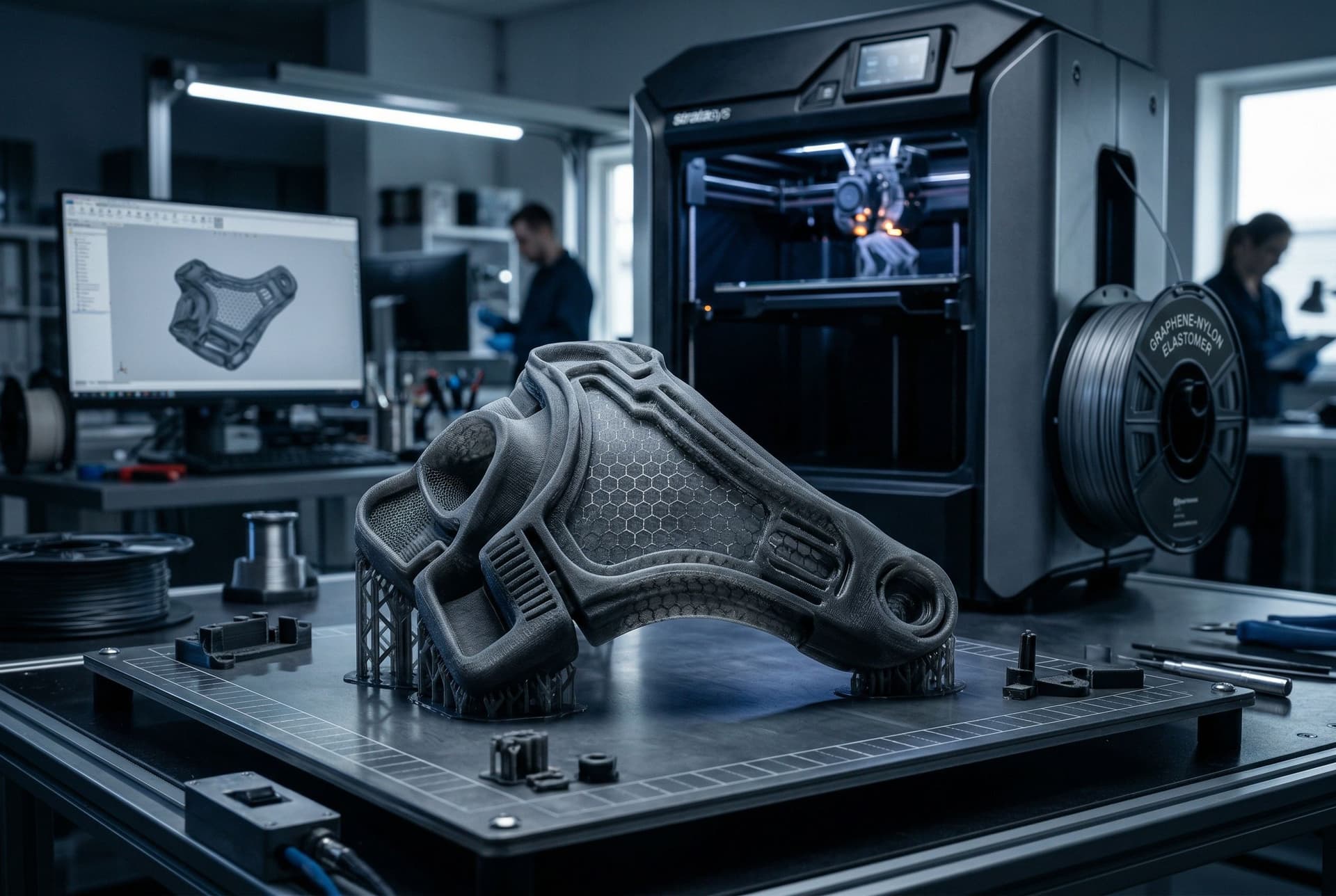
Nylon elastomer materials occupy a useful space in 3D printing because they combine flexibility with greater toughness than many standard soft filaments. They can absorb impact, recover after deformation, and survive handling in ways that make them attractive for industrial components, wearables, seals, protective covers, and functional prototypes. When graphene is added to a nylon elastomer system, the result becomes even more interesting. The material can move beyond simple flexibility and begin offering better mechanical integrity, improved durability, more functional thermal behavior, and in some formulations even partial electrical capability.
Graphene is a nanostructured carbon material known for its exceptional mechanical strength, electrical conductivity, thermal conductivity, and high surface area. In polymer systems, graphene acts less like a replacement material and more like a performance enhancer. Its role is to reinforce the matrix, influence how stress is distributed, and add useful functional behavior without massively increasing weight. In nylon elastomer filaments, that can be especially valuable because flexible materials often face a tradeoff between softness and strength. Graphene helps push that balance in a more useful direction.
One of the clearest advantages of graphene in nylon elastomer for 3D printing is reinforcement without making the material fully rigid. Flexible filaments are often chosen because they can bend, compress, and recover, but they can also suffer from limited dimensional stability and reduced strength under repeated use. Graphene can help improve stiffness at the right scale while preserving elasticity. That matters for parts that need to flex, but not feel weak. Custom gaskets, protective housings, soft robotic parts, flexible mounts, vibration-damping structures, and wearable components can all benefit from this kind of improvement.
Durability is another major benefit. Flexible printed parts are often exposed to repeated bending, abrasion, and mechanical cycling. Ordinary elastomer materials can fatigue, tear, or degrade over time, especially at stress concentrations or thin sections. Graphene can help reinforce those weak points by improving load transfer through the material and increasing resistance to crack formation. For real-world printed parts, this can translate into longer service life and better reliability.
Graphene may also improve wear behavior and surface resilience in nylon elastomer systems. This is useful when printed parts are rubbed, compressed, or repeatedly handled. Flexible cable guides, soft-contact fixtures, protective sleeves, and field-use accessories are all examples where a longer-lasting elastomer composite is more valuable than a basic soft filament.
Thermal behavior is another reason graphene-filled nylon elastomer attracts interest. Graphene’s thermal conductivity can help distribute heat more effectively through the composite. That does not turn a flexible polymer into a high-temperature engineering material, but it can improve heat spreading and reduce localized hotspots. In practical terms, this can help when flexible printed parts are used around electronics, light thermal loads, or applications where more stable temperature behavior matters.
Electrical functionality is an especially interesting area. Most flexible 3D printing materials are insulating, which limits their use in smart wearables, sensing systems, and flexible electronics. Graphene can create conductive pathways when dispersion and loading are properly controlled. Even if the resulting conductivity is modest, it may be sufficient for antistatic parts, pressure-sensitive structures, strain-responsive components, or conductive flexible prototypes. This makes graphene-filled nylon elastomer relevant not only as a mechanical material, but as a multifunctional one.
That multifunctionality is one of the biggest reasons to care about this material class. In additive manufacturing, every material that can serve more than one role becomes more valuable. A flexible print that is also tougher, more durable, and potentially electrically useful is far more interesting than a simple soft part. This is especially true in product development, where a single prototype often needs to represent several performance features at once.
Wearables and soft devices are one area where graphene-filled nylon elastomer makes sense. Designers increasingly want flexible printed components for body-worn systems, smart straps, flexible housings, and responsive accessories. A material that combines resilience, flexibility, and possible sensing or conductive behavior can be useful in this space. Even outside consumer wearables, industrial workers and field teams may benefit from soft printed parts that are durable, lightweight, and capable of supporting embedded functionality.
Soft robotics is another promising application area. Flexible printed actuators, compliant joints, grippers, and sensor-integrated parts often need materials that deform repeatedly without failing. Graphene can help by reinforcing the polymer system and possibly contributing to sensing behavior through resistance changes under strain. For experimental robotic systems, that makes graphene-filled nylon elastomer a compelling composite material.
At the same time, the material comes with real challenges. Flexible filaments are already more difficult to print than rigid ones because they can buckle in the extruder, require slower feed rates, and demand more careful printer setup. Adding graphene does not remove those process sensitivities. Instead, it means the material must be engineered carefully so that printability remains practical. Good compounding, consistent filament diameter, and tuned extrusion settings all matter.
Dispersion is another critical issue. If graphene is not distributed evenly through the nylon elastomer matrix, the material may show inconsistent performance, weak spots, or unreliable electrical behavior. High-quality composite processing is the difference between a serious engineering filament and a novelty product with impressive labeling but weak real performance.
Cost is also part of the conversation. Graphene-enhanced elastomer filaments will usually cost more than standard flexible materials. That cost only makes sense when the application benefits from the added functionality. For decorative soft prints, it may not be justified. For advanced prototypes, soft robotics, flexible electronics, or durable wearable components, the extra value can be very real.
The best current applications for graphene in nylon elastomer for 3D printing include:
- flexible technical prototypes
- durable wearables and smart accessories
- vibration-damping or shock-absorbing components
- soft robotic parts and compliant mechanisms
- protective sleeves, covers, and mounts
- sensor-oriented flexible structures
- antistatic or semi-conductive elastomer parts
These are all areas where a flexible polymer becomes much more useful when it gains structural reinforcement and functional performance.
In the long run, graphene-filled nylon elastomer represents the broader future of additive manufacturing materials. Instead of choosing between rigid strength and soft flexibility, designers increasingly want materials that blend multiple capabilities into one printable system. Graphene supports that direction by helping soft polymers become more durable, more technically capable, and in some cases more intelligent.
Graphene in nylon elastomer for 3D printing matters because it expands what flexible printed parts can actually do. It can help transform soft materials from simple comfort-focused filaments into serious functional composites. For developers working in wearables, robotics, flexible devices, and impact-resistant components, that makes graphene-filled nylon elastomer one of the more exciting material directions in additive manufacturing today.