Graphene and In-Memory Computing: Why Physics-Driven Chips Matter
Source article: Computing in a memory with physics, Science, DOI 10.1126/science.aei8090. This USA Graphene post summarizes the research and adds materials-market context.
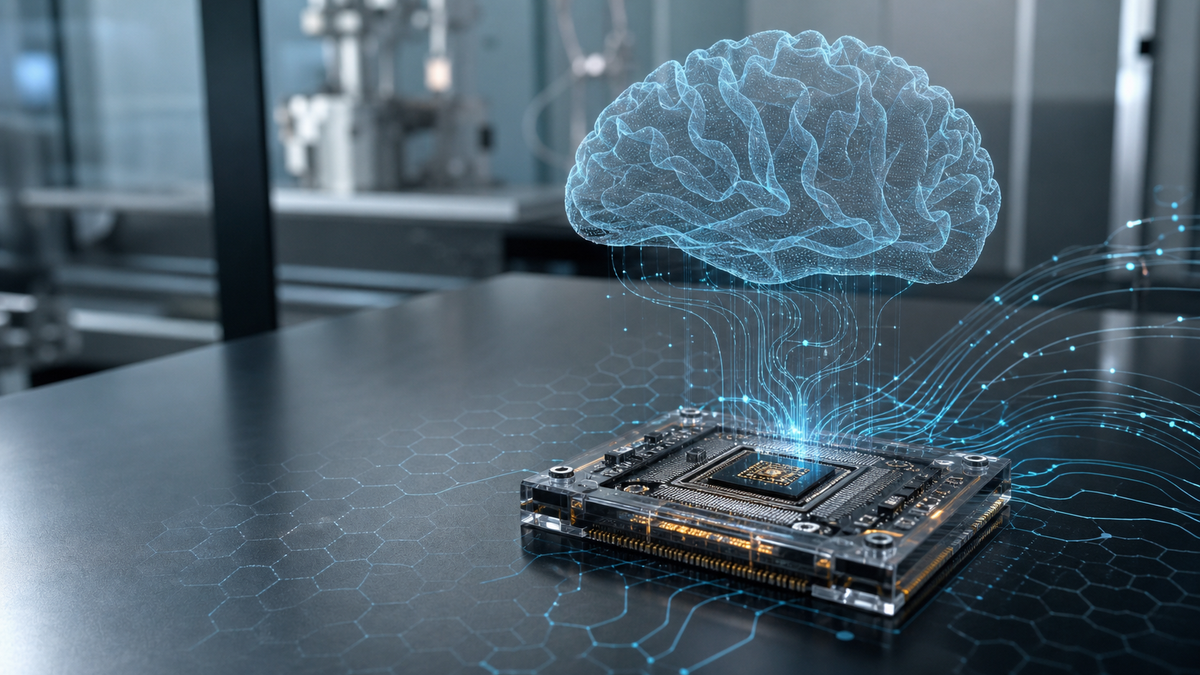
Computing in a memory with physics sounds like a slogan, but it describes one of the most important shifts happening in advanced hardware. Instead of forcing every AI calculation through the old split between memory and processor, researchers are building systems where the material itself helps compute. A recent Science Perspective by Xin Zheng and Ilia Valov, discussing a Science paper by Lei Cai, Yaoyu Tao, Chenchen Xie, Longhao Yan, and colleagues, is a useful signal of where this field is going.
The work centers on a neural dynamical system chip based on phase-change memristors. The reported hardware uses controlled physical behavior inside memory devices to accelerate neural dynamical system calculations, including high-fidelity cortex surface reconstruction. The underlying Science paper reports sub-10-millisecond operation, with a 2.12 millisecond single-iteration latency and major speed and power advantages over conventional GPU workflows for the tested reconstruction workload.
This is not a graphene chip. The specific device is based on phase-change memristors. But the lesson is highly relevant to graphene, graphene oxide, and other two-dimensional materials: future computing will increasingly depend on materials that do more than passively store bits. Materials that combine memory, transport, switching, sensing, thermal control, and physical dynamics could become the foundation for the next generation of AI accelerators.
What In-Memory Computing Is Trying to Fix
Traditional computer architecture separates memory from compute. Data sits in memory, moves to a processor, gets calculated, and then moves back. That design has worked for decades, but it becomes inefficient when workloads require huge numbers of repeated matrix operations, intermediate states, and feedback loops.
This is often called the memory wall. In many AI and scientific workloads, moving data consumes a large share of the time and energy. The processor may be powerful, but the system still waits on memory traffic. That is especially painful for neural networks, simulation, robotics, edge AI, and real-time scientific computing.
In-memory computing attacks the problem directly. It asks whether memory elements can also perform part of the computation. If the answer is yes, the system can reduce data movement, lower power, and improve latency. The result is not just a faster chip. It is a different way of thinking about computing hardware.
Why the Science Paper Matters
The Science paper, "A sub-10-millisecond neural dynamical system based on phase-change memristors," reports a 40-nanometer neural dynamical system chip that uses phase-change memristors and their multilevel compute-in-memory capabilities. Neural dynamical systems are useful for modeling continuous changes, solving differential-equation-like problems, and reconstructing dense geometric surfaces.
The hard part is latency. Neural dynamical systems often require adaptive step-size integration and repeated computation. On conventional hardware, that can push latency into hundreds of milliseconds. For real-time applications, that delay matters.
The researchers used the physics of phase-change memristors, including controlled conductance drift, as part of the computational process. That is the key conceptual jump. A device behavior that would normally be treated as a storage problem can become a useful computational mechanism if it is predictable and engineered well.
The reported system reached 2.12 milliseconds for single-iteration neural dynamical system computation at an error tolerance of 10^-7. The paper also reports 3.82x to 36.27x faster speed and 11.75x to 24.73x lower power than state-of-the-art neural dynamical system hardware in the tested comparisons, with end-to-end latency beating an NVIDIA A100 GPU by 50.38x to 478.18x in the reported hardware-measurement and simulation flow.
Those numbers are workload-specific, but they point to a broader opportunity: specialized material-based computing can outperform brute-force digital compute when the device physics match the math.
Where Graphene Fits Into This Story
Graphene is not a drop-in replacement for every memristor material. It is better to be precise. Phase-change memory relies on materials that switch between amorphous and crystalline states. Graphene does not do that in the same way.
However, graphene and related 2D materials are relevant because they offer tunable conductivity, high carrier mobility, large surface area, strong thermal transport, mechanical thinness, and compatibility with hybrid device stacks. Those properties matter in three areas that overlap with in-memory and neuromorphic computing.
First, graphene can support advanced interconnects and thermal management. As compute moves closer to memory, local heat density becomes a serious constraint. Graphene's thermal conductivity and thin-film behavior make it interesting for heat spreading layers, interface materials, and packaging concepts around high-density accelerator chips.
Second, graphene oxide and reduced graphene oxide have been studied in resistive switching and memristive devices. These devices are not the same as phase-change memristors, but they share the broader goal of using material state as part of information storage or computation.
Third, graphene-based sensors can connect physical signals directly to low-power edge systems. If future AI hardware increasingly computes through device physics, then sensor materials, memory materials, and compute materials may become more tightly integrated.
Physics-Driven Computing Is a Materials Problem
For USA Graphene readers, the most important point is that computing is becoming a materials problem again.
For many years, semiconductor progress was mostly described through transistor scaling, lithography, and digital architecture. Those still matter. But the next wave of performance gains may depend just as much on materials that can express useful physics inside the circuit.
Memristors are a good example. Their value comes from the fact that resistance can depend on prior electrical history. That gives them a memory-like behavior at the device level. With the right architecture, arrays of these devices can perform multiply-accumulate operations, store weights, or encode dynamic state.
Graphene and 2D materials add a different toolbox. They can provide atomically thin conductive paths, tunable interfaces, flexible substrates, transparent electrodes, thermal pathways, and chemically sensitive surfaces. In some systems, those properties could be combined with memristive materials rather than replacing them.
The future may not be "graphene versus memristors." It may be graphene with memristors, graphene with phase-change materials, graphene with CMOS, and graphene with photonics.
Commercial Applications to Watch
The first commercial wins for physics-driven in-memory computing are likely to be specialized, not general-purpose laptops or phones. That is normal. New hardware usually enters where the performance advantage is clear enough to justify integration work.
Potential areas include medical imaging reconstruction, brain-computer interfaces, robotics, real-time 3D perception, edge AI, scientific simulation, and low-power sensor processing. These workloads benefit from fast response, repeated matrix operations, and tight power budgets.
The Science paper's cortex reconstruction example is important because it shows a demanding geometry problem rather than a simple benchmark. Reconstructing complex surfaces in real time is relevant to neuroscience, imaging, digital twins, and physical-world AI.
For graphene companies, the opportunity may be upstream and adjacent: materials for thermal interface layers, conductive inks, sensor electrodes, EMI shielding, flexible interconnects, and hybrid device stacks that support advanced computing hardware.
What Still Has to Be Proven
The hard questions are not solved by one impressive chip. Physics-driven computing must prove repeatability, endurance, manufacturability, calibration stability, software integration, and economic value. Device-to-device variability is especially important because analog and memristive systems rely on physical behavior that can drift, age, or vary across fabrication batches.
There is also a software challenge. Developers are used to deterministic digital hardware. In-memory and analog compute systems require new toolchains, new error models, and careful mapping between algorithms and device physics.
Graphene faces similar commercialization questions. A material can show excellent properties in the lab and still struggle if it cannot be dispersed, deposited, patterned, contacted, or packaged consistently. The companies that win will be the ones that pair material performance with process control.
The Takeaway
The Science Perspective "Computing in a memory with physics" highlights a real direction for advanced computing: use the behavior of materials as part of the computation itself. The associated phase-change memristor chip shows that when device physics and algorithmic structure are aligned, specialized hardware can deliver major latency and energy gains.
For graphene, the lesson is not that every future AI chip will be made from graphene. The lesson is sharper: advanced computing is moving toward material-enabled architectures. Graphene and other 2D materials will matter where their conductivity, thermal behavior, thinness, sensing ability, or interface control solves a specific bottleneck.
That is a healthier and more realistic story than hype. The future of AI hardware will not be built by one material alone. It will be built by carefully engineered material systems where memory, compute, heat, and signal flow are designed together.
Evaluate Our Quality
Serious about B2B integration? Test our premium Pulsed Electrical Resistive Carbon Heating turbostratic graphene in your lab. 100g sample packs available now.
Explore More


