Coatings & Materials, General & Market
Graphene in Glues: Scientific Articles, Real Adhesive Performance, and What the Research Actually Shows
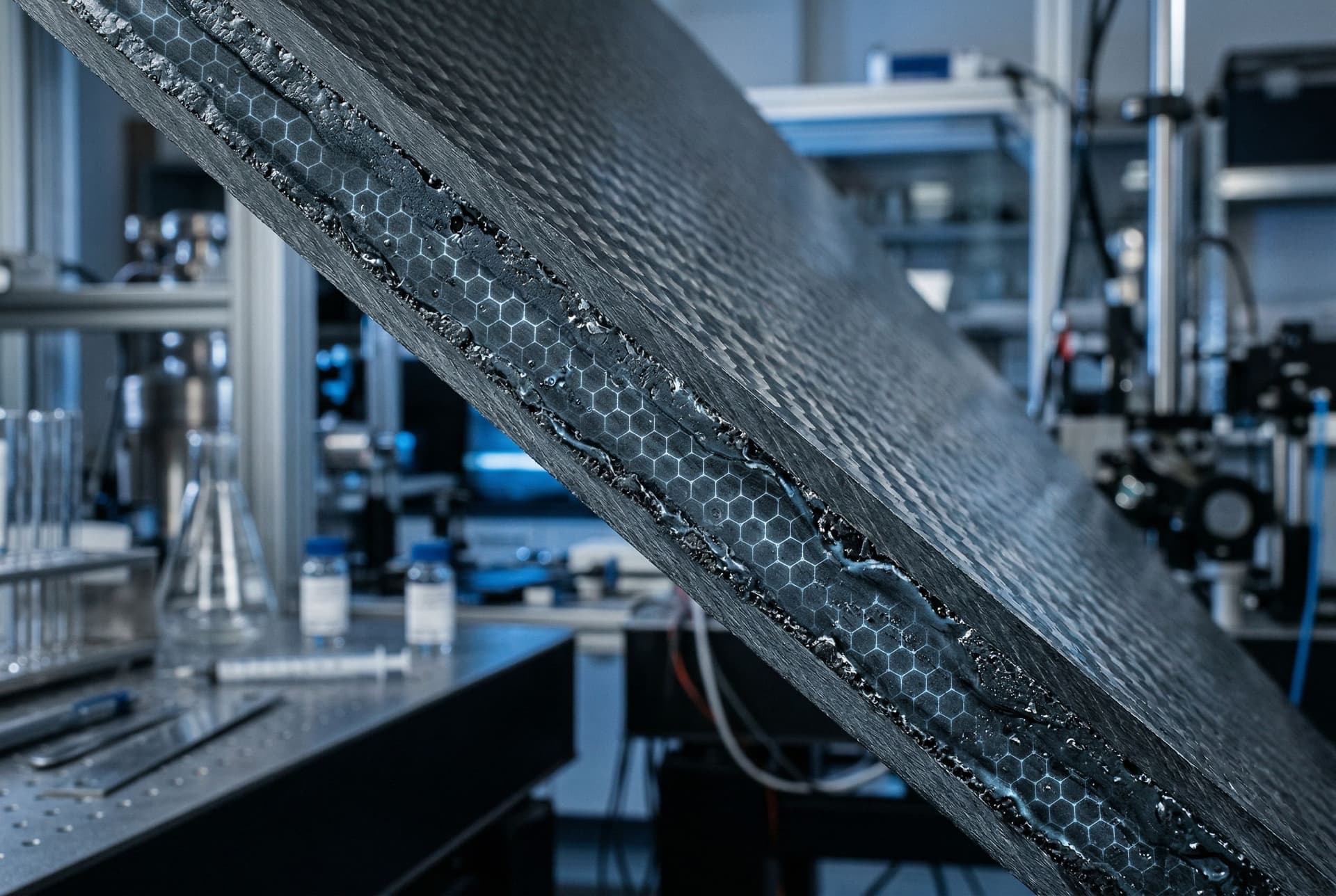
Scientific interest in graphene for adhesives has grown because glues are no longer expected to do only one job. In many industries, an adhesive must bond strongly, resist fracture, tolerate heat, survive moisture, and sometimes even conduct electricity or manage heat. That is a demanding list. Graphene has attracted attention because it offers a rare combination of properties that can improve several of those performance targets at once.
Graphene is a carbon nanomaterial built from atom-thin layers arranged in a hexagonal lattice. It is known for exceptional tensile strength, high electrical conductivity, high thermal conductivity, and a large specific surface area. In adhesive systems, graphene is not usually used alone. Instead, it is dispersed into polymer-based adhesives such as epoxy, polyurethane, acrylic, and related resin systems. The result is a composite adhesive that may become mechanically stronger, more fracture resistant, more thermally conductive, or more electrically functional than the base glue alone.
The strongest body of published research is in epoxy adhesives. This makes sense because epoxy systems are already widely used in structural bonding, electronics, coatings, transport, and industrial assembly. They are versatile, but like all materials they have tradeoffs. Researchers have studied how graphene, graphene oxide, reduced graphene oxide, and graphene nanoplatelets affect stiffness, lap shear strength, fracture toughness, conductivity, and thermal behavior in epoxy adhesives.
One of the most consistent findings is improved mechanical performance when graphene is added at low and well-controlled concentrations. Scientific studies repeatedly show that graphene can improve stiffness, tensile behavior, and toughness in adhesive systems. The explanation is straightforward. Graphene has enormous intrinsic strength, and when it is dispersed properly, it can help transfer load through the adhesive matrix more efficiently. It can also slow crack growth by forcing cracks to deflect, branch, or bridge around nanoscale filler structures.
This fracture behavior matters because many adhesive failures are not caused by simple overload in a uniform material. They begin at local stress concentrations, defects, microcracks, or poorly supported interfaces. A graphene-reinforced adhesive may resist those failure pathways better than the neat resin. Research summaries and review papers consistently point to higher fracture toughness and improved energy absorption in graphene-filled epoxy adhesives, especially when dispersion quality is good and filler loading is not excessive.
A second major theme in the literature is thermal conductivity. Standard polymer adhesives are usually poor thermal conductors, which becomes a problem in electronics, battery systems, power modules, LEDs, and any application where bonded parts must also move heat. Graphene is attractive here because it has very high intrinsic thermal conductivity. Even though the final adhesive composite never reaches the thermal performance of pure graphene itself, the improvement over ordinary adhesive can still be meaningful.
Researchers have shown that graphene-enhanced thermal adhesives can improve heat transfer significantly, especially in hybrid formulations where graphene works alongside other conductive fillers. This matters in real products because thermal bottlenecks often limit durability. If an adhesive layer can help move heat rather than trap it, that can improve electronics lifetime and reduce local overheating.
Electrical conductivity is another reason graphene-based adhesives are studied. In electronics manufacturing, there is demand for conductive adhesives that can replace or supplement solder in specific applications. Graphene and graphene-derived fillers can help create conductive pathways at relatively low loadings, especially when the filler network is engineered carefully. Published work has reported very large increases in conductivity compared with neat epoxy systems, in some cases by orders of magnitude.
That does not mean every graphene glue becomes a universal electrical adhesive. Performance depends strongly on filler morphology, loading level, oxidation state, dispersion, curing chemistry, and the target conductivity. But the direction is clear: graphene can make insulating adhesive systems far more electrically useful.
Barrier performance is another part of the scientific story. Graphene’s layered structure can make it harder for moisture, oxygen, or corrosive species to move through a coating or adhesive layer. In protective adhesives and bonded joints exposed to environmental stress, this can improve durability. Better barrier behavior matters in transport, outdoor structures, electronics packaging, and any environment where adhesives are exposed to humidity or aggressive conditions.
Graphene oxide deserves special attention because it behaves differently from pristine graphene. Its oxygen-containing functional groups often improve compatibility with polymer matrices, which can make dispersion easier and interfacial interaction stronger. In some adhesive systems, graphene oxide can improve bonding because those surface groups interact more readily with the host resin. That can be useful even if pristine graphene would offer higher intrinsic conductivity. In practice, material selection depends on whether the application prioritizes ease of dispersion, mechanical reinforcement, thermal performance, conductivity, or a combination of these.
Polyurethane and acrylic adhesives have also shown promising results in the literature. These systems are important because they are often used where flexibility, impact tolerance, and processing versatility matter. Graphene can help reinforce these adhesives while preserving or even improving useful flexibility in some formulations. That opens up potential in flexible bonding systems, coatings, wearable devices, and structural joints that experience repeated movement.
At the same time, the research makes one thing very clear: graphene is not automatically beneficial at any loading level. Dispersion is the central challenge. If graphene agglomerates, the adhesive can become less uniform, more brittle, and less reliable. Poorly dispersed filler behaves like a defect, not a reinforcement. Many of the best-performing studies rely on careful sonication, chemical functionalization, controlled mixing, or well-designed graphene derivatives to keep the filler distributed effectively.
This means that the phrase “graphene glue” by itself says almost nothing about performance. The important questions are: what form of graphene is used, how well is it dispersed, what is the filler fraction, what is the base resin, and what property is being optimized? A structural epoxy adhesive for fracture toughness is a very different target from a conductive adhesive for flexible electronics or a thermal adhesive for power devices.
Real-world performance expectations should therefore be realistic. Graphene-enhanced adhesives are not magic glues that become best-in-class in every category at once. But they do offer a platform for multifunctional improvement. A well-designed adhesive can become stronger, tougher, more conductive, or more thermally capable while still behaving like a practical glue. That is a valuable proposition in advanced manufacturing.
The applications are easy to see. In aerospace and automotive systems, stronger and lighter bonded joints are valuable. In electronics, conductive and thermally improved adhesives can help with assembly and heat management. In medical wearables and sensor systems, flexible conductive bonding has obvious relevance. In sports equipment and advanced composites, tougher adhesive interfaces can improve durability and energy handling.
The scientific literature supports the idea that graphene is one of the most promising nanofillers for next-generation adhesives, but it also shows that success depends on formulation quality rather than hype. The future of graphene in glues will likely be driven by targeted products: conductive adhesives for electronics, tougher epoxies for structural bonding, thermally improved adhesives for heat-sensitive systems, and durable barrier-enhanced systems for harsh environments.
What the research actually shows is encouraging but precise. Graphene improves adhesives when it is used deliberately, dispersed properly, and matched to the performance goal. That may sound less dramatic than marketing language, but in engineering it is exactly what matters. The strongest case for graphene in glues is not that it makes adhesives futuristic. It is that it can make them measurably better where performance really counts.