3D printing, Coatings & Materials
Graphene in ABS Plastics for 3D Printing: Tougher, Smarter Functional Parts
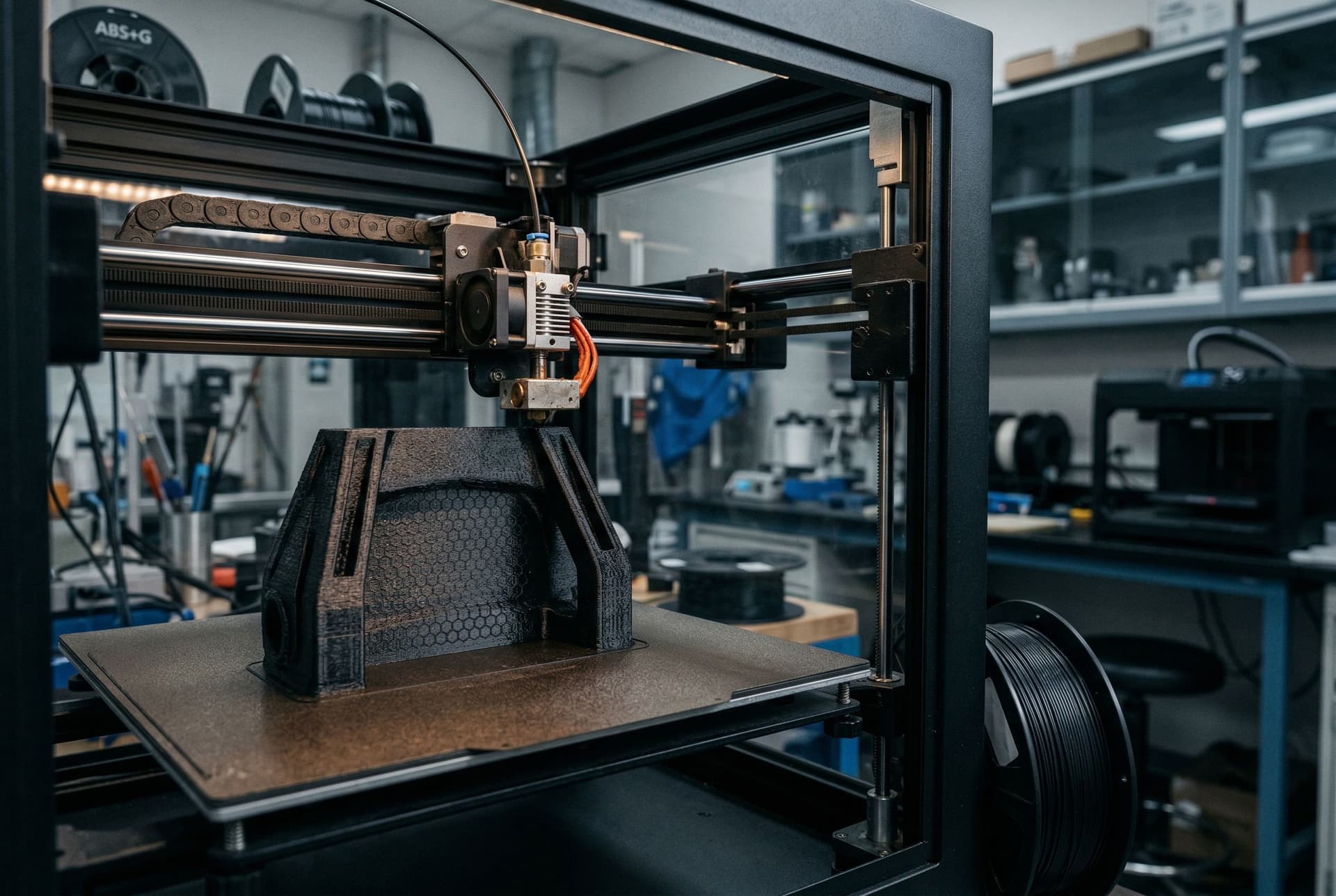
ABS has long been one of the more practical engineering plastics in desktop and industrial 3D printing. Compared with PLA, it offers better toughness, better heat resistance, and better suitability for functional parts. That is why ABS is still widely used for enclosures, brackets, housings, tools, and prototypes that need more durability than a simple display model. When graphene is added to ABS filament, the result can be even more interesting. The goal is not to replace ABS, but to push it toward better stiffness, conductivity, thermal behavior, and functional performance.
Graphene is a carbon nanomaterial made of atom-thin layers with exceptional mechanical, electrical, and thermal properties. In polymer systems, it acts as a reinforcing and multifunctional additive. When properly dispersed into ABS, graphene can improve several material characteristics at once. That makes graphene-ABS especially attractive for 3D printing users who want something more capable than standard filament but still within a printable thermoplastic workflow.
One of the biggest reasons to use graphene in ABS is mechanical performance. ABS already has an advantage over PLA in toughness, but graphene can improve stiffness and structural integrity. In printed parts, this can lead to components that feel more solid and more reliable under moderate mechanical loads. For printed brackets, tool holders, structural covers, and fixture parts, that kind of improvement matters. The value is not just in making parts harder; it is in making them more useful in real working environments.
Graphene can also improve the functional quality of ABS parts by helping with wear resistance and dimensional stability. In applications where parts are repeatedly handled, mounted, or exposed to mild abrasion, graphene-filled ABS may last longer than ordinary ABS. This is useful for custom hardware, workshop accessories, robot parts, or field-use prototypes where printed pieces are expected to survive actual service rather than just demonstrate a shape.
Electrical behavior is another major reason to explore graphene in ABS. Standard ABS is an electrical insulator, which is fine for many parts but limiting for others. Graphene can provide conductive pathways when the formulation is designed for that purpose. The conductivity is typically nowhere near metal, but it may be enough for antistatic parts, sensor housings, EMI-aware components, experimental printed electronics, or low-current functional structures. This makes graphene-ABS especially interesting for electronics prototyping, embedded systems development, and custom enclosures for technical equipment.
Thermal performance is another area where graphene may add value. ABS is already more temperature-tolerant than PLA, which makes it useful for printed parts near warm electronics, motors, or enclosed systems. Graphene can enhance thermal conductivity and help spread heat through the material more efficiently. This does not turn ABS into an aluminum heat sink, but it may improve the usefulness of printed parts in thermal management roles such as electronics housings, battery fixtures, and protective casings.
For design engineers, one of the strongest arguments for graphene-ABS is multifunctionality. Instead of choosing between a strong plastic, a conductive plastic, or a heat-tolerant plastic, graphene-filled ABS can push several of those properties in a better direction at once. That can simplify development work, especially during prototyping. A printed part that is structurally stronger, more stable near heat, and at least partially functional electrically is often much closer to a real product than a conventional plastic mock-up.
This is particularly relevant in industries where additive manufacturing is used for practical development rather than only cosmetic prototyping. Robotics, automotive product development, lab equipment, industrial automation, electronics, and drone systems all benefit from better functional prints. In these environments, graphene-ABS can help shorten the gap between concept parts and usable engineering prototypes.
Another benefit is that ABS already belongs to a family of materials associated with more serious technical printing. Users who are comfortable with heated beds, enclosed print volumes, and warp control may see graphene-ABS as a natural next step. It keeps the broader strengths of ABS while offering a more advanced composite profile. That makes it attractive to users moving from basic thermoplastics into more technical additive manufacturing.
There are also possible advantages in layer performance. One challenge with fused filament fabrication is that printed parts are often weaker along layer boundaries. Composite additives can sometimes influence how the polymer flows, bonds, and cools. Depending on the formulation, graphene may improve how the final structure holds together under load. The exact benefit depends on print settings and material quality, but even modest gains in interlayer performance can be important in functional parts.
Still, graphene-ABS is not automatically better in every situation. The first challenge is printability. ABS itself is already harder to print than PLA because of warping, shrinkage, and temperature sensitivity. Adding graphene can improve some functional properties, but it may also demand tighter process control. Printer setup matters. Bed adhesion matters. Chamber temperature matters. A well-formulated filament can still be practical, but it should be treated like a technical material, not a casual beginner spool.
Dispersion quality is another issue. If graphene is not distributed evenly through the ABS matrix, the results can be inconsistent. Weak spots, poor extrusion, rough surface texture, or unreliable conductivity may follow. This is one reason supplier quality matters so much. A graphene label alone does not guarantee real performance. Engineers and buyers should look for actual technical claims, test data, and evidence that the filament is compounded properly.
Cost must also be considered. Graphene-filled ABS will usually cost more than standard ABS. That premium only makes sense if the application benefits from the upgraded properties. For hobby models or decorative parts, the added expense may not be worth it. For functional technical parts, however, the price can be justified very easily if it reduces failure, improves performance, or produces more realistic prototypes.
The best current uses for graphene-ABS are situations where ordinary ABS almost works but could benefit from more functionality. That includes:
- stronger engineering prototypes
- electronics housings and technical enclosures
- antistatic or semi-conductive components
- custom industrial fixtures
- lightweight durable parts for robotics or automation
- parts exposed to moderate heat or wear
- advanced R&D and materials experimentation
These are all areas where 3D printing becomes more valuable when the filament contributes more than just printability.
Looking ahead, graphene in ABS fits a larger trend in additive manufacturing. Materials are becoming smarter and more specialized. Users increasingly want filaments tailored to real performance needs: thermal control, conductivity, reinforcement, wear resistance, and environmental stability. Graphene is attractive because it can improve several of these dimensions at once, especially when paired with already capable base polymers like ABS.
Graphene in ABS plastics for 3D printing matters because it helps shift printing from simple object creation toward more capable manufacturing. It does not eliminate ABS printing challenges, and it does not make every part industrial-grade by default. But it can create more functional, more durable, and more technically useful printed parts. For users who need 3D prints to do more than just look right, graphene-ABS is one of the more promising composite materials available today.